The best auto body shop chains in 2026 are Caliber Collision (the largest, with the widest lifetime-warranty network), Gerber Collision & Glass (strong on integrated glass plus collision), and Crash Champions (a fast-growing option with dedicated EV and luxury capability). For cosmetic repaints, Maaco is the budget leader, and for windshields and auto glass, Safelite AutoGlass is the default national choice. Which one is right for you depends less on the brand and more on the specific location: chain ownership tells you who signs the paychecks, not how good the technician working on your car actually is.
This guide compares the major national and franchise chains side by side, breaks down real pricing signals, and gives you a checklist to vet any individual location before you hand over your keys. Chains dominate the industry conversation for a reason. In 2026, the five largest collision consolidators — Caliber, Gerber (Boyd Group), Crash Champions, Classic Collision, and Joe Hudson's — operated roughly 4,019 locations, controlling about 13.3% of all U.S. shops and 31.7% of industry revenue, according to CT Acquisitions' Private Equity Auto Body (2026): The Consolidation Report. That scale is why you keep seeing the same names.
Auto body shop chains compared: the 2026 breakdown
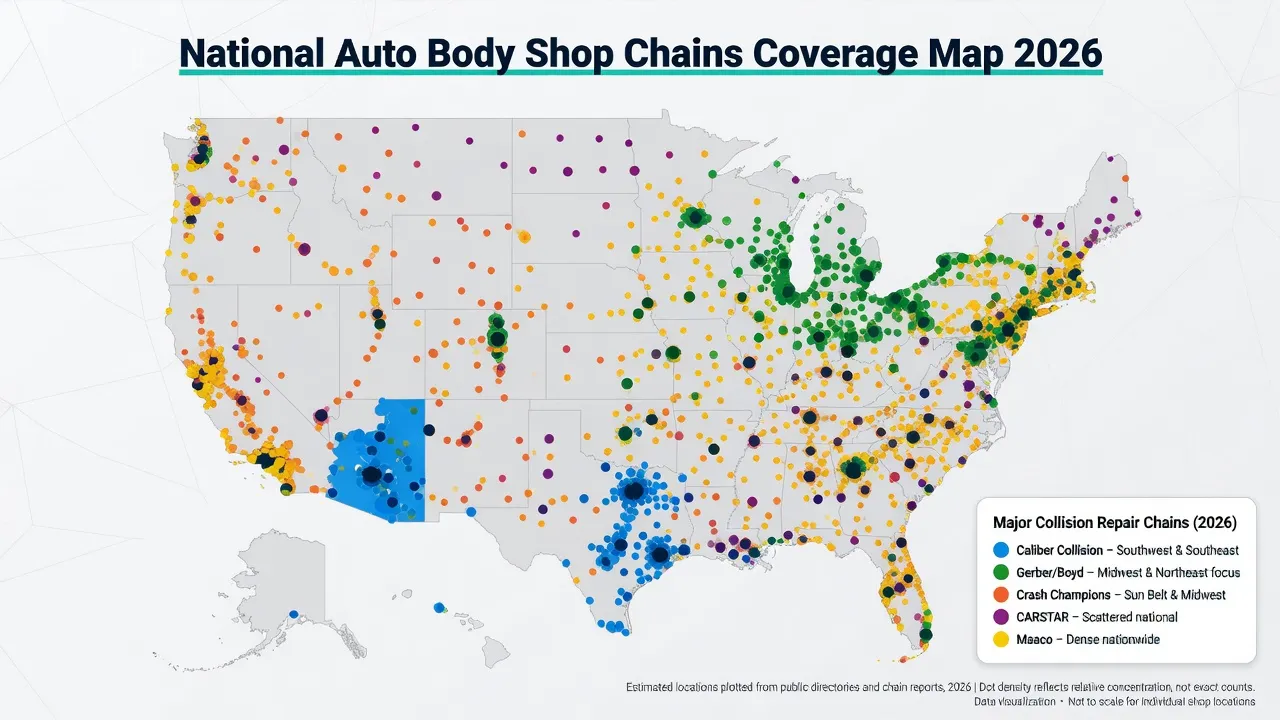
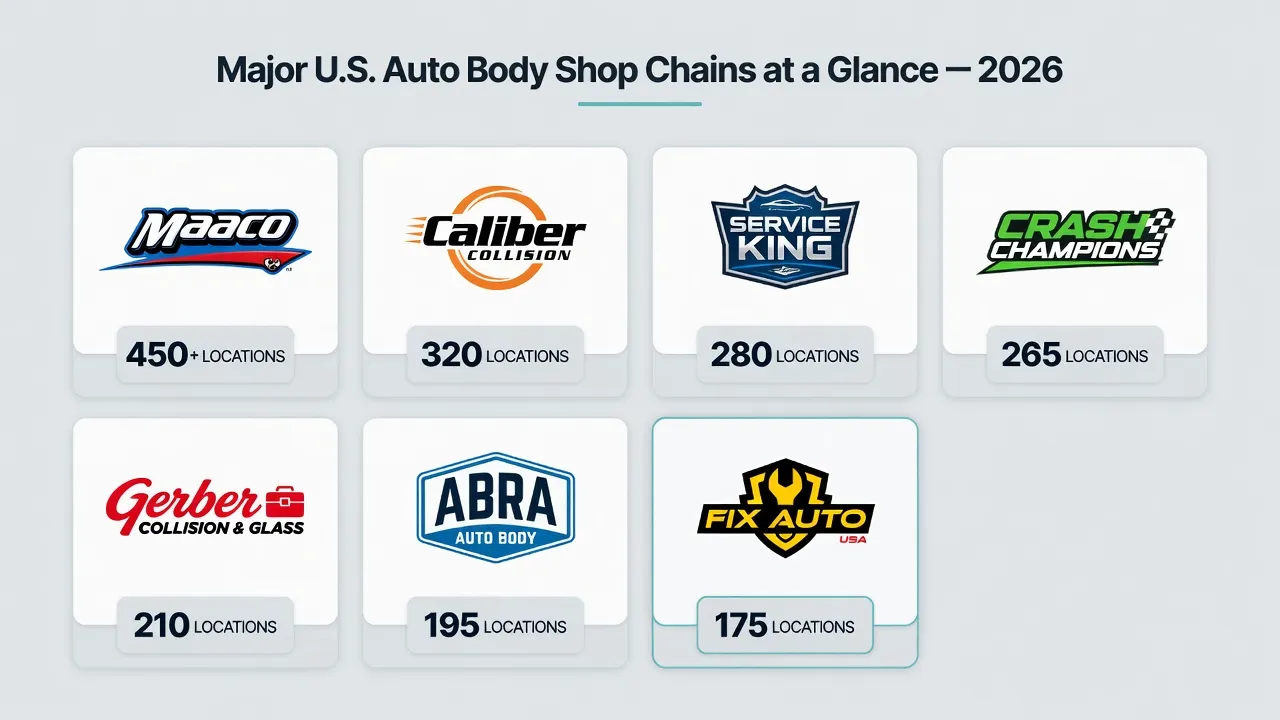
Here's how the major chains stack up on the things that actually affect your repair. Location counts reflect the most recent 2026 data; treat pricing as directional, since individual shops and insurance direct-repair agreements shift the final number.
| Chain | Type | U.S. locations (2026) | Specialty | Warranty |
|---|---|---|---|---|
| Caliber Collision | Corporate collision | ~1,861 | Full collision, ADAS, OEM certs | Lifetime |
| Gerber Collision & Glass | Corporate collision + glass | ~1,301 (N. America) | Collision plus in-house glass | Lifetime |
| Crash Champions | Corporate collision | ~658 | Collision, EV/luxury (Crash Luxe) | Lifetime |
| CARSTAR | Franchise collision | ~700+ (N. America) | Storm/hail, franchise-run | Nationwide (varies by store) |
| Classic Collision | Corporate collision | ~350 | Sun Belt/Southeast collision | Lifetime |
| Joe Hudson's | Corporate collision (Boyd) | ~258 | Southeast collision | Lifetime |
| Maaco | Franchise paint | ~500 | Cosmetic repaints | Up to 5 years (paint) |
| Fix Auto USA | Franchise collision | ~220 | West Coast, I-CAR focus | Varies by store |
| Safelite AutoGlass | Corporate glass | 7,100+ shops/mobile units | Windshield + auto glass | Lifetime (glass) |
A quick note on how to read that table. "Corporate" chains own and staff their shops directly, so warranty and process are more consistent across locations. "Franchise" chains license the brand to independent owners, which means quality and price can swing more from one store to the next. Neither model is automatically better, but it changes how much you can trust a nationwide promise at your local branch.
Caliber Collision: the biggest chain in the country
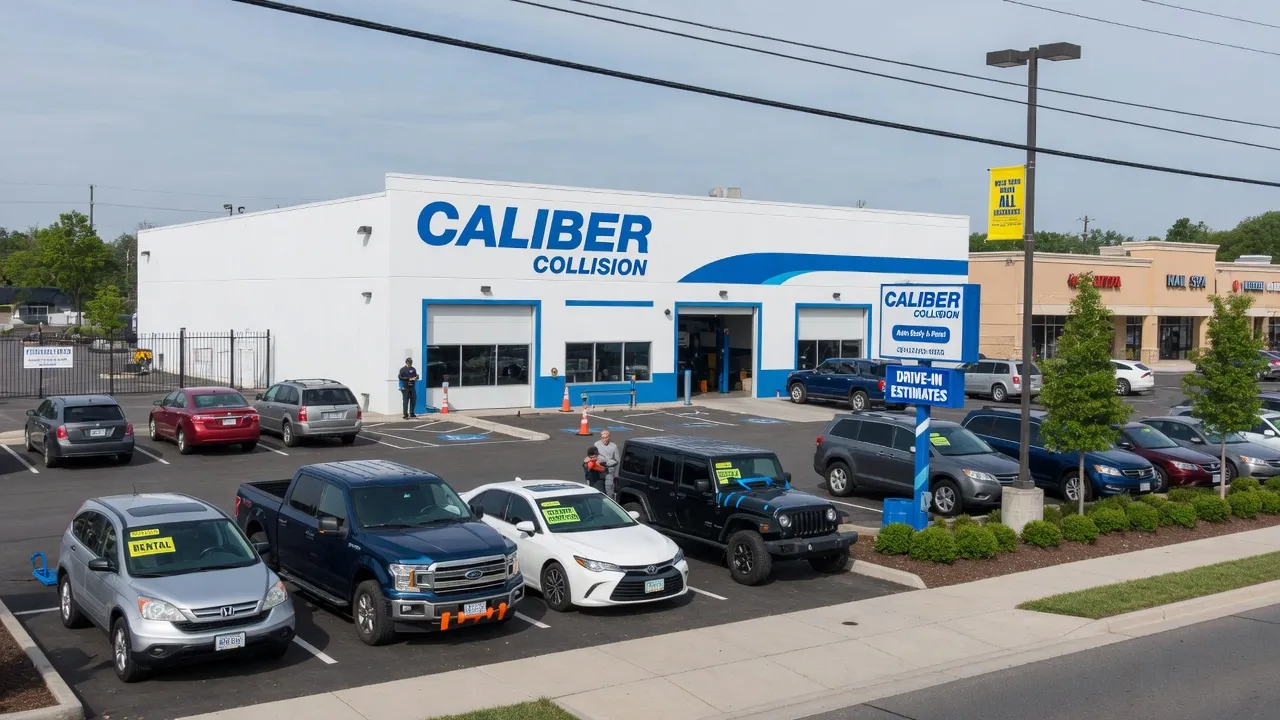
Caliber Collision is the largest auto body chain in the United States and the safest default if you want a lifetime warranty backed by a huge footprint. As of May 2026, Caliber operated about 1,861 locations across 41 states, according to ScrapeHero's Number of Caliber Collision locations in the USA in 2026 report. California alone accounts for roughly 318 of those shops. That density matters: if you move, get in a wreck while traveling, or need warranty work honored in another state, Caliber is the most likely chain to have a shop nearby. Our explainer on who owns Caliber Collision covers the company behind those shops.
Caliber focuses purely on collision — no paint-only side business, no tire-and-lube distraction. Most locations carry I-CAR training and a range of OEM (original equipment manufacturer) certifications, and the company has invested heavily in ADAS (advanced driver-assistance system) calibration, which matters more every year. In 2026, the share of repair estimates including at least one calibration reached 35.6% in the third quarter of 2025, up from 26.9% a year earlier, per CCC Intelligent Solutions' Crash Course 2026 report. If your car is a 2018 or newer model with lane-keep assist or automatic emergency braking, calibration capability is not optional.
The tradeoff with Caliber is volume-driven variability. High-throughput shops can feel impersonal, and reviews swing by location. For a deeper look at the common complaints, see our Caliber Collision review, and if you're weighing it directly against its fastest-growing rival, our Crash Champions vs Caliber Collision comparison breaks down the differences. Longtime readers may remember Caliber's old competitor Service King; that story is covered in Caliber Collision vs Service King.
Gerber Collision & Glass: collision and glass under one roof
Gerber is the best chain if you want collision repair and glass work handled by the same company. Owned by the Boyd Group, Gerber is the second-largest consolidator in North America, and it got substantially bigger at the start of 2026. In January 2026, Boyd closed its $1.3 billion acquisition of Joe Hudson's Collision Center, adding 258 Southeast locations and pushing Boyd's North American footprint up about 25% to 1,301 shops, according to CollisionWeek's Boyd Group Closes $1.3 Billion Acquisition of Joe Hudson's Collision Center.
The integrated glass capability is Gerber's real differentiator. Most collision chains subcontract windshield replacement; Gerber does it in-house, which can simplify a repair that involves both body damage and a cracked windshield with ADAS-linked cameras. Like the other corporate chains, Gerber offers a written lifetime warranty on its workmanship.
For the full picture on Gerber's process, pricing, and where it falls short, read our Gerber Collision review. If you're deciding between the two biggest players, Gerber vs Caliber Collision walks through the practical differences in warranty handling, insurance relationships, and turnaround.
Joe Hudson's Collision Center: the Southeast specialist now inside Boyd
Joe Hudson's is a well-regarded Southeast collision chain that is now part of the Boyd/Gerber family as of 2026. Before the acquisition, Joe Hudson's had built one of the strongest regional reputations in the industry, and it grew its store count by roughly 27% year over year — the fastest footprint growth among the big consolidators heading into the deal. The $1.3 billion purchase, which closed January 9, 2026, kept the Joe Hudson's brand operating across the Southeast while folding it into Boyd's network, per Boyd Group Services' own announcement.
If you're in Alabama, Georgia, Florida, or the surrounding states, a Joe Hudson's location gives you a locally trusted name now backed by a national parent's warranty and parts leverage. Expect the brand to gradually align with Gerber's standards over the next few years.
Crash Champions: the fast riser with EV and luxury capability
Crash Champions is the best mid-size chain for EV owners and luxury vehicles, thanks to its Crash Luxe program. As of March 2026, Crash Champions operated roughly 658 locations across the U.S., according to ScrapeHero's Number of Crash Champions locations in the USA in 2026 report. The company absorbed the former Service King network in a 2022 rebrand, which is how it scaled so quickly.
Crash Luxe is a dedicated tier for high-end and electric vehicles, where OEM certification and correct high-voltage repair procedures are non-negotiable. If you drive a Tesla, Rivian, or a premium European brand, verify that your local Crash Champions carries the specific certification your automaker requires — the Crash Luxe designation is a good starting signal but confirm it at the store level.
Our Crash Champions review covers customer-experience patterns and where the chain is still catching up to Caliber and Gerber on consistency. We also compare Gerber and Crash Champions head to head.
CARSTAR: the franchise network built for storms
CARSTAR is the largest franchise-model collision network in North America and a strong pick for hail and storm damage. In 2026, CARSTAR operated more than 700 locations across 35 U.S. states and all 10 Canadian provinces, according to Driven Brands, its parent company. Because CARSTAR shops are independently owned franchises rather than corporate-run, the local operator sets the tone — which cuts both ways.
The upside is that many CARSTAR owners are veteran body-shop operators who bought into the brand for its insurance relationships and national warranty, so you often get local ownership with corporate backing. CARSTAR has also built genuine expertise in catastrophe and hail repair, including paintless dent repair (PDR) for the dimpling that hailstorms leave behind. The downside is the franchise variability: a nationwide warranty is only as good as the specific store honoring it, so confirm the terms in writing.
See our CARSTAR review for a closer look at how the franchise model plays out in practice.
Classic Collision: the Sun Belt consolidator
Classic Collision is a rapidly expanding corporate chain concentrated in the Southeast and Sun Belt. As of June 2026, Classic Collision operated about 350 facilities nationwide and grew its store count by roughly 21% year over year — second only to Joe Hudson's among the big consolidators. It offers the same lifetime workmanship warranty you'd expect from a corporate operator, along with I-CAR training and OEM certifications at most locations.
Classic is worth knowing about if you're in Georgia, Florida, Texas, the Carolinas, or the Pacific Northwest, where its acquisition pace has been aggressive. As a newer national name, its brand consistency is still maturing, so vet the individual shop the same way you would any other.
Maaco: the affordable paint-first chain
Maaco is the cheapest way to repaint a whole car, but it's a cosmetic paint chain, not a structural collision shop. Maaco operates roughly 500 franchise locations and sells tiered paint packages: a Basic single-stage enamel job, a mid-tier Preferred package, and a Premium base-coat-plus-clear-coat system. Advertised starting prices sit near $600, $1,000, and $1,500, but real-world quotes run meaningfully higher once prep is added. In 2026, actual Basic jobs commonly land between $899 and $1,399, and Premium jobs between $1,799 and $2,499, according to CarPaintJobCost.com's Maaco Paint Job Cost 2026 breakdown, because the advertised price covers spray only — body prep, rust repair, and door-jamb painting are extra.
The warranty scales with the package: Basic single-stage typically carries a one-year warranty, while the Premium base/clear system carries up to five years. What Maaco does not do well is structural collision repair — frame straightening, airbag systems, ADAS recalibration. It's the right call for a faded daily driver or a cosmetic refresh, not for putting a wrecked car back together.
We cover Maaco in depth across three guides: the full Maaco review, a detailed Maaco paint job cost breakdown by package, and the broader question of how much it costs to paint a car across every option. If you're torn between the chain and a local shop, Maaco vs a local body shop lays out the tradeoffs.
Fix Auto USA: the West Coast franchise
Fix Auto USA is a franchise collision network concentrated heavily in California and the West. As of May 2026, Fix Auto had about 220 U.S. locations, and roughly 71% of them — 158 shops — were in California, according to ScrapeHero's Number of Fix Auto locations in the USA in 2026 report. The brand emphasizes I-CAR training and certified repair processes, and its franchise owners tend to be established local operators.
If you're on the West Coast, Fix Auto is a legitimate alternative to the bigger corporate chains, often with a more owner-driven, personal feel. Outside California and a handful of neighboring states, coverage thins out quickly, so it won't be an option for most of the country.
Safelite AutoGlass: the default for windshields
Safelite is the national standard for windshield and auto glass replacement, backed by the industry's only nationwide lifetime warranty. In 2026, Safelite backed its service with more than 7,100 physical shops and mobile glass units, reaching over 97% of U.S. drivers across all 50 states and serving about 6 million customers a year, according to Safelite's own Nationwide Auto Glass Warranty materials. Its lifetime warranty covers defects in materials and workmanship for as long as you own or lease the vehicle.
Glass is its own category. A modern windshield often houses the camera for lane-keeping and automatic emergency braking, so replacement increasingly requires ADAS recalibration in the same visit — something Safelite does routinely. The convenience of mobile service and insurance-network integration is Safelite's biggest draw. The knock against it is price and the occasional push toward full replacement when a chip could be repaired.
Before you book, it's worth comparing: our Safelite review covers the real-world experience, and Safelite vs a local glass shop explains when an independent installer beats the national chain on price and attention. Because most glass claims run through insurance, check your coverage first — we break down State Farm windshield coverage and GEICO windshield coverage so you know your deductible before the glass truck shows up.
Paint chains vs collision chains vs glass chains
The single most common mistake car owners make is treating all "auto body chains" as interchangeable. They fall into three distinct categories, and matching the category to your damage saves you money and headaches.
Collision chains — Caliber, Gerber, Crash Champions, CARSTAR, Classic Collision, Joe Hudson's, Fix Auto — fix crash damage. That means frame and structural work, panel replacement, airbag and safety-system repair, and ADAS recalibration, usually routed through your insurance. This is where you go after an accident.
Paint chains — Maaco is the dominant one — do cosmetic repaints. They're built to refinish a car's exterior affordably, not to repair structural damage or restore a vehicle after a collision. Going to a paint chain for crash damage, or a collision chain for a simple whole-car repaint, means paying for the wrong specialty.
Glass chains — Safelite leads, with regional players and local installers competing — replace windshields and auto glass. Some collision chains (notably Gerber) handle glass in-house, but for a standalone chip or crack, a dedicated glass provider is usually faster and cheaper. With ADAS-equipped windshields, confirm recalibration is included in the quote regardless of who does the work.
Chain vs independent: which should you choose?
A chain gives you a portable warranty and predictable process; a good independent often gives you more personal attention and, sometimes, higher-quality work on a single car. Neither wins outright, and the honest answer is that location-level quality varies more than the chain-versus-independent divide.
The case for chains is consistency and coverage. A corporate chain's lifetime warranty is honored at any of its locations, insurance direct-repair-program (DRP) relationships can speed up the paperwork, and you're never far from a shop. The case for independents is that a well-run local body shop lives or dies on reputation, so the owner has every incentive to get your car right the first time, and they're often more willing to fight your insurer for OEM parts.
One caveat worth keeping in mind: independent shops that survive for years are, by definition, the ones that earned repeat business, so satisfaction surveys favoring independents partly reflect that filtering. It doesn't mean the chain down the street is worse — it means you should judge the specific shop, not the sign out front. We go deeper on this in body shop chain vs independent.
DRP status is the other factor to understand. When a chain is on your insurer's direct-repair program, the claim moves faster and the insurer may guarantee the work, but the shop also faces pressure to control costs, which can mean aftermarket parts instead of OEM. You have the legal right in all 50 states to choose any licensed repair facility, DRP or not. Use that right.
How to choose the best auto body shop chain for your repair
The brand on the building matters less than five things you can verify at the specific location before you commit. Run this checklist regardless of which chain you're considering.
1. Match the chain to the damage. Collision goes to a collision chain, a whole-car repaint goes to a paint chain, and a windshield goes to a glass chain. Getting this right first eliminates most bad outcomes.
2. Verify certifications at that store. Ask whether the specific location holds I-CAR Gold Class status and any OEM certification for your make. Certifications are earned per shop, not granted chain-wide, so a corporate logo guarantees nothing on its own.
3. Read recent reviews, filtered to the last six months. A chain location's quality tracks its current manager and crew. Old five-star reviews from three years ago tell you little; recent ones tell you who's working there now.
4. Confirm ADAS recalibration for 2018-and-newer vehicles. If your car has driver-assist features, ask directly whether they recalibrate in-house or sublet it. With calibrations now part of more than a third of repairs, per CCC's Crash Course 2026 report, this is a standard requirement, not a luxury.
5. Get the warranty and parts terms in writing. Confirm the warranty length, what it covers, and whether the estimate uses OEM or aftermarket parts — before you sign anything. A verbal "lifetime warranty" means nothing without the document.
One more piece of context on why any of this matters financially: in 2026, the average collision repair reached about $4,818, with total-loss frequency hitting a record 23.1% of claims, according to CCC Intelligent Solutions' Crash Course 2026 report. Repairs are expensive and getting more complex, so the few minutes you spend vetting a shop protects a large bill.
Sources
- CT Acquisitions, Private Equity Auto Body (2026): The Consolidation Report — https://ctacquisitions.com/guides/private-equity-auto-body-2026/ (retrieved 2026-07-24)
- ScrapeHero, Number of Caliber Collision locations in the USA in 2026 — https://www.scrapehero.com/location-reports/Caliber%20Collision-USA/ (retrieved 2026-07-24)
- ScrapeHero, Number of Crash Champions locations in the USA in 2026 — https://www.scrapehero.com/location-reports/Crash%20Champions-USA/ (retrieved 2026-07-24)
- ScrapeHero, Number of Fix Auto locations in the USA in 2026 — https://www.scrapehero.com/location-reports/Fix%20Auto-USA/ (retrieved 2026-07-24)
- CollisionWeek, Boyd Group Closes $1.3 Billion Acquisition of Joe Hudson's Collision Center — https://collisionweek.com/2026/01/12/boyd-group-closes-1-3-billion-acquisition-joe-hudsons-collision-center/ (retrieved 2026-07-24)
- Boyd Group Services Inc., Completes Acquisition of Joe Hudson's Collision Center — https://boydgroup.com/news/boyd-group-services-inc-news/2026/boyd-group-services-inc-completes-acquisition-of-joe-hudsons-collision-center/ (retrieved 2026-07-24)
- Driven Brands, CARSTAR / Driven Collision network — https://www.drivenbrands.com/news/driven-brands-reaches-1000-collision-repair-locations-across-north-america/ (retrieved 2026-07-24)
- CarPaintJobCost.com, Maaco Paint Job Cost 2026: Tier-by-Tier Honest Breakdown — https://carpaintjobcost.com/maaco-paint-job-cost (retrieved 2026-07-24)
- Safelite, Nationwide Auto Glass Warranty — https://www.safelite.com/national-lifetime-warranty (retrieved 2026-07-24)
- CCC Intelligent Solutions, Crash Course 2026 Report Finds Higher Severity and Record Total Loss Frequency — https://www.cccis.com/news-and-insights/posts/ccc-crash-course-2026-report-finds-higher-severity-and-record-total-loss-frequency (retrieved 2026-07-24)
Sources
- I-CAR (Inter-Industry Conference on Auto Collision Repair) — collision repair industry training standards
- NHTSA Vehicle Safety — federal vehicle safety and crashworthiness standards
Frequently Asked Questions
Which auto body shop chain has the most locations?
Caliber Collision has the most locations of any collision chain, with about 1,861 U.S. shops across 41 states as of May 2026, per ScrapeHero data. For glass specifically, Safelite AutoGlass is far larger, backing its service with more than 7,100 shops and mobile units nationwide.
Is Service King still in business?
Not under that name. Service King was absorbed into Crash Champions in a 2022 rebrand, and its locations now operate as Crash Champions shops. If you had warranty work done at a Service King, a Crash Champions location should honor it.
Do all auto body chains accept all insurance?
Most major chains work with all major insurers, but not every chain is on every insurer's direct-repair program (DRP). Being off a DRP list doesn't stop a shop from handling your claim — you have the legal right in all 50 states to choose any licensed repair facility, and the shop will still bill your insurance directly.
What's the difference between a corporate chain and a franchise body shop?
Corporate chains — Caliber, Gerber, Crash Champions, Classic Collision — own and staff their shops directly, so warranty and process are more uniform. Franchise chains — CARSTAR, Maaco, Fix Auto — license the brand to independent owners who run their own shops, so price and quality can vary more from one location to the next.
Do auto body shop chains offer warranties?
Yes. All four major corporate collision chains (Caliber, Gerber, Crash Champions, Classic Collision) offer written lifetime warranties on workmanship. Franchise chains like CARSTAR carry a nationwide warranty that varies by store. Maaco's paint warranty scales with the package, from about one year on Basic to up to five years on Premium. Safelite offers a lifetime glass warranty.
Is a chain or an independent shop better for collision repair?
It depends on the specific shop more than the model. Chains offer a portable lifetime warranty and faster insurance processing; a good independent often offers more personal attention and more willingness to push for OEM parts. Vet the individual location's certifications and recent reviews rather than assuming the brand decides quality.
Which chain is best for electric or luxury vehicles?
Crash Champions' Crash Luxe program is purpose-built for EVs and luxury vehicles, and Caliber and Gerber both carry extensive OEM certifications. Whichever you choose, confirm the specific location holds your automaker's required certification for high-voltage or aluminum-intensive repairs before booking.