Last updated: June 2026
Most car owners hit this moment eventually: a quote from Maaco comes in at $500, and the estimate from a local body shop down the road is $2,500. The price gap is real, it's dramatic, and it's confusing.
Is that $2,000 difference pure profit markup? Is Maaco cutting corners? Or is there a genuine quality difference that car owners need to understand before handing over their keys?
This guide breaks down the key differences in cost, prep work, quality, warranties, and use cases between Maaco and local independent body shops — and gives you a clear framework for figuring out which fits the specific repair at hand. Because "which is better" depends entirely on the situation.
The Maaco vs. local body shop decision starts with understanding what each option actually is, and what drives those cost differences.
What is Maaco, and how does it work?
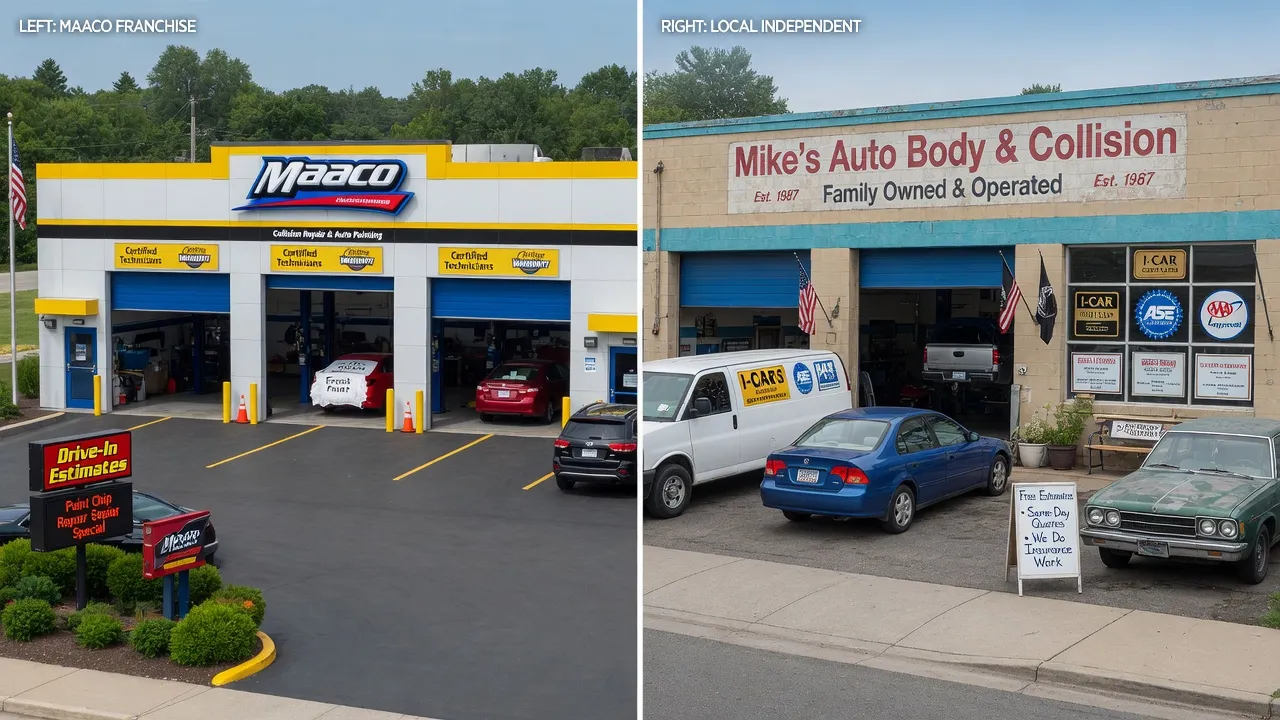
Maaco is a franchise network of auto body and paint shops under the Driven Brands corporate umbrella, which also owns CARSTAR, Meineke, and other automotive service chains. With more than 500 locations across the United States and Canada, Maaco is the largest automotive paint and collision repair franchise in North America. For car owners searching for a cheap auto body shop alternative to full-service independents, Maaco is usually the first name that surfaces.
The franchise model matters for consumers. Each Maaco location is independently owned and operated — a Maaco in Phoenix and a Maaco in Cleveland may have different staffing, different prep standards, and different quality outcomes, even though they run under the same brand name and pricing structure. Corporate provides the brand, training frameworks, and marketing; the franchisee handles daily operations.
What Maaco specializes in
Maaco's core business is cosmetic paint work and light collision repair. Paint jobs (single panels, partial repaints, and full repaints), minor dents, and surface-level cosmetic restoration make up most of Maaco's work.
What Maaco generally doesn't handle: major structural or frame damage, complex multi-panel collision repairs, or repairs requiring ADAS (Advanced Driver Assistance Systems) sensor recalibration. Car owners dealing with structural damage from a collision should seek an independent shop with the right certification and equipment for that type of work.
How Maaco keeps prices low — the real explanation
The price gap between Maaco and a full-service independent shop isn't random. It follows from structural differences in how each type of business approaches the work.
The prep work equation
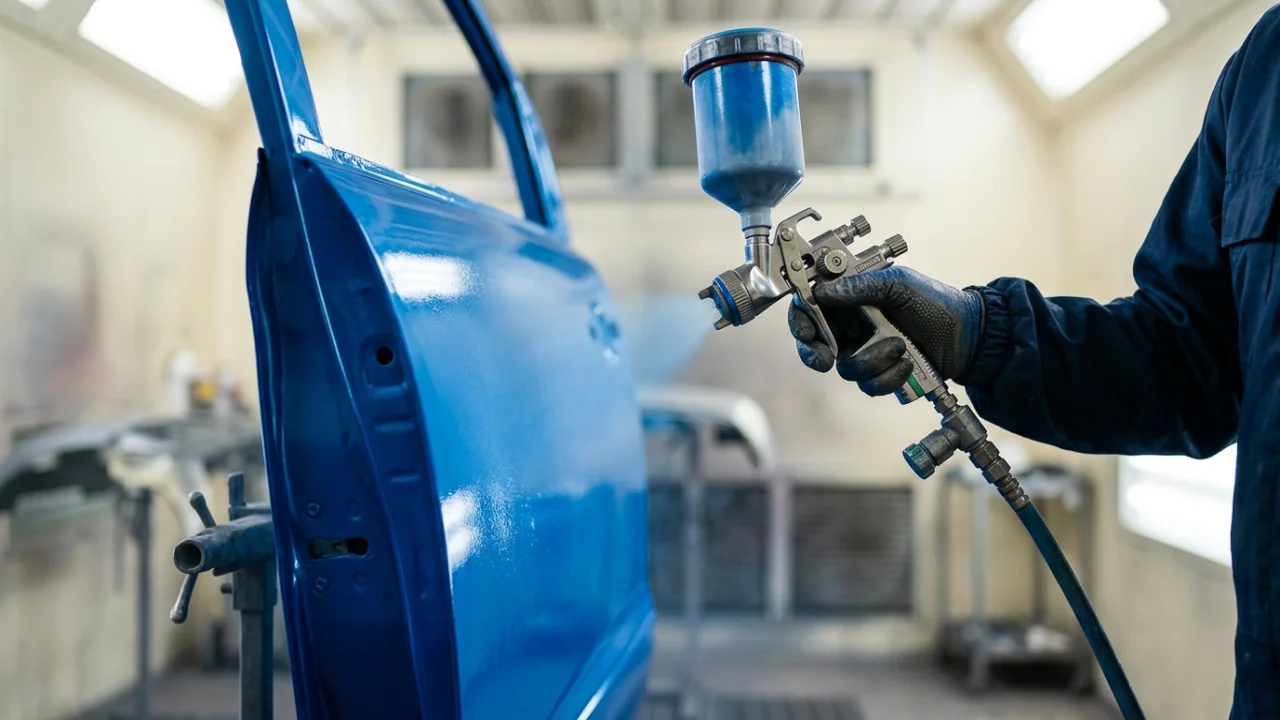
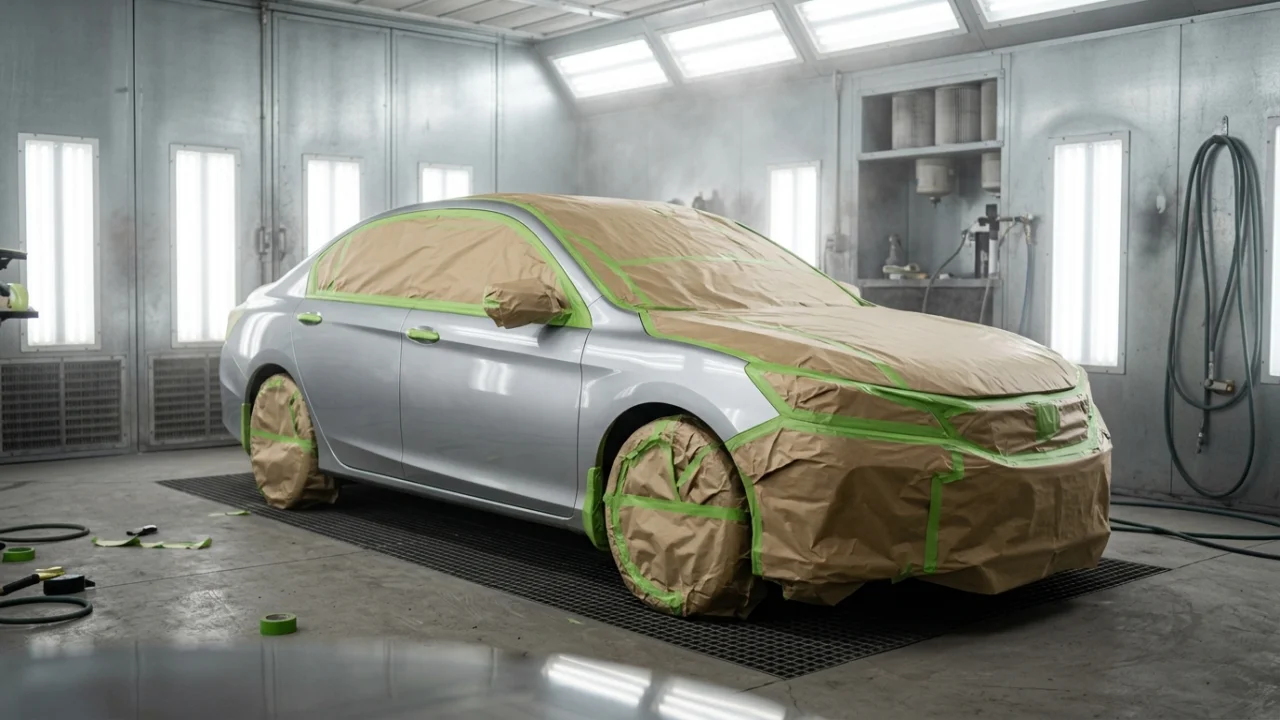
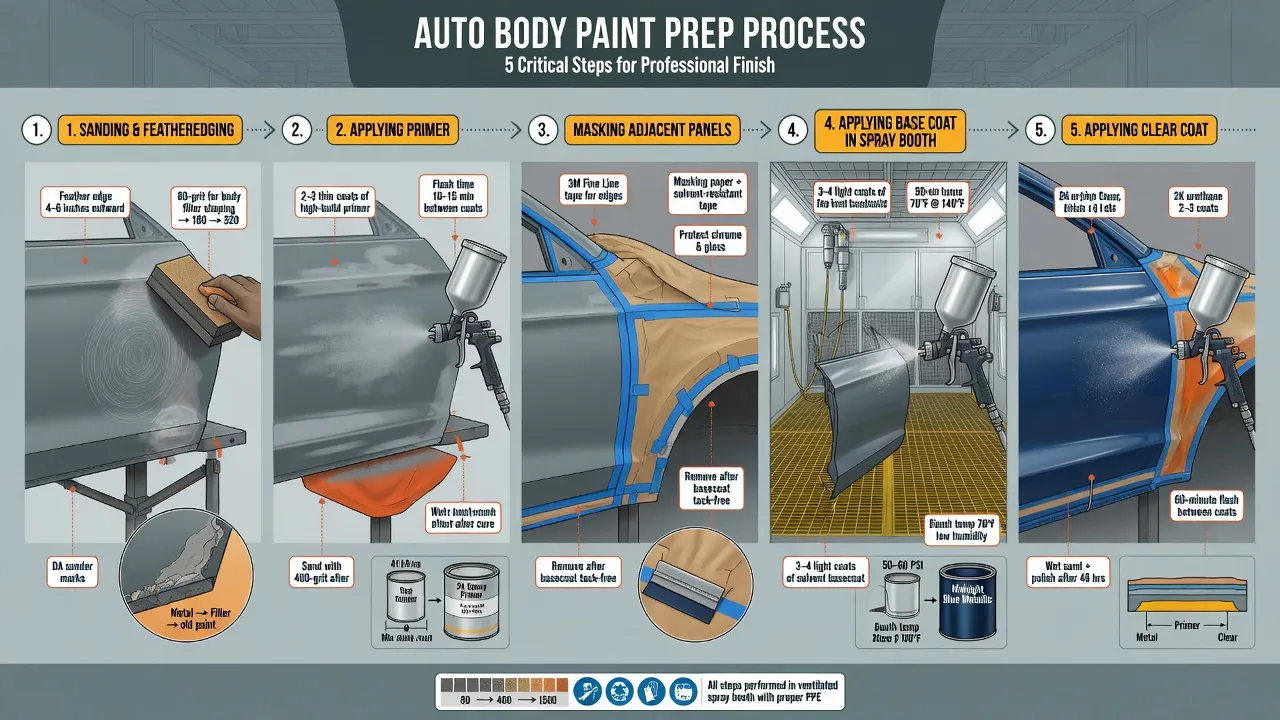
Prep work — the sanding, priming, masking, and surface preparation that happens before paint ever touches a vehicle — accounts for roughly 60 to 70% of paint job quality outcomes, according to collision repair industry standards. A paint job applied over inadequate prep will fade, peel, and chip faster regardless of paint quality.
Maaco's economy-tier pricing is as low as it is because prep work at that tier is minimal. The economy package uses a single-stage enamel paint (no separate clear coat layer) and involves limited surface preparation. The result can look fine right after the job but tends to show wear faster than a full-prep repaint.
Maaco's package tiers
Maaco structures its services in package tiers, each reflecting a different level of prep, paint technology, and warranty coverage:
| Package | Price Range | Paint Type | Clear Coat | Prep Level | Warranty |
|---|---|---|---|---|---|
| Economy | $300–$700 | Single-stage enamel | No | Minimal | Limited (~90 days on rust, 1 year on defects) |
| Preferred | $1,000–$1,700 | 2-stage urethane | Yes | Moderate | 1–3 years |
| Premium | $2,000–$4,500+ | High-grade urethane | Yes | Full (includes stripping) | Up to 5 years (prorated) |
Price ranges are national averages as of 2026. Actual prices vary by location and vehicle size. See our Maaco paint job cost guide and the market-wide cost to paint a car for full breakdowns.
The critical takeaway: Maaco's higher-tier packages approach independent shop pricing and involve substantially more prep work. The economy tier is where the $500 paint job lives — prep shortcuts are how that price point is achieved.
A clear coat (the transparent protective layer applied over the color coat in 2-stage paint systems) is absent from Maaco's economy tier. Clear coat extends paint life, provides UV protection, and gives paint its glossy depth. Without it, economy paint jobs age noticeably faster.
What local independent body shops offer
A local independent auto body shop that does full-service paint and collision work runs on a fundamentally different model than Maaco's economy tier.
Full prep work standards
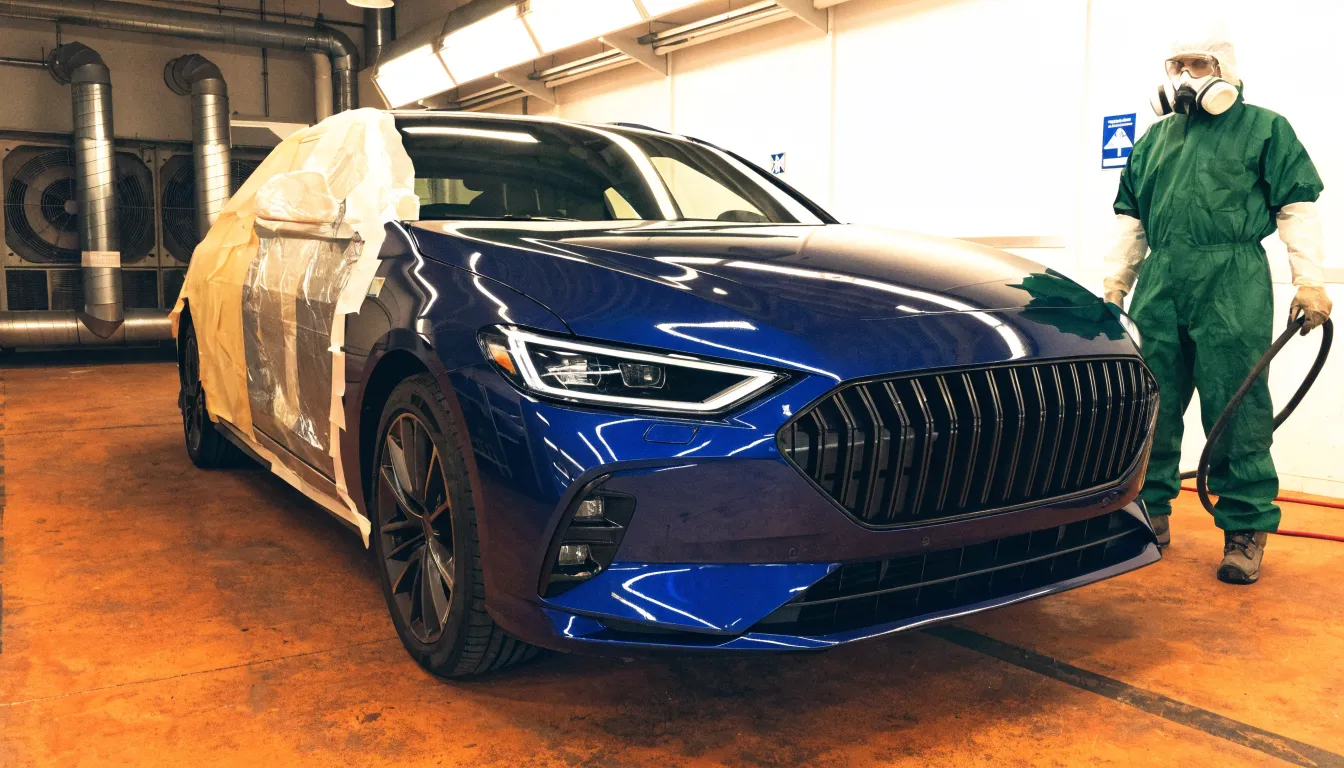
When a reputable independent shop does a paint job, "full prep" typically involves:
- Sanding the existing paint down to smooth any surface irregularities
- Featheredging — gradually sanding down the edges of any existing damage so new material blends smoothly
- Applying primer to create a proper bonding surface for the new paint
- Masking adjacent panels, glass, and trim to protect them from overspray
- Blending — fading new paint into the existing finish on adjacent panels so the repair area matches seamlessly
This prep process takes considerably more time than economy-tier work. That's the primary driver of the cost difference — not profit margin.
Certifications that indicate quality
Independent body shops can earn certifications that signal training and capability:
- I-CAR Gold Class: Awarded by the Inter-Industry Conference on Auto Collision Repair (I-CAR), this certification requires technicians to complete ongoing training in the latest collision repair techniques and vehicle technologies. It's widely considered the industry's top quality benchmark.
- ASE certification: The Automotive Service Excellence (ASE) program certifies individual technicians in specific repair competencies.
- OEM certifications: Some shops earn certification directly from vehicle manufacturers (Honda, Toyota, BMW, etc.) to perform repairs to factory standards.
Maaco locations may hold some of these certifications, but it varies by franchise. When evaluating any Maaco location, ask directly whether it's I-CAR Gold Class certified.
Typical independent shop pricing
For a full repaint with proper prep:
- Single-panel repaint (with blend): $500 to $1,500
- Partial repaint (2–4 panels): $1,500 to $3,500
- Full vehicle repaint: $3,000 to $6,000+
For collision repair:
- Minor collision (bumper, single panel): $1,500 to $4,000
- Moderate collision (multiple panels, no structural damage): $3,000 to $8,000
- Major collision (structural involvement): $5,000 to $12,000+
These ranges vary by market. Labor rates in major metros like Los Angeles, New York, and Chicago run 40 to 60% higher than rural markets — a standard variable in auto body repair pricing across the country.
Maaco vs. local shop — side-by-side comparison
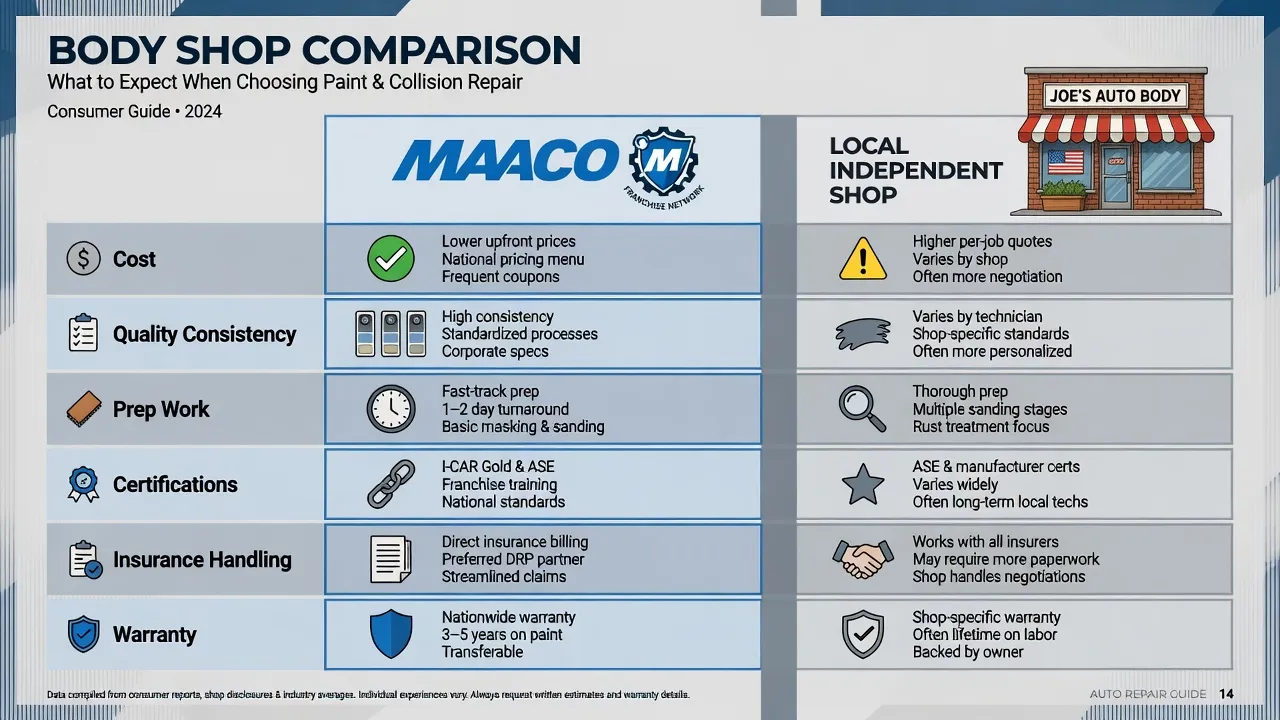
The table below summarizes the key differences across the factors that matter most for car owners making this decision:
| Factor | Maaco | Local Independent Shop |
|---|---|---|
| Price range (paint) | $300–$4,500+ (varies widely by tier) | $1,500–$6,000+ |
| Quality consistency | Variable by franchise location | Variable by shop |
| Prep work | Varies by package tier | Thorough at full-service shops |
| Certifications | Varies by franchise (I-CAR varies by location) | I-CAR, ASE, OEM certifications available |
| Insurance/DRP handling | Yes — participates in DRP networks | Most handle insurance claims |
| Warranty | 90 days (rust, economy tier) to 5 years (premium tier, prorated) | Typically 1–3 years; some shops offer lifetime warranties |
| Best suited for | Cosmetic work, budget repairs, older vehicles | Major repairs, collision work, newer vehicles, insurance claims |
| Location availability | 500+ US locations | Highly variable by market |
Note: "Varies by shop" applies to both options — quality at any body shop, chain or independent, depends on the specific location, technicians, and management.
Insurance claims — what both options mean for your repair
This is the section most comparison guides skip entirely: the insurance and Direct Repair Program (DRP) angle.
A Direct Repair Program (DRP) is a contractual relationship between an insurance company and a body shop. In exchange for being listed as a "preferred" or "recommended" shop on the insurer's list, participating shops agree to certain terms — discounted labor rates, aftermarket parts when possible, and streamlined communication with the insurer.
Maaco participates in DRP networks with select insurance carriers. This means car owners whose insurers recommend Maaco can bring their vehicle there for covered repairs. For minor cosmetic damage on an older vehicle, this can be a convenient and efficient option.
Independent shops handle insurance claims too, and many are also DRP-partnered with major insurers. The difference is that full-service independent shops often have more room to negotiate for OEM (Original Equipment Manufacturer) parts and complete repair documentation — which matters more for newer vehicles.
Consumer rights when insurance is involved
In every U.S. state, car owners have the legal right to choose their own repair facility, regardless of which shop the insurance company recommends. An insurer can suggest a DRP shop but can't legally mandate one. Choosing a non-DRP shop doesn't reduce coverage or void the claim.
When insurance is involved, the repair shop choice affects:
- Parts selection: DRP agreements often favor aftermarket parts over OEM parts to reduce costs. Car owners can request OEM parts — some states require insurers to use them for vehicles under a certain age.
- Repair documentation: For newer vehicles, thorough OEM repair documentation from a certified shop protects resale value and can matter for lease return inspections.
For major collision repairs on a 2020 or newer vehicle, a full-service independent shop (or an I-CAR Gold Class certified shop) that documents OEM repair procedures is the better call — regardless of what the insurer recommends.
Find auto body shops in California or browse your own state's directory to compare DRP shop options and independent shop options in your local market.
When Maaco makes sense — practical scenarios
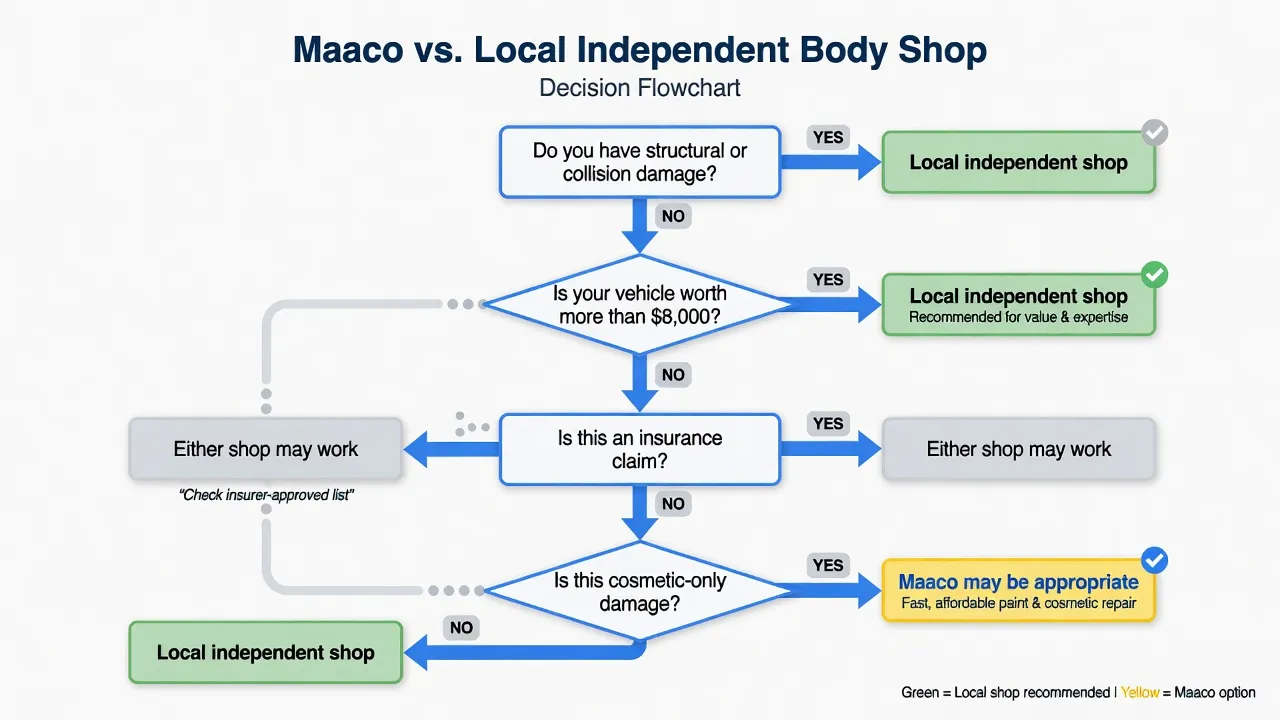
Maaco isn't the right choice for every car owner in every situation — but it is the right choice in specific circumstances. These scenarios help clarify when the cost-quality tradeoff works in the car owner's favor:
Scenario 1: Pre-sale cosmetic refresh on a high-mileage vehicle
A 2010 Honda Civic with faded, oxidized paint is worth about $4,000 in its current condition. A professional repaint at a full-service shop would cost $2,500 to $3,500. A Maaco Economy or Preferred job at $500 to $1,200 may be entirely sufficient to improve curb appeal before sale — even if the finish isn't perfect, the economics make sense given the vehicle's value.
Scenario 2: Cosmetic damage on an older vehicle with no insurance involvement
Surface scratches, faded paint, or minor scuffs on a vehicle worth $6,000 or less that the owner plans to drive for another few years — Maaco's mid-tier packages can deliver acceptable results at a fraction of the cost of a full-service shop.
Scenario 3: Budget is fixed and structural integrity is not at stake
When budget is the primary constraint and the damage is cosmetic only (not structural, not safety-related), Maaco's volume-based model can provide a functional outcome.
Scenario 4: Limited independent shop options in the local market
In some markets, a well-run Maaco franchise may be the best-equipped option available. Not every town has a full-service, I-CAR Gold Class certified independent shop nearby.
When a local shop is the better choice
There are situations where the cost savings of Maaco's economy tier don't outweigh the quality or safety considerations:
Collision damage involving structural or safety components
Any repair that involves the unibody structure, frame straightening, airbag deployment, or other safety systems requires a shop with proper frame-pulling equipment, measuring systems, and the expertise to restore structural integrity. Maaco isn't designed for this work. For guidance on what collision repair involves at a full-service shop, it helps to understand the process before picking a shop. This also applies to bumper repair when the bumper contains ADAS sensors — cosmetic replacement at a discount shop that skips sensor recalibration creates a real safety risk.
A newer, higher-value, or leased vehicle
For a 2022 Toyota RAV4 worth $28,000, or a leased vehicle being returned at the end of the term, repair quality and documentation matter. A substandard paint job or undocumented repair can affect a lease return assessment or resale value.
Insurance claim involving OEM parts and documented repair history
When an insurer is paying for the repair, car owners should ensure the work is done at a shop that provides thorough repair documentation, uses OEM parts where appropriate, and holds the certifications to perform the repair to manufacturer standards.
Color-matched blend on a newer vehicle
When only one panel needs repainting on a 2021 vehicle with a metallic or specialized paint finish, blending — fading new paint into the existing finish on adjacent panels — is essential for an invisible repair. Maaco's standard process may not include blending into adjacent panels at economy-tier pricing. A visible color mismatch on a newer vehicle undermines the entire repair.
ADAS recalibration is required after the repair
Modern vehicles from roughly 2018 onward contain ADAS — Advanced Driver Assistance Systems including cameras, radar sensors, and ultrasonic sensors embedded in bumpers, mirrors, and windshields. Any repair to a bumper, windshield, or body panel housing ADAS components requires recalibration after the repair. Not all shops — including many Maaco locations — have the equipment and software for ADAS recalibration. Skipping it leaves safety systems nonfunctional.
How to evaluate any body shop before authorizing work
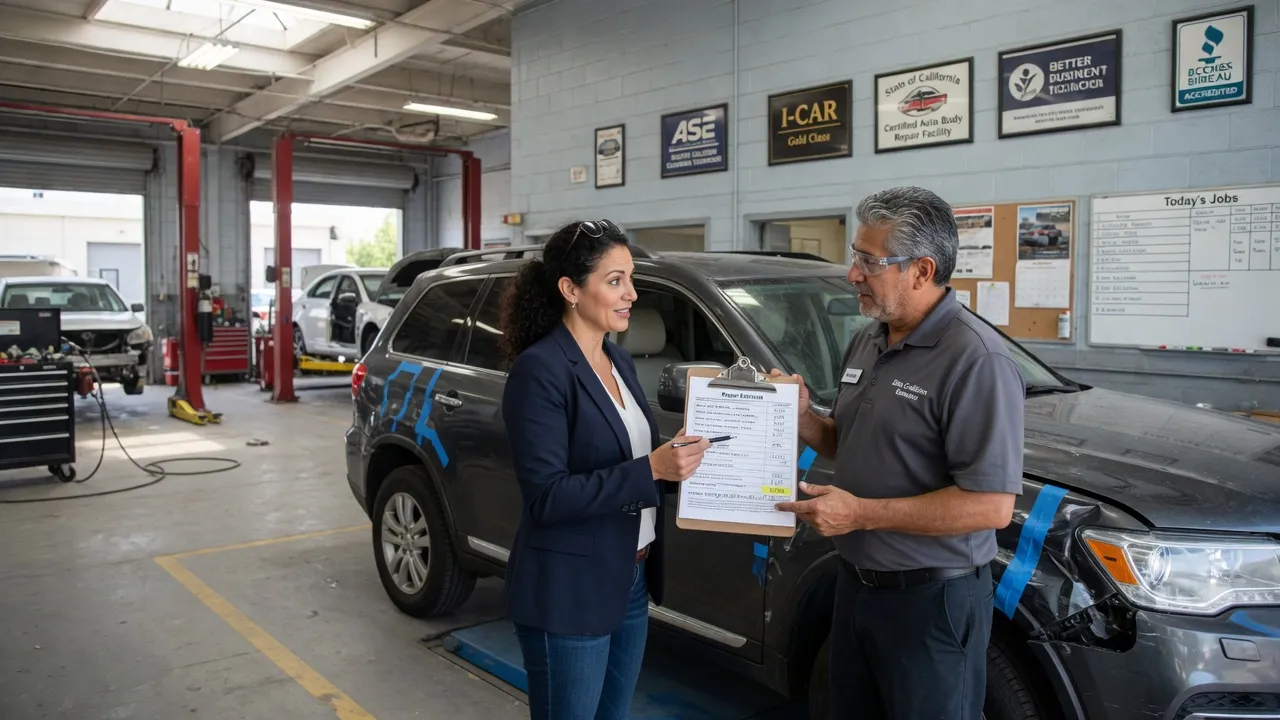
These five questions apply when evaluating any body shop — Maaco or independent — before authorizing a repair:
1. What does the prep work include for this estimate?
Ask specifically: Will the affected area be sanded and primed before painting? Will adjacent panels be masked? Will the new paint be blended into adjacent panels? Get specific answers, not vague assurances. At Maaco, ask which package tier the estimate reflects — economy prep is meaningfully different from premium prep.
2. What type of paint will be used, and does it include a clear coat?
Single-stage enamel without a clear coat is the entry-level option. Two-stage urethane with clear coat is the industry standard for durable, lasting results.
3. What warranty is provided, and what does it cover specifically?
Request the warranty terms in writing before authorizing any work. Understand what triggers a warranty claim, what the shop will do to remedy defects, and how long coverage lasts. Maaco's economy-tier warranty is limited (roughly 90 days on rust recondition, 1 year on paint defects); the premium tier extends to 5 years (prorated). Full warranty details are on Maaco's warranty policy page. Independent shops vary widely — some offer lifetime warranties on paint and labor.
4. Is the shop I-CAR Gold Class certified, or does it carry any OEM certifications?
For collision work especially, certifications show that technicians have completed rigorous, ongoing training. A certified shop isn't a guarantee of quality, but it's a meaningful positive indicator.
5. Can I see recent examples of completed work similar to mine?
A reputable shop — Maaco or independent — should be able to show before-and-after photos for similar repairs. This matters most for color matching and blending on newer vehicles.
Getting two or three estimates before authorizing any significant repair is worth the time. Estimates are free, and comparing them shows how different shops approach the same job — a useful quality signal beyond price alone.
For auto painting services and scratch repair on panels where color matching matters, the prep and blending questions above are particularly important. The same applies when evaluating paintless dent repair (PDR) as an alternative to full repaint for minor dents — a qualified technician can often restore the panel without any paint work at all, at a fraction of either shop's repaint cost.
Frequently asked questions
Is Maaco good?
Maaco produces variable results depending on the franchise location, the package tier selected, and the technicians doing the work. At the economy tier, Maaco provides a functional paint job at low cost with minimal prep. At the preferred and premium tiers, results get closer to independent shop quality. Maaco works best for cosmetic work on older, lower-value vehicles. Consumer Affairs aggregates more than 5,800 Maaco reviews with an average rating of about 3.6 out of 5. For a deeper look at quality and complaints, read our full Maaco review.
How much does a Maaco paint job cost?
Maaco's economy package starts at roughly $300 to $700 for a basic single-stage repaint. The preferred package runs $1,000 to $1,700 with a clear coat finish. The premium package ranges from $2,000 to $4,500 or more and includes full prep and a multi-year warranty. Prices vary by location and vehicle size.
Can Maaco handle collision repair and insurance claims?
Maaco handles light collision repair and cosmetic damage. Maaco participates in Direct Repair Program (DRP) networks with some insurance carriers, so it can process insurance claims for qualifying repairs. Maaco generally isn't appropriate for major structural collision damage, frame repair, or repairs requiring ADAS recalibration.
What is the main difference between Maaco and a local body shop?
The core difference is prep work standards and scope of services. Maaco's economy tier cuts prep to hit a low price point. Full-service independent body shops do more extensive prep work, handle structural and collision damage, hold more certifications, and can perform ADAS recalibration. Independent shops also tend to offer more personalized service with owner-level accountability.
How do I find a good Maaco vs. a bad one?
Check Google and Yelp reviews filtered to the most recent 6 months, looking specifically for comments about paint quality, color matching, and how problems were handled. Ask the location directly what certifications it holds and what prep the estimate includes. A well-run Maaco franchise will answer these questions directly.
Is Maaco a cheap auto body shop or a full-service body shop?
Maaco is a cheap auto body shop for cosmetic paint work — not a full-service collision repair facility. Its business model is built around volume paint jobs at low price points. For structural collision damage, frame repair, or ADAS recalibration, a full-service independent shop is required. For budget cosmetic work on an older vehicle, Maaco's economy and preferred tiers offer pricing that full-service shops can't match.
Key takeaways
Neither Maaco nor a local independent shop is universally better. The right choice comes down to three factors: the type of damage, the vehicle's value, and the budget.
Choose Maaco when:
- The damage is cosmetic only (paint, minor surface issues)
- The vehicle is older and its value is modest relative to repair costs
- Budget is the primary constraint and structural safety isn't involved
- A quality independent shop isn't accessible in the local market
Choose a local independent shop when:
- The damage is structural, involves safety systems, or requires collision repair
- The vehicle is newer, high-value, or leased
- An insurance claim involves OEM parts or repair documentation
- Color matching and blending on adjacent panels matters
- ADAS recalibration will be required after the repair
In both cases, the same rule applies: ask specifically about prep work, request the warranty in writing, and verify certifications before authorizing any repair.