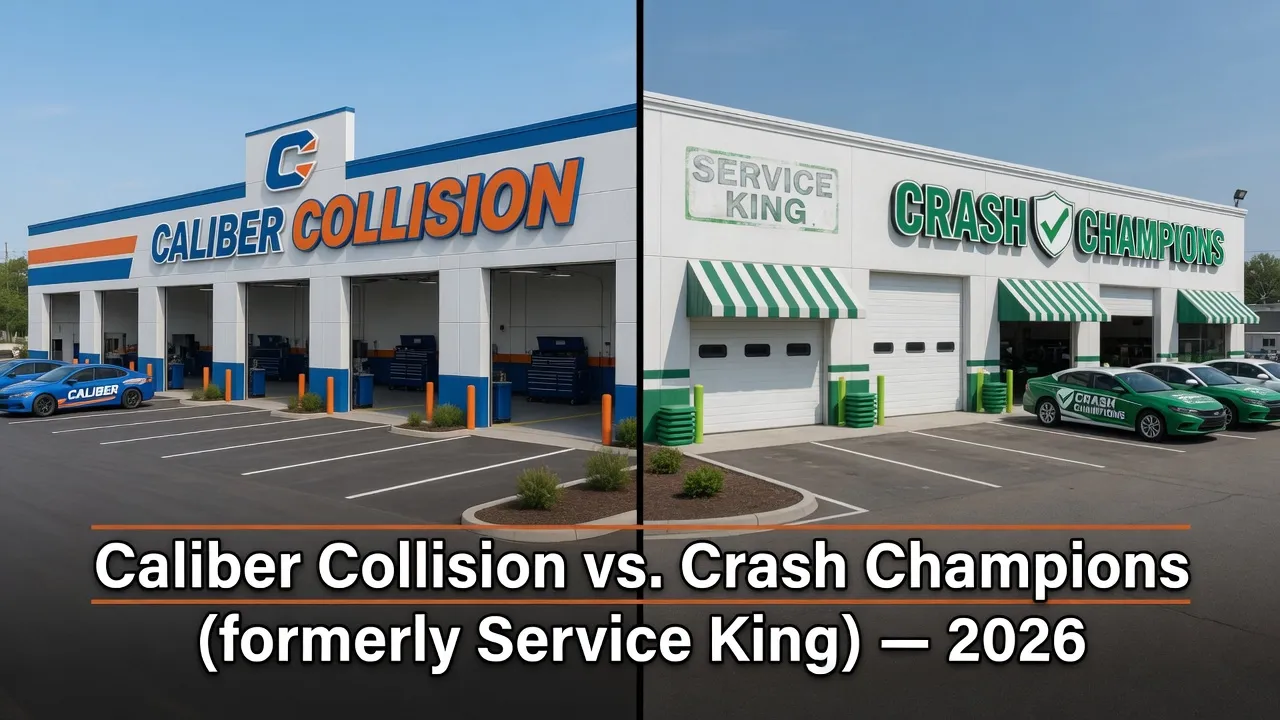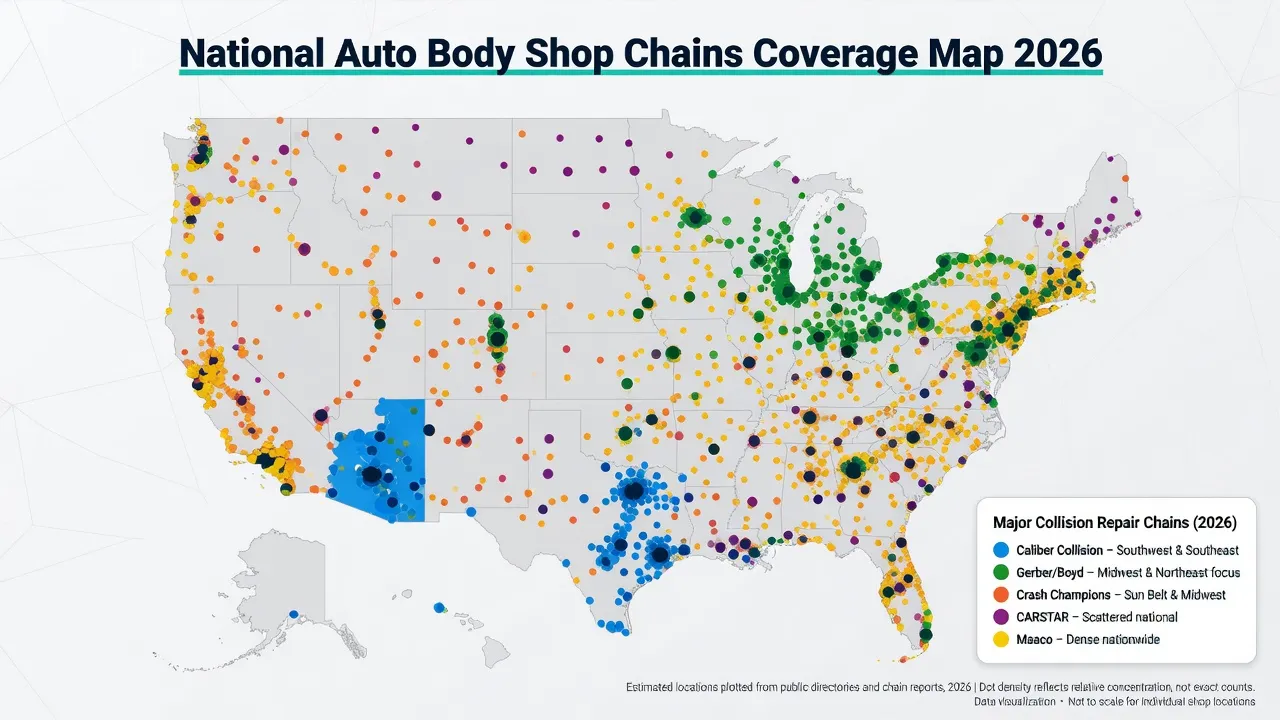
Crash Champions is a national collision repair chain with 650+ locations across 38 states, formed primarily through the acquisition of Service King's locations after Service King's 2022 bankruptcy. This Crash Champions review covers what the chain actually delivers in 2026: repair quality, Crash Champions customer service, DRP insurance partnerships, warranty coverage, and how it compares to competitors.
Bottom line: Crash Champions is a capable chain with real variability between locations. Whether it's good depends almost entirely on which location you use, not the brand as a whole.
Service King used to be one of the most recognized names in collision repair. Then, almost overnight, thousands of customers showed up to locations with new signs. And a lot of questions.
If you're searching for a Crash Champions review because you're unsure whether the rebrand changed anything that matters, that's the right question to ask. A name change doesn't guarantee the same technicians, the same insurance relationships, or the same repair standards carried over. This guide cuts through the marketing and looks at what Crash Champions actually delivers in 2026: where it stands on quality, what the customer experience typically looks like, what happened to Service King's DRP partnerships, and what car owners should check before dropping off their vehicle.
One thing up front: Crash Champions has strengths and real weaknesses. Both deserve an honest look.
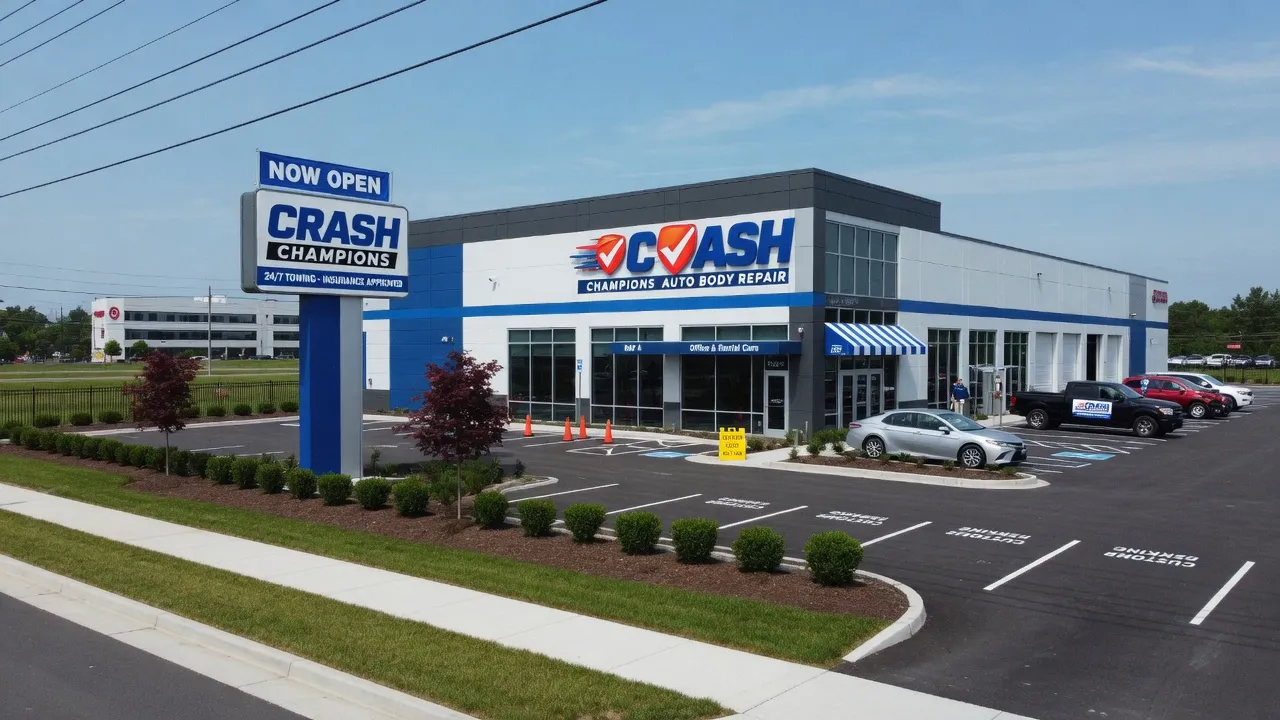
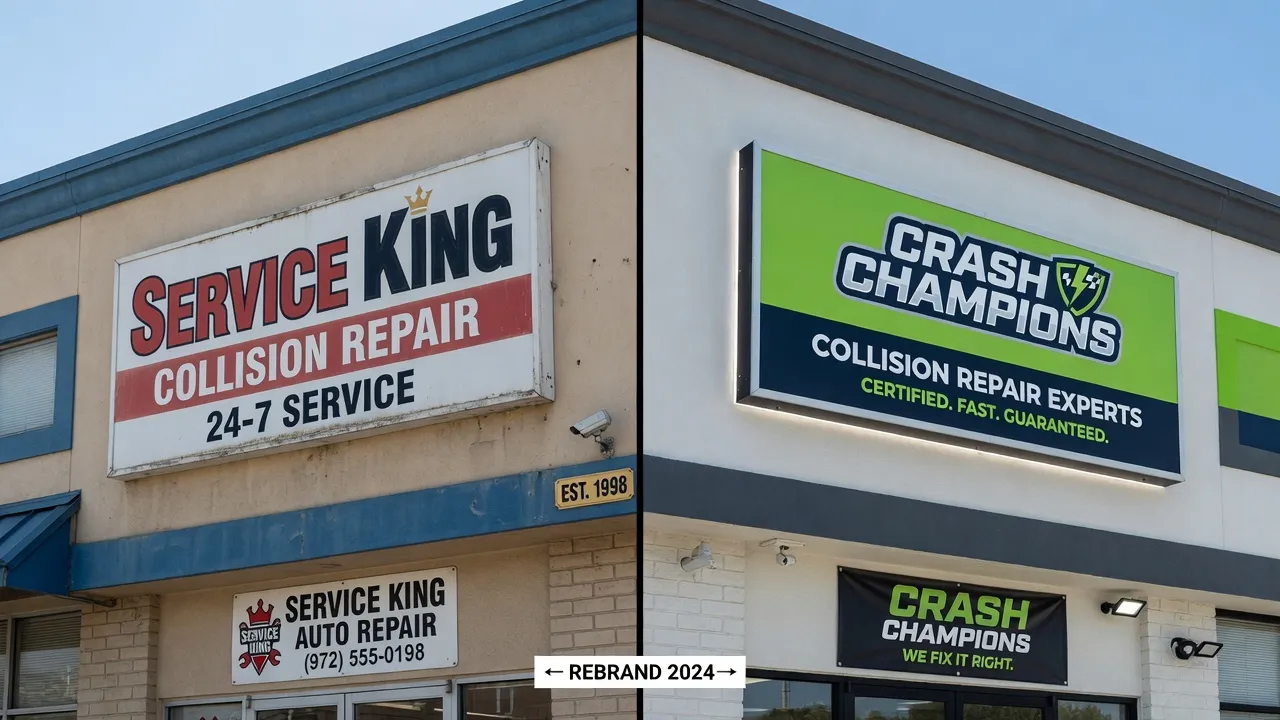
The Service King rebrand: what happened and why
Service King Collision Repair Centers was founded in 1976 in Dallas, Texas, and grew into one of the country's largest chain body shop networks. At its peak, the company operated more than 350 locations across the southern and western United States.
In 2021 and 2022, Service King ran into serious financial trouble. The company filed for bankruptcy protection in 2022 after struggling with debt accumulated from years of rapid acquisition-driven expansion. During that same period, Crash Champions, a Chicago-based chain that had been growing aggressively through its own acquisitions, stepped in to purchase a large portion of Service King's locations out of bankruptcy.
By 2023, the Service King brand had largely been absorbed. Most surviving locations were rebranded as Crash Champions. The company kept acquiring additional shops through 2024 and 2025, and by 2026 operates more than 650 locations across 38 states.
From a consumer standpoint, the transition meant that shops most customers knew as Service King now operate under a different ownership structure, different management systems, and a different brand identity. Some locations closed entirely during the bankruptcy. Others changed hands. The experience at any given location depends on which path it took.
Understanding this history matters because the rebrand wasn't just cosmetic. It was a genuine ownership change with real implications for staffing, systems, and service culture at the shop level.
Crash Champions in 2026: scale, reach, and what the numbers say
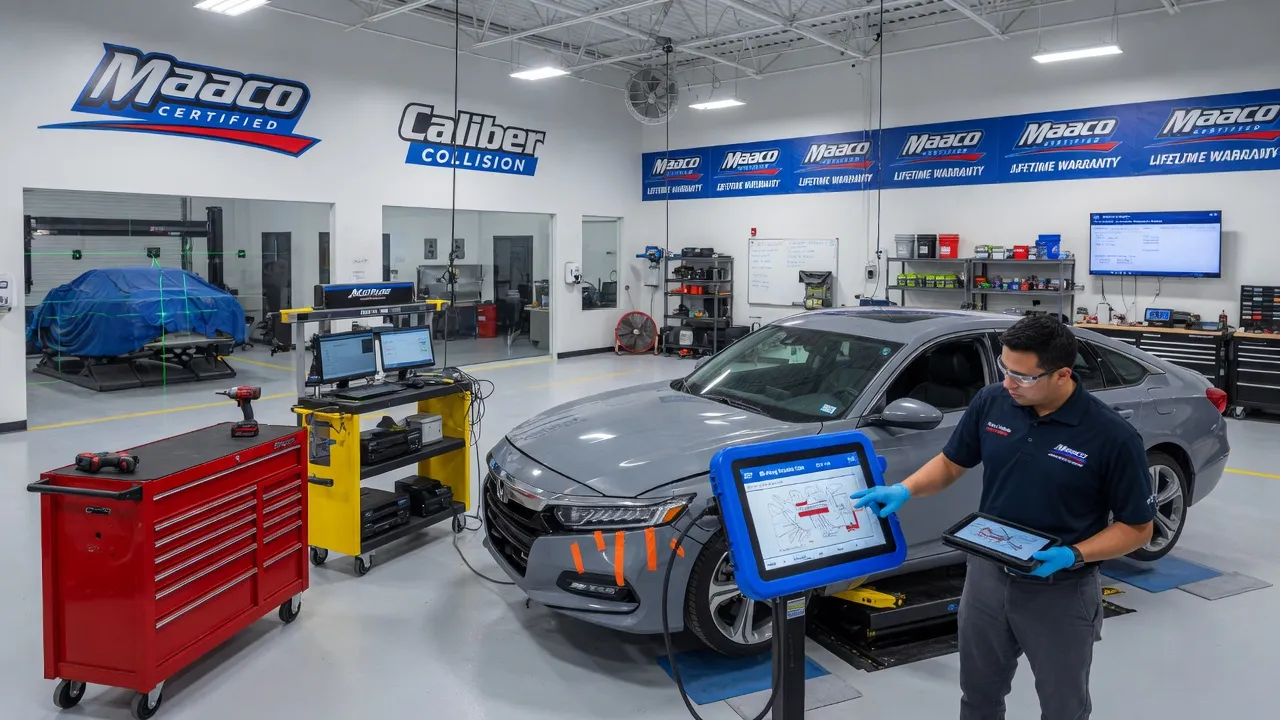
With 650+ locations across 38 states, Crash Champions is one of the three largest collision repair chains in the United States, alongside Caliber Collision and CARSTAR. That scale brings both advantages and risks. For a matchup with another large consolidator, see how Crash Champions compares with Gerber.
What scale works in a car owner's favor:
- Widespread insurer relationships mean most major insurance companies have existing DRP agreements with Crash Champions, which can simplify the claims process
- Centralized training and equipment standards (when enforced) mean a Crash Champions location should have the tools for most modern vehicles
- Nationwide warranty coverage: repairs are backed by a limited lifetime warranty that transfers between locations, which matters if you move or travel
Where scale creates friction:
The CCC Crash Course 2026 Industry Report puts the average collision repair cost at $4,818. At that price point, repair quality variation between individual locations is a real concern for car owners. Large chains often struggle with consistent execution across hundreds of franchise-model shops.
Crash Champions' total loss rate runs in line with the industry average of 23.1%, and ADAS (Advanced Driver Assistance Systems) calibration is required on roughly 28.3% of repairs. That number will keep rising as newer vehicles become the dominant repair volume. The supplement rate industry-wide sits at 63%, meaning more than half of all repair jobs require additional estimate revisions after teardown. Each of these stats represents a point where customer experience can break down if communication isn't handled well.
For a broader comparison of how Crash Champions stacks up against the other major chains, see how Crash Champions compares to all major chains.
What changed after the merger, and what stayed the same
This is the question most former Service King customers actually want answered.
What changed:
- Brand identity, signage, and corporate communications
- Ownership structure and parent company management
- Some regional management teams and area directors
- Technology systems, including estimating platforms and customer communication portals
- The company's DRP portfolio (discussed in more detail below)
What generally stayed the same:
- The physical shop locations and their equipment
- Most of the shop-level technicians at locations that remained open
- I-CAR training standards (Crash Champions maintains I-CAR Gold Class certification requirements)
- The core collision repair process itself
The honest answer is that the experience at any specific location depends heavily on whether that location kept its experienced technicians and management after the transition. Some locations had significant staff turnover. Others kept their team intact. Car owners can't know this from the outside without asking directly.
One practical question worth asking any Crash Champions location: how long have the estimators and production managers been at this specific shop? A team that worked together through the rebrand is more likely to have a settled workflow than a location that went through major turnover.
Crash Luxe: the EV and luxury vehicle program
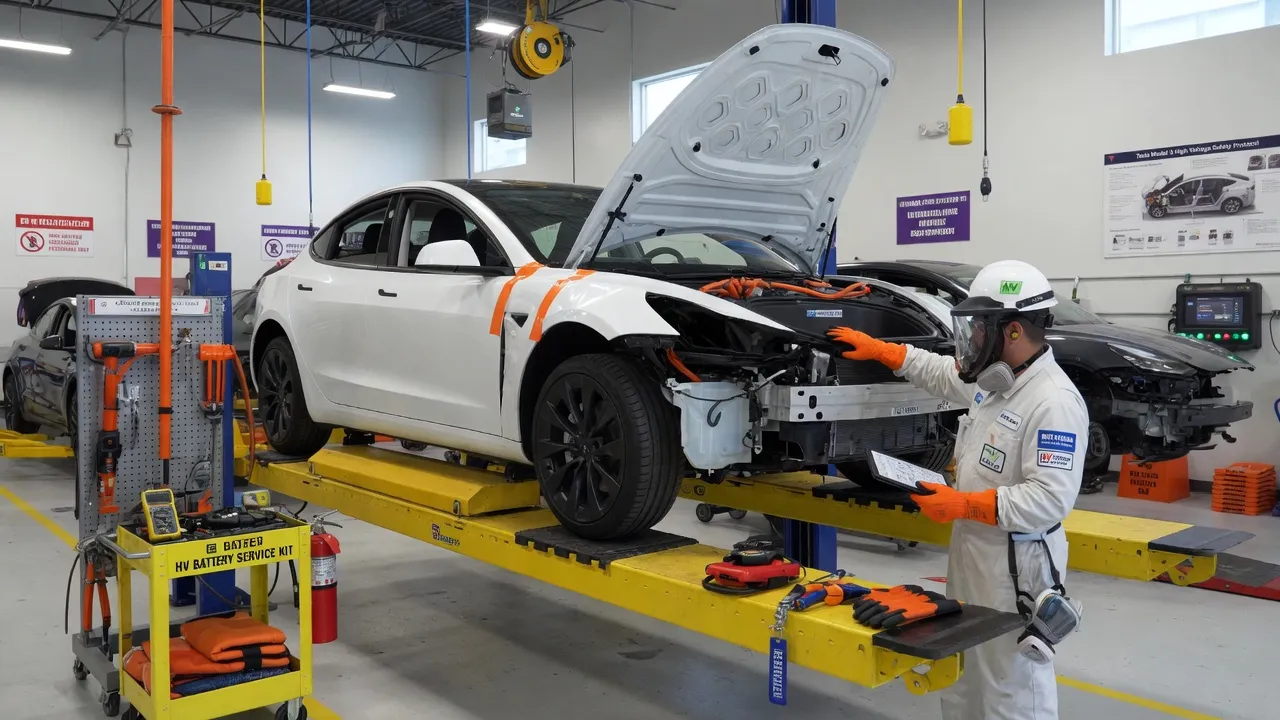
Crash Champions introduced Crash Luxe as a specialized program for electric vehicles and high-end luxury brands. Not every Crash Champions location operates under the Crash Luxe designation. Crash Luxe shops have additional certifications, specialized equipment for high-voltage EV systems, and technicians trained for vehicles from brands like Tesla, Rivian, BMW, and Mercedes-Benz.
Why does this matter? EV body repair requires handling high-voltage battery systems safely. It isn't the same skill set as conventional collision repair. A shop that isn't certified for the specific vehicle it's repairing can void manufacturer warranties, miss required repair procedures, or create safety issues that aren't visible on the surface. I-CAR publishes OEM certification requirements for EVs and luxury brands that car owners can reference directly.
Before bringing any EV or luxury vehicle to a Crash Champions location, car owners should confirm that location carries the relevant OEM certification for their specific vehicle. Crash Luxe designation is a starting point, not a guarantee of every brand's authorization.
If ADAS recalibration is needed after the repair (required on approximately 28.3% of all collision jobs, and a higher percentage on EVs), confirming the shop has dynamic or static calibration capability for the specific vehicle's systems is equally important. For a deeper look at why calibration matters, the auto glass repair service category is one of the most common triggers for required recalibration.
Services offered at Crash Champions locations
A standard Crash Champions location offers the following services:
- Collision repair: Structural and non-structural damage from accidents, including frame and unibody repair
- Auto glass repair and replacement: Windshield replacement and chip repair, with in-house ADAS recalibration at equipped locations (see auto glass repair for details on what recalibration involves)
- ADAS calibration: Required after many repairs involving cameras, sensors, or radar systems
- Paintless Dent Repair (PDR): Removal of dents without repainting, typically used for hail damage and minor door dings
- Fleet repair: Commercial accounts for businesses managing vehicle fleets
Not every location offers every service. PDR availability and ADAS calibration capability vary. Confirming specific services before dropping off a vehicle saves time and avoids surprises.
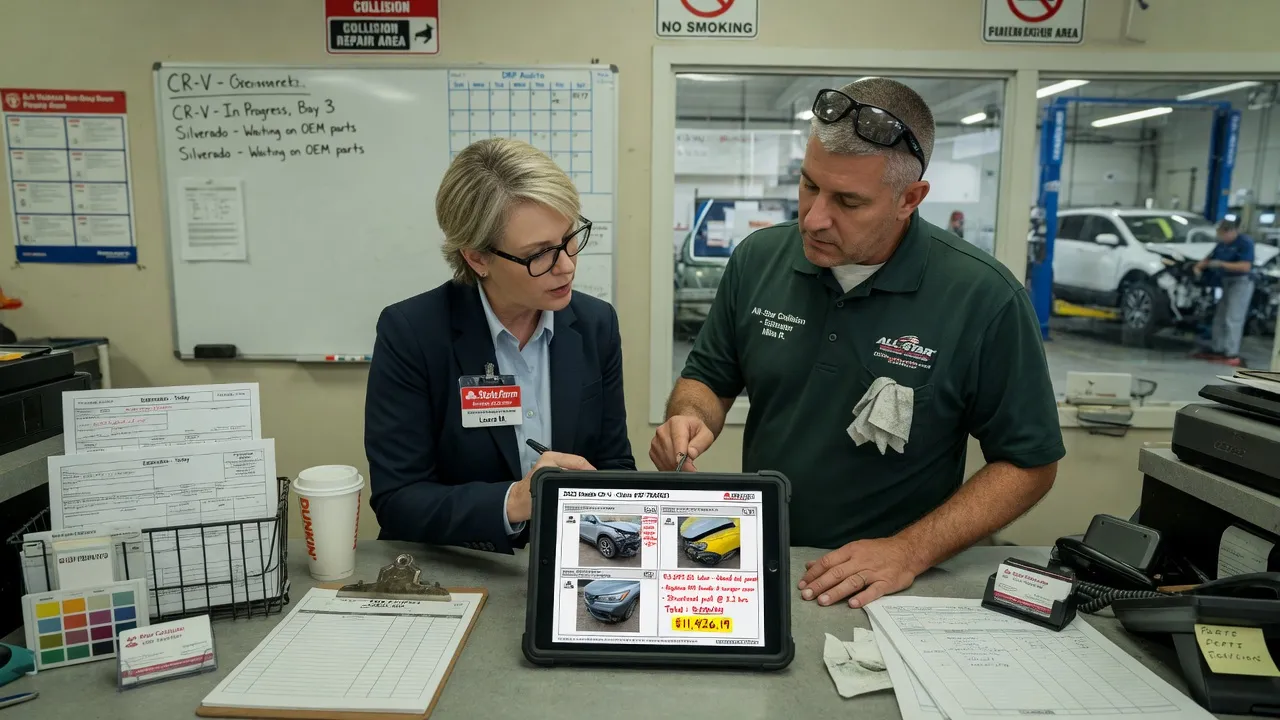
DRP (Direct Repair Program) partnerships mean that Crash Champions has contractual relationships with major insurance carriers. A DRP relationship means the insurer has pre-approved the shop to write estimates and complete repairs under the insurer's guidelines. For the car owner, a DRP shop often means faster claim approval and streamlined paperwork. It also means the shop operates under cost and process parameters set in part by the insurer.
Car owners should understand that choosing a DRP shop doesn't mean surrendering control of the repair. The right to choose any repair facility regardless of insurer preference exists in every U.S. state. For a plain-language explanation of how DRP relationships work and what they mean in practice, see Crash Champions DRP insurance partners explained.
Crash Champions review: what customers say in 2026
Customer reviews for Crash Champions skew toward two distinct experiences. Understanding the pattern is more useful than any single review.
Where reviews are consistently positive:
- Shops that communicate proactively during the repair. Customers who receive regular status updates report higher satisfaction, even when repairs take longer than initially estimated.
- Locations with experienced, long-tenured estimators. Reviews frequently credit a specific estimator or advisor by name when the experience was good.
- Repairs on common domestic and Japanese vehicles, where the shop has high volume and technician familiarity.
Where reviews tend to go negative:
- Communication gaps during the repair. The most common complaint is not hearing from the shop until the car owner calls. This is a systemic issue at many large chain shops, not unique to Crash Champions, but it's present in the review data.
- Supplement delays. When additional damage is found during teardown (which happens on 63% of jobs industry-wide), the shop must get insurer approval for additional costs. Customers who aren't informed about this process are often caught off guard by extended timelines.
- Repeat visits for the same repair. Some negative reviews describe having to return for paint issues, fitment problems, or missed items. Most are resolved under warranty, but the inconvenience is real.
What this means for car owners: The Crash Champions experience varies more by location than by the chain as a whole. A location with stable, experienced staff and good communication practices will deliver a very different experience than one with high turnover. Checking Google reviews for the specific location, not the brand broadly, and filtering for the most recent 90 days gives a more accurate read than the aggregate star rating.
A quick story illustrates the pattern: Marcus, a fleet manager in suburban Atlanta who regularly uses a local Crash Champions for his company's vehicle repairs, describes his experience as "consistent and predictable" after developing a relationship with the shop's production manager. His counterpart at a different company, who used a Crash Champions location in a different city, had a frustrating experience with a repair that required three visits to get the paint blend right. Same brand, different outcomes.
For strategies on getting the best results at any chain body shop, see how to get best results at Crash Champions.
DRP insurance partners: which insurers use Crash Champions
Crash Champions maintains DRP relationships with most of the major national insurance carriers. The specific DRP portfolio shifted during the Service King bankruptcy period, as insurers periodically review and update their preferred shop networks.
As of 2026, Crash Champions has active DRP relationships with carriers including State Farm, GEICO, Allstate, Progressive, Farmers, USAA, and several regional carriers. The list of participating locations for each insurer varies, and not every Crash Champions location participates in every program.
What a DRP relationship means in practice:
When a car owner files a claim with an insurer that has a DRP agreement with Crash Champions, the insurer may direct them to a local Crash Champions location. The shop can write the initial estimate under the insurer's guidelines, and in many cases work is authorized more quickly than at a non-DRP shop.
DRP relationships involve pricing concessions. Shops agree to labor rates and part sourcing guidelines that the insurer has negotiated. This is worth knowing because it affects how supplement negotiations go if additional damage is found during teardown. It doesn't mean the car owner loses any rights, but it does mean the shop operates within a framework the insurer has defined.
Car owners working with insurance claims can still choose a non-DRP shop if they prefer. The insurer must cover reasonable repair costs regardless. The tradeoff is that a non-DRP shop may require more administrative back-and-forth on approvals.
For a full explanation of the insurance claims process and consumer rights in shop selection, see the insurance claims guide.
Warranty details: what's covered and for how long
Crash Champions offers a limited lifetime warranty on collision repairs performed at their facilities. Here's what that means in practice:
What the lifetime warranty covers:
- Workmanship defects in the repair itself
- Paint delamination or peeling caused by the repair application
- Parts installed by Crash Champions for defects related to installation
What the warranty typically does not cover:
- Pre-existing damage or conditions unrelated to the repair
- Normal wear on parts
- Damage caused by subsequent accidents or environmental factors after pickup
- Issues arising from insurer-directed use of non-OEM parts (the parts manufacturer's warranty, not Crash Champions' warranty, would apply)
The "nationwide" aspect: Crash Champions states that warranty claims can be honored at any Crash Champions location, not just the original repair shop. This is useful for car owners who move or travel, though in practice, getting a warranty repair addressed at a different location can require some documentation of the original work.
Before leaving any collision repair shop, car owners should get the warranty terms in writing. Verbal assurances are hard to act on later. The National Association of Insurance Commissioners (NAIC) provides a plain-language guide to consumer rights during auto insurance claims, including repair facility selection. For context on how chain shop warranties compare to independent shops, see chain vs independent comparison.
How to evaluate your local Crash Champions location
The Crash Champions brand sets minimum standards, but individual location quality varies. Before committing a vehicle to any specific location, the following checklist helps car owners make a better-informed decision.
Location evaluation checklist:
-
Check recent Google reviews. Filter for reviews from the past 90 days. Look for patterns in communication complaints or praise, not just the star average.
-
Confirm I-CAR Gold Class status. Ask directly whether the location holds current I-CAR Gold Class certification. This indicates that a minimum percentage of technicians have completed current I-CAR training requirements.
-
Verify OEM certifications for your vehicle. If driving a Tesla, BMW, Honda, Ford, or another brand with OEM certification programs, ask whether the location holds that specific manufacturer's certification. This matters most for EVs and luxury vehicles.
-
Ask about ADAS calibration capability. If your vehicle has cameras, radar sensors, or lane-keeping systems, ask whether the shop performs calibrations in-house or sublets them to a third party. In-house is generally faster.
-
Ask about supplement handling. How does the shop communicate when additional damage is found? How long does approval typically take with your insurer? A shop with a clear process here signals operational maturity.
-
Request a written estimate and warranty documentation. Both should be provided before work begins, without pressure to decide on the spot.
-
Ask how long key staff have been at this location. Estimator and production manager continuity is a stronger quality indicator than the brand name alone.
Sandra, a car owner in the Chicago suburbs, used this approach before choosing between two nearby Crash Champions locations. The first couldn't confirm I-CAR certification for her 2024 Acura. The second confirmed both I-CAR Gold Class and Honda certification, had an estimator who had been at that location for four years, and walked her through the supplement process clearly. Her repair, a significant rear-quarter panel job, came back on time with no return visits required. The location mattered far more than the brand.
For a broader evaluation framework covering chain shops of all kinds, the collision repair service guide covers what to look for in any shop handling structural damage.
Key takeaways from this Crash Champions review
Crash Champions is a capable chain with real variability between locations. The rebrand from Service King involved genuine ownership changes, not just new signage, which means location-by-location quality depends heavily on local management and staff stability.
Here's what matters most for car owners:
- Scale has real advantages. 650+ locations, nationwide warranty coverage, and established DRP relationships with major insurers simplify the insurance claim process for most drivers.
- Quality is location-dependent. The brand sets minimum standards, but individual shop execution varies. The local team matters more than the national name.
- Crash Luxe is the right choice for EVs and luxury vehicles. Confirm OEM certification before bringing any EV or high-value vehicle to any location, Crash Luxe-designated or not.
- Communication is the most common friction point. Asking upfront about the shop's update process and supplement handling approach predicts the experience better than star ratings.
- The Service King DRP legacy largely transferred. Most major insurer relationships that existed under Service King were maintained or rebuilt under the Crash Champions brand.
If evaluating Crash Champions against other chains, the full side-by-side comparison with Caliber covers how these networks differ on certifications, pricing, and customer experience patterns.
Before any repair at a chain shop, getting at least one comparison estimate from an independent shop in the area is worth the extra step. Understanding the chain vs independent comparison helps car owners decide which type of shop is the better fit for their specific situation.
Frequently asked questions
Is Crash Champions the same as Service King?
Crash Champions acquired most of Service King's locations after Service King filed for bankruptcy in 2022. The shops were rebranded as Crash Champions. While the physical locations are often the same buildings, Crash Champions operates under different ownership, management systems, and brand standards than Service King did. Some former Service King staff transferred to the new ownership; others did not.
Is Crash Champions a good body shop?
Crash Champions ranges from very good to mediocre depending on the specific location. Shops with stable, experienced staff and good communication practices consistently earn positive reviews. Locations with high staff turnover or weak communication processes show up in negative review patterns. Checking recent location-specific Google reviews and confirming I-CAR certification gives a better read than evaluating the brand as a whole.
What DRP insurance companies work with Crash Champions?
Crash Champions holds DRP agreements with most major national insurers, including State Farm, GEICO, Allstate, Progressive, Farmers, and USAA, among others. Not every location participates in every program. Car owners should confirm with their insurer whether their local Crash Champions is in their carrier's DRP network.
Does Crash Champions offer a warranty?
Yes. Crash Champions provides a limited lifetime warranty on collision repairs, covering workmanship defects and paint issues caused by the repair. The warranty is honored at any Crash Champions location, not just the original shop. Car owners should request written warranty documentation before leaving the shop.
What is Crash Luxe?
Crash Luxe is Crash Champions' specialized program for electric vehicles and luxury vehicles. Crash Luxe locations have additional OEM certifications, high-voltage EV repair equipment, and technicians trained for specific luxury and EV brands. Not every Crash Champions location is a Crash Luxe location.
How does Crash Champions compare to Caliber Collision?
Our dedicated Crash Champions vs. Caliber Collision comparison covers this head-to-head in detail.
Both are large national chains with similar service offerings and DRP structures. Caliber Collision has a slightly larger footprint and has been operating under a single unified brand longer than Crash Champions. Review patterns suggest similar location-by-location variability at both chains. For a detailed comparison, see Caliber vs Service King/Crash Champions.
Can I use Crash Champions with any insurance company?
Car owners can use any repair facility with any insurance company. If Crash Champions isn't in an insurer's DRP network, the insurer may require more administrative steps but must still pay reasonable repair costs. The right to choose any repair facility applies in every U.S. state.