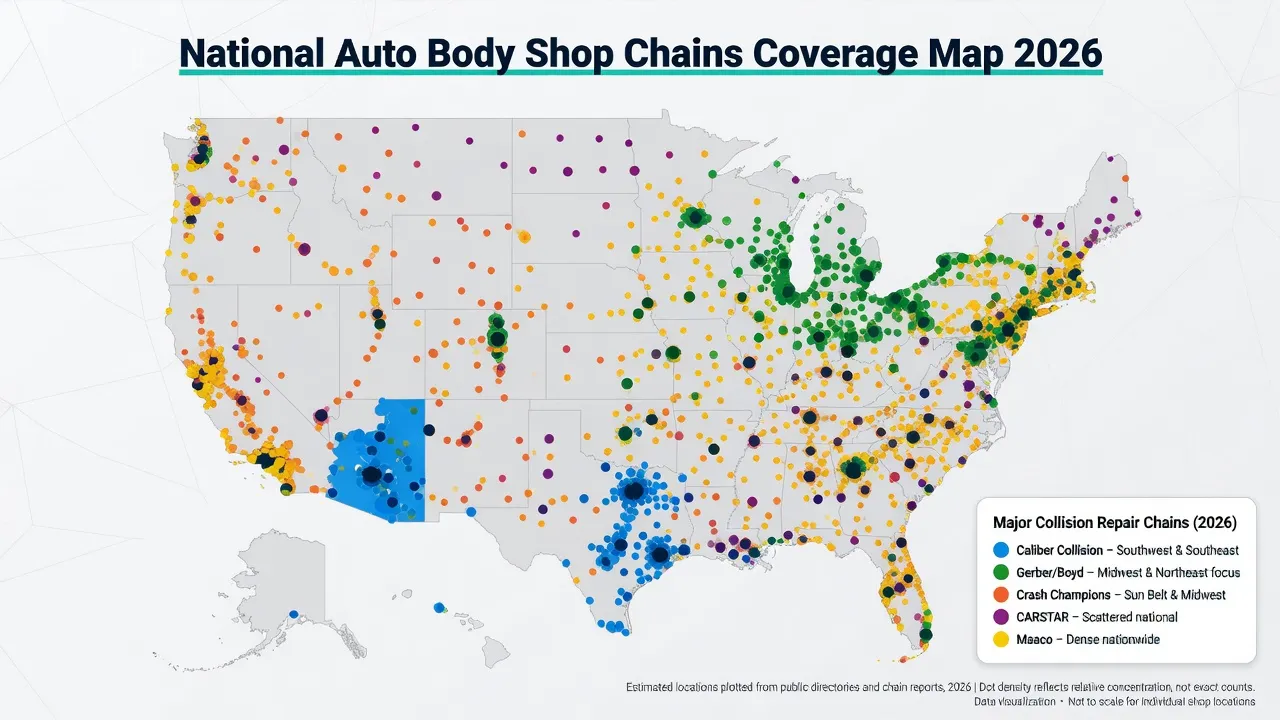
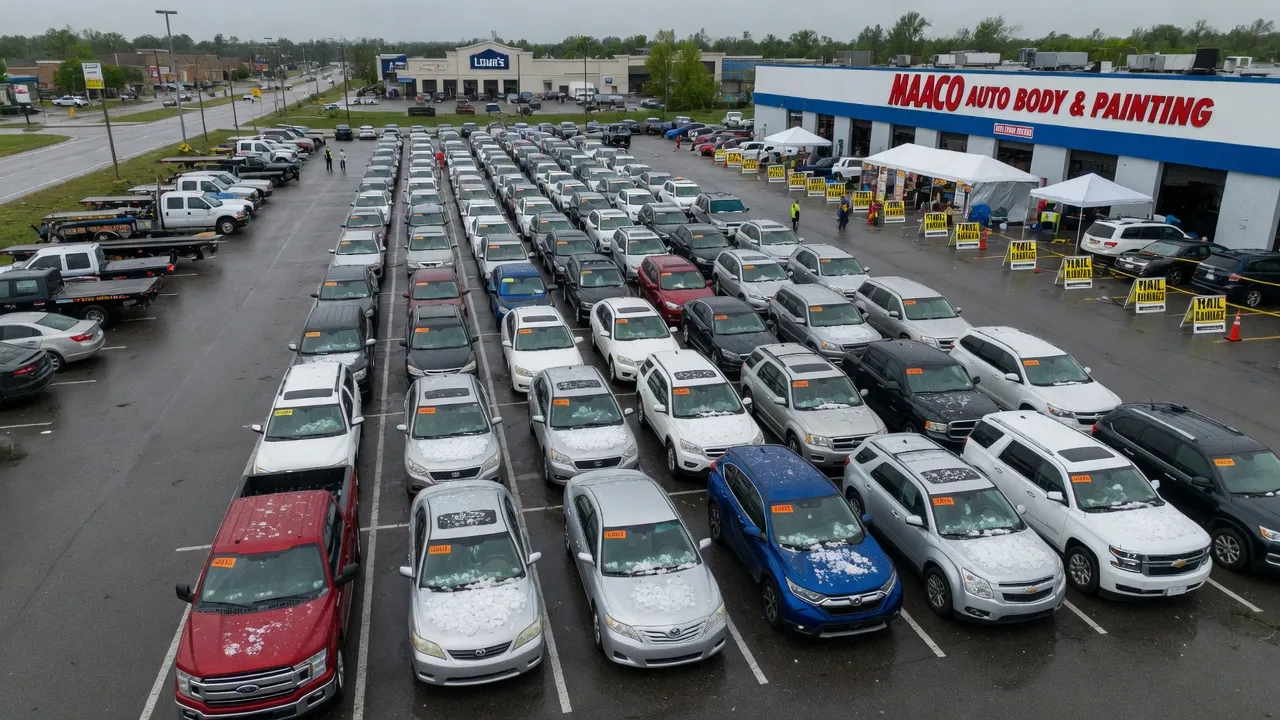
A single hail storm can drop thousands of cars at body shops in the same week. Choosing the best body shop for hail damage — rather than just the nearest one — can mean the difference between a two-week turnaround and a two-month wait.
Most car owners think of body shop chains as interchangeable. Drop off the car, get it fixed, pick it up. But when it comes to hail damage specifically, the differences between chains matter more than most people realize. Some have invested heavily in storm response infrastructure. Others treat hail jobs like any other repair and get buried when volume spikes.
This guide covers what to look for when choosing a hail storm auto body repair chain, how the major networks compare, and what questions to ask before handing over the keys. It also covers the repair method question most car owners don't know to ask: whether a shop will use paintless dent repair (PDR) or traditional bodywork, and why that choice affects both cost and outcome.
For a broader look at how the major chains compare across all repair types, see our ranking of major auto body chains.
Why hail damage is different from other collision repairs
Most collision repairs are one-off events. A car gets hit, it gets repaired, done. Hail damage doesn't work that way.
When a storm hits, every shop in the affected area gets flooded simultaneously. A single severe hail event in the Dallas-Fort Worth metro can generate 50,000 or more repair claims in a week. That kind of volume surge exposes every weakness in a shop's staffing, scheduling, and supply chain.
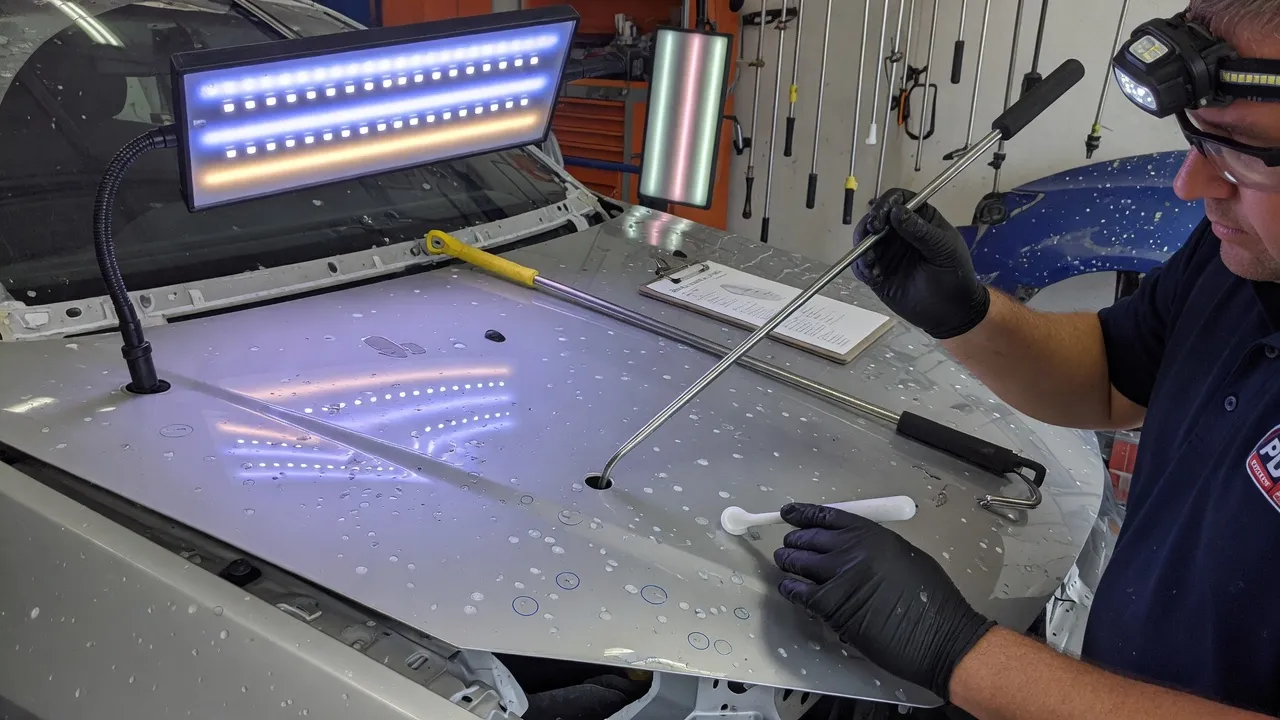
Hail damage also requires a different skill set than conventional collision work. The primary repair method, paintless dent repair (PDR), involves technicians using specialized metal rods to massage dented panels back into shape from behind without any repainting. PDR requires years of dedicated training. A shop that handles mostly fender benders may have one PDR technician on staff. A shop that specializes in storm work may have a team of six or eight.
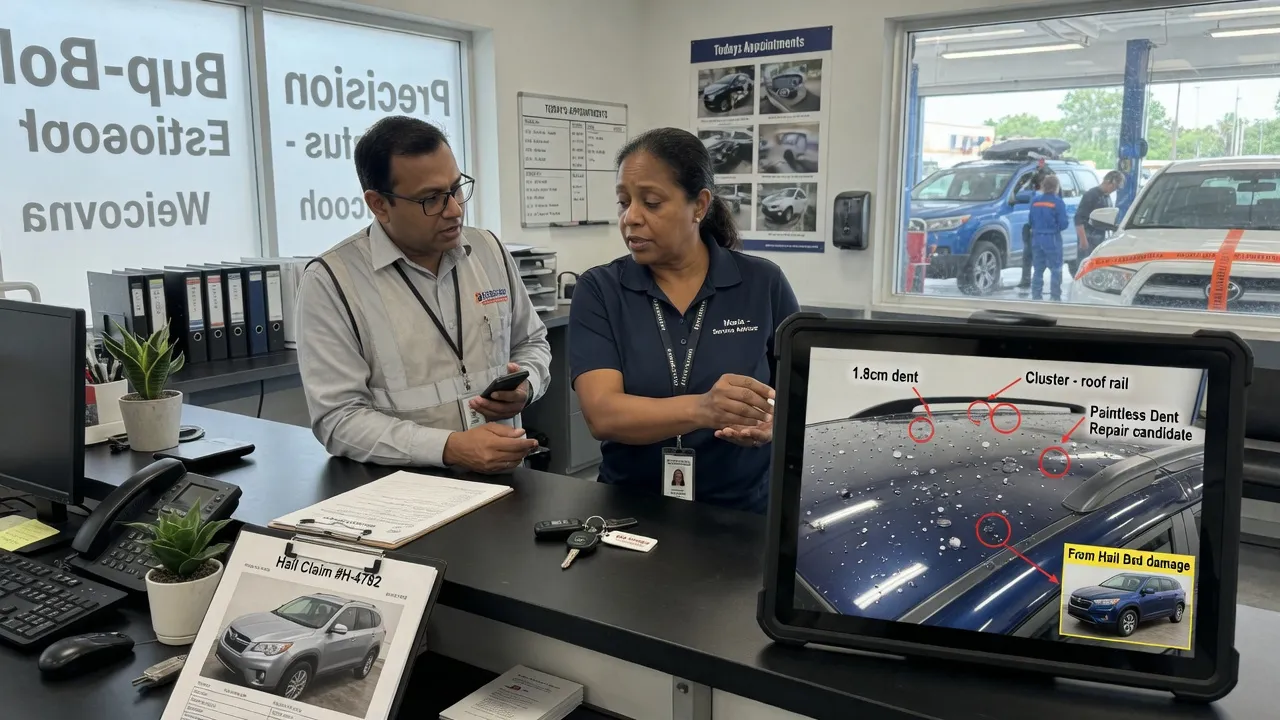
There's also the insurance dimension. Hail claims run through comprehensive coverage, not collision coverage. That means a different set of insurance workflows, different supplement processes, and sometimes different adjuster contacts than what a shop handles day-to-day for accident repairs. Shops without storm experience can slow down the process just by being unfamiliar with how hail claims move through insurers.
Finding the best body shop for hail damage isn't just about proximity. It's about finding a shop that has the PDR staff, storm capacity, and insurance relationships to handle your car efficiently.
For a more detailed look at how hail damage repair works, including what determines whether PDR is possible, see our dedicated hail repair guide.
CARSTAR hail damage: the chain built around storm markets
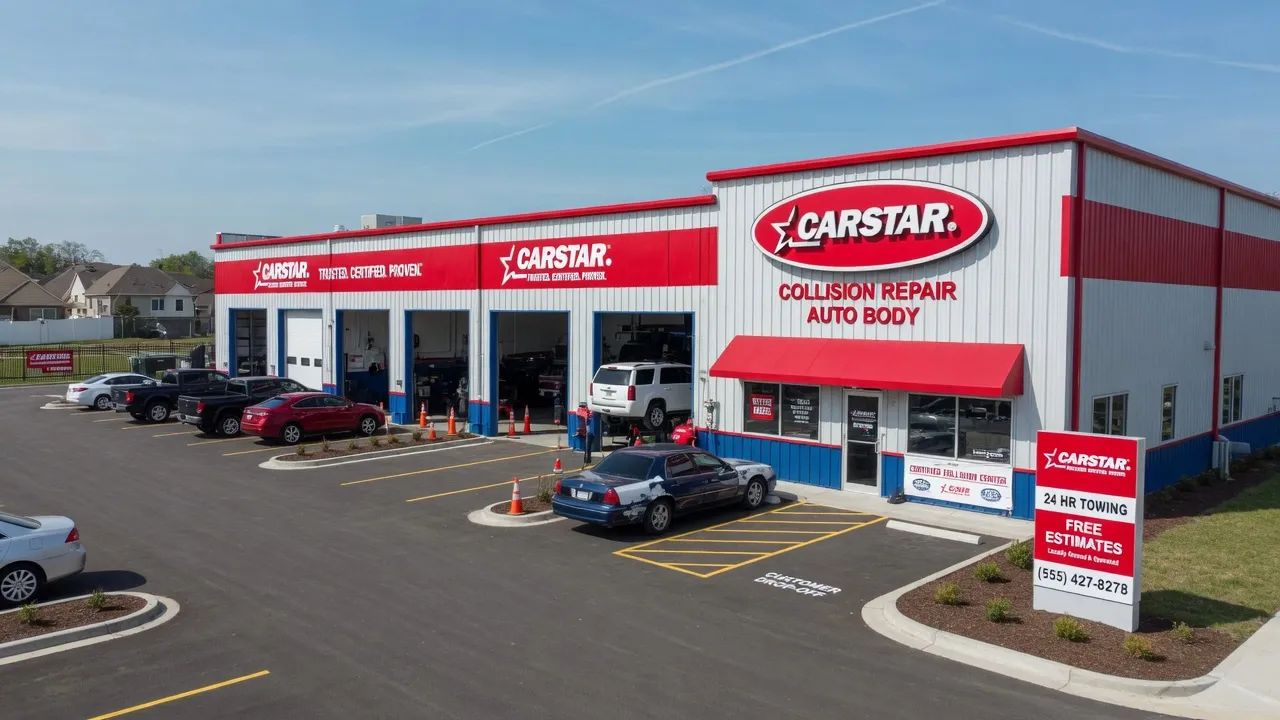
CARSTAR is the collision repair chain hail damage specialists most often mention first. The network has built a large portion of its 750-plus locations in markets that see regular hail activity, including Texas, Colorado, Kansas, Oklahoma, and Nebraska.
The network's storm response structure is more organized than most consumers realize. When a major weather event hits a market, CARSTAR can bring in additional PDR technicians from outside the storm zone into affected locations. This helps keep turnaround times manageable when a single store might otherwise be overwhelmed with a hundred or more vehicles in a week.
CARSTAR locations are independently owned and operated under a franchise model, which means individual location quality varies. But the corporate-level focus on storm markets means that CARSTAR franchisees in hail-prone areas tend to have higher PDR capacity than comparable chains in the same markets.
A few things worth knowing about CARSTAR specifically:
- Most CARSTAR locations work with all major insurers under direct repair program (DRP) agreements, meaning they can start repairs without waiting for a separate adjuster inspection in many cases
- Turnaround for moderate hail damage at a storm-prepared CARSTAR location typically runs seven to 14 business days during active storm seasons
- The network reports that hail claims make up a disproportionate share of its annual repair volume compared to the broader industry
For a deeper look at CARSTAR's history and network, including how it built its storm-damage background, see our full CARSTAR review.
Caliber Collision's storm response program
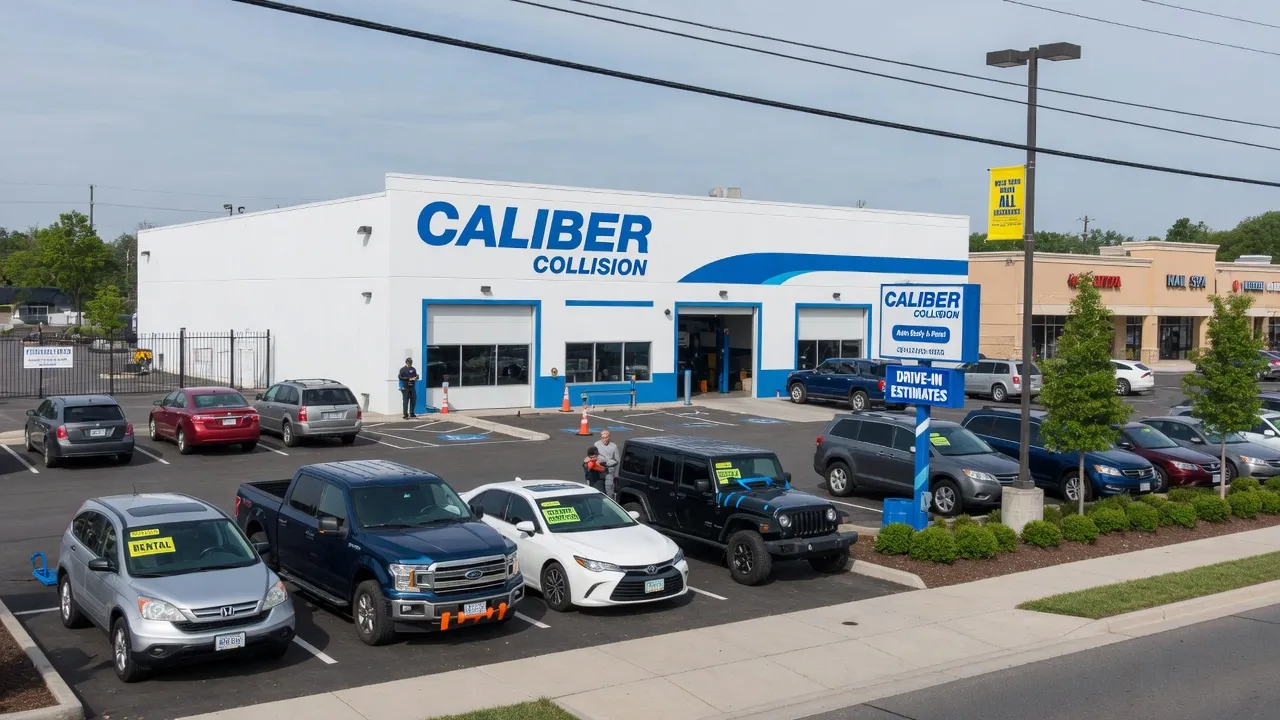
Caliber Collision is the largest chain in the country by location count, with more than 1,800 shops across 41 states. Size alone doesn't make a chain good at hail work, but Caliber has invested in storm response capability as part of its service offering.
Caliber operates what it calls a catastrophe response program, which routes storm-affected vehicles to locations that are staffed and equipped for high-volume hail repair. During active storm seasons, select Caliber locations in affected markets take on additional PDR staff to handle surge volume.
Here's what car owners should know before choosing Caliber for hail damage:
- Caliber's DRP relationships with major insurers like State Farm, GEICO, and Allstate can speed up the insurance approval process
- Not all Caliber locations have equivalent PDR depth. Locations in the hail belt states tend to be better staffed for storm work than shops in lower-frequency markets
- Caliber's written lifetime warranty covers workmanship, which includes PDR repairs
One thing to verify before committing to a Caliber location: ask directly how many PDR technicians are currently on staff and what their current backlog looks like. During peak storm season, even well-staffed shops can run three to four weeks out. Knowing the real wait time before dropping off the car helps avoid surprises.
For a full breakdown of what to expect at Caliber, see our Caliber Collision review.
Crash Champions in storm markets
Crash Champions grew through the acquisition of Service King locations, particularly in Texas, where Service King had a strong network. That history matters for hail damage because Texas is the most active hail state in the country.
Former Service King shops in Texas had established relationships with insurers on hail claims, built up PDR capacity over years of storm seasons, and operated in markets where hail repair is a major part of the annual business. Many of those locations now run as Crash Champions shops and have kept that institutional knowledge and staffing.
The honest assessment of Crash Champions for hail damage: quality varies considerably by location. Shops that were previously high-performing Service King locations in storm markets tend to be solid options. Shops converted from other acquired brands may have less storm-specific depth.
Car owners in Texas, Oklahoma, and the southern Midwest who are considering Crash Champions should ask about PDR-specific staffing and how the location handled hail volume in the most recent storm season. That conversation will reveal quickly whether the shop has real storm experience or is treating hail as a general repair category.
Our Crash Champions review covers the full network in more detail.
PDR vs. traditional repair for hail damage
This is the most important technical decision in any hail repair, and it's one most car owners don't fully understand before they hand their car over.
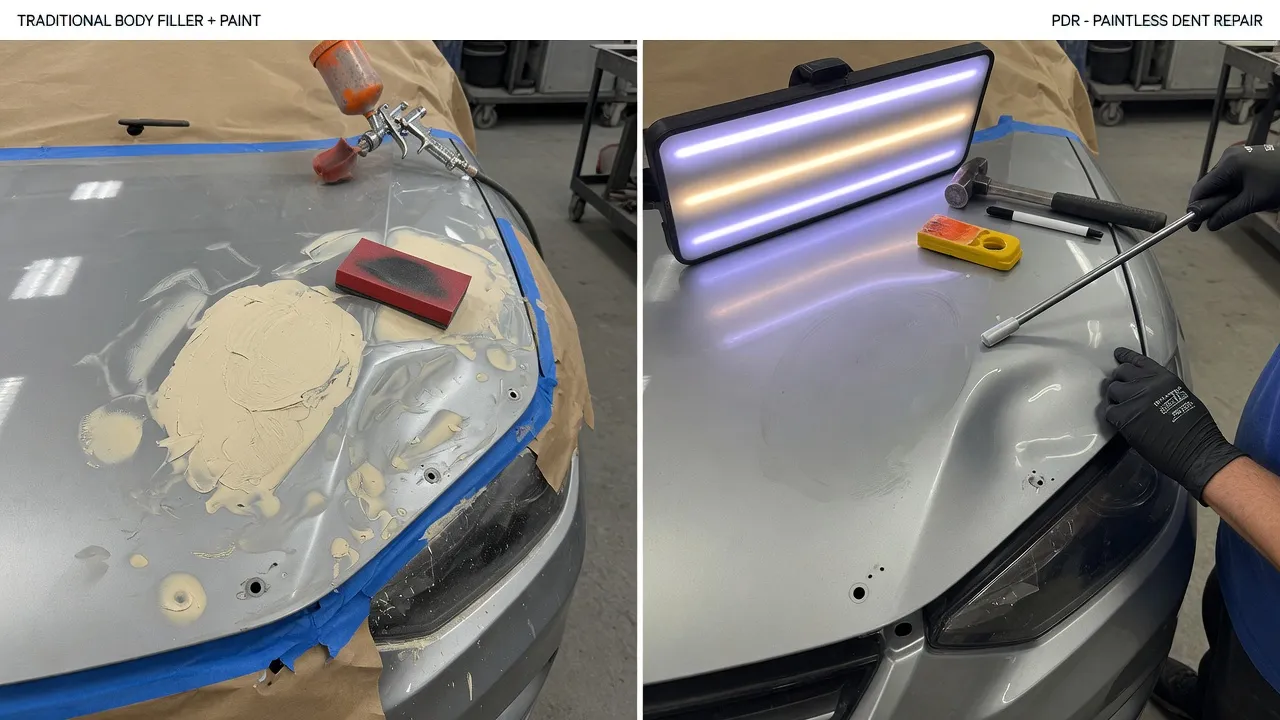
Paintless dent repair (PDR) is the preferred method for hail damage when it qualifies. A PDR technician accesses the back side of each dented panel and uses long metal rods, combined with specialized lighting to see the surface clearly, to push the metal back to its original contour. No filler, no primer, no paint. The factory finish is preserved.
PDR works when:
- The paint surface is not cracked or chipped
- The dents are not excessively deep relative to their diameter
- The damage is on accessible steel or aluminum panels (not composite materials)
- No previous body filler exists in the affected areas
For most hail events, PDR is possible. Hailstones create many shallow, rounded dents rather than the sharp creases caused by collisions. That shape is exactly what PDR handles well.
Traditional body repair involves grinding damaged areas, applying body filler to smooth the surface, sanding, priming, and repainting the affected panels. It's necessary when the paint is broken, when dents are too sharp or deep for PDR, or when a panel has prior repairs that prevent PDR access.
The cost difference is real:
| Damage Level | PDR Cost Range | Traditional Repair Cost Range |
|---|---|---|
| Light (under 50 dents) | $1,000–$2,500 | $2,500–$5,000 |
| Moderate (50–100 dents) | $2,500–$4,500 | $4,500–$8,000 |
| Severe (100+ dents) | $4,000–$7,000 | $7,000–$12,000+ |
PDR saves 40% to 60% compared to traditional repair for equivalent hail damage. It also takes less time: two to five business days for PDR versus one to two weeks for traditional work requiring paint.
The other big advantage of PDR is paint preservation. Repainted panels can be identified by used car buyers and detract from resale value. Panels repaired with PDR retain their factory finish, which holds resale value better.
When evaluating any shop for hail repair, ask specifically whether the damage qualifies for PDR and what percentage of the repair will use PDR versus traditional methods. A shop that defaults to traditional repair on damage that qualifies for PDR either lacks PDR staff or is maximizing the claim value at the car owner's long-term expense.
For more detail on the paintless dent repair process, including how to evaluate whether a repair was done correctly, see our full PDR guide.
How to find the best body shop for hail damage in your area
Not every chain location is equal, even within the same brand. When evaluating any body shop for hail damage specifically, these factors separate storm-ready shops from shops that just happen to accept hail claims:
PDR technician count. Ask directly: how many PDR technicians currently work at this location? One or two PDR techs at a shop taking on large storm volume means long delays. Five or more PDR techs indicates a shop that has invested in storm capacity.
Storm volume history. Ask how many hail claims the shop handled in the last major storm event in the area. A shop that processed 200 vehicles in the last storm season has systems for managing high volume. A shop that handled 20 does not.
Insurance experience on hail claims. Comprehensive coverage claims for hail damage move differently through insurer workflows than collision claims. Shops with storm experience have established contacts and processes for getting approvals and supplements moving quickly. Ask whether the shop handles supplements in-house or requires the car owner to be involved.
Turnaround time transparency. Get a specific estimate, in business days, before dropping off the vehicle. During active storm season, honest shops will tell you they're four to five weeks out. That's useful information. A shop that vaguely promises "we'll get to it soon" hasn't earned the commitment.
PDR certification. The National Paintless Dent Repair Association (NAPDRA) and PDR Nation offer technician certifications. Not all good PDR techs are certified, but certification indicates formal training investment. Shops staffed by I-CAR Gold Class certified technicians have also met industry training standards for collision repair broadly.
Warranty terms. Any reputable shop should provide a written warranty on PDR work. Most major chains offer lifetime warranties on workmanship.
Insurance considerations for hail damage
Hail damage runs through comprehensive coverage, not collision coverage. That's an important distinction for deductible purposes, since many car owners carry a lower deductible on comprehensive than on collision.
According to 2026 data from CCC Intelligent Solutions, the average repair cost for storm damage is $4,818. Supplement requests — which happen when the initial insurance estimate doesn't cover the full repair cost after the shop does a detailed assessment — occur on roughly 63% of storm damage claims. That's a high rate, and it means car owners should understand the supplement process before repairs begin.
The supplement process works like this: the insurance company issues an initial estimate based on a visual inspection, often without the vehicle being disassembled. Once the shop begins work and removes panels, additional damage is frequently found. The shop documents the additional damage and submits a supplement to the insurer for approval. This process can add days to the repair timeline if the shop isn't experienced at getting supplements approved quickly.
A few rights worth knowing:
- Car owners have the right to choose any body shop for insurance-covered repairs, regardless of what the insurer suggests
- If the insurance estimate is below what the repair actually costs, the shop files a supplement and the insurer is generally obligated to cover the full cost of a reasonable repair
- Some states require insurers to use OEM parts unless the car owner agrees otherwise in writing
For a full walkthrough of how the insurance supplement process works on hail claims, including how to avoid delays, see our dedicated guide.
Also consider whether filing a claim makes sense based on your deductible and the extent of the damage. For light hail damage under $1,000, the out-of-pocket cost may be close enough to the deductible that paying directly and skipping the claims process is worth it. For moderate-to-severe damage in the $2,500-plus range, filing under comprehensive is almost always the right call.
For a complete overview of the insurance claims process for auto body work, including documentation steps and how to dispute a low estimate, see our insurance claims guide.
Regional breakdown: chains by hail-prone market
Hail season runs April through September in the central US, with peak activity in May and June, according to NOAA severe weather data. These states account for most auto hail claims each year:
Texas. The highest-volume hail state in the country. The Dallas-Fort Worth and San Antonio metros are the most active markets. CARSTAR, Caliber, and Crash Champions (with its Service King legacy shops) all have strong presence here. For car owners in Texas, the deciding factor is usually which specific location has current capacity, not which brand to choose. Find auto body shops in Texas to compare local options.
Colorado. The Denver metro and Front Range corridor see some of the most destructive hail storms in the country, with golf ball-sized or larger hail hitting vehicles in many years. CARSTAR has a strong presence here, and several independent PDR-specialist shops operate specifically because of storm volume. Body shops in Colorado range from national chains to storm-specialist independents.
Oklahoma and Kansas. Both states see frequent hail activity. Chain coverage is thinner here than in Texas, which sometimes means longer waits at chain locations during active storm seasons. Independent PDR shops pick up a lot of volume in these markets.
Midwest (Missouri, Nebraska, Iowa, Illinois). Storm frequency is lower than the southern plains but still meaningful. Caliber has the strongest chain presence across these states. During storm surges, Caliber's catastrophe response program can help route vehicles to less-backlogged locations.
For car owners wondering whether a large chain or a local independent PDR specialist is the better choice for hail damage, the answer depends on the specific situation. On the question of whether Maaco handles hail damage well, the answer is that Maaco's model is generally not built around PDR-intensive storm work; that article covers the tradeoffs in more detail.
Frequently asked questions
Which chain is the best body shop for hail damage overall?
No single chain is definitively best. CARSTAR has the most deliberate focus on storm markets and has built its network specifically in hail-prone areas. That said, individual location quality matters more than brand. The best choice is the local chain location — regardless of brand — that has current PDR capacity, storm experience, and the shortest realistic turnaround time for the level of damage.
How long does hail damage repair take at a major chain?
It depends on damage severity and storm season timing. Light hail damage using PDR typically takes two to five business days at a well-staffed shop. Moderate damage takes five to 10 business days. Severe damage requiring some traditional repair can take two to three weeks. During active storm season, all of these timelines stretch because shops are handling surge volume. Add three to seven business days to any estimate if a storm just hit your area.
Does hail damage have to go through insurance?
No. Car owners can pay for hail damage repair out of pocket, which makes sense when the damage is minor enough that the repair cost is close to or below the comprehensive deductible. For damage above $1,500 to $2,000, filing under comprehensive coverage is typically the right financial call.
What questions should I ask a shop before dropping off my hail-damaged car?
Ask: How many PDR technicians do you currently have on staff? What percentage of this repair do you expect to do with PDR versus traditional bodywork? What is your current realistic turnaround time? Do you handle insurance supplement requests directly, or will I need to be involved? Do you offer a written warranty on PDR work? The answers reveal quickly whether the shop has genuine storm experience.
Can all hail damage be repaired with PDR?
Not all damage qualifies for PDR. If the paint is cracked or chipped, traditional repair is required for those areas. Very deep or sharp dents, dents near body-line creases, and panels made of non-metal materials (fiberglass, carbon fiber) can't be repaired with PDR. For most passenger vehicles with typical hail damage from average-sized hailstones, the majority of dents will qualify for PDR, but most vehicles have at least some areas requiring traditional repair as well.
Does PDR affect the car's paint warranty or resale value?
PDR preserves the factory paint finish. Because no repainting occurs, the original paint warranty terms aren't affected, and the vehicle's appearance at resale is indistinguishable from pre-damage condition when PDR is done well. That's one of PDR's biggest advantages over traditional body repair, where repainted panels can often be spotted on inspection and may lower perceived resale value.
Key takeaways
Finding the best body shop for hail damage requires looking past the brand name and evaluating the specific location's capability. The most important factors are PDR technician depth, storm volume experience, and current turnaround time.
Among the major chains, CARSTAR has the most deliberate storm-market focus, with a network built around hail-prone states and organized storm response capability. Caliber Collision's catastrophe response program and broad national footprint make it a reliable option in markets where CARSTAR has limited presence. Crash Champions locations with Service King histories in Texas and the southern plains retain meaningful storm-specific experience.
On the repair method: ask for PDR wherever the damage qualifies. The cost savings of 40% to 60% compared to traditional repair, combined with factory paint preservation, make PDR the right call for most hail damage situations.
During hail season, turnaround times stretch at every shop. Getting a realistic timeline estimate upfront, understanding the supplement process, and documenting damage thoroughly before dropping off the vehicle all protect the car owner's interests throughout the repair.
Car owners who want to compare hail damage repair options, understand paintless dent repair in more detail, or find shops offering collision repair in their area can browse by service or location through the AutoBodyShopNear.com directory.
Insurance processes and costs vary by carrier, policy, and state. Consult your specific policy for coverage details. Repair cost ranges reflect 2026 national averages and will vary by geographic market, vehicle type, and damage severity.