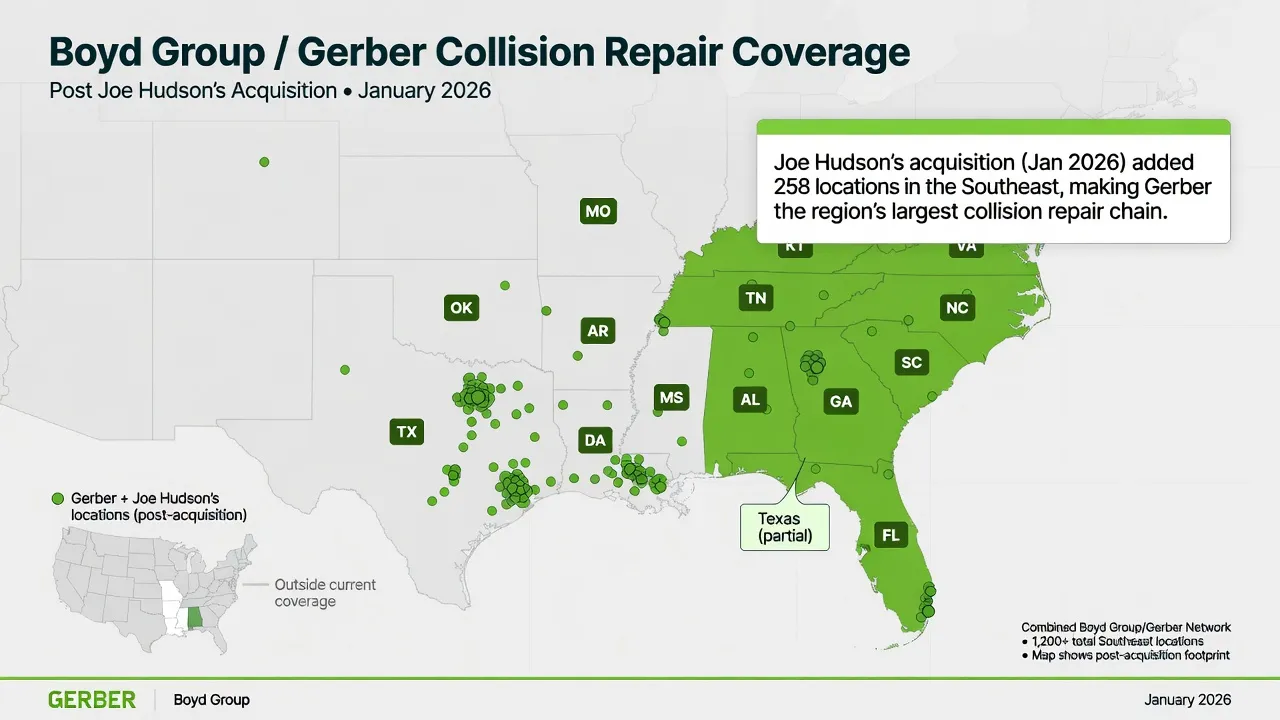
This Gerber Collision review covers what matters most to car owners: repair quality, warranty terms, how insurance claims work at their shops, and whether the chain is worth choosing in 2026. Gerber Collision & Glass became a much larger company in January 2026, when Boyd Group — the Canadian public company that owns and operates the chain — completed its $1.3 billion acquisition of Joe Hudson's Collision Centers. That deal added 258 locations across the Southeast United States overnight. The combined network now stands at 1,301 shops, making Gerber the second-largest corporate-owned collision repair chain in the country, behind only Caliber Collision. For a direct head-to-head, see our Gerber vs. Caliber Collision comparison.
For car owners, that growth matters in two ways. First, there's a reasonable chance a Gerber location is now closer to you than it was a year ago, particularly if you live in Alabama, Georgia, Tennessee, the Carolinas, or elsewhere in the Southeast. Second, it raises the practical question this review addresses: is Gerber Collision & Glass actually a good place to have your car repaired?
This review covers Gerber's services, pricing structure, warranty, insurance partnerships, geographic strengths and gaps, and an honest look at what customers actually report. It also explains what the Joe Hudson's acquisition means for car owners who may be seeing newly rebranded Gerber locations in their area.
For context on how Gerber fits among all the major national chains, see our complete comparison of auto body shop chains.
What Gerber Collision & Glass is — and who owns it
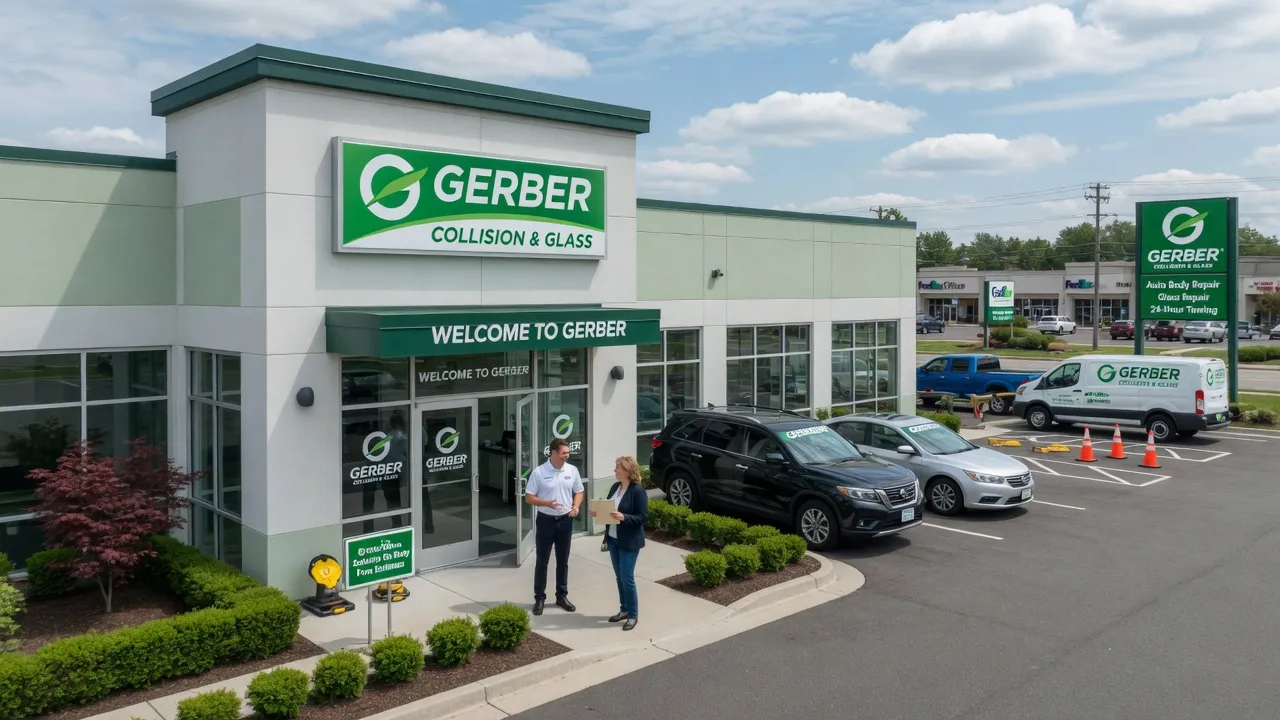
Gerber Collision & Glass is a corporate-owned collision repair chain founded in 1947 and headquartered in Elmhurst, Illinois. It's operated under Boyd Group Services Inc. since 2004, when the Canadian company acquired the brand as part of its U.S. expansion strategy.
Boyd Group (ticker: BYD on the Toronto Stock Exchange, and now also NYSE-listed following a 2026 U.S. equity offering) is a publicly traded company with a straightforward business model: acquire and operate collision repair shops under a centralized management structure. Unlike franchise models — where individual owners set their own standards — all Gerber locations run as corporate-owned shops, which means standardized training programs, centralized quality protocols, and consistent estimating systems across the network.
This corporate ownership structure matters for car owners evaluating the chain. Quality consistency is generally higher at corporate-owned chains than at franchise networks, because corporate chains have the authority and financial incentive to enforce standards across every location. A Gerber shop in Michigan and a Gerber shop in Florida are operating under the same management framework, training requirements, and warranty program.
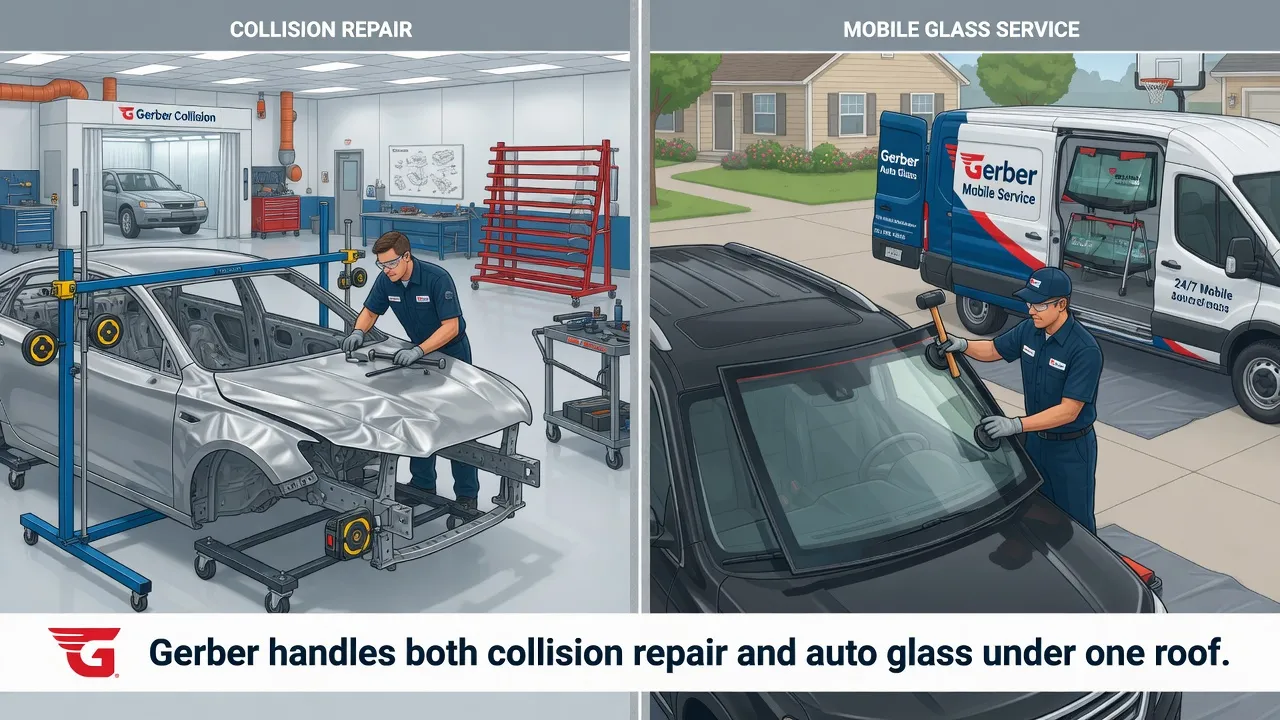
Gerber's dual-service identity — collision repair and auto glass — sets it apart from competitors like Caliber Collision, which focuses exclusively on collision repair. The ability to handle both body damage and windshield replacement under one roof matters when an insurance claim involves both types of damage, which is a common scenario in accidents.
The January 2026 Boyd Group/Joe Hudson's acquisition: what changed for customers
On January 9, 2026, Boyd Group completed its $1.3 billion acquisition of Joe Hudson's Collision Centers (JHCC Holdings), adding 258 locations across 18 states to its network. Joe Hudson's had been a Southeast-focused chain — strong in Alabama, Mississippi, Georgia, Tennessee, the Carolinas, and Texas — and had been backed by private equity firm TSG Consumer Partners.
The acquisition makes Gerber the dominant collision repair provider in the Southeast, a region where it previously ranked a distant second to Caliber Collision. From Boyd's perspective, the geographic fit was strong: Gerber's historical strength in the Midwest and Northeast now combines with Joe Hudson's Southeast footprint to create broader national coverage.
What this means for customers who used Joe Hudson's shops:
Locations that were previously branded as Joe Hudson's Collision Centers have been or are being rebranded as Gerber Collision & Glass. In most cases, the staff at those locations remains the same — Boyd Group's typical acquisition approach involves retaining existing technicians and service managers rather than replacing them. For customers with established relationships at a particular shop, the rebranding is primarily cosmetic.
A few operational changes do accompany the transition:
- Warranty: Repairs completed going forward fall under Gerber's National Lifetime Guarantee (described in detail below), rather than whatever warranty Joe Hudson's offered at that location.
- Insurance coordination: Gerber operates as a Direct Repair Program (DRP) partner for most major insurers. Joe Hudson's had its own DRP relationships; those are now being migrated to Gerber's agreements. There may be a brief transition period during which a specific location's DRP status with a particular insurer is being updated.
- Estimating systems: Gerber uses CCC One as its primary estimating platform, the same system used by most major insurers' adjusters. Joe Hudson's locations transitioning to Gerber's systems are adopting this standardized platform.
The most relevant fact for car owners in the Southeast: if you had a good experience at a Joe Hudson's location and you're now seeing a Gerber sign at that address, the repair team you trusted is likely still there.
Gerber Collision & Glass services: what they offer
Gerber's service offering covers two main categories, which distinguishes it from chains that do only one.
Collision repair
Gerber provides full-service collision repair, covering the range of damage that results from accidents:
- Auto body repair: Panel replacement and repair, dent removal, structural repairs
- Frame and structural repair: Unibody alignment and straightening for vehicles with structural damage (note: "frame" and "unibody" are different structural systems, but both involve computerized measuring equipment to verify correct geometry)
- Paint and refinishing: Color matching, panel painting, blending to match surrounding panels
- Paintless Dent Repair (PDR): A method of removing dents without repainting by manipulating the metal from behind the panel — faster and less expensive than traditional repair when the paint is undamaged
- Hail damage repair: Both PDR and traditional repair for storm-related dents
- Mechanical repairs related to collision damage: Suspension components, cooling systems, and other mechanical systems damaged in accidents (Gerber doesn't perform general mechanical maintenance — oil changes, routine tune-ups, and similar services are outside their scope)
Gerber's technicians hold I-CAR and ASE (Automotive Service Excellence) certifications. I-CAR (Inter-Industry Conference on Auto Collision Repair) certification indicates formal training in collision repair techniques; ASE certification covers a broader range of automotive service skills. Both are industry-standard credentials that confirm a technician has completed verified training rather than learning exclusively on the job.
Auto glass repair and replacement
Gerber's auto glass repair services include:
- Windshield chip repair: Resin injection into small chips to prevent crack propagation — typically takes 30 minutes and can often be done at the customer's location through mobile service
- Windshield replacement: Full replacement for cracked or severely damaged windshields
- Side and rear glass replacement: Door glass, rear windshields, and quarter glass
- Mobile glass service: Gerber's glass technicians can come to a customer's home or workplace at no additional charge for glass-only repairs that don't require shop equipment
Glass technicians are certified to National Glass Association (NGA) and Automotive Glass Replacement Safety Standards (AGRSS). These certifications are specific to auto glass and cover installation standards that affect windshield structural integrity — an important safety consideration given that windshields contribute to the roof crush resistance of modern vehicles.
A critical detail for 2019 and newer vehicles: Modern windshields frequently house Advanced Driver Assistance System (ADAS) sensors — the cameras and radar units that power lane departure warnings, automatic emergency braking, and adaptive cruise control. ADAS sensors embedded in or behind the windshield must be recalibrated after windshield replacement to function correctly. Car owners replacing a windshield in a recent-model vehicle should confirm with any shop — including Gerber — whether ADAS recalibration is included or requires a separate appointment.
Gerber's warranty: what the National Lifetime Guarantee actually covers
Gerber offers what it calls a National Lifetime Guarantee on repairs, and understanding exactly what this covers — and what it doesn't — matters before authorizing any work.
What is covered:
Gerber guarantees all collision repairs against defects of workmanship for as long as the original customer owns the vehicle. For auto glass, the warranty covers air leaks, water leaks, defective materials, and defective workmanship for the same ownership period.
If a warranty issue arises, Gerber will replace faulty parts and perform the necessary work to restore the vehicle to pre-accident condition at no cost to the customer.
What is explicitly excluded:
The warranty does not cover:
- Rust or corrosion (unless rust was caused by faulty workmanship — typically difficult to prove)
- Damage from subsequent accidents or collisions
- Theft or vandalism
- Stone chips or scratches from road debris
- Damage from improper maintenance
The ownership transfer limitation:
The National Lifetime Guarantee is tied to the original owner's ownership of the vehicle. If the car is sold, the warranty doesn't transfer to the new owner. This means a car owner planning to sell a repaired vehicle shouldn't rely on the Gerber warranty as a selling point for a future buyer.
Windshield chip repairs:
For windshield chip repairs, if the repair doesn't hold satisfactorily, Gerber credits the cost of the chip repair toward the full cost of a windshield replacement. This is standard practice in the glass repair industry.
Comparison note: Caliber Collision also offers a lifetime warranty on all repairs, with similar ownership-based terms. CARSTAR's warranty structure varies by location due to the franchise model. For car owners comparing Gerber's warranty to competitors, the lifetime, ownership-based coverage is industry-standard among the major corporate-owned chains.
Insurance and DRP partnerships: how Gerber fits into the claims process
Gerber Collision & Glass operates as a Direct Repair Program (DRP) partner for most major insurance companies. Understanding what this means helps car owners handle the claims process more confidently.
A Direct Repair Program (DRP) is a contractual arrangement between an insurance company and a body shop. The insurer designates the shop as a preferred or approved repair facility, and in exchange, the shop agrees to certain terms — typically including streamlined claims handling, volume commitments, and sometimes pricing concessions. The insurer benefits from faster claims processing and predictable costs; the shop benefits from a steady flow of insurer-referred customers.
Gerber's specific DRP program is called Gerber Platinum Solutions, and it covers the services and workflow the company provides to insurance partners. Through this program, Gerber handles the following on behalf of the customer and insurer:
- Direct electronic communication with the insurance adjuster
- Supplement filing when additional damage is discovered during repair
- Rental car coordination (Gerber arranges the rental at drop-off for covered repairs)
- Electronic repair status updates to both the customer and insurer
What DRP status means for car owners:
At Gerber, DRP status means the insurance company's adjuster and Gerber's estimator have an established working relationship, which typically reduces the back-and-forth that can slow repairs. For straightforward insurance-covered collision repairs, this is genuinely convenient.
The trade-off — which applies to all DRP shops — is that DRP agreements sometimes include terms about parts sourcing. Specifically, whether the insurer can direct the shop to use aftermarket (non-OEM) parts rather than original equipment manufacturer (OEM) parts. OEM parts are produced by the vehicle's original manufacturer and are guaranteed to fit; aftermarket parts are produced by third parties and may vary in fit quality.
Car owners have the right to request OEM parts and to choose any repair facility. Insurance companies can recommend a DRP shop, but can't require car owners to use one. If a customer prefers OEM parts, that preference should be stated in writing at estimate time. Many states have laws requiring insurers to disclose when aftermarket parts are used.
For a detailed explanation of how DRP arrangements work and what consumer rights apply, see our guide on what DRP body shops are and how they affect your repair.
Geographic coverage: Gerber's strengths and gaps
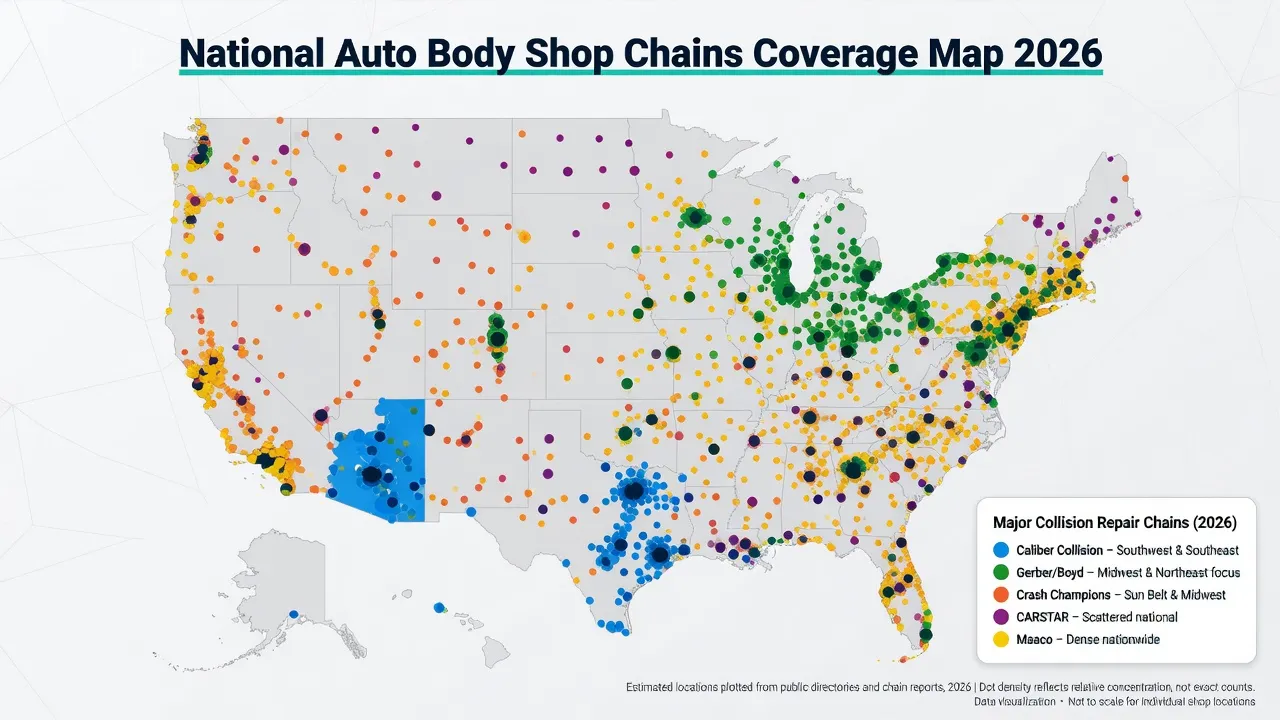
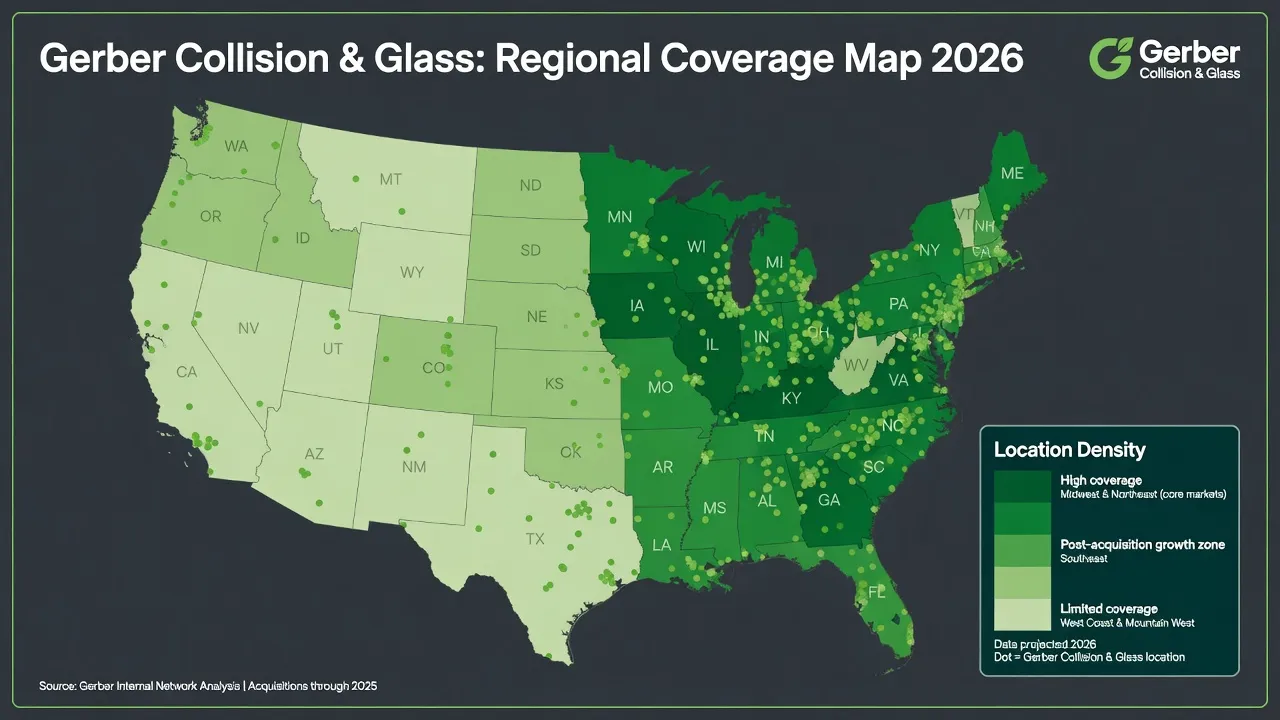
With 1,301 locations post-acquisition, Gerber's coverage is genuinely broad — but not evenly distributed. Knowing where Gerber is strongest helps car owners set realistic expectations about whether a Gerber shop will be a convenient option in their market.
Gerber's strongest markets (highest location density):
- Midwest: Michigan, Illinois, Indiana, Ohio, Minnesota, Wisconsin — Gerber's historical home market, with dense urban and suburban coverage in cities like Chicago, Detroit, Minneapolis, and Columbus
- Northeast: Pennsylvania, New York, New Jersey, Connecticut — solid coverage in a region where Caliber Collision has historically been thinner
- Southeast (post-acquisition): Alabama, Georgia, Tennessee, Mississippi, the Carolinas — now Gerber's highest-growth region, with 258 freshly acquired Joe Hudson's locations
- Mid-Atlantic: Virginia, Maryland, North Carolina — moderate coverage
Markets with thinner Gerber presence:
- West Coast: Caliber Collision and Fix Auto dominate California, Oregon, and Washington, where Gerber has limited locations
- Mountain West: Colorado, Utah, Nevada — CARSTAR has stronger presence in storm-prone Mountain West markets
- Southwest: Arizona, New Mexico — Caliber Collision is the dominant corporate chain here
Car owners in the Midwest or Northeast searching for collision repair near them are more likely to find a Gerber location convenient than car owners in California or Arizona, where Caliber Collision is the larger corporate-owned presence.
What customers actually say: an honest review analysis
Gerber's customer reviews present a mixed picture that reflects a pattern common to large corporate chains: most customers report satisfactory or positive experiences, but a meaningful minority report issues ranging from communication problems to workmanship quality concerns.
What customers consistently praise
Across Gerber's own feedback platform and third-party review sources, the following themes appear most frequently in positive reviews:
Insurance and rental coordination: Customers regularly cite the smooth handling of insurance communication and rental car logistics as a genuine stress-reducer. For car owners who've never navigated a collision claim, having the shop handle the insurer communication directly saves time and reduces anxiety.
Repair quality on standard work: For typical collision repairs — bumper replacements, panel repairs, paint matching — many customers report results that met or exceeded their expectations. Paint color matching in particular receives positive mentions.
Staff professionalism: Service advisors at many locations receive praise for keeping customers informed, explaining the repair process, and following up proactively.
Recurring complaints
The more critical reviews cluster around several consistent themes:
Communication failures: The most common complaint across Gerber reviews involves poor communication during repairs — customers not receiving updates, estimated completion dates that slip without notification, and difficulty reaching their location by phone. This is a process complaint rather than a workmanship complaint, but it's the most consistent negative pattern.
Extended timelines: Connected to communication issues, some customers report vehicles taking significantly longer than estimated, sometimes by weeks. This is partly attributable to parts availability challenges that affect the entire collision repair industry, but customers report Gerber doesn't always communicate proactively when delays occur.
Parts sourcing disputes: Some customers report disputes over aftermarket versus OEM parts, particularly in insurance-directed repairs. Car owners who specifically requested OEM parts sometimes report that aftermarket parts were used without notification.
Location-to-location variability: Multiple reviews across platforms note that a positive experience at one Gerber location didn't predict a positive experience at another. This is less common at corporate-owned chains than at franchise operations, but the size of Gerber's network means individual location management quality still plays a meaningful role.
What the ratings show in context: On independent platforms that aggregate consumer complaints, Gerber's ratings skew negative (around 1.8 out of 5 on aggregators like SmartCustomer, where dissatisfied customers are disproportionately motivated to write reviews). On Gerber's own feedback platform, ratings are overwhelmingly positive — reflecting a self-selection bias in company-curated reviews. The realistic picture sits somewhere between these extremes. For most straightforward insurance-covered collision repairs, Gerber delivers adequate to good work. For complex repairs, older vehicles, or situations where OEM parts are important, the experience varies more by location.
Gerber Collision pricing: what to expect
Gerber doesn't publish standard pricing, which is consistent with every major auto body chain. Collision repair costs depend on too many variables — damage severity, vehicle make and model, parts availability, labor rates in the local market — to quote a meaningful average without seeing the vehicle.
That said, knowing the cost factors that apply to Gerber's repairs helps car owners evaluate estimates:
Labor rates: Gerber's labor rates are generally at or near industry average for corporate-owned chains in a given market. Rates in major metros like Chicago, New York, and Detroit will be 30–50% higher than in smaller markets in the same region, reflecting local labor market conditions. Car owners in Chicago or New York City should expect correspondingly higher estimates.
Parts sourcing: As a DRP shop, Gerber may use aftermarket parts on insurance-covered repairs unless OEM parts are requested and authorized. OEM parts typically cost 20–40% more than aftermarket equivalents. For a vehicle under five years old or one where maintaining resale value matters, requesting OEM parts is worth considering.
Glass pricing: Windshield replacement pricing depends on whether the glass has embedded ADAS sensors. A standard replacement may cost $300–$600; a windshield with embedded camera systems, lane departure sensors, or heads-up display components can cost $600–$1,500 or more, with ADAS recalibration adding $150–$400 on top of the glass cost.
Insurance deductibles: For insurance-covered repairs, car owners pay their deductible and Gerber bills the remainder to the insurer. Gerber doesn't waive deductibles — any shop that offers to waive an insurance deductible is engaged in a practice that's illegal in most states.
| Repair Type | Typical Cost Range | Notes |
|---|---|---|
| Minor dent / panel repair | $300–$800 | PDR may apply if paint is undamaged |
| Bumper repair/replacement | $500–$1,500 | Sensor recalibration additional if applicable |
| Single panel repaint | $800–$1,800 | Includes blending adjacent panels |
| Major collision (multi-panel) | $2,500–$8,000+ | Depends on structural damage |
| Windshield replacement (non-ADAS) | $300–$600 | Mobile service available |
| Windshield replacement (ADAS sensor) | $600–$1,500+ | ADAS recalibration additional |
| Hail damage repair (moderate) | $1,500–$4,000 | PDR preferred method when possible |
These ranges reflect 2026 national averages. Actual estimates will vary based on vehicle specifics, damage extent, geographic market, and parts sourcing decisions.
Gerber Collision vs. Caliber Collision: key differences
The two most direct competitors in the corporate-owned collision repair space are Gerber and Caliber Collision. Car owners who have both nearby often ask how to choose. The differences are real but narrower than marketing materials suggest.
| Factor | Gerber Collision & Glass | Caliber Collision |
|---|---|---|
| Locations | 1,301 | 1,863 |
| Geographic strength | Midwest, Northeast, Southeast | Southwest, Southeast, nationwide |
| Auto glass services | Yes — included service | No — collision only |
| Ownership model | Corporate (Boyd Group) | Corporate |
| Warranty | National Lifetime Guarantee | Lifetime warranty |
| DRP partnerships | Major insurers (Gerber Platinum Solutions) | Major insurers |
| ADAS recalibration | Available at most locations | Available at most locations |
| EV specialty program | Limited | Limited |
| Best for | Combined collision + glass claims; Midwest/Northeast customers | Pure collision repair; Southwest/nationwide coverage |
The most practical differentiator is geography and the glass service combination. If the insurance claim involves windshield damage alongside body panel damage — a common scenario — Gerber's ability to handle both under one roof simplifies coordination. For pure collision repair in markets where both chains have strong coverage, the choice often comes down to which specific location has better recent reviews and shorter current lead times.
For a broader comparison including Crash Champions, CARSTAR, and other chains, see our full auto body shop chains comparison. For the side-by-side comparison of Caliber and Crash Champions — including how they both stack up against Gerber — see our Caliber Collision vs. Crash Champions: 2026 guide. If Crash Champions is your other option, see our Gerber vs. Crash Champions comparison.
How to evaluate a specific Gerber location before committing
The variability in customer experiences across Gerber locations means evaluating the specific shop — not just the brand — is essential. Gerber's corporate standards set a floor, but individual location management and staffing quality still determine the actual experience.
Before scheduling a repair at any Gerber location:
-
Search Google reviews for that specific address. Filter to reviews from the past six months. Look for patterns in complaints — if multiple recent reviews mention communication problems or quality issues, that reflects the current management team rather than the brand overall. Positive reviews that mention specific staff members by name are a good signal.
-
Confirm the location's DRP status with your insurer. Call your insurance company and verify that the specific Gerber location is in their DRP network. This matters for smooth claims processing. If the location isn't a DRP partner for your insurer, coordination may require more back-and-forth.
-
Ask whether the estimate uses OEM or aftermarket parts. Request this in writing. For vehicles under 5 years old, many car owners prefer OEM parts to ensure quality fit and finish. Many insurers will approve OEM parts when requested; the key is asking before, not after, the repair begins.
-
Ask about ADAS recalibration. If your vehicle is a 2019 model year or newer and either the windshield is being replaced or any front-end structural work is being done, confirm whether ADAS recalibration is included and what equipment the shop uses. Not all locations have in-house ADAS calibration equipment; some sublet this work to specialists.
-
Confirm completion timeline in writing. At drop-off, ask the service advisor for an estimated completion date and request that they contact you proactively — not just when the vehicle is ready, but if the timeline changes by more than one business day.
-
Get the warranty terms in writing. Gerber's National Lifetime Guarantee is standard, but getting written confirmation of the repairs covered at that visit protects the customer if a warranty dispute arises later.
For a complete step-by-step framework that applies to any chain — not just Gerber — see our guide on how to get the best repair at any auto body shop chain.
Pros and cons of Gerber Collision & Glass
Strengths:
- Combined collision and glass services: The ability to handle body damage and windshield replacement together is a real convenience advantage, particularly for insurance claims that involve both
- Corporate-owned quality standards: Centralized management produces more consistent results than franchise models
- National Lifetime Guarantee: Ownership-based lifetime warranty is industry-competitive and provides meaningful protection for retained vehicles
- DRP partnerships streamline claims: Insurance coordination through Gerber Platinum Solutions reduces friction for standard insurance-covered repairs
- Strong Midwest and Northeast coverage: Customers in these regions have consistently dense Gerber access
- Technician certifications: I-CAR and ASE certifications at most locations confirm verified training
- Mobile glass service: No-cost mobile windshield work is a practical convenience
Weaknesses:
- Communication inconsistency: The most documented complaint across review platforms involves inadequate communication during repairs — a process issue that individual locations handle differently
- Thin West Coast and Mountain West coverage: Customers in California, Arizona, Colorado, and the Pacific Northwest will find limited Gerber options
- Post-acquisition integration variability: Southeast locations recently transitioned from Joe Hudson's are still completing their integration; experiences may vary during the transition period
- Parts sourcing disputes on insurance claims: Some customers report aftermarket parts being used on insurance-covered repairs when OEM was preferred — requires active management by the customer at estimate time
- Lead time variability: Heavily booked locations, particularly in metro markets, can have multi-week intake lead times
Is Gerber Collision worth using? Key takeaways
For most car owners in the Midwest, Northeast, or Southeast with a standard collision repair covered by insurance, Gerber Collision & Glass is a credible, industry-competitive option. The National Lifetime Guarantee, DRP insurance partnerships, and corporate-owned quality standards put it in the same tier as Caliber Collision for typical collision repair work.
The glass integration is a real differentiator. If a claim involves windshield damage alongside body work, Gerber's ability to manage both in one facility — and coordinate both with the insurer at the same time — simplifies what is otherwise a complicated multi-shop coordination process.
The documented weaknesses — communication inconsistency and post-acquisition variability in Southeast locations — are manageable with proactive steps at drop-off. Setting explicit communication expectations, requesting OEM parts in writing, and confirming ADAS recalibration capability are standard practices that any car owner should follow at any chain, not just Gerber.
The January 2026 Boyd/Joe Hudson's acquisition creates a temporary caveat for Southeast customers: locations recently rebranded from Joe Hudson's are still integrating into Gerber's systems, and the transition period introduces some variability. Checking recent Google reviews for a specific location — filtered to the past six months — is the most reliable way to assess the current quality of a particular shop.
For car owners choosing between Gerber and Caliber Collision where both are available, the decision often comes down to which specific location has stronger recent reviews and whether glass work is part of the claim. Neither brand is uniformly better; individual location quality drives the outcome more than the corporate brand.
Before any major repair: Get a written estimate, confirm parts sourcing preferences, ask about ADAS recalibration if applicable, and set explicit communication expectations. These steps protect car owners at Gerber, Caliber, or any other chain.
To find and compare Gerber Collision locations alongside other options in your area, browse auto body shops near you. Car owners in the Southeast can also browse auto body shops in Georgia or auto body shops in Texas to compare local options including recently rebranded Gerber locations. For a full overview of all the major national chains, see our auto body shop chains comparison guide.
Sources
- I-CAR (Inter-Industry Conference on Auto Collision Repair) — collision repair industry training standards
- NHTSA Vehicle Safety — federal vehicle safety and crashworthiness standards
Frequently asked questions about Gerber Collision & Glass
Does Gerber Collision offer a warranty on repairs?
Yes. Gerber provides a National Lifetime Guarantee on all collision repairs for as long as the original owner keeps the vehicle. The warranty covers defects in workmanship and materials. It doesn't cover rust, subsequent accidents, theft, or improper maintenance. Auto glass replacements are also warranted against air leaks, water leaks, and workmanship defects for the ownership period.
Is Gerber Collision a DRP shop for my insurance company?
Gerber operates as a DRP partner for most major insurance carriers through its Gerber Platinum Solutions program. To confirm whether a specific location participates in your insurer's DRP network, contact your insurance company or ask the specific Gerber location directly. DRP status affects how smoothly the claims coordination process works, but car owners can use any licensed shop regardless of DRP status.
What happened when Boyd Group acquired Joe Hudson's Collision Centers?
Boyd Group — the Canadian public company that operates Gerber Collision & Glass — completed the $1.3 billion acquisition of Joe Hudson's on January 9, 2026. The deal added 258 locations across 18 southeastern states. Former Joe Hudson's locations have been or are being rebranded as Gerber Collision & Glass, typically retaining the existing staff. Car owners who used Joe Hudson's can expect continuity of personnel, with Gerber's warranty program and estimating systems now in place.
How does Gerber Collision compare to Caliber Collision?
Both are corporate-owned chains with lifetime warranties and major insurer DRP partnerships. Gerber's primary advantage is the combination of collision repair and auto glass under one roof, plus stronger coverage in the Midwest and Northeast. Caliber's primary advantage is a larger network (1,863 locations vs. Gerber's 1,301) and denser coverage in the West and Southwest. For a direct comparison, see our full auto body shop chains comparison.
Does Gerber Collision do ADAS recalibration?
ADAS (Advanced Driver Assistance Systems) recalibration is available at most Gerber locations, but equipment and capability vary. For 2019-and-newer vehicles with windshield-mounted cameras, lane departure sensors, or adaptive cruise control components, car owners should ask whether ADAS recalibration is included and whether it's performed in-house or sublet to a third party.
Can I use Gerber Collision without going through insurance?
Yes. Gerber accepts out-of-pocket repairs. Car owners choosing to pay without filing an insurance claim receive the same repair quality and warranty coverage. For smaller repairs — a cracked windshield below the comprehensive deductible, a minor dent, or cosmetic damage — paying out of pocket may make more financial sense than filing a claim and potentially affecting future premiums.
Last updated: June 2026. Costs, locations, and DRP partnerships are subject to change. Always verify current information with your specific Gerber location and insurance carrier.