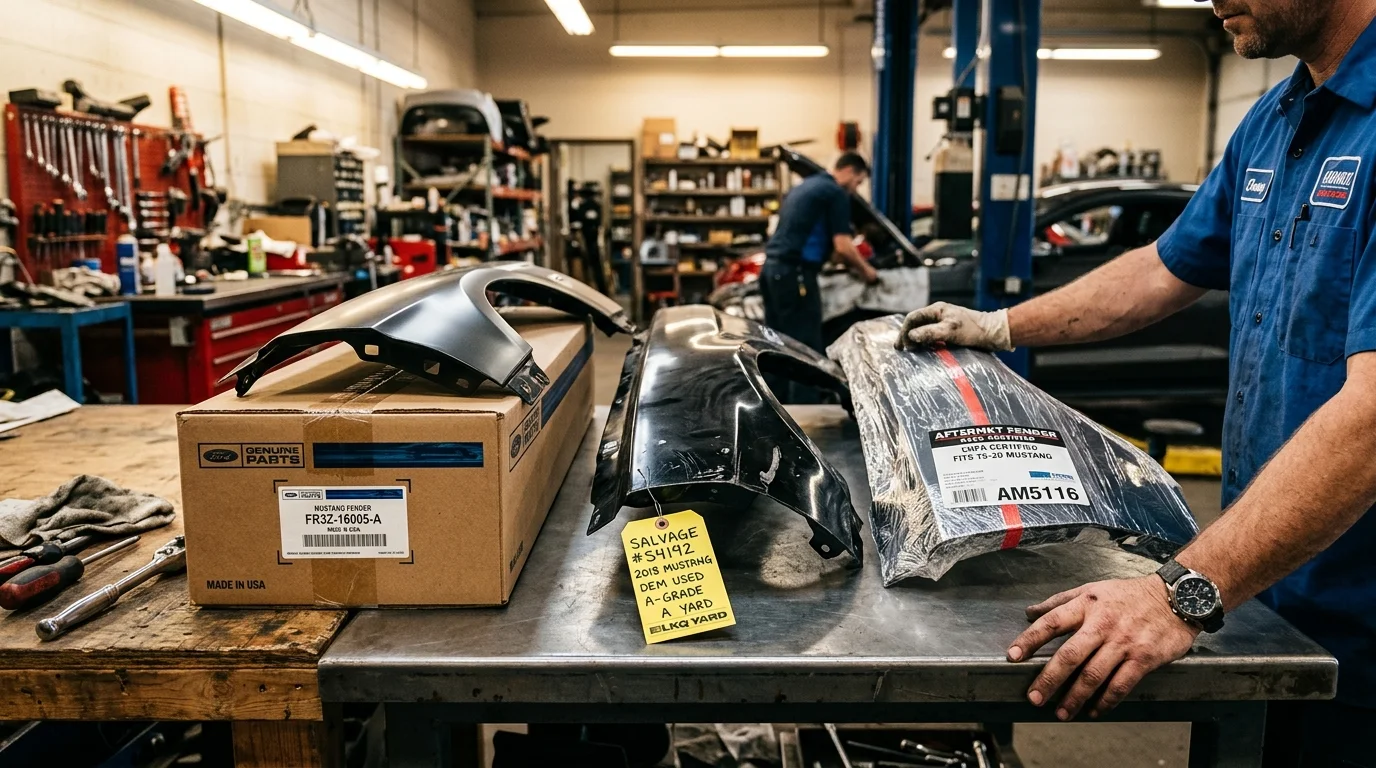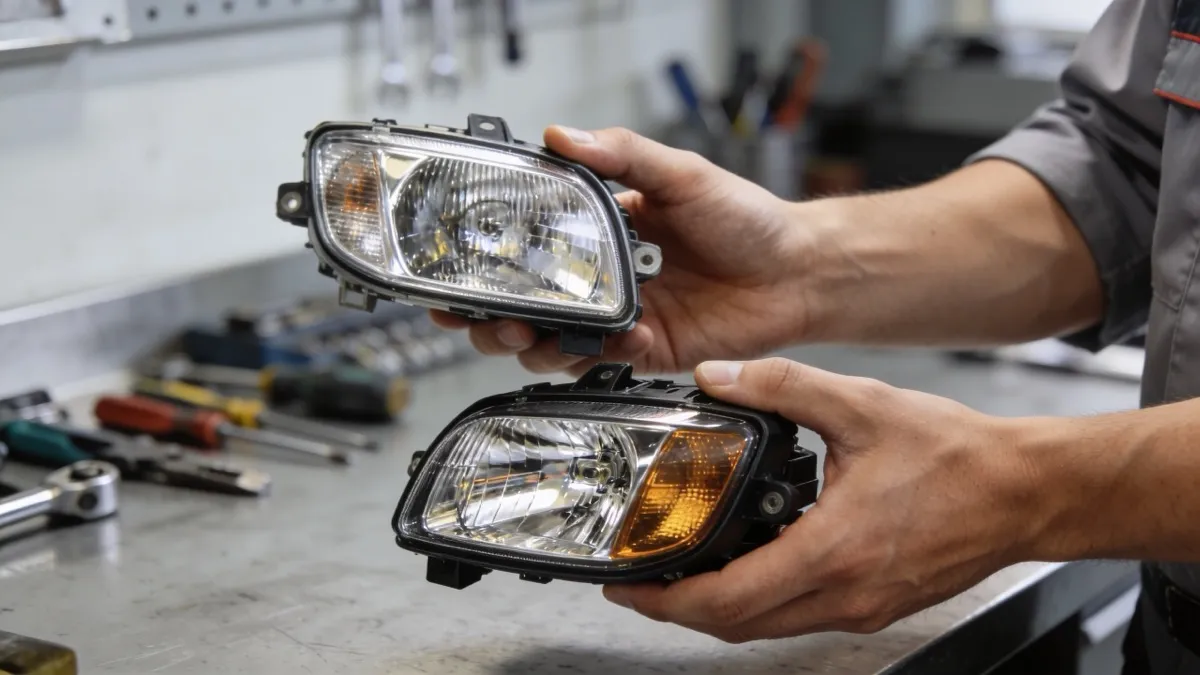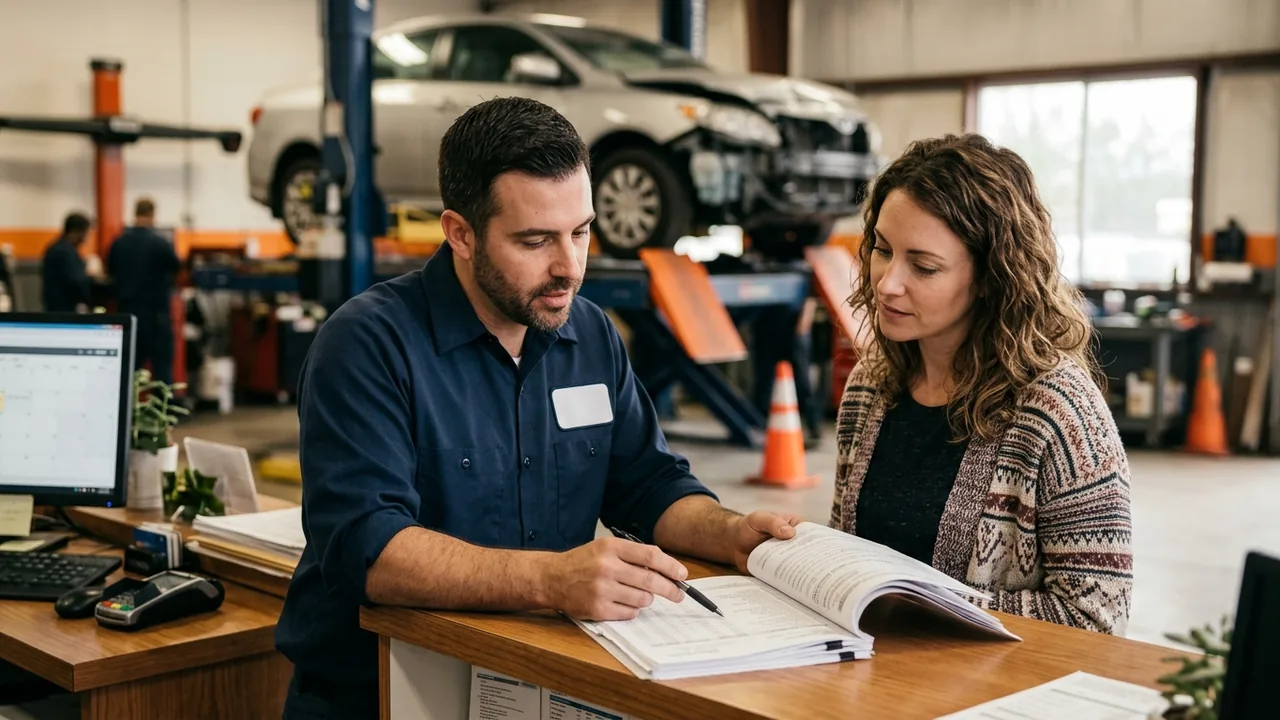
In most states, yes — your auto policy almost certainly gives the insurer the right to specify used or aftermarket parts, and the payout is based on the cheaper part regardless of what you would prefer. What limits that right is state law, not your policy: roughly 31 states require written disclosure when non-OEM parts are specified, a handful require your written consent, and a few bar substitute parts entirely on newer vehicles.
There is a catch almost no consumer article mentions. Most state statutes govern aftermarket crash parts — copies made by third-party manufacturers. A used OEM part pulled from a wrecked car of the same model was made by your automaker, so it often slips outside the definition and the rules never attach. Which category is on your estimate decides which rights you have.
Key Takeaways
- Your policy is the default: insurers pay for parts of "like kind and quality," which usually means used or aftermarket.
- Most state disclosure and consent statutes cover aftermarket parts only. West Virginia's Supreme Court held in 2014 that its crash parts act does not reach recycled OEM parts at all.
- Verified age or mileage limits exist in only a few states: Rhode Island (48 months), New Hampshire (2 years and 30,000 miles), West Virginia (3 model years), Massachusetts (20,000 miles). Texas bars insurers from specifying part condition outright.
- The REPAIR Act is about diagnostic data and tools, not part type — do not cite it in a parts dispute.
- Leverage exists before the parts are ordered, not after a recycled fender is painted and hung.
What your policy actually promises
A standard auto policy promises to restore your vehicle to its pre-loss condition — not to install brand-new factory parts. The obligation is written in terms of value and condition, and the industry phrase for the substitute is "like kind and quality," abbreviated LKQ on estimates.
That discretion gets used. CCC's Crash Course 2026 report put OEM parts at 63.5% of total part replacement dollars in 2025 and aftermarket at 22.7% — a share CCC described as surpassing historical highs — leaving roughly 13.8% for recycled, reconditioned, and optional OE combined. Enlyte's 2026 Trends Report found combined use of aftermarket, recycled, and remanufactured parts rose 1.5% as shops responded to OEM price increases.
None of which makes the substitute part bad — a recycled OEM fender came off the same tooling as the one it replaces, which is why it fits. Our guide to used OEM, aftermarket, and new parts compares the three on quality and OEM vs aftermarket parts in insurance claims covers the estimate side. This article is about who decides.
"Like kind and quality" is a standard, not a specification
No widely adopted regulation defines like kind and quality with any precision. It sets a performance standard — fit, quality, and performance — and leaves the argument to be had case by case.
The language comes from the NAIC's After Market Parts Model Regulation (Model 891), which most states built on. It bars an insurer from requiring aftermarket parts that are not "at least equal in kind and quality to the original part in terms of fit, quality and performance," and requires a disclosure on the estimate in type no smaller than 10 points. It does not say what those three words mean.
Massachusetts is the one state that puts a definition on paper: under 211 CMR 133.04, "a part is of like kind and quality when it is of equal or better condition than the pre-accident part" — tying the standard to your car's actual condition before the crash. Hawaii never defines LKQ but requires the part carry a written guarantee for at least 90 days or the original part's guarantee period, whichever is longer.
Practically, a dispute over a used part is a dispute about condition and documentation. "This door has a crease and surface rust the original didn't have" is an argument that survives; "I don't want a junkyard part" is not.
The gap most articles miss: used parts often aren't covered
State disclosure and consent statutes are written around the term "aftermarket crash part," defined by who manufactured it. A used OEM part was made by the vehicle manufacturer, so it falls outside that definition — and outside the protections.
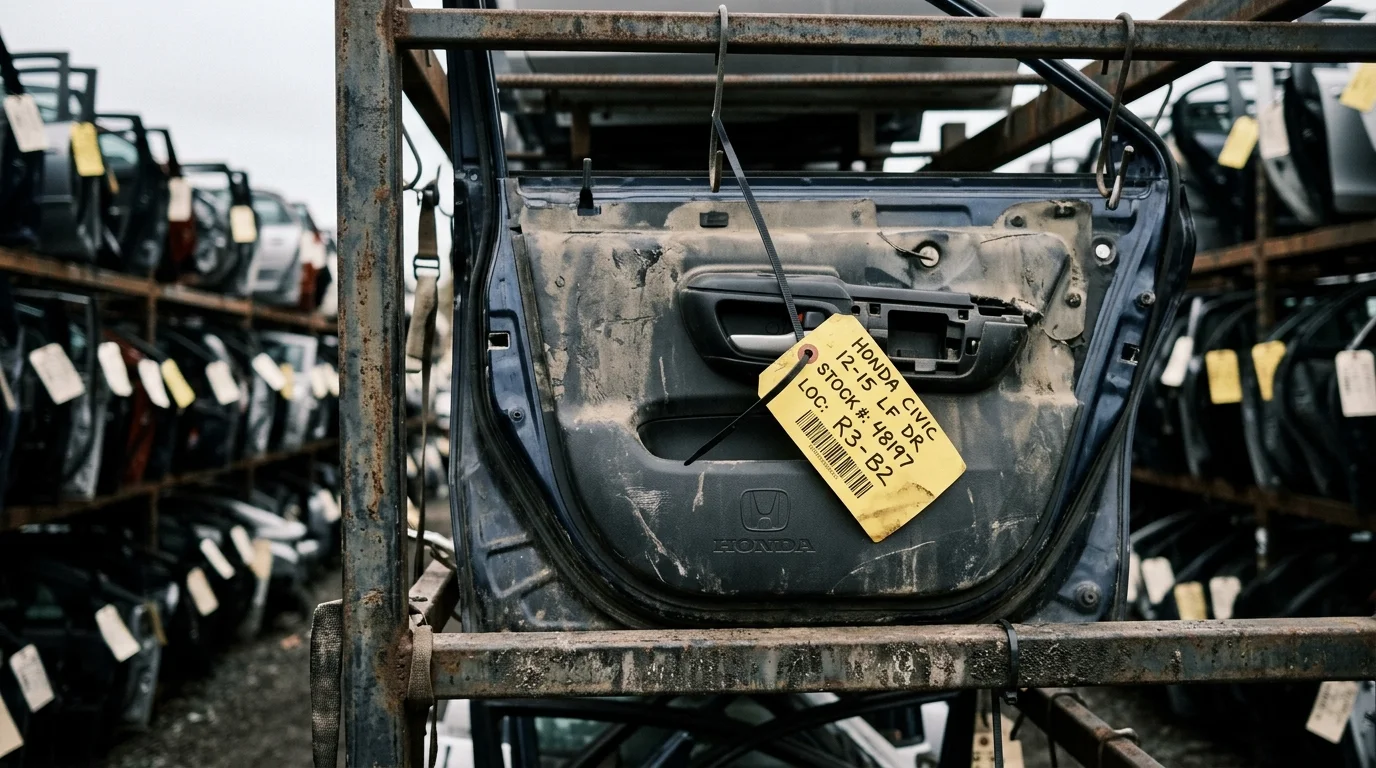
A state supreme court has said so directly. In Liberty Mutual Insurance Co. v. Morrisey (2014), West Virginia's Supreme Court of Appeals held that the state's Automotive Crash Parts Act applies only to aftermarket crash parts, not to salvage or recycled OEM parts, which it called diametrically different. West Virginia's written-consent requirement — one of the strongest in the country — does not apply when the substitute is a recycled genuine part.
The mechanism is definitional. Michigan defines a "non-OEM aftermarket crash part" as one "not made by or for the manufacturer of a motor vehicle." Utah's 2026 H.B. 119 uses the same construction and never mentions used parts. NAIC Model 891 defines aftermarket parts by shape — "sheet metal or plastic parts that generally constitute the exterior" — and says nothing about condition. New York's current regulation does not address recycled parts either.
Two states break the pattern. Massachusetts directs appraisers to specify "a rebuilt, aftermarket or used part of like kind and quality," pulling used parts inside the rule. Texas goes furthest: Insurance Code section 1952.301 bars an insurer from limiting coverage "by specifying the brand, type, kind, age, vendor, supplier, or condition of parts." Condition is the operative word — that reaches used parts head-on.
Which state protections are real
The 50-state survey everyone cites comes from subrogation firm Matthiesen, Wickert & Lehrer: roughly 35 states with rules on insurer obligations for non-OEM crash parts, 31 requiring a disclosure statement with the estimate, 13 requiring like kind and quality, 6 requiring the insured's consent. That chart was last updated in March 2022, so treat it as directional. The restrictions below are confirmed against the primary statute — and several states named in popular listicles, Hawaii and Washington among them, have no age-based ban in current law.
| State | Restriction | Citation |
|---|---|---|
| Rhode Island | No aftermarket parts without express written consent under 48 months from manufacture; insurer may not refuse OEM at 48–72 months | R.I. Gen. Laws § 27-10.2-2 |
| New Hampshire | No insurer may require aftermarket parts on vehicles in service under 2 years with 30,000 or fewer miles | RSA 407-D:3-a |
| West Virginia | Written consent required in the year of manufacture plus 2 succeeding years (aftermarket only) | W. Va. Code § 46A-6B-3 |
| Massachusetts | Appraiser must specify LKQ parts unless the vehicle has 20,000 miles or fewer | 211 CMR 133.04 |
| Texas | Insurer may not specify brand, type, age, vendor, or condition of parts | Tex. Ins. Code § 1952.301 |
| Hawaii | Insurer must offer a choice between LKQ and OEM; insured pays the difference for OEM | Haw. Rev. Stat. § 431:10C-313.6 |
New Hampshire adds a detail worth knowing: a 2018 department bulletin confirms that failure to give the exact statutory disclosure bars the insurer from requiring aftermarket parts at all. Procedure has teeth.
Your four options when you don't want the part
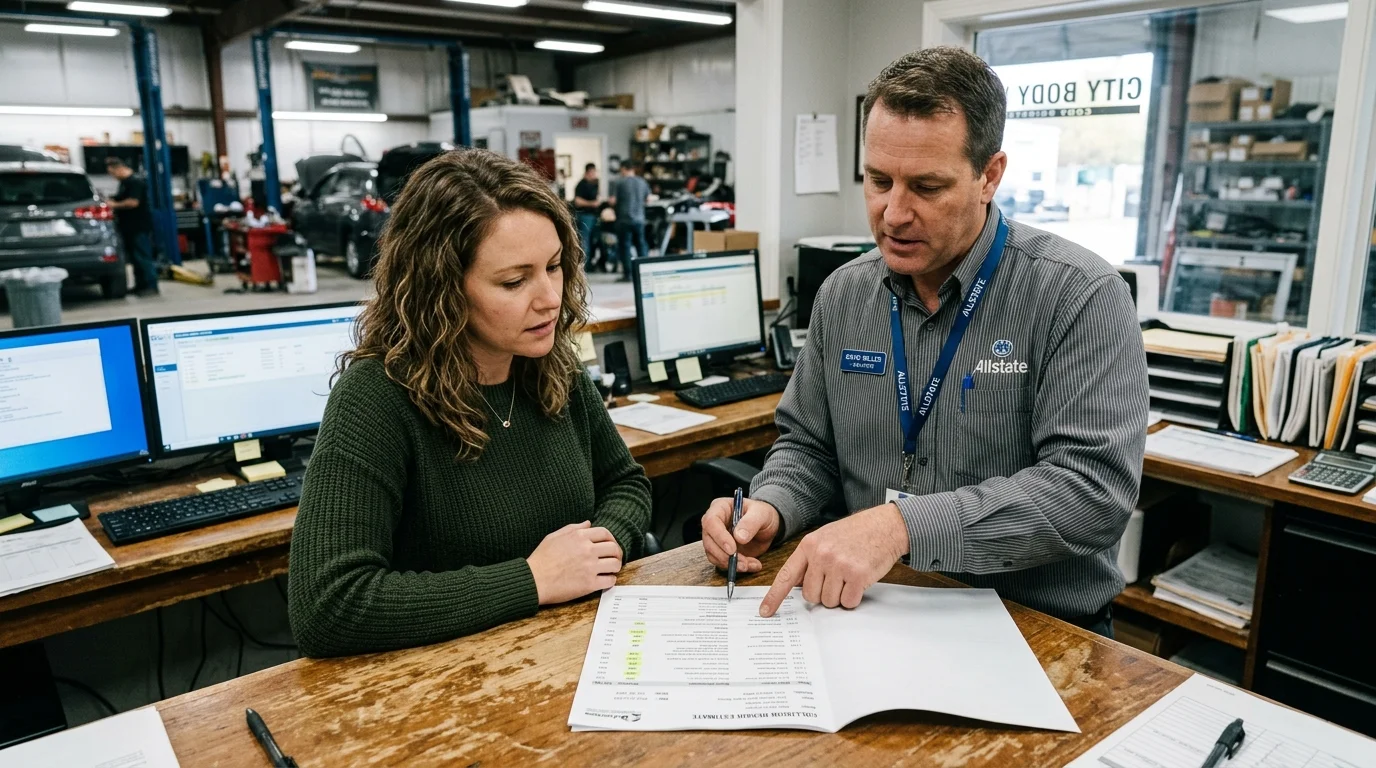
Start with the line-item estimate — look for LKQ, RECY, QRP, A/M, or CAPA codes — and ask who wrote the requirement, the insurer's guidelines or the shop's sourcing preference. That decides who you are negotiating with. From there, four moves.
Pay the difference. The most common resolution: the insurer pays the substitute price, you pay the gap. Ask for the differential line by line — on a single panel it is often smaller than people expect.
Buy an OEM parts endorsement — before the claim. Liberty Mutual sells Original Parts Replacement for vehicles 10 years old or newer carrying comprehensive and collision. American Family offers OEM coverage with a candid caveat in its own materials: the endorsement "does not guarantee that OEM parts will be used," because availability depends on the manufacturer. Neither publishes pricing, so ask your agent at renewal — and ignore the $20–$50 per year figures circulating online, which trace to no verifiable source.
Document why the part fails the standard. The strongest play on a used part, because it argues condition rather than preference. Have the shop photograph the substitute next to the damaged original and write up the fit or condition deficiency. The supplement process exists for exactly this.
File a state complaint. The NAIC maintains a directory of state insurance departments and a complaint guide. Regulators forward the complaint to the carrier, which must respond in writing — which alone resolves a share of parts disputes. Your right to choose the shop is separate and generally stronger; see your right to choose your own body shop and what a DRP shop is.
The REPAIR Act does not cover parts
The REPAIR Act (H.R. 1566 / S. 1379) governs access to vehicle-generated data, diagnostic tools, and repair information. It says nothing about which replacement parts an insurer may specify. It gets miscited in parts disputes constantly.
H.R. 1566 was forwarded from subcommittee to full committee by voice vote in February 2026; the Senate companion has not moved since referral. In May 2026 the House Energy and Commerce Committee reportedly set the full text aside for a narrower right-to-repair title inside the Motor Vehicle Modernization Act (H.R. 7389).
What changed in 2026
Utah is the only 2026 bill that became law. H.B. 119, signed March 18 and effective May 6, requires insurers to notify policyholders in writing that the insurer "may authorize or specify the use of aftermarket crash parts" — applying to policies issued or renewed on or after October 1, 2026 — and requires estimates to identify each non-OEM aftermarket crash part. It is a disclosure bill, not a parts-choice bill, and it does not address used parts.
Two others are pending. Ohio's H.B. 636, the Auto Insurance Transparency Act, would require every Ohio auto insurer to offer OEM parts coverage and let policyholders choose OEM by paying the difference; it has sat in House Insurance Committee since December 2025. New York's S4753 would require written owner authorization before replacement crash parts are installed and restrict vehicles to new OEM parts for the first three years — and unlike most legislation, it explicitly classifies recycled parts. Similar New York bills have died in committee for six straight years.
Put it in writing, and do it early
Every one of those options works better before the parts are ordered. Once a recycled fender is color-matched and hung, changing course means a new part, a new paint operation, and an argument over who pays. Put the request in writing, ask for any denial in writing citing your state's disclosure rule by name, and have the shop document condition with photos. A written record is what a regulator can act on; a phone call is not.
If you are sourcing a part yourself rather than fighting over one, our guide to buying used auto body parts from a salvage yard covers grading and interchange, and LKQ vs local salvage yards compares suppliers. For the wider claim picture see our auto body insurance claims guide and what your insurance won't tell you about OEM vs aftermarket parts, or compare shops near you for collision repair and auto body repair.
Sources
- Insurance Information Institute — auto insurance claims statistics
- National Association of Insurance Commissioners — state insurance commissioner consumer resources
- Federal Trade Commission — Auto Warranties — consumer rights regarding auto repair and warranties
- Insurance Information Institute — insurance guidance for consumers
- I-CAR — repair procedures and parts selection guidance
- CCC Intelligent Solutions — auto claims and repair data analytics
Frequently Asked Questions
Can my insurance company require used parts on my car?
Yes, in most states. Your policy obligates the insurer to restore pre-loss condition using parts of like kind and quality, which commonly means used or aftermarket. Roughly 31 states require written disclosure when non-OEM parts are specified, but most of those statutes are written around aftermarket parts and do not clearly reach used OEM parts.
What does "like kind and quality" mean on my estimate?
It means the part must be at least equal to the original in fit, quality, and performance. Almost no state defines those words precisely. Massachusetts is the exception, defining the part as one "of equal or better condition than the pre-accident part" — a standard tied to your car's actual condition, which is the most useful framing to argue from.
Can I refuse aftermarket parts and get OEM instead?
You can request OEM and pay the price difference — that route is always open. Whether the insurer must pay for OEM depends on your policy and your state. A few states require written consent before non-OEM parts are installed, and an OEM parts endorsement bought before the claim closes the gap automatically.
Does the REPAIR Act protect my right to OEM parts?
No. The REPAIR Act (H.R. 1566 / S. 1379) covers access to vehicle-generated data, diagnostic tools, and repair information, and protects your choice of service provider. It does not regulate insurer claims handling or which parts an insurer may specify, so citing it in a parts dispute will not help.
What should I do if my insurer won't approve OEM parts?
Get the denial in writing first. Cite your state's disclosure requirement by name, ask your body shop to document why the substitute part does not meet fit, quality, and performance, and photograph it next to the original. If the response is inadequate, file a complaint with your state insurance department through the NAIC directory — the carrier must respond to the regulator in writing.
Sources
- NAIC, After Market Parts Model Regulation (MO-891) — https://content.naic.org/sites/default/files/model-law-891.pdf (retrieved 2026-08-12)
- NAIC, Model 891 State Adoption Table (ST-891, Fall 2022) — https://content.naic.org/sites/default/files/model-law-state-page-891.pdf (retrieved 2026-08-12)
- Matthiesen, Wickert & Lehrer, S.C., Use of Aftermarket (Non-OEM) Crash Parts in Repair of Damaged Vehicles (chart last updated March 18, 2022) — https://www.mwl-law.com/use-aftermarket-non-oem-crash-parts-repair-damaged-vehicles/ (retrieved 2026-08-12)
- National Law Review, Salvage/Recycled OEM Parts Held Not Covered Under West Virginia Automotive Crash Parts Act (Liberty Mutual Ins. Co. v. Morrisey, No. 13-0195) — https://natlawreview.com/article/salvagerecycled-original-equipment-manufacture-oem-parts-held-not-covered-under-west (retrieved 2026-08-12)
- R.I. Gen. Laws § 27-10.2-2, Aftermarket parts — https://codes.findlaw.com/ri/title-27-insurance/ri-gen-laws-sect-27-10-2-2.html (retrieved 2026-08-12)
- N.H. RSA 407-D:3-a, Use of after market parts — https://law.justia.com/codes/new-hampshire/2023/title-xxxvii/chapter-407-d/section-407-d-3-a/ (retrieved 2026-08-12)
- New Hampshire Insurance Department, Bulletin INS No. 18-020-AB (May 3, 2018) — https://mm.nh.gov/files/uploads/nhid/documents/ins-18-020-ab.pdf (retrieved 2026-08-12)
- W. Va. Code § 46A-6B-3, Automotive Crash Parts Act — https://code.wvlegislature.gov/46A-6B-3/ (retrieved 2026-08-12)
- 211 CMR 133.04, Massachusetts appraisal and repair standards (Cornell LII) — https://www.law.cornell.edu/regulations/massachusetts/211-CMR-133-04 (retrieved 2026-08-12)
- 11 NYCRR § 216.7, Standards for prompt, fair and equitable settlements (Cornell LII) — https://www.law.cornell.edu/regulations/new-york/11-NYCRR-216.7 (retrieved 2026-08-12)
- Haw. Rev. Stat. § 431:10C-313.6, Like kind and quality parts — https://codes.findlaw.com/hi/division-2-business/hi-rev-st-sect-431-10c-313-6.html (retrieved 2026-08-12)
- Tex. Ins. Code § 1952.301, Restrictions on repair of motor vehicles — https://law.justia.com/codes/texas/insurance-code/title-10/subtitle-c/chapter-1952/subchapter-g/section-1952-301/ (retrieved 2026-08-12)
- Ga. Comp. R. & Regs. 120-2-52-.05, Aftermarket crash parts disclosure (Cornell LII) — https://www.law.cornell.edu/regulations/georgia/Ga-Comp-R-Regs-R-120-2-52-.05 (retrieved 2026-08-12)
- Michigan Compiled Laws § 257.1362, Definitions, aftermarket crash parts — https://www.legislature.mi.gov/Laws/MCL?objectName=mcl-257-1362 (retrieved 2026-08-12)
- Utah Legislature, H.B. 119 (2026), Enrolled — https://le.utah.gov/Session/2026/bills/enrolled/HB0119.pdf (retrieved 2026-08-12)
- Autobody News, Utah H.B. 119 Signed Into Law; Aftermarket Parts Disclosure Requirements Take Effect May 6 — https://www.autobodynews.com/news/utah-h-b-119-signed-into-law-aftermarket-parts-disclosure-requirements-take-effect-may-6 (retrieved 2026-08-12)
- Ohio Legislature, H.B. 636, 136th General Assembly (Auto Insurance Transparency Act) — https://www.legislature.ohio.gov/legislation/136/hb636 (retrieved 2026-08-12)
- Repairer Driven News, Ohio Legislator: OEM Parts Bill Would Curb Deceptive Practices, Foster Claim and Repair Transparency — https://www.repairerdrivennews.com/2026/03/05/ohio-legislator-oem-parts-bill-would-curb-deceptive-practices-foster-claim-and-repair-transparency/ (retrieved 2026-08-12)
- New York State Senate, Senate Bill S4753 (2025-2026) — https://www.nysenate.gov/legislation/bills/2025/S4753 (retrieved 2026-08-12)
- Congress.gov, H.R. 1566 — REPAIR Act (119th Congress) — https://www.congress.gov/bill/119th-congress/house-bill/1566 (retrieved 2026-08-12)
- Congress.gov, S. 1379 — REPAIR Act (119th Congress) — https://www.congress.gov/bill/119th-congress/senate-bill/1379 (retrieved 2026-08-12)
- SEMA, U.S. House Committee Advances Legislation to Enact Right to Repair Provisions — https://www.sema.org/news-media/enews/2026/22/us-house-committee-advances-legislation-enact-right-repair-provisions (retrieved 2026-08-12)
- Liberty Mutual, Original Parts Replacement Coverage — https://www.libertymutual.com/vehicle/auto-insurance/coverage/original-parts-replacement (retrieved 2026-08-12)
- American Family Insurance, OEM Coverage — https://www.amfam.com/insurance/car/coverages/oem-coverage (retrieved 2026-08-12)
- CCC Intelligent Solutions, Crash Course 2026 — https://www.cccis.com/reports/crash-course-2026 (retrieved 2026-08-12)
- Repairer Driven News, CCC Report Shows Shift to DRP and AI Appraisals — https://www.repairerdrivennews.com/2026/04/10/ccc-report-shows-shift-to-drp-and-ai-appraisals/ (retrieved 2026-08-12)
- Autobody News, Enlyte's 2026 Trends Report Tracks Climbing Calibration Costs, Uneven Parts Inflation — https://www.autobodynews.com/regional/midwest-regional-news/enlytes-2026-trends-report-tracks-climbing-calibration-costs-uneven-parts-inflation-and-a-repair-rate-reversal (retrieved 2026-08-12)
- NAIC, State Insurance Departments Directory — https://content.naic.org/state-insurance-departments (retrieved 2026-08-12)
- NAIC, How to File a Complaint — https://content.naic.org/consumer/how-to-file-complaint (retrieved 2026-08-12)