Buying used body parts from a salvage yard works best when you search the national inventory databases first, decode the seller's damage grade before you drive anywhere, and inspect the panel for filler and rust before money changes hands. The parts worth buying this way are the ones that bolt on and get painted — fenders, doors, hoods, decklids, bumper covers — and the parts worth refusing are anything that carries a sensor, restrains a passenger, or holds the structure together.
Key Takeaways
- Search Car-Part.com and the Hollander Interchange before visiting a yard — the interchange tells you which other years and models carry the identical panel.
- Recycled body parts are graded on the ARA scale: Grade A is up to 1.0 unit of damage, Grade B is 1.1–2.0, Grade C is 2.1 or more. One unit is roughly the surface area of a credit card.
- Self-service yards are the cheapest route but sell as-is with short, store-credit-only exchange windows that vary by location.
- Ford's May 2026 position statement bars recycled parts well beyond sensors — it names quarter panels, bumper beams, bumper fascias, and grilles because they sit in or near radar paths.
- Never buy salvage airbags or restraint components. NHTSA has issued urgent warnings about substandard replacement inflators, and GM revised its restraint systems position statement in June 2026.
Step 1: Search the national inventory before you leave the house
Nobody needs to drive from yard to yard anymore. Recyclers list inventory into shared networks, so you can query thousands of yards from one screen.
- Car-Part.com is the largest consumer-facing search. Its Trading Partners tool alone reaches roughly 4,200 recyclers, and results show the yard, the price, the donor vehicle's mileage, and usually the damage code.
- LKQ's online catalog covers the largest single recycler network in North America. Our comparison of LKQ vs local salvage yards covers when that network is worth the premium.
- HollanderParts.com runs directly on the interchange catalog, which makes it the best tool for widening a search rather than narrowing it.
- eBay Motors is worth checking for trim and cosmetic parts, though you are buying from an individual seller with no grading standard behind the listing.
Search by VIN wherever the tool allows it. The VIN pins trim and option content, which determines whether a door has the right harness openings and mirror mount.
Step 2: Understand the Hollander Interchange
The Hollander Interchange is the index that tells you a fender from a different model year — or a different badge entirely — is the same physical part. Hollander has been publishing it for more than 80 years and is now a Solera company; it catalogs millions of auto parts and their interchangeable equivalents, and more than 3,000 businesses run on it.
The practical value is supply. If your 2018 sedan's front fender is scarce, the interchange may show that the 2016–2020 range shares one part number and that a sister-brand platform twin uses it too, turning a one-yard search into a fifty-yard search. Every serious recycler lists by interchange number, so quoting it on the phone eliminates a round trip.
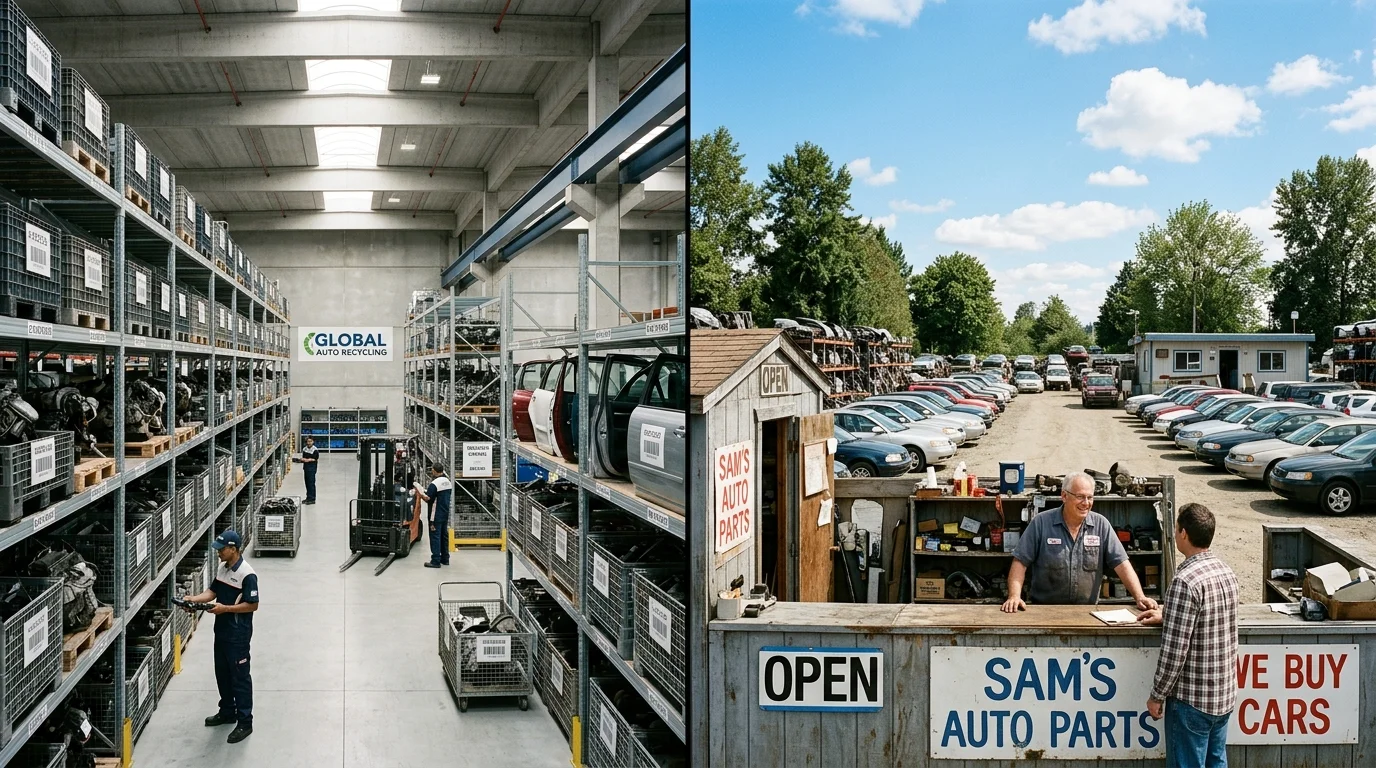
Step 3: Choose self-service or full-service
The two yard models are different businesses. The right one depends on whether your time or your money is scarcer.
| Self-service (u-pull-it) | Full-service | |
|---|---|---|
| Who removes the part | You do | Yard staff |
| Pricing | Flat rate by part type, regardless of make or model | Priced per part, typically as a percentage of the new OE price |
| Entry fee | Small admission charge, varies by location | None |
| Inspection | You inspect on the car, before removal | Yard inspects and grades before sale |
| Warranty | Short exchange window, usually store credit only | 30–90 days standard, longer on collision parts at large chains |
| Shipping | Pickup only | Freight available |
Self-service yards keep prices low by charging the same for a part regardless of what it came off — U-Pull-&-Pay states that each part carries the same price "regardless of the make, model, or year." That is a bargain on a panel for an expensive car and a poor deal on a common economy car. Full-service yards charge more but hand you a graded, cleaned part with paperwork.
Step 4: Read the grade and damage code
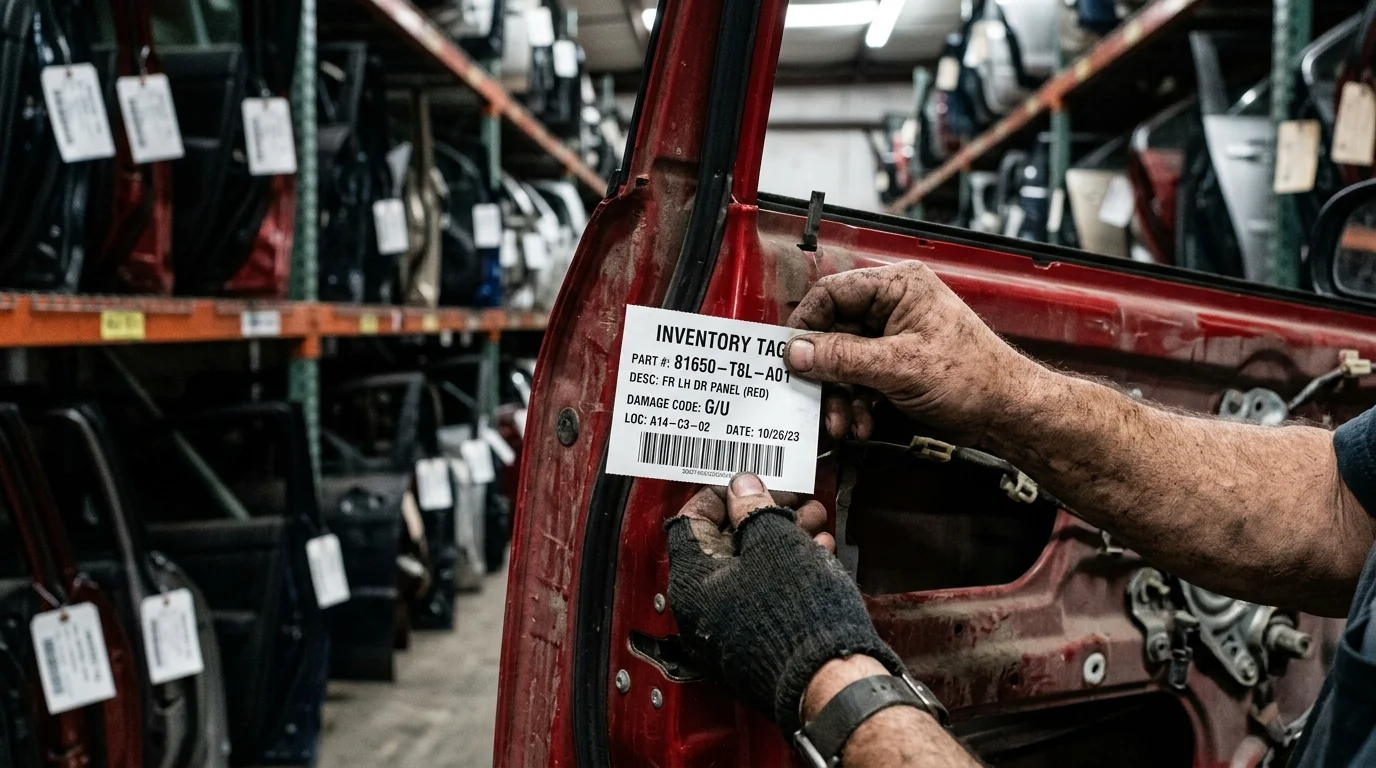
The Automotive Recyclers Association standard grades sheet metal by units of damage, where one unit is approximately the surface area of a credit card. Grade A is 0.0 to 1.0 unit, Grade B is 1.1 to 2.0, and Grade C is 2.1 or more. An undamaged part is coded 000.
Listings also carry a three-character damage code combining location and damage type. The letters are standardized: D is a dent, C a crease, S a surface scratch, G a gouge, K a buckle, R surface rust, H hail, P parking-lot dings, T a paint problem. A code like 5S1 describes a small scratch in location five — irrelevant once the panel is refinished.
For a part you are painting anyway, Grade B with a dent code is often the smart buy, since your shop will prep and block the panel regardless. What you should not accept at any grade is R for rust, because surface rust on a used panel is frequently the visible edge of perforation starting from the inside.
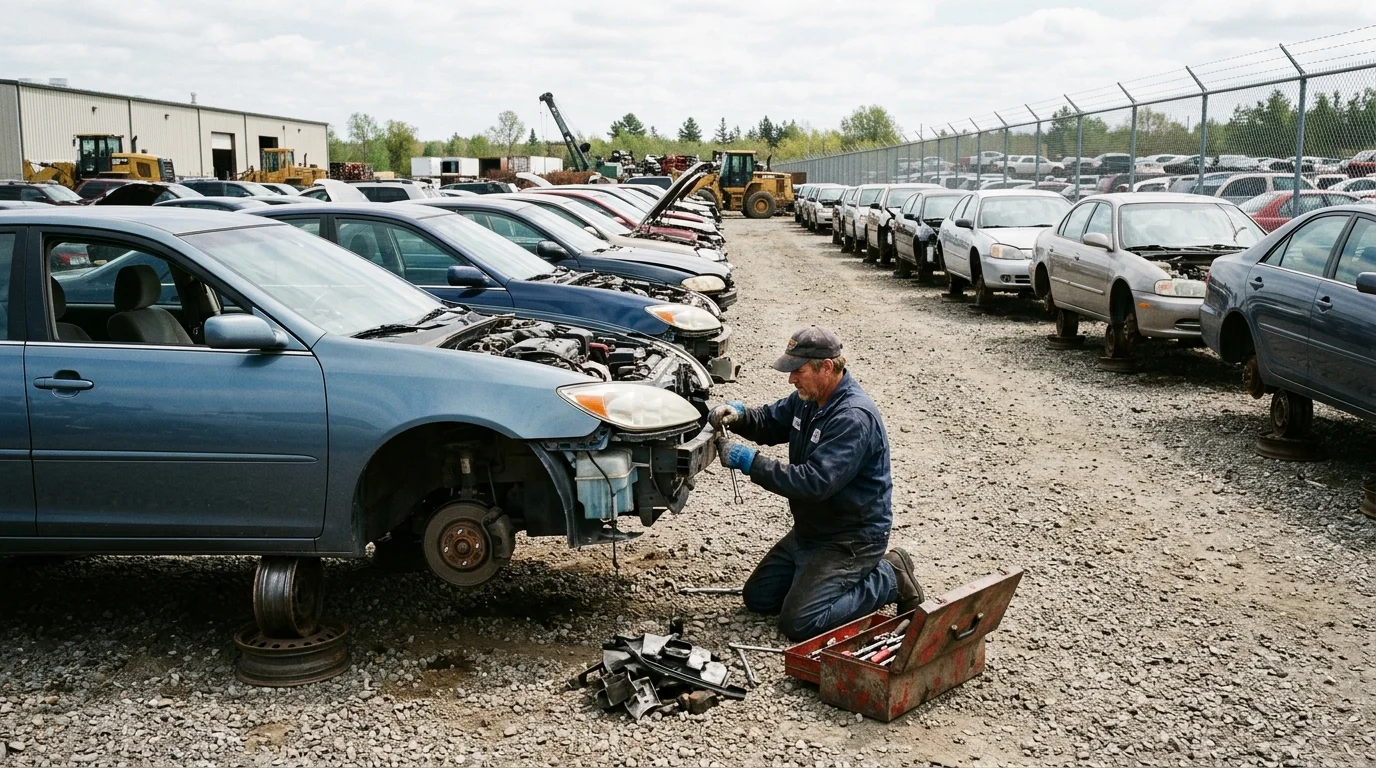
Step 5: What to bring, and how to inspect
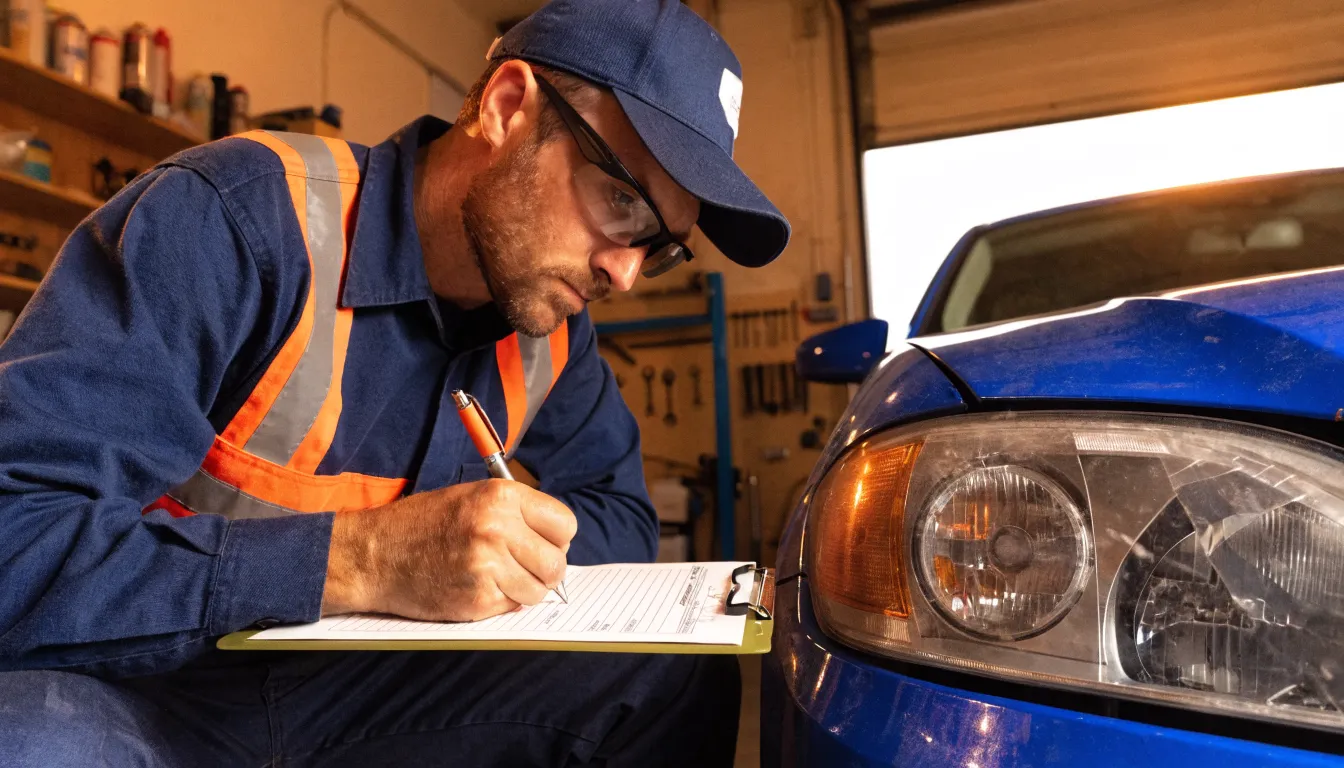
For a self-service yard, bring a socket set with extensions, a ratcheting wrench, panel poppers for clips, penetrating oil, work gloves, and a dolly for anything larger than a fender. Bring your VIN written down, the interchange number, and a charged phone. Then inspect before you spend an hour removing anything:
- Check for body filler. Run a small magnet across the panel — it will slide or fall where filler is thick. A previously repaired panel means unknown repair quality under your new paint.
- Check paint thickness. Ford's May 2026 position statement warns that three or more coats of paint can attenuate or deflect radar signals, so a heavily repainted fascia is a functional problem, not a cosmetic one.
- Check every mounting tab and bracket. Broken tabs on a bumper cover or a bent hinge face are the most common reason a cheap panel becomes an expensive one at the shop.
- Check flanges and seams for rust, especially door bottoms, the lower fender return, and the hood's leading edge, where corrosion starts inside and works out.
- Photograph everything before removal, including the donor car's VIN plate. In a dispute, your photos are the record.
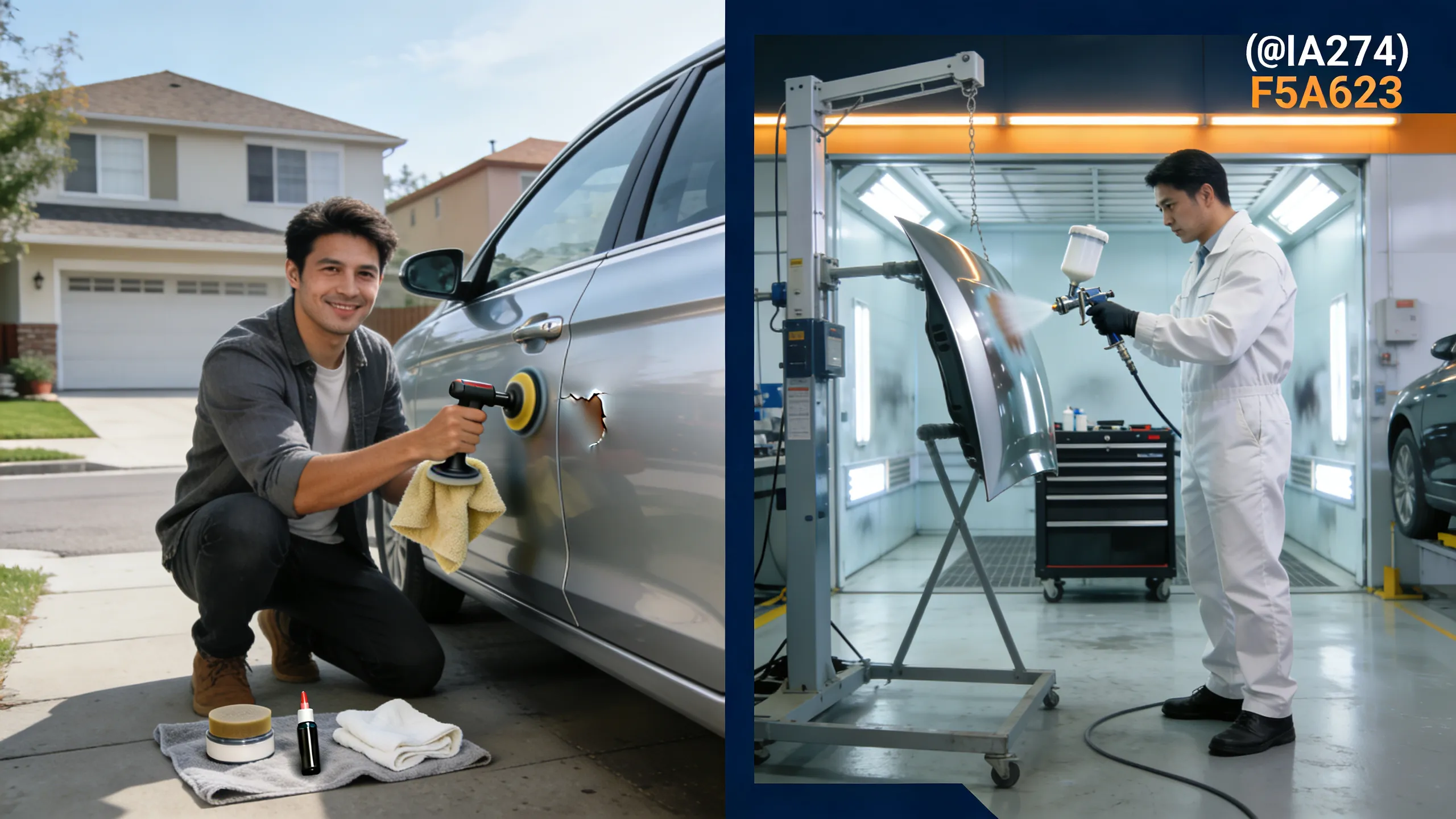
If you are installing it yourself, read our comparison of DIY vs professional auto body repair first — paint matching is where home repairs go wrong.
Step 6: Confirm warranty, returns, and shipping
Terms vary more than people expect, so ask before you pay. Full-service yards typically offer a 30 to 90 day return window, and LKQ publishes a limited lifetime sheet metal warranty on recycled collision products covering rust perforation from the inside out for as long as the original purchaser owns the vehicle, plus a six-month/6,000-mile warranty on recycled mechanical parts. Self-service yards are stricter and inconsistent — corporate policy and individual franchise locations publish different windows, and refunds are usually store credit. Read the sign at the counter rather than assuming.
Large panels move by LTL freight rather than parcel, so a cheap door can carry freight costs that erase the savings. Always price the part delivered; within a two-hour drive, pickup usually wins. Our guides to auto body repair cost and collision repair cost put those savings against the labor and paint side of the bill.
What not to buy from a salvage yard
Skip anything safety-critical or sensor-related, regardless of price or condition. Ford's May 2026 collision position statement says "recycled, salvaged, aftermarket, or reconditioned ADAS sensors are not approved for use," and the restriction extends past electronics to parts that mount sensors or sit in their field of view — it names bumper beams, quarter panels, mounting brackets, bumper fascias, and grilles. GM updated its position statements in June 2026 with prohibiting language covering salvaged ADAS components across Chevrolet, Buick, GMC, and Cadillac, plus a revised restraint systems statement.
Airbags deserve their own warning. NHTSA has issued urgent public warnings about substandard replacement inflators after fatal ruptures, and the affected vehicles skew heavily toward cars with salvage or rebuilt titles whose airbags were replaced outside a dealership. No price makes that trade worth it.
Structural components — rails, aprons, pillars, and anything the OEM procedure calls sectioned or bonded — belong to your shop's judgment, not to a parts-hunting decision.
Red flags that should end the transaction
- No grading and no damage code. A legitimate recycler inventories to the ARA standard. A seller who cannot give you a grade has not inspected the part.
- No stated return policy. "All sales final" on a shipped part you have never seen is a wager, not a deal.
- Pressure to buy sight-unseen with no photos. Every real yard can photograph a part in five minutes.
- Payment by wire, gift card, or peer-to-peer app. Documented scams have run by listing a real salvage yard's address on a fake storefront and seeding reviews. Check when reviews were posted, not just how many.
- No business address or license number. Verify the yard exists where it claims before sending money.
Used parts are not a fringe choice — the ARA reports the industry employs more than 140,000 people at over 9,000 locations and recycles more than four million vehicles a year in the US and Canada. For how these parts reach your estimate, see our pillar guide to used OEM vs aftermarket vs new parts, and if a carrier is pushing recycled parts onto your claim, read whether insurance can force used parts on you. When you are ready to install, compare shops for collision repair or auto body repair near you.
Sources
- I-CAR — repair procedures and parts selection guidance
- CCC Intelligent Solutions — auto claims and repair data analytics
Frequently Asked Questions
Is it safe to buy used body parts from a salvage yard?
Yes, for bolt-on cosmetic panels — fenders, doors, hoods, decklids, and bumper covers are genuine factory parts that fit exactly because they came off the same tooling. It is not safe for ADAS sensors, cameras, radar modules, airbag or restraint components, or structural parts. Ford's May 2026 position statement and GM's June 2026 updates both prohibit recycled ADAS components, and Ford extends the restriction to panels that mount sensors or sit in their field of view.
How much can I save buying from a salvage yard?
The Automotive Recyclers Association puts savings at 20% to 80% off comparable new parts, though as a trade association it does not publish the methodology behind that range. One concrete CCC data point: a recycled door at roughly $2,000 against about $4,000 new OEM. Savings run widest on large panels for high-volume vehicles and narrowest on late-model cars where donor supply is thin.
What's the difference between self-service and full-service salvage yards?
Self-service yards charge a small admission fee, let you walk the lot with your own tools, and price parts at a flat rate by part type regardless of vehicle. Full-service yards pull, clean, grade, and inventory the part for you, and can ship it. Self-service wins on common parts for expensive cars; full-service wins when you want a graded part with a real warranty.
Do salvage yard parts come with a warranty?
Full-service yards commonly offer a 30 to 90 day return period, and large recyclers go further — LKQ publishes a limited lifetime sheet metal warranty covering rust perforation from the inside out for the original purchaser, plus a six-month/6,000-mile warranty on recycled mechanical parts. Self-service yards offer much shorter exchange windows, usually store credit rather than a refund, with terms that differ by location.
How do I know if a salvage yard part will fit my car?
Use the Hollander Interchange, the catalog that maps compatible parts across makes, models, and years. Car-Part.com and HollanderParts.com both search on it, so one interchange number surfaces every donor vehicle carrying the identical panel — often across several model years and sister brands. Search by VIN where the tool allows it, because trim and option content determine mounting points and harness openings.
Sources
- Ford Motor Company, Collision Position Statement: ADAS Integrity and Repair Technical Imperatives (May 1, 2026) — https://www.oem1stop.com/sites/default/files/Collision%20Position%20Statement%20ADAS%20Integrity%20and%20Technical%20ImperativesPDF5.1.26.pdf (retrieved 2026-08-12)
- I-CAR Repairability Technical Support, General Motors Updates Position Statements — https://rts.i-car.com/crn-2455.html (retrieved 2026-08-12)
- CollisionWeek, GM Rewrites ADAS Position Statement to Prohibit Salvaged, Aftermarket Sensors (July 30, 2026) — https://collisionweek.com/2026/07/30/gm-rewrites-adas-position-statement-prohibit-salvaged-aftermarket-sensors/ (retrieved 2026-08-12)
- Automotive Recyclers Association, Industry Statistics — https://www.a-r-a.org/industry-statistics/ (retrieved 2026-08-12)
- Automotive Recyclers Association, Recycled Parts Standards and Codes — https://www.a-r-a.org/wp-content/uploads/ara-standard_and_codes.pdf (retrieved 2026-08-12)
- Auto Recycling Now, It's All In the Description (ARA damage code walkthrough) — https://autorecyclingnow.com/processes/its-all-in-the-description/ (retrieved 2026-08-12)
- Bill's Used Parts, ARA Damage Locator and Code Reference — https://www.billsusedparts.com/ara-damage-locator.php (retrieved 2026-08-12)
- Solera, Hollander Solutions — https://www.solera.com/solutions/vehicle-repair/hollander/ (retrieved 2026-08-12)
- Hollander Solutions, Products: Interchange — https://www.hollandersolutions.com/products/ (retrieved 2026-08-12)
- Car-Part.com, Trading Partners — https://products.car-part.com/ (retrieved 2026-08-12)
- LKQ Corporation, Our Industry-Leading Warranty — https://lkqcorp.com/about-us/our-industry-leading-warranty/ (retrieved 2026-08-12)
- LKQ Corporation, Limited Lifetime Warranty: Sheet Metal Products — https://www.lkqcorp.com/wp-content/uploads/2019/07/warranty-sheet-metal-0711.pdf (retrieved 2026-08-12)
- U-Pull-&-Pay, Used Auto Parts Pricing — https://www.upullandpay.com/used-auto-parts/parts-pricing/ (retrieved 2026-08-12)
- Pick-N-Pull San Antonio, Warranties — https://picknpullsa.com/warranties/ (retrieved 2026-08-12)
- NHTSA, Deadly Air Bag Replacements — https://www.nhtsa.gov/air-bags/deadly-air-bag-replacements (retrieved 2026-08-12)
- Repairer Driven News, NHTSA Uncovers More Crashes, Deaths Linked to Illegally Imported Airbags (April 3, 2026) — https://www.repairerdrivennews.com/2026/04/03/nhtsa-uncovers-more-crashes-deaths-linked-to-illegally-imported-airbags-mulls-permanent-ban/ (retrieved 2026-08-12)
- Autobody News, Dip in Used-Vehicle Values Could Impact Repairable Claims (CCC recycled vs. new door example) — https://www.autobodynews.com/news/dip-in-used-vehicle-values-could-impact-repairable-claims (retrieved 2026-08-12)
- Automotive Recyclers Association, ROE — Recycled Original Equipment — https://www.a-r-a.org/roe-recycled-original-equipment/ (retrieved 2026-08-12)
- SlashGear, Used Auto Parts Website Scam (documented salvage-yard-address fraud pattern) — https://www.slashgear.com/2199374/used-auto-parts-website-affordable-quality-scam/ (retrieved 2026-08-12)