Use OEM parts if your vehicle is under 5 years old, leased, or headed for resale — they guarantee exact fit, preserve warranty coverage, and protect resale value. Aftermarket parts save 25–50% on repair costs but bring fit issues, paint-match problems, and potential warranty gaps that make them a riskier choice on newer vehicles.
Insurance companies routinely specify aftermarket parts to control claim costs. Body shops work with whatever the estimate approves. Car owners are left hoping the replacement panel fits and holds up.
Understanding the difference between OEM parts vs aftermarket options, and when each makes sense, gives you the leverage to make informed decisions and, in some cases, negotiate better outcomes. This guide covers each part type, how insurance handles the choice, and the specific situations where paying more for OEM collision parts is worth it.
For a broader overview of the repair process, see the collision repair guide.
OEM vs aftermarket parts: quick comparison
OEM parts offer exact-fit quality and manufacturer warranty backing. Aftermarket parts cost 20–50% less but vary in certification and fit. The right choice depends on the component, the vehicle's age, and whether safety systems are nearby.
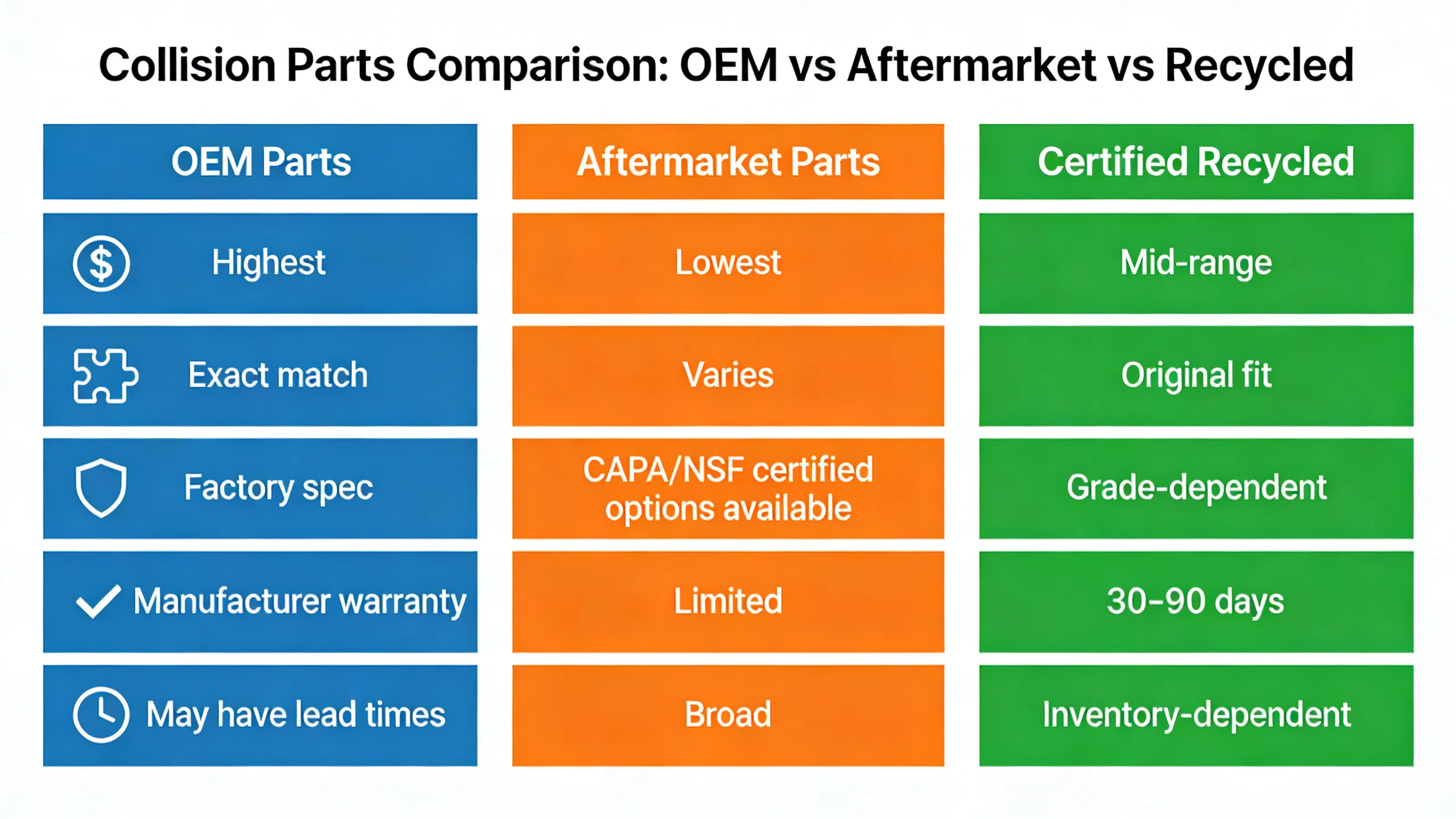
The table below summarizes the key differences across three part types you'll encounter in collision repair.
| Factor | OEM Parts | Aftermarket Parts | Certified Recycled Parts |
|---|---|---|---|
| Price | 20–60% higher than aftermarket | Lowest upfront cost | Mid-range; varies by part condition |
| Fit and finish | Exact match, made by original supplier | Varies by manufacturer and certification | Matches original (same OEM part, used) |
| Warranty | Manufacturer warranty, often lifetime on structure | Limited; varies widely by supplier | Typically 30–90 days from salvage yard |
| Availability | May be limited for older or rare vehicles | Broad availability for most vehicles | Depends on local inventory and vehicle age |
| Insurance acceptance | Requires documentation or state law protection | Preferred by most insurers on standard claims | Accepted on many claims; treated similarly to aftermarket |
Each part type has legitimate use cases. The right choice depends on the vehicle, the component being replaced, and the specific circumstances of the repair.
What are OEM parts?
OEM stands for Original Equipment Manufacturer. OEM parts are made by the same supplier that built them for the vehicle's original assembly. When a car rolls off the factory line, every panel, bracket, sensor mount, and structural piece meets the manufacturer's exact engineering specs. OEM collision parts are replacements built to those same specs, often by the same supplier.
How they're made
Auto manufacturers don't always produce their own sheet metal and plastic components in-house. They contract with dedicated suppliers who build to precise tolerances, material grades, and finish standards. OEM parts for collision repair come from that same supply chain. When a manufacturer like Honda or Ford certifies a part as OEM, it means that part was produced or approved to the same standards as what left the factory originally.
Advantages of OEM
Guaranteed fit and finish. OEM parts are built to the same specs as the original, so alignment with adjacent panels, sensor mounting points, and paint adhesion surfaces should match exactly. That matters for appearance and function, especially on components near Advanced Driver Assistance Systems (ADAS) sensors.
Predictable repair outcomes. Body shops working with OEM parts spend less time fitting, adjusting, or shimming. Fewer adjustments mean faster repairs. Fewer surprises on the final bill.
Manufacturer-backed warranty. Most OEM parts carry the vehicle manufacturer's warranty. In some cases, that covers material and workmanship defects for the life of the vehicle.
Preserved ADAS compatibility. Panels, bumper fascias, and mounting structures that house radar, camera, or lidar sensors need tight dimensional tolerances for ADAS calibration to succeed. OEM parts are the safest bet for these fits (most relevant on 2019+ models with integrated sensor packages).
Disadvantages of OEM
Higher cost. OEM parts typically cost 20% to 60% more than comparable aftermarket parts, depending on the component and vehicle make. On a multi-panel repair, that gap adds up fast.
Availability gaps. For vehicles more than five to seven years old, OEM parts may no longer be in active production. Dealers and distributors can face backorder situations that stretch timelines. High-demand collision parts, bumpers, fenders, doors, sometimes carry weeks-long lead times. Some 2023–2025 models are especially affected right now.
What are aftermarket parts?
Aftermarket parts are replacement components made by third parties, companies with no involvement in the vehicle's original production. They produce collision parts for a wide range of makes and models, usually at significantly lower prices than OEM.
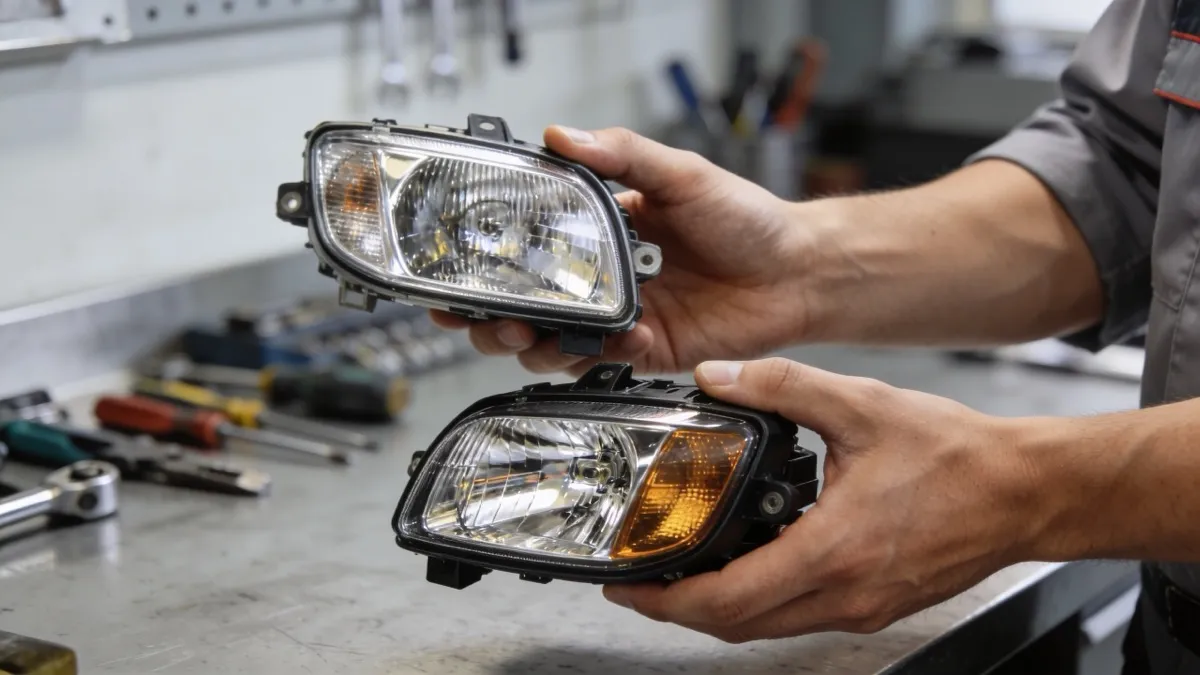
Aftermarket body parts quality varies considerably. At the top of the spectrum, certified parts meet verified fit and finish standards. At the lower end, uncertified parts may require modification to install and may not match OEM dimensions or material strength. Not all aftermarket parts are equal.
Quality tiers: certified vs. uncertified
The industry recognizes two broad categories:
Certified aftermarket parts have passed independent third-party testing for fit, finish, and corrosion resistance. They're tested against OEM benchmarks and must meet defined tolerances before earning certification.
Uncertified aftermarket parts have no standardized quality verification. They may fit well, or may need adjustment. Material composition, weld points, and paint adhesion properties vary by manufacturer. These show up most in lower-tier repair estimates, so ask specifically when you see a generic "aftermarket" line item.
CAPA and NSF certification
Two certification programs define the quality ceiling for aftermarket body parts:
CAPA (Certified Automotive Parts Association) is one of the most recognized standards in the field. CAPA-certified parts go through independent testing for fit, finish, material, and performance against OEM benchmarks. According to CAPA's testing standards, certified parts must meet or exceed OEM equivalents across a defined set of engineering criteria.
NSF International runs a parallel certification covering similar dimensional and material requirements. Most major insurers accept NSF-certified parts as equivalent to CAPA alternatives.
When an estimate says "LKQ," "aftermarket," or just lists a third-party supplier name, asking whether those parts carry CAPA or NSF certification is the single fastest quality check you can do. Takes 30 seconds. Worth it.
Advantages of aftermarket
Lower cost. Aftermarket parts cost 20% to 50% less than OEM equivalents on average. Across a multi-panel repair, that gap can add up to hundreds or thousands of dollars on a single claim.
Broad availability. Aftermarket suppliers tend to have large inventory networks with faster lead times than OEM distributors, especially for high-demand collision parts.
Competitive market. Multiple suppliers produce parts for the same vehicles. That price competition benefits both insurers and car owners paying out of pocket.
Disadvantages of aftermarket
Fit inconsistency. Even certified aftermarket parts sometimes require more fitting time than OEM equivalents. Panel gaps, mounting hole alignment, and surface contour can vary; particularly on lower-tier parts.
Inconsistent quality. Without CAPA or NSF certification, you have no standardized verification of what you're getting. Uncertified aftermarket parts may look identical on an estimate but differ significantly in material thickness, coating, or dimensional accuracy.
Shorter or absent warranties. Aftermarket part warranties vary widely. Some suppliers offer full replacement guarantees. Others offer almost nothing beyond the statutory minimum. That difference matters for long-term durability.
Certified recycled parts: the third option
Recycled OEM parts, sometimes called certified recycled, salvage, or "like-kind-and-quality" (LKQ) parts, come from vehicles that were totaled or dismantled in controlled salvage operations. Because they're actual OEM parts pulled from wrecked vehicles, they offer original-factory fit at lower-than-new prices.
What they are
Certified recycled parts go through an inspection and grading process at salvage facilities. Structural components are assessed for prior damage, corrosion, and deformation. Cosmetic parts are graded on condition, scratches, paint quality, and surface integrity. Better salvage operations provide graded parts with condition documentation and limited warranties. Not all do.
When recycled parts make sense
Recycled parts work well for vehicles where OEM parts are no longer in production, or where the vehicle's age and value make the cost premium of new OEM parts hard to justify. A seven-year-old vehicle with a clean salvage-sourced door panel in excellent condition can be a better value call than a new aftermarket door of uncertain quality.
They're also common on comprehensive insurance claims (non-collision damage) where the goal is restoring pre-loss condition cost-effectively.
Quality concerns
Condition grading isn't standardized across all salvage yards. Ask for documentation of the part's grade, the source vehicle's mileage and condition history, and the warranty covering installation. A low-grade recycled part creates the same fit and finish problems as a low-quality aftermarket part.
How insurance companies decide on OEM vs aftermarket parts
Insurance companies carry a lot of weight in the OEM vs aftermarket parts car decision. In most standard collision and comprehensive claims, insurers write estimates using the part type that keeps claim costs lowest, usually aftermarket or certified recycled parts.
Why insurers default to aftermarket
The financial incentive is straightforward. On a single claim, the difference between OEM and aftermarket parts can range from $200 to $2,000 depending on damage scope. Across millions of annual claims, that cost differential is substantial.
Most insurance policies allow "like-kind-and-quality" parts in repair estimates. Unless the policy specifically requires OEM parts, or state law mandates OEM usage or disclosure, the insurer's default position is aftermarket or recycled. They're not required to tell you that upfront in many states.
State laws requiring disclosure
About 30 states have enacted legislation requiring insurers to disclose when non-OEM parts are specified in a repair estimate. The scope varies considerably:
- Some states require written notification that aftermarket parts will be used.
- A smaller number require insurer documentation that those parts meet OEM quality standards.
- Some state laws specifically protect lease vehicles or newer vehicles from non-OEM substitution.
Check your state's insurance department website or review your policy to understand what protections apply. The National Association of Insurance Commissioners (NAIC) maintains a consumer resource hub with state-by-state guidance on auto insurance claims and parts disclosure rules. This area of consumer protection law is still evolving, so checking your state's current rules before filing a claim is worth the time.
How to request OEM parts on your claim
You have more options than you might think when an insurer defaults to aftermarket parts. Here are the steps to pursue OEM collision parts on a claim:
- Review the repair estimate line by line. Identify which parts are listed as aftermarket or recycled.
- Ask the body shop to request OEM parts. Many shops will advocate directly with the insurer's adjuster.
- Cite your state's disclosure or OEM protection laws if applicable.
- Request OEM parts in writing. Document every conversation and request.
- Offer to pay the price difference. Some insurers will allow OEM substitution if the car owner pays the cost differential between aftermarket and OEM pricing.
- Escalate to a supervisor or file a complaint with the state insurance department if the insurer refuses a legally required accommodation.
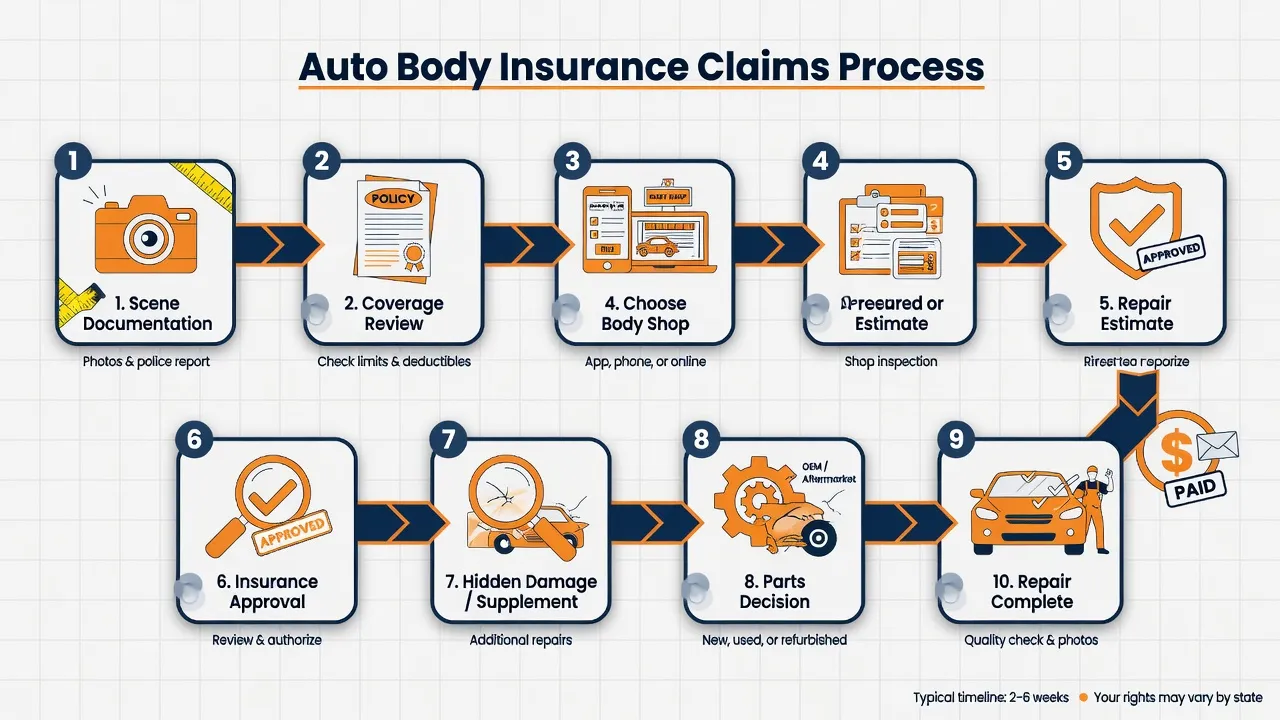
For more on working through the claims process, the insurance claim collision repair guide covers consumer rights in depth.
When OEM collision parts are worth the extra cost
Not every repair requires OEM parts. But several specific situations make OEM the more defensible choice, and in some cases, the safer one.
Safety-critical components
Bumper reinforcement bars, crumple zones, structural rails, door intrusion beams, these components are engineered to absorb and redirect crash energy in predictable ways. They go through extensive finite element analysis and crash testing as part of the vehicle's original design.
Aftermarket structural parts may meet general quality standards. They may not replicate the exact material yield strength, geometry, and welding specs of OEM equivalents. When performance in a future crash matters, not just appearance. OEM parts offer more confidence. That's not a trivial distinction.
ADAS-equipped panels
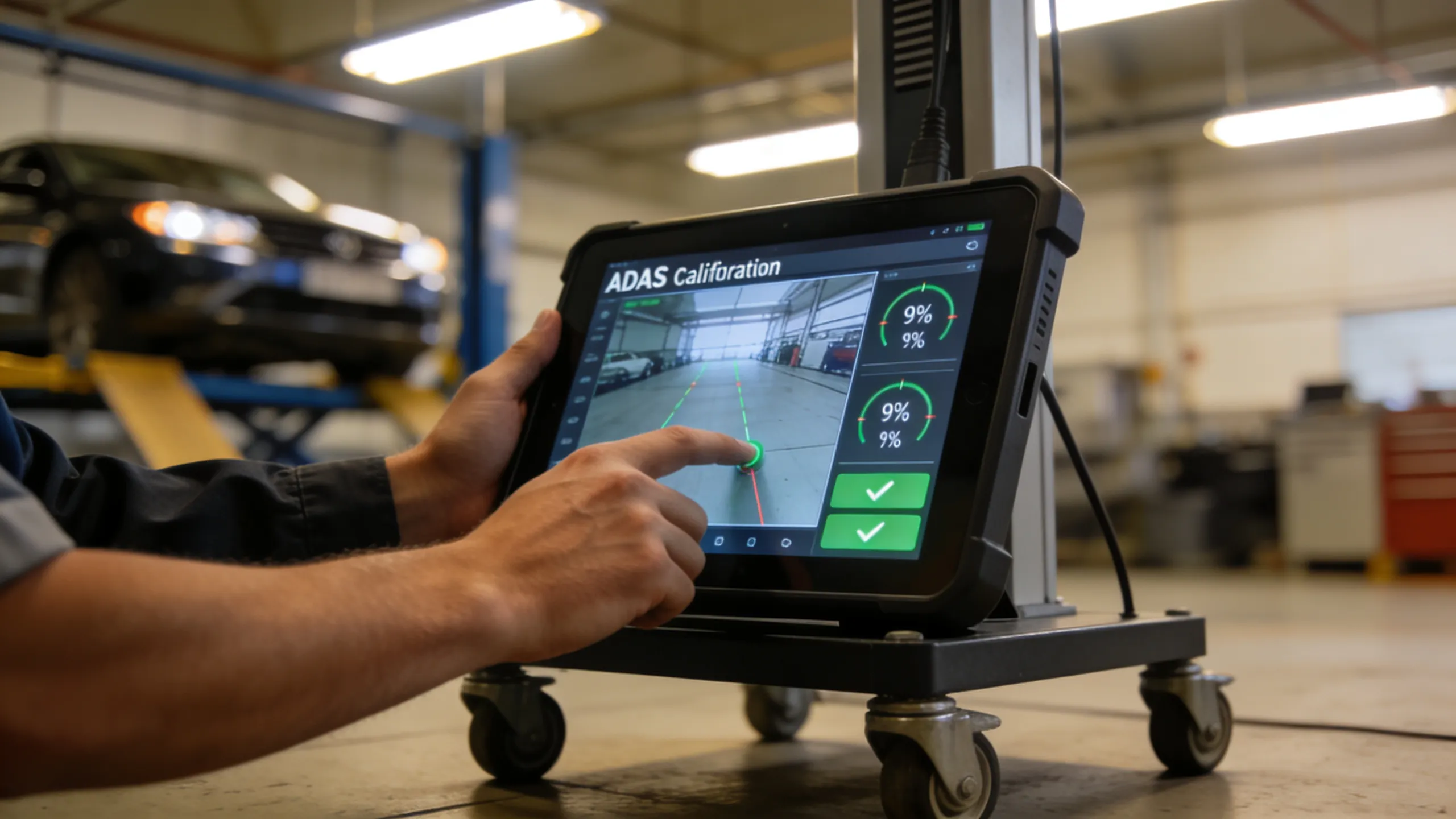
Modern vehicles integrate radar, camera, and lidar sensors into bumper fascias, mirror housings, and grille panels. Those mounting locations need precise dimensional tolerances for ADAS calibration to succeed. Even a millimeter of variation in sensor mounting geometry can cause calibration to fail or produce inaccurate system behavior.
For panels housing ADAS components, OEM parts eliminate that dimensional uncertainty. Shops following OEM repair procedures often require OEM parts for sensor-adjacent panels to ensure calibration validity. For a fuller look at how parts quality affects ADAS systems, see ADAS calibration cost and process.
Lease and warranty considerations
Vehicle lease agreements typically require the car to be returned in a condition consistent with its original specification. Using non-OEM parts in a collision repair can create disputes at lease termination if a lessor or inspection service identifies non-factory components. It happens more often than people expect.
Some automaker new vehicle warranties also include provisions related to non-OEM parts. The Magnuson-Moss Warranty Act generally prohibits manufacturers from voiding warranties solely because aftermarket parts were used, but there are specific situations, particularly with structural or powertrain-adjacent repairs, where OEM parts documentation still matters.
Resale value impact
Carfax and similar vehicle history services now track repair records in increasing detail. Buyers and appraisers are becoming more aware of repair quality indicators, including whether OEM or aftermarket parts were used. On newer vehicles or premium makes, documented OEM repairs support a stronger resale position compared to repairs using uncertified aftermarket components.
The value impact is hard to quantify precisely. But appraisers and industry research broadly agree that documented, quality repairs using OEM collision parts support better diminished value recovery outcomes. Worth factoring in if you plan to sell.
For a broader look at repair quality and certified shop standards, see certified collision repair and the collision repair cost guide. Car owners in high-cost states like California can browse auto body shops in California to compare certified providers in their area.
State Laws: What Protection Actually Exists
Consumer protection for OEM parts varies significantly by state. Know what applies where you live.
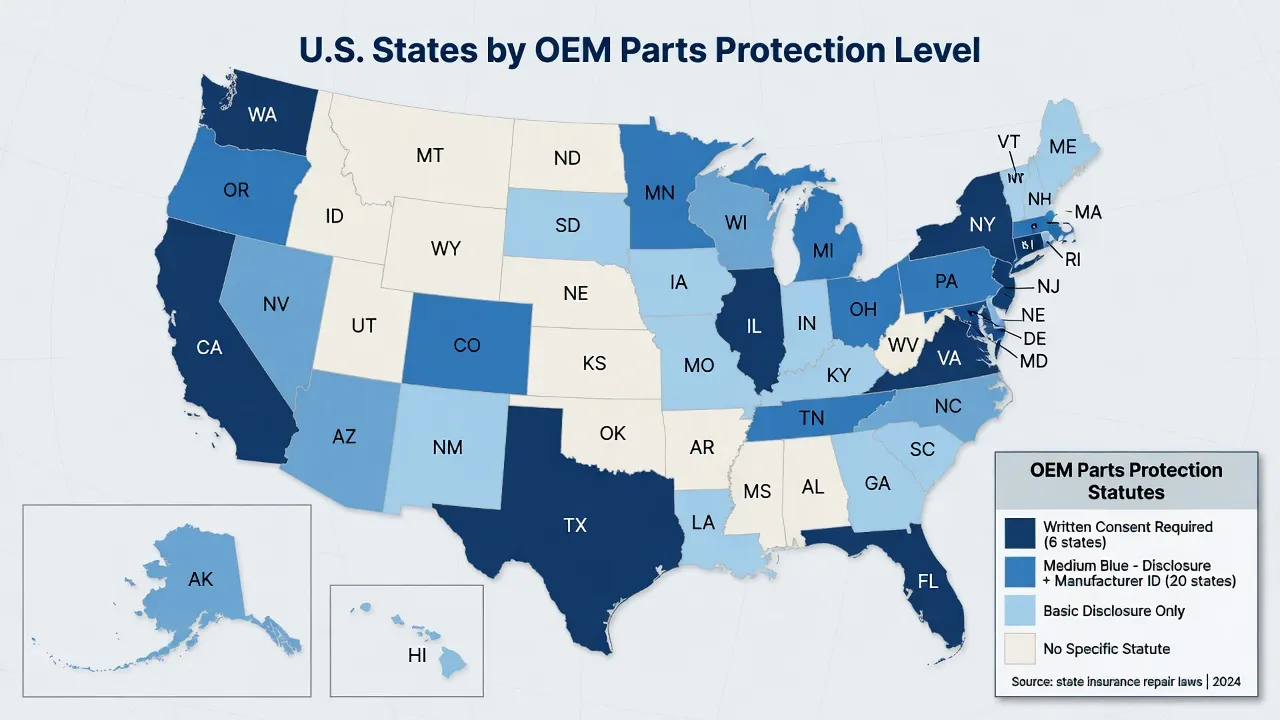
States requiring consent before using aftermarket parts: Six states require written consent from the vehicle owner before a repair facility can install non-OEM parts. Without signed authorization, the shop must use OEM components.
States requiring quality parity: Thirteen states mandate that aftermarket parts meet "like kind and quality" standards compared to OEM parts. Enforcement varies, but these laws give you a basis for challenging substandard parts.
Recent legislative developments:
- Texas SB 1429 (2026): For vehicles 36 months old or newer, insurance providers must authorize OEM glass unless the owner provides written consent for non-OEM alternatives. The disclosure must be in at least 12-point font and explicitly state the part isn't from the original manufacturer.
- New York pending legislation: Bills under consideration would require OEM parts for vehicles within two years of their model year or through the duration of the manufacturer's warranty.
- Ohio HB 636: The "Auto Insurance Transparency Act" would ensure policyholders can choose OEM parts and receive clear disclosure about what parts are being used.
California Insurance Code Section 1874.87 allows insurers to authorize aftermarket or recycled parts only if they're equal to OEM quality in safety and performance and come with a written warranty.
The real-world impact on your vehicle
Fit and finish problems
Aftermarket body parts vary in how precisely they match OEM dimensions. In blind testing conducted by a major insurer's body shop program, independent observers found that 75% to 80% of non-OEM hoods and fenders needed metal adjustment — technicians had to "massage" the panels to fit correctly. That adjustment adds labor time and, in some cases, leaves visible panel gaps or misaligned body lines that reduce the repair's cosmetic quality.
For car owners, this often surfaces at vehicle pickup. A fender that sits slightly proud of the door. A bumper cover with an uneven gap at the headlight. A hood with a crease that doesn't quite follow the vehicle's body line. These are all signs that aftermarket fit tolerances weren't tight enough for the specific vehicle.
ADAS safety system risks
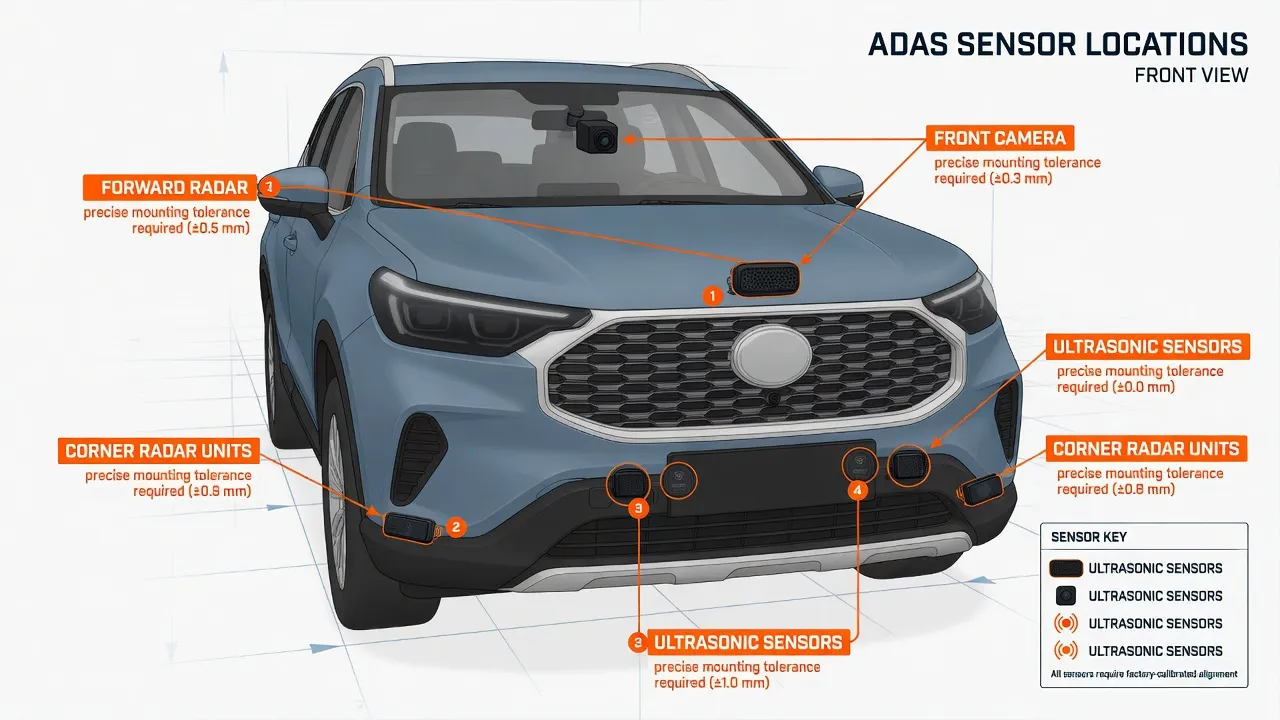
This is where the OEM vs. aftermarket parts insurance claim debate has shifted in recent years. Modern vehicles — 2019 and newer models especially — integrate radar sensors, forward-facing cameras, ultrasonic sensors, and lidar units directly into body panels, bumpers, and grille assemblies. According to CCC Crash Course 2026 data, 28.3% of repairable collision estimates now include at least one ADAS calibration line item.
The calibration process requires that sensors sit within manufacturer-specified tolerances for angle, height, and lateral position. Even a 0.6-degree deviation in camera angle can reduce the effectiveness of automatic emergency braking, according to Insurance Institute for Highway Safety (IIHS) research. A 2025 industry study found that an aftermarket windshield used without proper recalibration caused lane departure warning inconsistency and full automatic emergency braking failure during testing.
Aftermarket bumpers, grilles, and mirror housings may not position sensor mounting points within the tolerances needed for reliable calibration. In those cases, the body shop may complete the calibration with compromised results or flag the part as incompatible — which triggers a supplement claim. Either outcome costs time and, potentially, safety performance. For a full explanation of how supplement claims work and how long they take, see what is an insurance supplement in auto body repair. This issue is particularly acute for windshield replacements, where the camera mounted at the base of the glass requires OEM-grade glass thickness and clarity — see auto glass repair and ADAS recalibration for a deeper look at windshield-specific considerations.
Resale value reduction
Car buyers, used car dealers, and trade-in evaluators check repair history and flag aftermarket body panels. Vehicles repaired with aftermarket structural components can fetch 5% to 10% less on trade-in compared to equivalent vehicles repaired with OEM parts, according to trade-in valuation surveys. On a vehicle worth $30,000, that gap is $1,500 to $3,000 — a cost that materializes years after the claim, and one insurers never mention when writing the estimate.
This resale value reduction is also connected to diminished value claims. Aftermarket repairs can deepen the inherent diminished value of a repaired vehicle, since buyers perceive the repair quality as lower. For more on this, see the diminished value claim guide.
State laws: what your insurer is required to tell you
Thirty-five states have statutes or regulations addressing insurer obligations around non-OEM aftermarket parts, according to consumer rights resources maintained by crashrepairinfo.com. The protections vary widely:
31 states require that repair estimates include a disclosure statement when non-OEM parts are specified. Car owners in these states should see language on the estimate identifying aftermarket components.
20 states require the estimate to identify the manufacturer of each non-OEM part — not just note that aftermarket parts are used generally.
Six states require the consumer's written consent before non-OEM parts can be installed:
- Arkansas — written notice required
- Indiana — written consent required for vehicles within five model years
- Kansas — estimate must identify non-OEM parts
- Rhode Island — written consent required for vehicles within 30 months of model year
- West Virginia — written notice required before use
- Additional state requirements are being adopted: Louisiana introduced legislation in 2026 requiring written consent before any non-OEM installation on first-party and third-party claims
California requires that car owners receive an Auto Body Repair Consumer Bill of Rights disclosing their options. Aftermarket part manufacturers must be identified in writing when their parts are used in California repairs. Car owners looking for shops in California that work with OEM parts can find them through the auto body shops in California directory.
Even in states without consent requirements, the "pre-loss condition" standard in most policies creates a path for disputing aftermarket parts that demonstrably don't restore the vehicle to original quality — particularly for ADAS-equipped components.
Important: Regardless of state law, car owners always have the right to request OEM parts and pay the cost difference out of pocket. The insurer controls what the policy covers — not what parts the body shop installs. That distinction gives every car owner leverage, in every state.
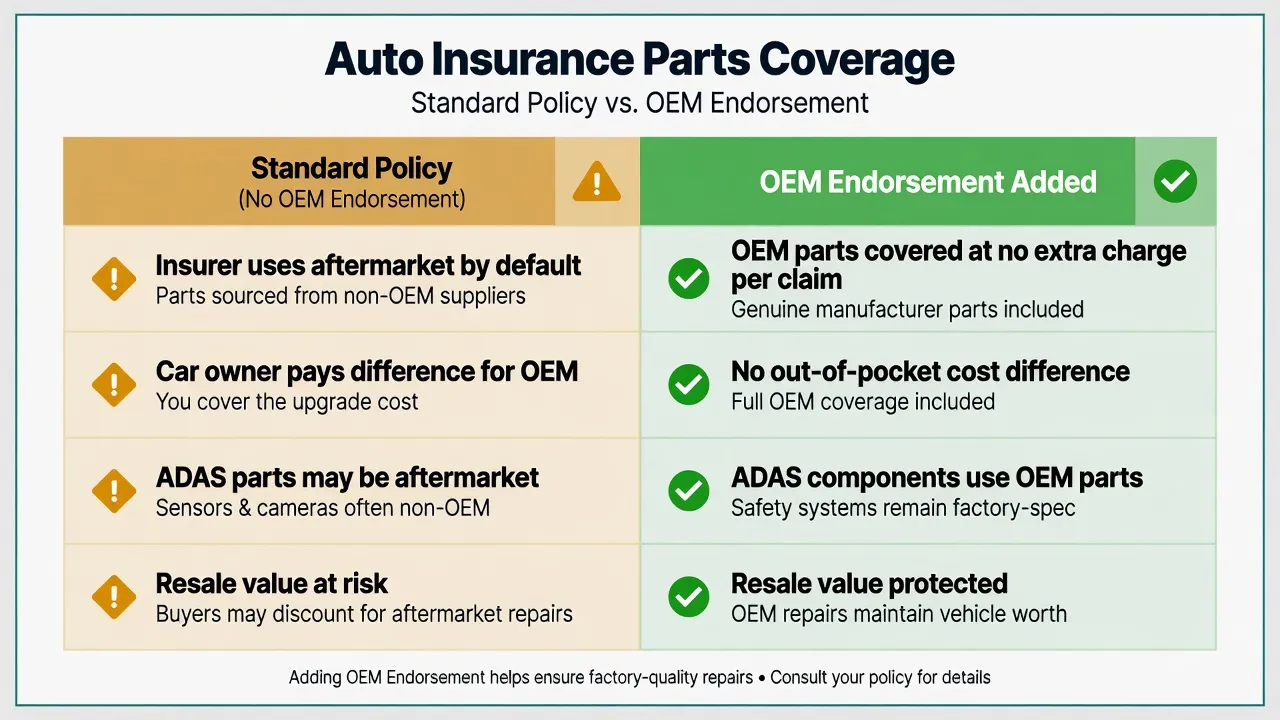
OEM endorsements: adding protection before the next claim
An OEM parts endorsement is a policy add-on that obligates the insurer to cover original manufacturer parts, regardless of their default parts policy. Not all insurers offer this endorsement, and it applies only to vehicles within a certain age window (commonly five to ten model years).
Some insurers offer OEM parts endorsements as a named add-on to the policy, while others allow policyholders to request OEM parts at claim time with the cost difference paid out of pocket — without a formal endorsement requirement. Coverage varies by carrier, and not all insurers offer an OEM endorsement for passenger cars at all. Reviewing the policy declarations page, or calling the insurer directly before a claim occurs, is the most reliable way to understand what OEM coverage is available.
Cost for an OEM endorsement is $20 to $50 per year added to the annual premium — a modest amount relative to the $1,500 to $3,000 resale value protection it can preserve.
If a vehicle is newer, financed, or leased, an OEM endorsement deserves serious consideration. Many lease agreements and manufacturer warranties include language that could be affected by aftermarket repair parts.
New vehicles, warranties, and the Magnuson-Moss Warranty Act
Car owners with vehicles still under the manufacturer's original warranty should know how aftermarket parts interact with warranty coverage. The Magnuson-Moss Warranty Act (15 U.S.C. § 2302) prohibits manufacturers from voiding a vehicle warranty solely because an aftermarket part was used — unless the manufacturer can show that the aftermarket part caused the defect or failure at issue.
In practice, a manufacturer can't void the entire powertrain warranty because an aftermarket bumper cover was installed after a collision. But if an aftermarket sensor bracket leads to a calibration failure that damages the vehicle's ADAS control module, the manufacturer may deny warranty coverage for that specific system failure on the grounds that the aftermarket part caused the damage.
For vehicles under warranty, requesting OEM parts — for any component near a sensor, camera, or structural weld point — reduces this risk.
Key takeaways
The OEM vs aftermarket parts car decision isn't one-size-fits-all. The right answer depends on the component, the vehicle, and the specific context of the repair.
Use OEM parts when:
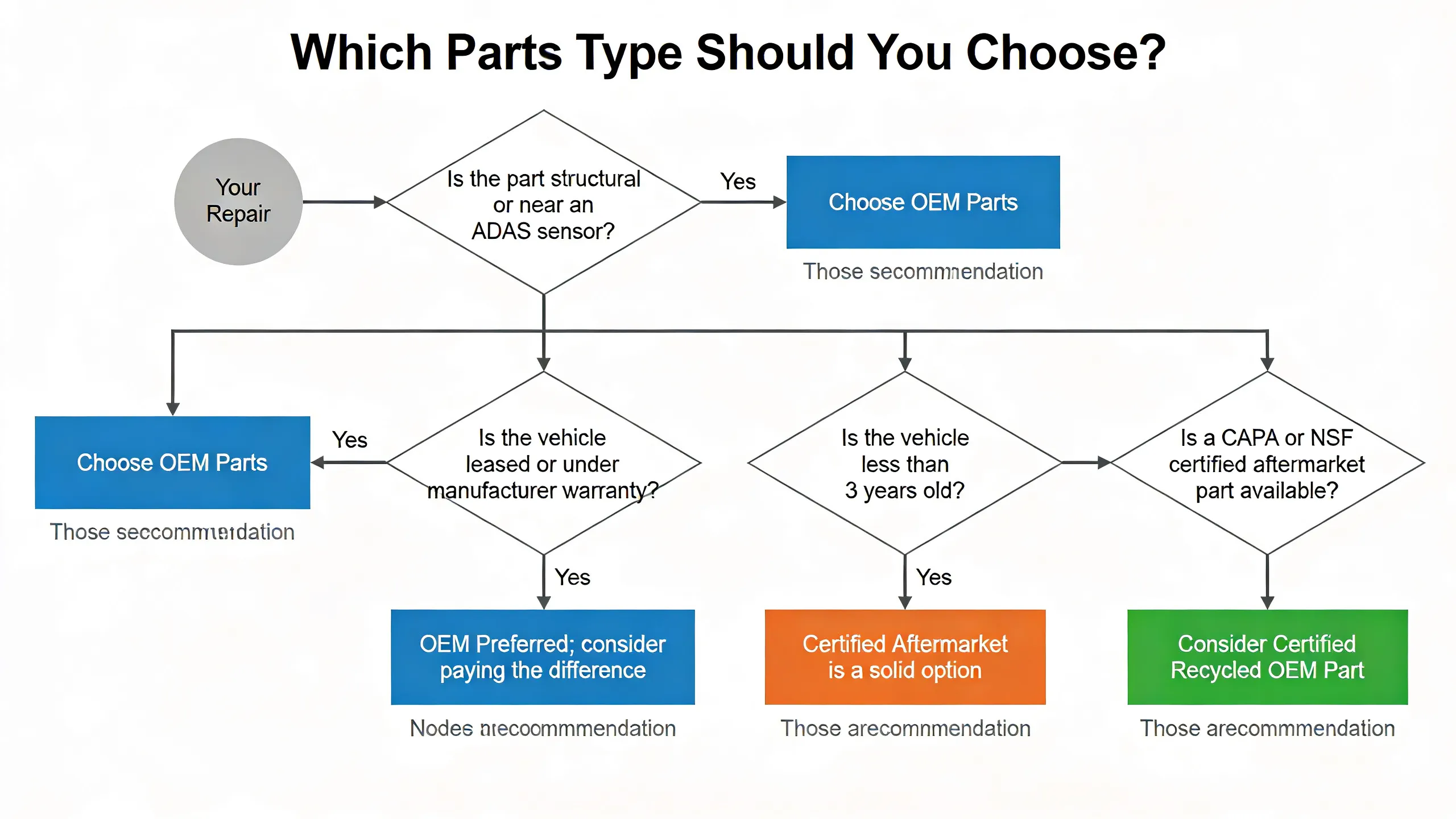
- The component is structural or safety-critical.
- The vehicle has active ADAS sensors near the repair area.
- The car is leased, under manufacturer warranty, or relatively new.
- Long-term resale value is a priority.
Certified aftermarket parts are a reasonable option when:
- The repair involves cosmetic or non-structural panels on older vehicles.
- The parts carry CAPA or NSF certification.
- The insurer's estimate uses certified parts and cost savings are meaningful.
- The body shop confirms proper fit during the repair process.
Certified recycled parts can work when:
- The vehicle is older and OEM parts are no longer in production.
- A high-quality, low-mileage used part is available with documentation.
- The salvage facility provides graded condition information and a warranty.
For any claim involving parts, you should:
1. Review the estimate and identify the part type specified for each line item.
2. Ask whether aftermarket parts are CAPA or NSF certified.
3. Understand state disclosure laws that may apply.
4. Request OEM parts for structural or ADAS-adjacent components, even if it means paying the difference.
5. Keep all documentation, part numbers, certification markings, installation records, for warranty and resale purposes.
For collision repairs involving significant damage, finding a shop with OEM certification for the vehicle's brand can help ensure parts and procedures align. Browse collision repair shops in your area to compare options and certifications.
Frequently asked questions
What's the difference between OEM and aftermarket parts?
OEM (Original Equipment Manufacturer) parts are made by the vehicle's original supplier, ensuring an exact fit, finish, and material match. Aftermarket parts come from third-party manufacturers and vary in quality. Certified aftermarket parts (CAPA or NSF) meet tested standards; uncertified parts have no verified quality baseline.
Are aftermarket body parts safe?
CAPA- or NSF-certified aftermarket parts are independently tested for fit, finish, and material performance against OEM benchmarks. Uncertified parts have no standardized quality verification. For cosmetic, non-structural repairs on older vehicles, certified aftermarket parts are generally considered a quality-adequate option by insurers and professional body shops.
Can I request OEM parts from my insurance company?
Yes. Car owners can request OEM collision parts on an insurance claim. Insurers may require paying the cost difference between aftermarket and OEM pricing. Some states require disclosure when non-OEM parts are used and provide additional protections for newer or leased vehicles. Reviewing your state's regulations and policy language is the recommended first step.
Are OEM parts worth the extra cost?
For structural components, parts near ADAS sensors, and vehicles where warranty or lease conditions apply, OEM parts are generally worth the premium. For cosmetic repairs on older vehicles using certified aftermarket parts, the cost savings are meaningful and the quality gap is narrower. The decision depends on the component type, vehicle age, and the car owner's priorities.
What are CAPA certified aftermarket parts?
CAPA (Certified Automotive Parts Association) is an independent certification program that tests aftermarket collision parts for fit, finish, corrosion resistance, and material performance against OEM equivalents. Parts that pass CAPA testing earn a certification seal and are considered a quality-verified alternative to OEM. CAPA-certified parts are accepted by most insurance carriers and are a meaningful quality indicator when evaluating aftermarket options. More information is available at capacertified.org.
Do aftermarket parts void my warranty?
Under the Magnuson-Moss Warranty Act, manufacturers generally can't void an entire warranty because aftermarket parts were used. However, if an aftermarket part causes damage to a warranty-covered component, that specific claim may be denied. For vehicles under active coverage, OEM parts are the safest choice for sensor-adjacent or structural repairs.
Insurance processes, state laws, and parts availability are subject to change. Consult your insurance policy and state insurance department for guidance specific to your situation. Parts specifications may vary by vehicle make, model, and year.