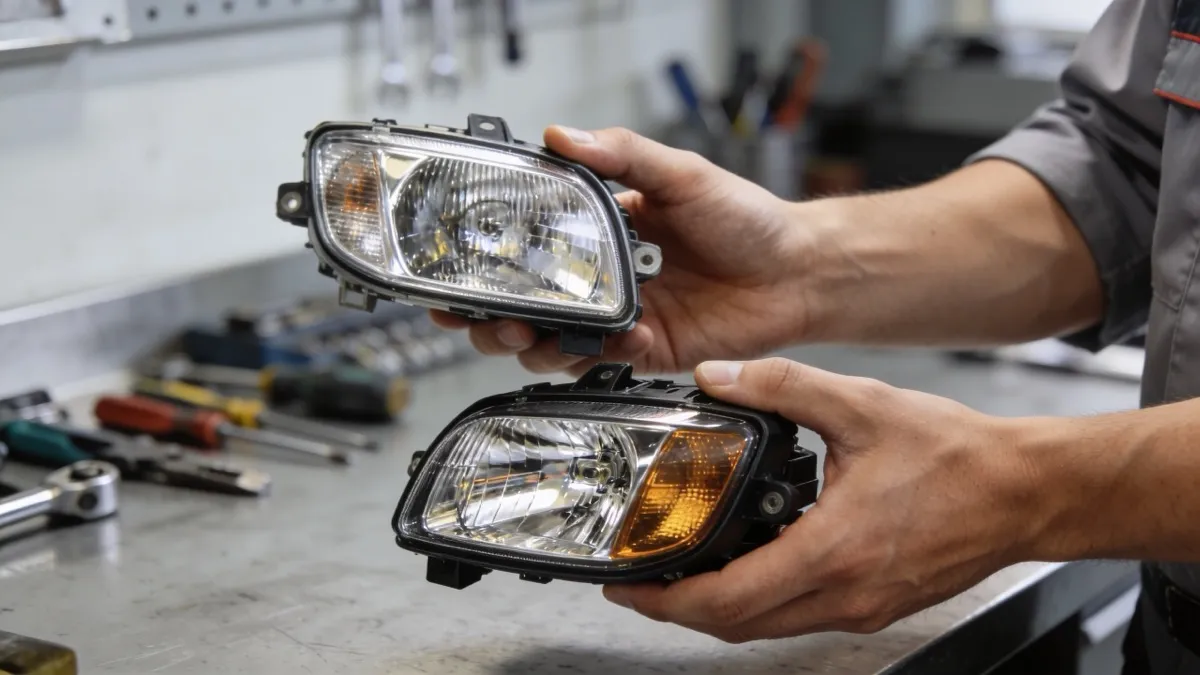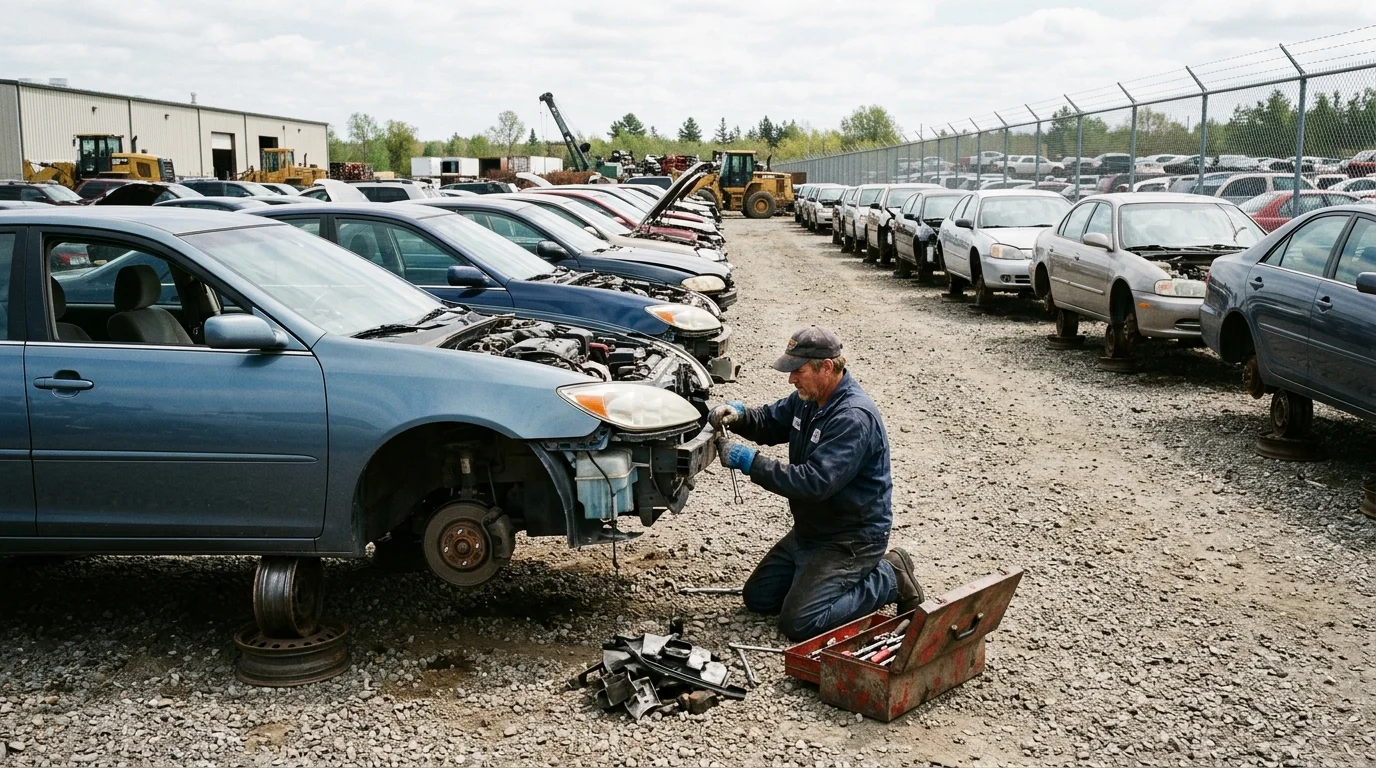
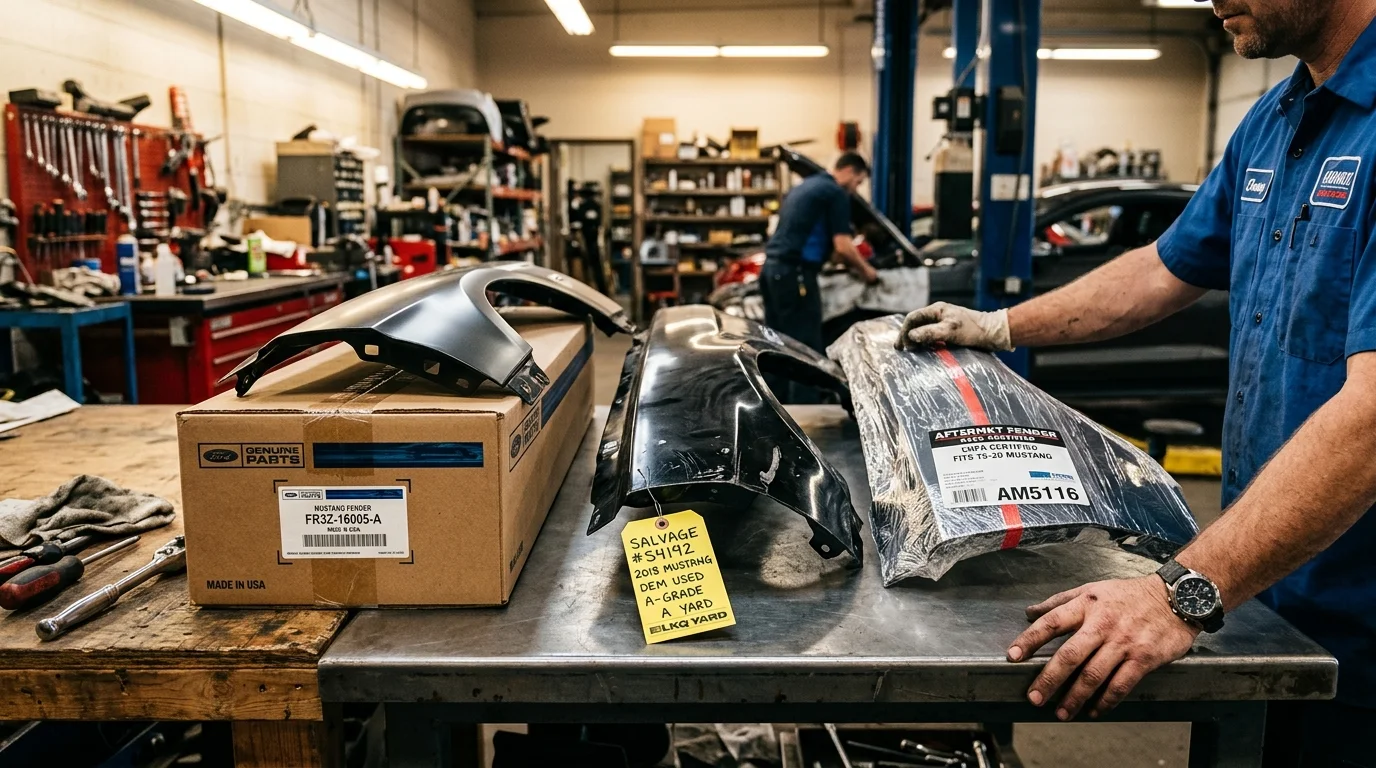
Your body shop can install three kinds of replacement parts: used OEM parts pulled from wrecked vehicles, aftermarket parts made by third-party manufacturers, and new parts from the automaker. Used OEM parts are genuine factory parts with prior service life, which is why they fit like the original — and why insurers like them, since recycled parts run 20% to 80% cheaper than new ones, according to the Automotive Recyclers Association. The part type is written on your estimate, but only if you know the abbreviation to look for.
Key Takeaways
- Recycled OEM parts save 20–80% vs new OEM and fit identically — they were made on the same factory tooling (ARA).
- Only ~20% of aftermarket crash parts carry CAPA certification; 75–80% used by shops have no independent quality seal (Forbes/CAPA).
- Ford, Lincoln, and GM issued 2026 position statements prohibiting recycled or aftermarket ADAS sensors and cameras — body panels are still fine.
- Your estimate lists part type on every line (OEM, LKQ, A/M, CAPA) — ask to see the full line-item breakdown before parts are ordered.
- The Magnuson-Moss Warranty Act prevents automakers from voiding your warranty over non-OEM parts unless the part caused the failure.
Most car owners never learn which of the three went on their car. The decision gets made in the window between the estimate and the parts order, by an estimator working from an insurer's parts guidelines and a distributor's inventory screen. This guide walks through that supply chain — where each part type comes from, who decides, and how to read your own paperwork to find out what is bolted to your vehicle right now. If you are still deciding which type you want, start with our breakdown of OEM vs aftermarket parts for auto body repair; this page is about what happens behind the counter afterward.
The three types of parts your body shop can install
Used OEM parts are genuine factory parts with the best fit and the lowest price; new OEM parts are identical to what left the factory and cost the most; aftermarket parts are new but built by a different company to a copied design. Every collision estimate is a mix of these three, and the mix is chosen part by part.
Used OEM (also called recycled OEM, salvage, or LKQ parts)
These are original factory parts removed from vehicles that were totaled, flooded, or retired. A door from a low-mileage sedan rear-ended in a parking lot is still a perfectly good door, and because it was made on the same tooling as the panel it replaces, the fit, mounting points, metal gauge, and corrosion coatings are all factory-correct.
The trade is condition and availability. A recycled fender may carry the donor car's paint, minor dings, or a repaired area from an earlier incident. Recyclers grade parts A, B, or C by damage severity, but grading is not standardized across the industry the way certification is. The detail on picking good ones is in our guide to buying used auto body parts from a salvage yard without getting burned.
Aftermarket parts
Aftermarket crash parts are new parts made by companies with no relationship to the automaker, reverse-engineered from the original. They are cheap to stock, widely available on common vehicles, and heavily favored in insurer parts guidelines. Quality ranges from genuinely excellent to unusable — a spread certification programs exist to narrow, with mixed results.
New OEM parts
These come in a factory box from a dealer parts department. They are the baseline every other part type is measured against, and the only type covered by the automaker's warranty and validated in its own testing. They also cost the most and, on newer or low-volume models, may be the only option that exists.
| Part type | Who made it | Relative cost | Fit | Warranty source |
|---|---|---|---|---|
| New OEM | The automaker | Highest | Exact by definition | Vehicle manufacturer |
| Used / recycled OEM | The automaker (prior service life) | 20–80% below new OEM (ARA) | Factory tooling, so exact | Recycler or distributor |
| Aftermarket | Third-party manufacturer | Below new OEM; varies widely | Varies by supplier and certification | Part manufacturer or distributor |
| Remanufactured | OEM core, rebuilt to spec | Between used and new | Factory tooling | Remanufacturer |
How often does each show up? Mitchell's collision data put the split at roughly 63.6% of parts dollars to new OEM, 22.45% to aftermarket, 10.46% to recycled, and 3.48% to remanufactured; by the first half of 2023, Mitchell had aftermarket at 21.5% and recycled at 9.4%. Neither CCC nor Mitchell publishes the current breakdown outside their paid reports, so treat those as the last firm public numbers — but the shape holds: roughly two-thirds new OEM, a fifth aftermarket, one part in ten recycled.
That balance is shifting toward alternatives. CCC's Crash Course 2026 found aftermarket part dollars up 1.7% year over year in 2025 while OEM part dollars fell 1.8%. Enlyte, Mitchell's parent, reported OEM part prices rising 4.21% in 2025 against 3.89% for aftermarket. When OEM prices climb faster, insurers steer harder toward everything else.
How body shops actually source parts
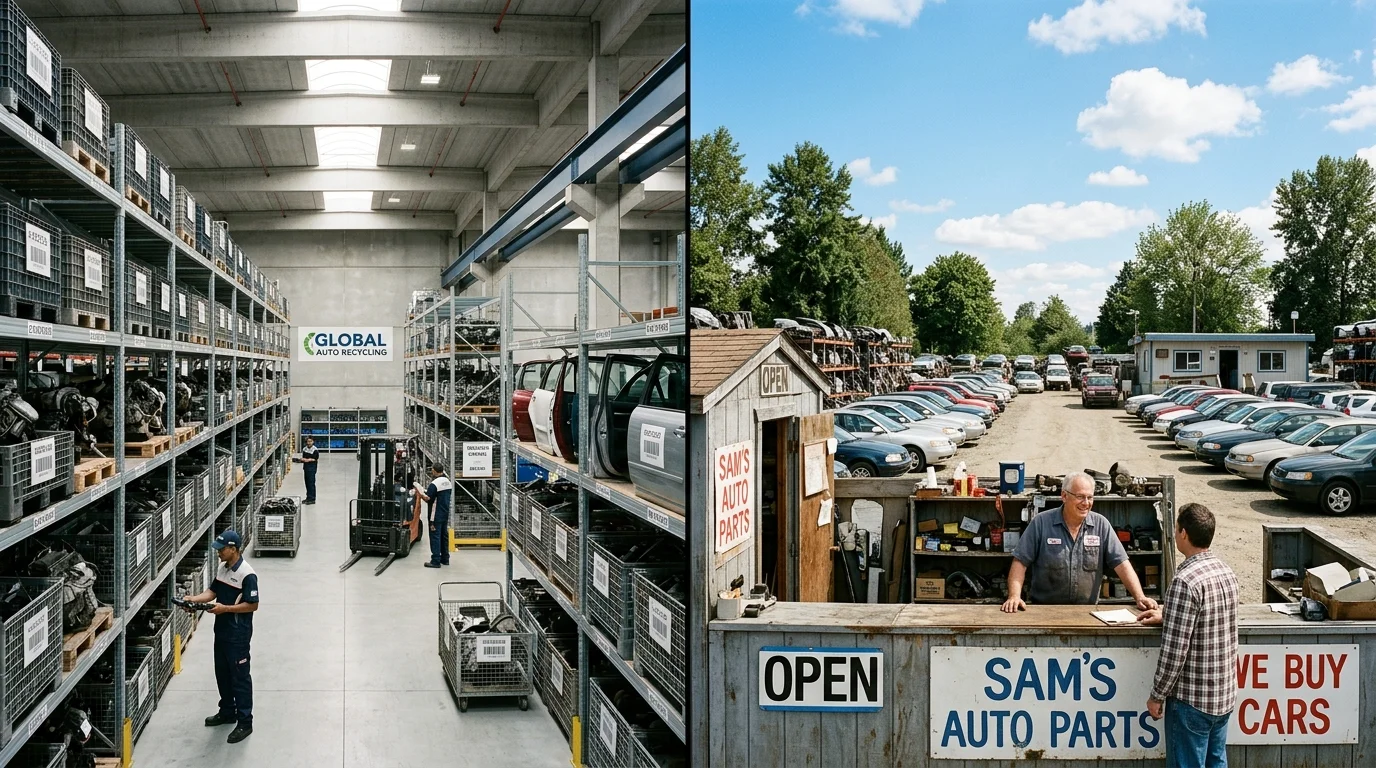
Shops buy from four channels — recycled parts distributors, local salvage yards, aftermarket wholesalers, and dealer parts counters — and most of the ordering happens inside the estimating software, not over the phone. When an estimator writes a line for a right front fender, the software surfaces available alternatives with prices and delivery times from suppliers in the shop's network. The estimator picks, and a purchase order goes out. The four channels:
- National recycled parts distributors. LKQ Corporation is the dominant one, reporting $13.651 billion in 2025 revenue ($5.651 billion from North America) and processing roughly 284,427 end-of-life vehicles that year, reusing or remanufacturing more than 4.9 million individual parts. Scale buys inventory visibility and next-day delivery — the two things a shop cares about most.
- Local independent salvage yards. Smaller operations, often better on price and on unusual vehicles, but with thinner inventory systems. We compare the two directly in LKQ vs local salvage yards.
- Aftermarket wholesalers. Distributors stocking third-party bumper covers, fenders, hoods, lamps, and grilles for high-volume vehicles.
- Dealer parts departments. For new OEM — the default when a vehicle is late-model, structurally complex, or carries sensors in the damaged area.
The Hollander Interchange: why a part from a different car fits yours
Recycled parts sourcing runs on a database most car owners have never heard of. The Hollander Interchange, now a Solera business unit with more than 80 years of history in automotive recycling, assigns a number to each part and maps every other vehicle that used the same or a compatible component. It covers more than 160 part types across more than 1,000 models built since 1965.
This is why a recycler can supply a genuine OEM door for your 2019 sedan that came off a 2021 model, or off a corporate-cousin nameplate built on the same platform. It is not a substitute part — it is the same part, made on the same tooling, that happened to be installed on a different car. That distinction is the most misunderstood thing about recycled parts.
"Like kind and quality": what the phrase actually means
Like kind and quality (LKQ) is insurance language meaning a replacement part must be at least equal to the original in fit, quality, and performance — but no regulation defines those three words, which is why the standard is argued about constantly.
The phrase traces to the NAIC's 1987 model regulation on aftermarket parts, which states that an insurer "shall not require the use of after market parts in the repair of an automobile unless the after market part is at least equal in kind and quality to the original part in terms of fit, quality and performance." The model also requires written disclosure on the estimate, in type no smaller than 10 points, when non-OEM parts are specified. Most states built their rules on that template.
Iowa shows what the standard looks like in force. Iowa Administrative Code rule 191-15.45 requires aftermarket crash parts to be "certified by a nationally recognized entity to be at least equal in kind and quality to the original equipment manufacturer part in terms of fit, quality and performance," and mandates this policy language: "Physical damage coverage under this policy includes payment for aftermarket crash parts. If you repair the vehicle using more expensive original equipment manufacturer (OEM) parts, you may pay the difference."
Two things to keep straight. First, "fit, quality and performance" are nowhere defined in the model language — the ambiguity is structural, not accidental. Second, LKQ the standard and LKQ the company are unrelated: LKQ Corporation is a parts distributor, like kind and quality is a claims term. Consumers conflate them constantly, and so do some estimates.
For the full picture on what an insurer can and cannot require of you, see can your insurance company force you to accept used parts?
CAPA certification: what the yellow seal covers
CAPA certification means an aftermarket part passed independent testing for fit, material composition, and coating quality — but it does not include a full-vehicle crash test, and only a minority of aftermarket parts carry the seal.
The Certified Automotive Parts Association was founded in 1987 and has certified parts since 1990, passing 128 million certified parts by September 2021. It is accredited by ANSI to develop American National Standards, with approved standards covering bumper cover dimensional stability, hood striker retention, and radiator vibration testing.
What certification actually tests, per CAPA's published program:
- Material composition and mechanical properties against the OEM part
- Dimensional accuracy, including an actual vehicle test fit
- Coating performance and corrosion resistance — CAPA requires sheet metal parts like hoods and fenders to be galvanized even when the OEM part is not
- Electromagnetic compatibility for electronic parts, plus durability and FMVSS safety compliance
- Two stages: the factory is approved first, then individual parts, with ongoing random inspections of both
CAPA runs 14 certification categories, including newer ones for exterior cameras, automotive sensors, and windshields — a direct response to sensors migrating into body panels and glass.
The limits matter as much as the coverage. CAPA certification does not include whole-vehicle crashworthiness testing comparable to NHTSA or IIHS protocols; there are no federal rules governing crash testing of aftermarket crash parts at all. And penetration is low: CAPA's own executive director told Forbes that only about one in five aftermarket replacement parts is CAPA certified, and that 75–80% of certifiable parts used by collision repairers carry no seal. That figure dates to 2017 and CAPA has not published an update, but nothing suggests certification has become the norm since.
The practical read: a yellow CAPA seal is meaningfully better than an uncertified aftermarket part, and the seal on the part is the only proof of it. It is not equivalence with OEM, and nobody at CAPA claims it is.
How the parts choice changes your repair
Part type affects four things you will actually notice: how long the repair takes, who honors the warranty, whether the ADAS sensors recalibrate cleanly, and what you can argue at resale.
Fit and cycle time
A part that does not fit costs days, not dollars. When an aftermarket panel needs gaps massaged or mounting tabs modified, the shop either eats the labor or writes a supplement, and your car sits. Recycled OEM avoids that failure mode by construction. It is one reason many shops quietly prefer recycled OEM over aftermarket for large panels even when both are approved.
Warranty — yours and the part's
Using an aftermarket or recycled part does not void your vehicle warranty. Under the Magnuson-Moss Warranty Act, 15 U.S.C. § 2302(c), no warrantor may condition a written or implied warranty on the consumer using a branded article or service. To deny a claim, the manufacturer must show the specific part caused the failure.
What changes is who backs the part. LKQ offers a limited lifetime warranty on recycled sheet metal covering defects and rust-through for as long as the original purchaser owns the vehicle — but it excludes installation labor unless pre-approved, excludes damage from a subsequent accident or improper installation, and does not apply to commercial vehicles. Utah's H.B. 119, effective May 6, 2026, requires estimates to spell out exactly this: non-OEM part warranties come from the part manufacturer or distributor, not the vehicle manufacturer.
ADAS and sensor calibration — the part of this that changed in 2026
This is where automakers have drawn a hard line, and recently. In a position statement dated May 1, 2026, Ford and Lincoln stated that "ADAS validation has only been done on Ford or Lincoln Genuine Parts," and that sensors from a recycler, salvage yard, aftermarket supplier, or reconditioning operation are off the approved list and "may not pair correctly with the vehicle's software or with the other sensors around them." Ford also now requires calibration of every ADAS component touched during a repair, fault code or not, noting that "a misaligned sensor will not always log a fault." Days earlier, on April 28, 2026, GM rejected salvaged, recycled, reconditioned, remanufactured, aftermarket, and secondary-market ADAS components as "not approved and strictly prohibited by GM."
Read the scope carefully: both statements target ADAS components — cameras, radar modules, sensors — not fenders and doors generally. A recycled quarter panel on a 2020 crossover raises none of these concerns. A recycled front radar module does.
The volume keeps growing. CCC found calibrations on 35.6% of repairable estimates in Q3 2025, up from 26.9% a year earlier, with the average calibration fee climbing from roughly $188 to $485.56 across 2025. Enlyte, measuring a different data set, put calibration penetration at 34.7% of 2025 estimates versus 12.1% in 2022.
One counterpoint cuts against the simple story. UK Transport Research Laboratory research concluded that Original Equipment Equivalent glass does not impair ADAS sensor function, and AAA's testing found an ADAS windshield replacement costs $1,200–$1,600 with aftermarket glass against $1,300–$1,650 with factory glass. On sensor-bearing glass the savings from going aftermarket are small, because the cost is the calibration labor, not the pane. AAA also found ADAS components can add up to 37.6% to total repair cost after a crash.
Resale value
Here the honest answer is that nobody has measured it. Appraisers and insurers argue routinely about whether non-OEM parts depress a vehicle's value, and it is a standard element in diminished value claims — but no published study puts a number on the effect attributable to parts choice specifically. Be skeptical of any article that quotes you a percentage; we could not find a primary source for one.
How to find out what parts your shop is using
The answer is on your estimate, in a column most people skip. Every major estimating system flags part type with a code next to each line.
Ask for the full line-item estimate, not the summary total, and look for these markers:
- OEM, NEW, or a dealer part number — new original equipment
- LKQ, RECY, or QRP — recycled/used OEM (Quality Replacement Part is a common label)
- A/M, AM, or CAPA — aftermarket, with CAPA indicating certified
- RMAN or RECOND — remanufactured or reconditioned
- OPT OEM — optional OEM, a discounted-price genuine part program
Then verify physically. Genuine OEM parts carry the automaker's logo stamped or molded in; recycled OEM parts carry that logo plus a recycler's inventory tag; CAPA-certified parts carry a yellow seal with a traceable certification number — no seal, no certification, regardless of what the invoice says. On a bumper cover or fender these markings sit on the inner face, visible before paint and often still visible from underneath afterward.
Three questions worth asking your estimator: which lines here are non-OEM, who wrote that requirement — the insurer's guidelines or the shop's preference, and will you show me the part before it goes on? A shop that hesitates on the third is telling you something. Our list of 7 red flags in body shop estimates covers the rest, and an OEM-certified collision center is contractually bound to that automaker's parts and procedure requirements.
What to do if you want OEM parts
You have three routes: pay the difference yourself, buy an OEM parts endorsement before you ever have a claim, or invoke a state law that limits non-OEM parts on your vehicle.
Pay the difference. The most common path, and the one written into policy language in states like Iowa. Your insurer pays the aftermarket or recycled price and you pay the gap. Get the differential in writing per line — it is often smaller on individual parts than people expect.
Buy an OEM endorsement. Many carriers sell an original-parts endorsement for a modest premium. It only helps if you buy it before the accident, which is why almost nobody has it. If your car is under five years old or carries meaningful ADAS content, price it at your next renewal.
Check your state's rules. A widely cited 50-state survey by Matthiesen, Wickert & Lehrer found roughly 35 states with rules covering insurer obligations on non-OEM crash parts, 31 requiring a disclosure statement with the estimate, 20 requiring the non-OEM manufacturer be identified, 13 requiring like kind and quality, and 6 requiring the insured's consent before use. That survey was last updated in September 2017, so verify with your own state insurance department before relying on a count. The strongest documented age-based restriction is Rhode Island's, where non-OEM parts require the owner's express written consent on vehicles less than 48 months past their manufacture date.
Newer activity is worth tracking. Utah's H.B. 119 took effect May 6, 2026, adding notification and estimate-disclosure requirements, with the policy notice obligation applying to policies issued or renewed on or after October 1, 2026. Ohio's H.B. 636 and New York's S4753 would go further on parts choice, but both remain pending. The federal REPAIR Act (H.R. 1566 / S. 1379) is frequently miscited as a parts bill — it governs access to diagnostic data, tools, and repair information, not part type.
Whichever route you take, the leverage is the same: raise it before the parts are ordered, not after they are painted. Once a recycled fender is color-matched and hung, changing course means a new part, new paint, and an argument about who pays. Our guide to collision repair cost covers what to expect on the total, and you can compare shops near you for collision repair or general auto body repair before you commit.
Sources
- I-CAR — repair procedures and parts selection guidance
- CCC Intelligent Solutions — auto claims and repair data analytics
Frequently Asked Questions
Are used OEM parts as good as new OEM parts?
In fit and material, yes — a recycled OEM part was made on the same factory tooling as the part it replaces, so mounting points, metal gauge, and corrosion coatings are identical. The variables are cosmetic condition and prior service life, which is why parts are graded before sale. The exception is ADAS components: Ford, Lincoln, and GM all published position statements in 2026 prohibiting recycled sensors, cameras, and radar modules regardless of physical condition.
Can I refuse used or aftermarket parts on my repair?
You can ask for OEM, and in most cases you can get it by paying the difference between what your insurer approved and the OEM price. Whether your insurer must pay for OEM depends on your policy language and your state — roughly 6 states require your consent before non-OEM parts are used, and Rhode Island bars them without written consent on vehicles less than 48 months old. Our post on whether insurance can force used parts on you covers the mechanics.
Do aftermarket or used parts void my car's warranty?
No. The Magnuson-Moss Warranty Act (15 U.S.C. § 2302(c)) prohibits a manufacturer from conditioning your warranty on the use of branded parts or service. To deny a specific claim, the automaker has to show the non-OEM part caused the failure. What you do lose is manufacturer backing on the part itself — a non-OEM part is warranted by the part maker or distributor instead, which Utah's 2026 disclosure law now requires estimates to state outright.
What does LKQ mean on my body shop estimate?
On an estimate line, LKQ almost always means "like kind and quality" — the insurance term for a recycled or used OEM part meeting the fit, quality, and performance standard. It is not necessarily a part from LKQ Corporation, the parts distributor, though the acronym collision causes endless confusion. If the line item matters to you, ask which supplier the part is coming from by name.
Are CAPA certified parts as good as OEM?
CAPA certification verifies material composition, dimensional accuracy with a real vehicle test fit, corrosion coating, and electromagnetic compatibility against the original part — meaningfully more rigorous than no certification. It does not include full-vehicle crash testing, and no federal rules require crash testing of aftermarket crash parts. Treat the yellow seal as a floor on quality, not as equivalence with a factory part.
How much cheaper are recycled auto body parts?
The Automotive Recyclers Association puts the savings at 20% to 80% off comparable new parts, though as a trade association it does not publish the methodology behind that range. A concrete example from CCC estimate data: a recycled door at about $2,000 against roughly $4,000 for the new OEM equivalent. Savings run widest on large panels for common vehicles and narrowest on late-model or low-volume cars where donor supply is thin.
Sources
- Mitchell International, Collision Repair Industry Data, Q2 2018 — https://www.mitchell.com/insights/article/auto-physical-damage/mitchell-collision-repair-industry-data-q2-2018 (retrieved 2026-08-12)
- Aftermarket Matters, Collision Claims: What every insurer, repairer and OEM needs to know (Mitchell H1 2023 parts-mix data) — https://www.aftermarketmatters.com/national-news/collision-claims-what-every-insurer-repairer-and-oem-needs-to-know/ (retrieved 2026-08-12)
- CCC Intelligent Solutions, Crash Course 2026: Complexity Compounds — https://www.cccis.com/reports/crash-course-2026 (retrieved 2026-08-12)
- CCC Intelligent Solutions, Crash Course Q4 2025 — https://www.cccis.com/reports/crash-course-2025/q4 (retrieved 2026-08-12)
- Enlyte, Navigating Complexity in Collision Claims (Envision Trends Report 2026) — https://www.enlyte.com/insights/article/industry-trends/navigating-complexity-collision-claims (retrieved 2026-08-12)
- Automotive Recyclers Association, ROE — Recycled Original Equipment — https://www.a-r-a.org/roe-recycled-original-equipment/ (retrieved 2026-08-12)
- Automotive Recyclers Association, Industry Statistics — https://www.a-r-a.org/industry-statistics/ (retrieved 2026-08-12)
- LKQ Corporation, Announces Results for Fourth Quarter and Full Year 2025 — https://investor.lkqcorp.com/news/news-details/2026/LKQ-Corporation-Announces-Results-for-Fourth-Quarter-and-Full-Year-2025/default.aspx (retrieved 2026-08-12)
- Auto Recycling World, LKQ's 2025 Sustainability Report — https://autorecyclingworld.com/lkqs-2025-sustainability-report-puts-salvage-volumes-european-expansion-and-ev-repair-at-the-core/ (retrieved 2026-08-12)
- LKQ Corporation, Our Industry-Leading Warranty — https://lkqcorp.com/about-us/our-industry-leading-warranty/ (retrieved 2026-08-12)
- Solera, Hollander Solutions — https://www.solera.com/solutions/vehicle-repair/hollander/ (retrieved 2026-08-12)
- Hollander Solutions, Products — https://www.hollandersolutions.com/products/ (retrieved 2026-08-12)
- NAIC, Model Law 891: After Market Parts Model Regulation — https://content.naic.org/sites/default/files/model-law-891.pdf (retrieved 2026-08-12)
- Iowa Administrative Code r. 191-15.45, Guidelines for use of aftermarket crash parts (Cornell LII) — https://www.law.cornell.edu/regulations/iowa/Iowa-Admin-Code-r-191-15-45 (retrieved 2026-08-12)
- Certified Automotive Parts Association, What We Certify — https://www.capacertified.org/About/WhatWeCertify (retrieved 2026-08-12)
- Certified Automotive Parts Association, The Certification Process — https://www.capacertified.org/About/TheCertificationProcess (retrieved 2026-08-12)
- Certified Automotive Parts Association, ANSI/CAPA Approved Standards — https://www.capacertified.org/ANSI/ANSI_CAPA_Approved_Standards (retrieved 2026-08-12)
- ABPA, CAPA Certifies More Than 128 Million Parts — https://www.autobpa.com/2021/09/10/capa-certifies-more-than-128-million-parts/ (retrieved 2026-08-12)
- Forbes, Widespread Use of Uncertified 'Grey Market' Parts for Car Repairs Undermines Crash Safety — https://www.forbes.com/sites/dianahembree/2017/06/25/widespread-use-of-uncertified-grey-market-parts-for-car-repairs-undermines-crash-safety/ (retrieved 2026-08-12)
- Autobody News, Ford, Lincoln and GM Tighten ADAS Repair Standards in Refreshed Position Statements — https://www.autobodynews.com/news/ford-lincoln-and-gm-tighten-adas-repair-standards-in-refreshed-position-statements (retrieved 2026-08-12)
- BodyShop Business, GM Adds 'Strictly Prohibits' Language to Position Statements — https://www.bodyshopbusiness.com/gm-adds-strictly-prohibits-language-to-position-statements/ (retrieved 2026-08-12)
- AAA, Fixing Advanced Vehicle Systems Makes Up Over One-Third of Repair Costs Following a Crash — https://newsroom.aaa.com/2023/12/fixing-advanced-vehicle-systems-makes-up-over-one-third-of-repair-costs-following-a-crash/ (retrieved 2026-08-12)
- AAA, New Vehicle Technologies Double Repair Bills for Minor Collisions — https://newsroom.aaa.com/2018/10/new-vehicle-technologies-double-repair-bills-minor-collisions/ (retrieved 2026-08-12)
- Fleet News, OEE and OEM glass offers same ADAS functionality, says new research (TRL) — https://www.fleetnews.co.uk/news/fleet-industry-news/2019/08/08/oee-and-oem-glass-offers-same-adas-functionality-says-new-research (retrieved 2026-08-12)
- 15 U.S.C. § 2302, Magnuson-Moss Warranty Act (Cornell LII) — https://www.law.cornell.edu/uscode/text/15/2302 (retrieved 2026-08-12)
- Matthiesen, Wickert & Lehrer, S.C., Use of Aftermarket (Non-OEM) Crash Parts in Repair of Damaged Vehicles (last updated September 26, 2017) — https://www.mwl-law.com/use-aftermarket-non-oem-crash-parts-repair-damaged-vehicles/ (retrieved 2026-08-12)
- R.I. Gen. Laws § 27-10.2-2, Aftermarket parts — Time limit prohibition — https://webserver.rilegislature.gov/Statutes/TITLE27/27-10.2/27-10.2-2.htm (retrieved 2026-08-12)
- Autobody News, Utah Aftermarket Parts Bill Reinforces Disclosure Requirements for Collision Repairers — https://www.autobodynews.com/news/utah-aftermarket-parts-bill-reinforces-disclosure-requirements-for-collision-repairers (retrieved 2026-08-12)
- Auto Care Association, Congress Reintroduces Bipartisan Auto Right to Repair Legislation (REPAIR Act, H.R. 1566 / S. 1379) — https://www.autocare.org/news/latest-news/details/2025/02/25/congress-reintroduces-bipartisan-auto-right-to-repair-legislation-to-protect-consumer-choice (retrieved 2026-08-12)
- Autobody News, Dip in Used-Vehicle Values Could Impact Repairable Claims (CCC recycled vs. new door example) — https://www.autobodynews.com/news/dip-in-used-vehicle-values-could-impact-repairable-claims (retrieved 2026-08-12)