File a third-party claim with the other driver's insurer when they're clearly at fault and their insurer accepts liability: you pay no deductible. File a first-party claim with your own insurer when you caused the crash, fault is disputed, the other driver is uninsured or unknown, or you need the repair started now. You pay your deductible up front, and if someone else was at fault, your insurer can try to recover it for you.
Key Takeaways
- First-party means your own policy (collision, uninsured motorist property damage). Third-party means the at-fault driver's property damage liability coverage.
- Third-party claims skip your deductible, but the other insurer usually won't pay until it accepts liability.
- First-party claims start faster. If the other driver was at fault, your insurer can pursue them through subrogation, and a successful recovery can refund some or all of your deductible.
- You choose the body shop either way. The insurer paying the bill writes the estimate and approves supplements.
- If you need a rental right away, your own rental reimbursement coverage usually moves faster than waiting on the other insurer.
- Michigan is different: vehicle damage there usually runs through your own collision coverage, with a capped "mini-tort" claim against the at-fault driver.
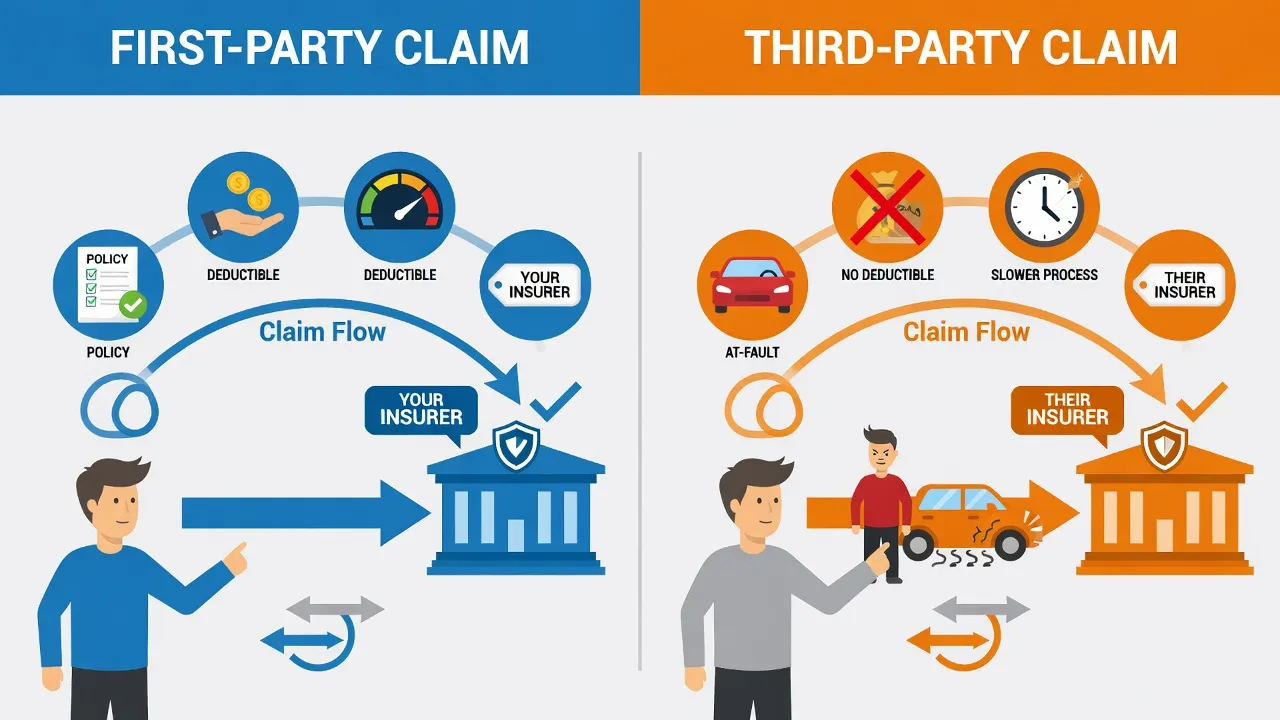
First-party vs third-party in two sentences each
First-party claim: you claim on your own policy. For car damage that's usually collision coverage, which the Insurance Information Institute notes pays for your repairs minus the deductible even if you were at fault, or uninsured motorist property damage (UMPD) if your policy has it.
Third-party claim: you claim against the at-fault driver's property damage liability coverage, which pays for damage they cause to other people's property. You aren't that insurer's customer, so the terms of their policy, like an appraisal clause, are generally not yours to use.
Which claim to file: the scenario table
| Scenario | Claim to file | Your deductible? | Who controls the repair | Speed to start |
|---|---|---|---|---|
| You caused the crash | First-party (collision) | Yes | You pick the shop; your insurer approves the estimate | Fast |
| Other driver at fault, insured, liability accepted | Third-party | No | You pick the shop; their insurer approves the estimate | Starts once liability is accepted |
| Other driver at fault, but their insurer is slow or stalling | First-party now, subrogation later | Yes, up front; may be refunded | You pick the shop; your insurer approves the estimate | Fast |
| Fault disputed or shared | First-party | Yes, up front; refund depends on final fault | You pick the shop; your insurer approves the estimate | Fast |
| Other driver uninsured | First-party (UMPD or collision) | Depends on which coverage; UMPD often has its own deductible | You pick the shop; your insurer approves the estimate | Fast |
| Damage exceeds the other driver's limits | Third-party up to their limit, then your own coverage for the rest | Only on the part your policy pays | You pick the shop; their insurer approves up to its limit, then your insurer for the rest | Slower; two insurers involved |
| Hit-and-run, driver unknown | First-party (collision, or UMPD where your state allows it) | Usually | You pick the shop; your insurer approves the estimate | Fast, once you've reported it to police |
| You need a rental right away | First-party if you carry rental reimbursement; otherwise third-party once liability is accepted | Your deductible applies to the repair claim, not the rental itself | You pick the shop; the paying insurer approves the estimate | Fast with your own rental coverage |
| Michigan crash | Your own collision coverage, plus a mini-tort claim for what it doesn't pay | Depends on your collision option; part can be recovered through mini-tort | You pick the shop; your insurer approves the estimate | Fast |
"Speed to start" is relative. Your own insurer already has your policy and doesn't need to settle fault before paying collision. A third-party insurer usually investigates liability first.
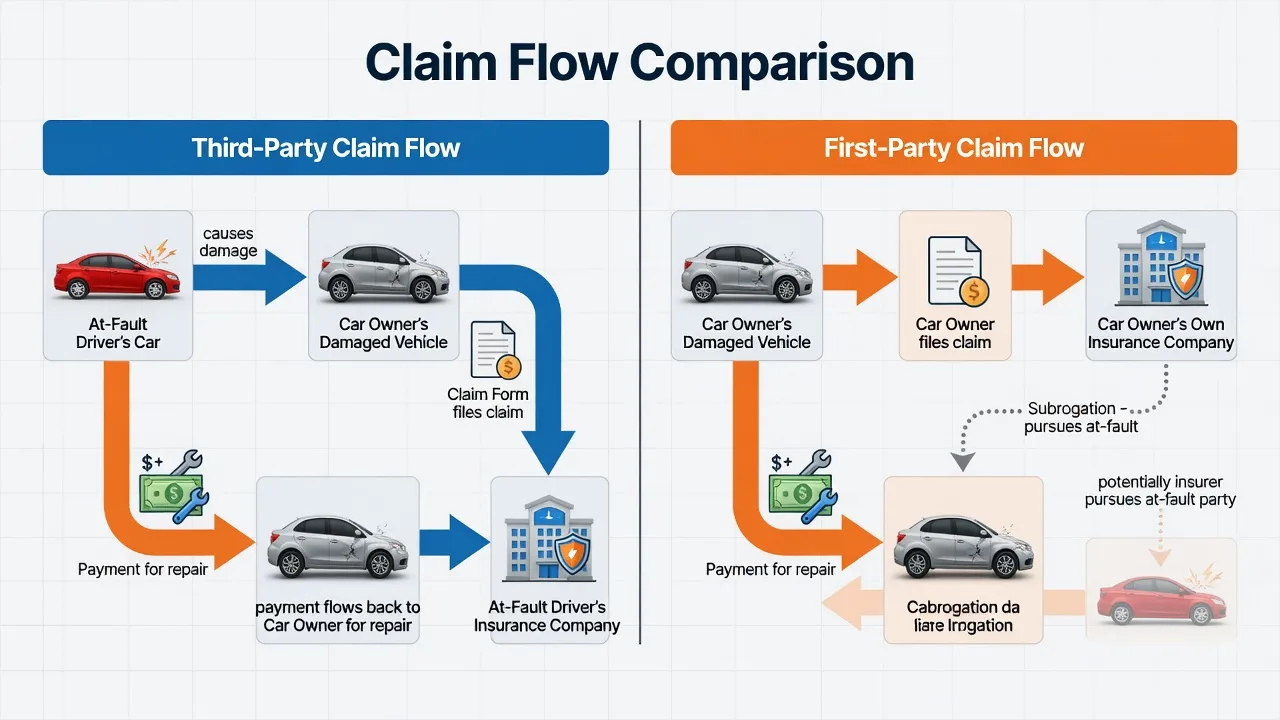
Scenario by scenario
You were at fault
Your only route for your own car is collision coverage, if you carry it. The other driver files a third-party claim against your liability coverage for their car. Before filing for minor damage, compare the repair quote with your deductible. For the math, see when to pay out of pocket instead of filing.
The other driver was clearly at fault and their insurer accepts it
This is the case where third-party is usually best. No deductible, and their insurer may also pay for a rental while your car is in the shop. Ask the adjuster to confirm in writing that liability is accepted before the shop starts work, and get the claim number to your shop. If you're not sure what to collect at the scene, see what to do when someone hits your car.
The other driver was at fault, but their insurer won't commit
If the other insurer hasn't accepted liability and you need the car, file on your own collision coverage. You pay the deductible to get moving, and your insurer pursues the at-fault driver's insurer for what it paid. AAA describes subrogation as your insurer's right to request reimbursement from the at-fault party, with the recovered money used to repay part or all of your deductible. GEICO says its payment recovery usually takes about six months and that it can't guarantee the full deductible back.
Here's how the two routes compare on an illustrative $3,200 repair with a $500 deductible (example numbers, not averages):
- First-party now: you pay the $500 deductible to the shop and your insurer pays $2,700. If subrogation succeeds, you may get some or all of the $500 back later.
- Third-party: you pay $0, but the repair payment waits until the other insurer accepts liability.
If the other insurer is stalling, work through it in this order:
- Get the third-party claim number and the adjuster's name.
- Ask in writing for a liability decision by a specific date.
- If there's no decision by then, open a claim on your own collision coverage.
- Tell both adjusters and your shop which claim the shop is billing.
- Ask your insurer to confirm it will pursue subrogation, and follow up on your deductible.
Fault is disputed or shared
Go first-party. Waiting on two insurers to agree on fault can leave your car sitting. If fault is later split, any deductible refund may be partial. Keep the police report, photos and witness details; they matter in the insurers' fault decision.
The other driver has no insurance
Use UMPD if your policy has it, or collision if it doesn't. Progressive notes that UMPD deductibles usually fall between $100 and $1,000 and can differ from your collision deductible, so check which is lower. UMPD isn't sold in every state; Progressive says some states require it, some require insurers to offer it, and others leave it to the insurer.
The other driver's coverage isn't enough
Their property damage liability pays only up to the limit they bought. If your repair costs more, your own collision coverage can pay the rest, minus your deductible. You can also pursue the driver personally for the difference, often in small claims court. On a big repair, it's often simpler to put the whole claim through your own collision coverage and let your insurer chase the other company.
Hit-and-run
There's nobody to file a third-party claim against, so it's first-party. Collision coverage pays after your deductible. Progressive says a driver who flees is treated as "uninsured" in most states, so UMPD may apply, but some states require physical contact or an identified driver. Progressive advises reporting the hit-and-run to police within 24 hours of the crash or of finding the damage. For a parked-car hit with no note, see someone hit my car door and left.
Your crash was in Michigan
Michigan's no-fault system works differently for car damage. Your own collision coverage pays for your repairs, and your claim against the at-fault driver for vehicle damage is limited to $3,000 under the "mini-tort" provision, according to a paper on Michigan no-fault reform published by the Insurance Information Institute. That's the route for a deductible or repair costs your insurance didn't pay. Ask your insurer which collision option you carry, since that affects how much you pay out of pocket first.
Who controls the repair in each claim
You choose the shop in both. California's Auto Body Repair Consumer Bill of Rights says an insurer "shall not require the repairs to be done at a specific auto body repair shop," and Texas says you have the right to choose the shop and parts. Our guide to your right to choose a body shop covers how that works in practice. If you need a shop, start with our collision repair directory.
What changes is who negotiates with the shop:
- First-party: your insurer writes the estimate and approves supplements. You have your policy's terms on your side if you disagree, including an appraisal clause if your policy has one.
- Third-party: the other driver's insurer writes the estimate and approves supplements. You aren't a party to their policy, so its appraisal clause isn't yours to invoke. Disputes come down to documentation and, if needed, a complaint to your state insurance department.
If the estimate comes in short on either kind of claim, what to do when the insurance estimate is too low walks through supplements, reinspection and appraisal.
Rental cars: who pays
On an accepted third-party claim, Progressive says the at-fault driver's insurance may end up paying for your rental. On a first-party claim, your rental is paid only if you carry rental reimbursement, which Progressive says typically requires both comprehensive and collision coverage and comes with a daily and total cap; its example is $50 a day up to $1,500. Progressive also notes that using your own collision and rental coverage can be faster than waiting on the other insurer's investigation. For limits and common gaps, see our rental car coverage after an accident guide.
Getting your deductible back
If you go first-party and the other driver was at fault, subrogation is how you get your deductible back. Some states put rules around it. Texas, for example, requires your insurer to do one of three things when another person may be liable: take action to recover your deductible within one year of paying your claim, refund the deductible, or tell you it won't pursue recovery so you can try yourself. In Michigan, the mini-tort claim is how you go after the deductible.
Diminished value
A repaired car can be worth less than one that was never in a crash. A diminished value claim is typically made against the at-fault driver, so if lost value matters for your car, don't give up the third-party route without checking first. How it's calculated and which states allow it are covered in our diminished value claim guide.
No-fault states
The Insurance Information Institute counts 12 no-fault states plus Puerto Rico: Florida, Hawaii, Kansas, Kentucky, Massachusetts, Michigan, Minnesota, New Jersey, New York, North Dakota, Pennsylvania and Utah. No-fault rules mainly cover injury claims through personal injury protection. Michigan is the clear exception for vehicle damage, as covered above. If you're in another no-fault state, ask your insurer how property damage claims against the other driver work there.
Frequently Asked Questions
Can I file with my insurer and the other driver's insurer at the same time?
You can report the crash to both, but only one insurer pays a given repair. A common pattern is to open a third-party claim, then switch to your own collision coverage if the other insurer stalls. Tell both adjusters which claim the shop is billing so nobody pays twice.
Will a not-at-fault first-party claim affect my rates or renewal?
It depends on your state and insurer, and rules on surcharges for not-at-fault claims vary. Some states also limit nonrenewals. Texas, for example, says an insurer can't refuse to renew your policy solely because of a claim that can't reasonably be considered your fault, unless you have two in one year. Ask your insurer how it treats not-at-fault claims before you file.
Do I need a police report to file?
Not always, but it helps prove fault on a third-party claim, and for a hit-and-run your insurer may require one. Our guide to filing a claim without a police report covers what to use instead.
Which claim pays for a rental faster?
Usually your own, if you carry rental reimbursement, because it doesn't wait for a liability decision. On a third-party claim, ask the other adjuster to confirm in writing that the rental is approved, and for how long, before you pick up the car.
Where do I complain if either insurer drags its feet?
Your state insurance department. You can find yours through the NAIC's state insurance department directory. Include your claim number, a timeline and copies of your emails.
Sources
- Insurance Information Institute: What is covered by a basic auto insurance policy?
- Insurance Information Institute: Background on no-fault auto insurance
- AAA Club Alliance: What is subrogation in an insurance claim?
- GEICO: Payment recovery
- Progressive: Hit-and-run insurance
- Progressive: Uninsured motorist property damage deductible
- Progressive: Rental car reimbursement coverage
- Texas Department of Insurance: Consumer Bill of Rights, Personal Automobile Insurance (2021 edition)
- California Department of Insurance: Auto Body Repair Consumer Bill of Rights
- Insurance Information Institute: Born and Klein, No-Fault Auto Insurance Reform in Michigan (2023)
- NAIC: State Insurance Departments directory