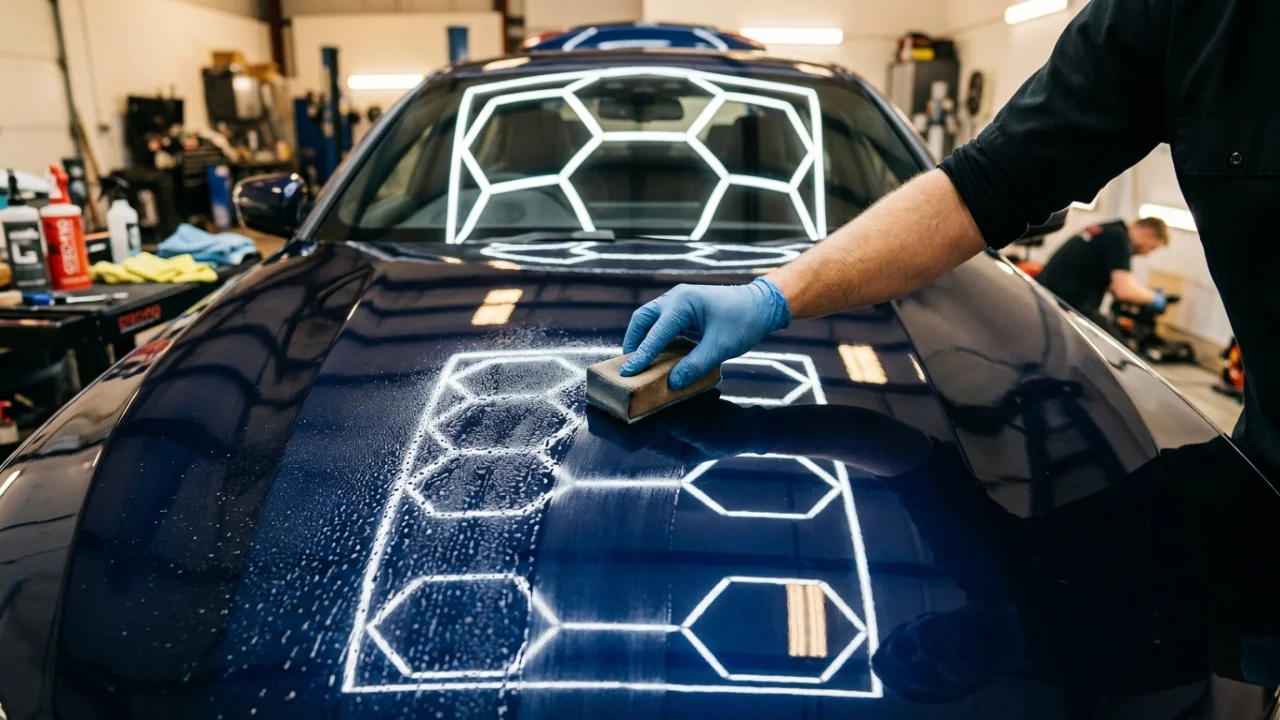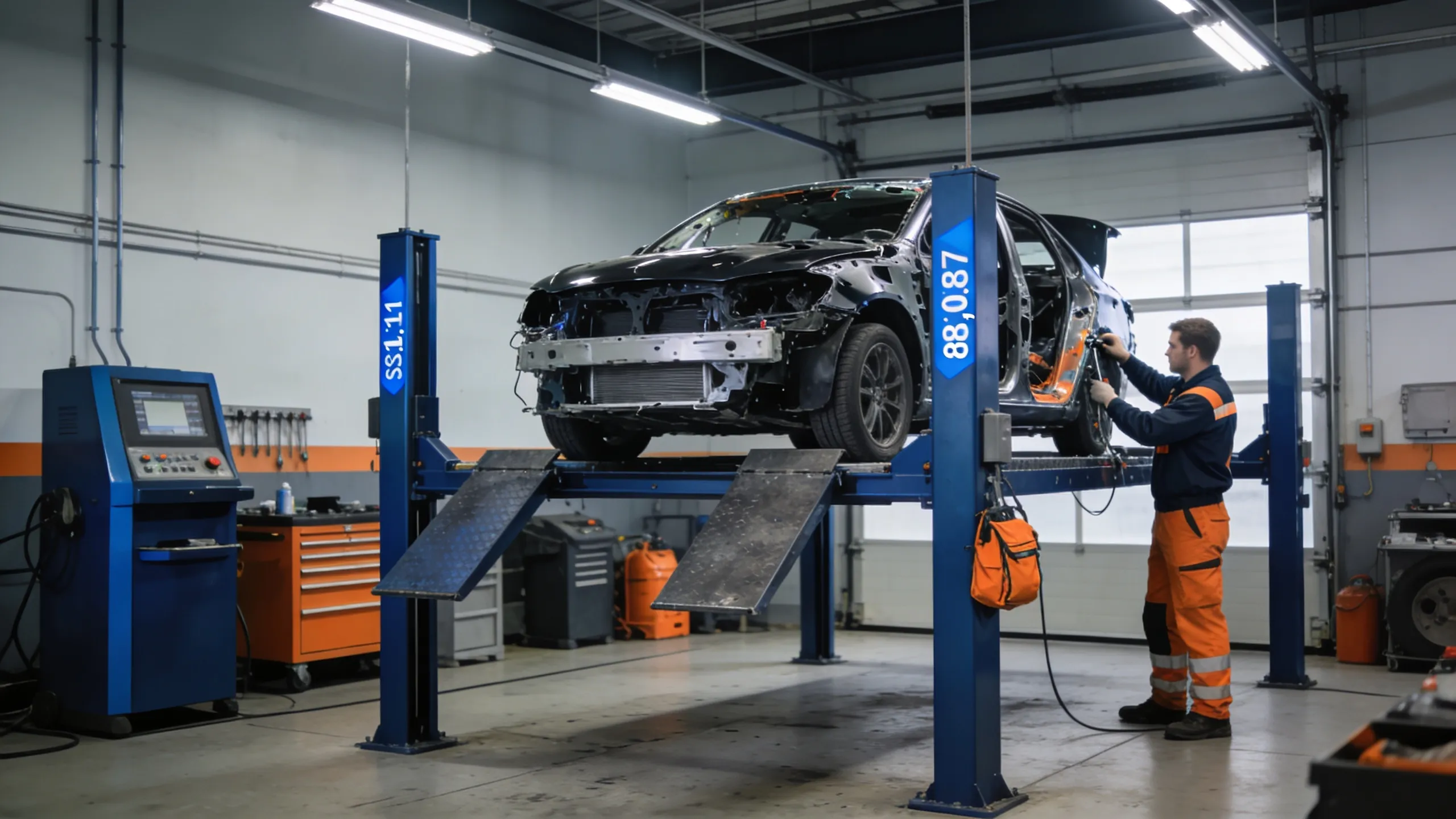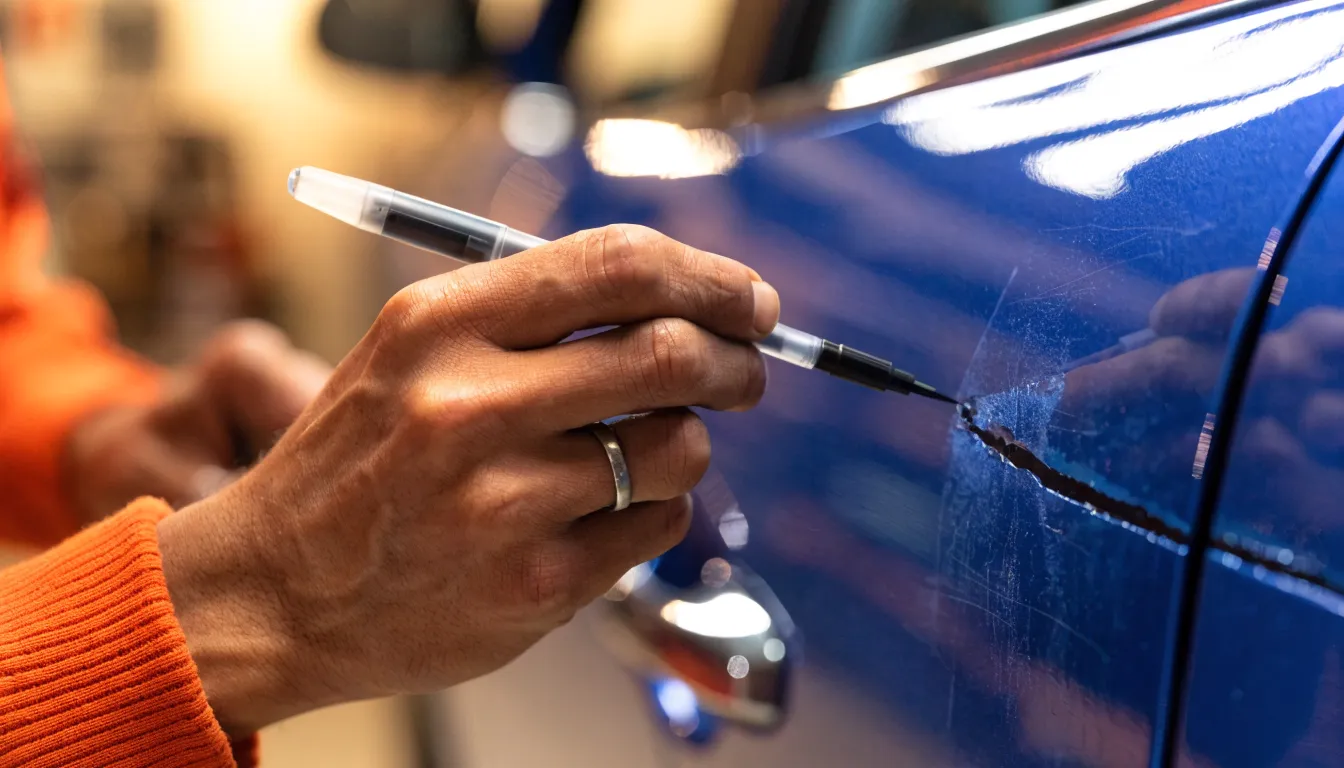
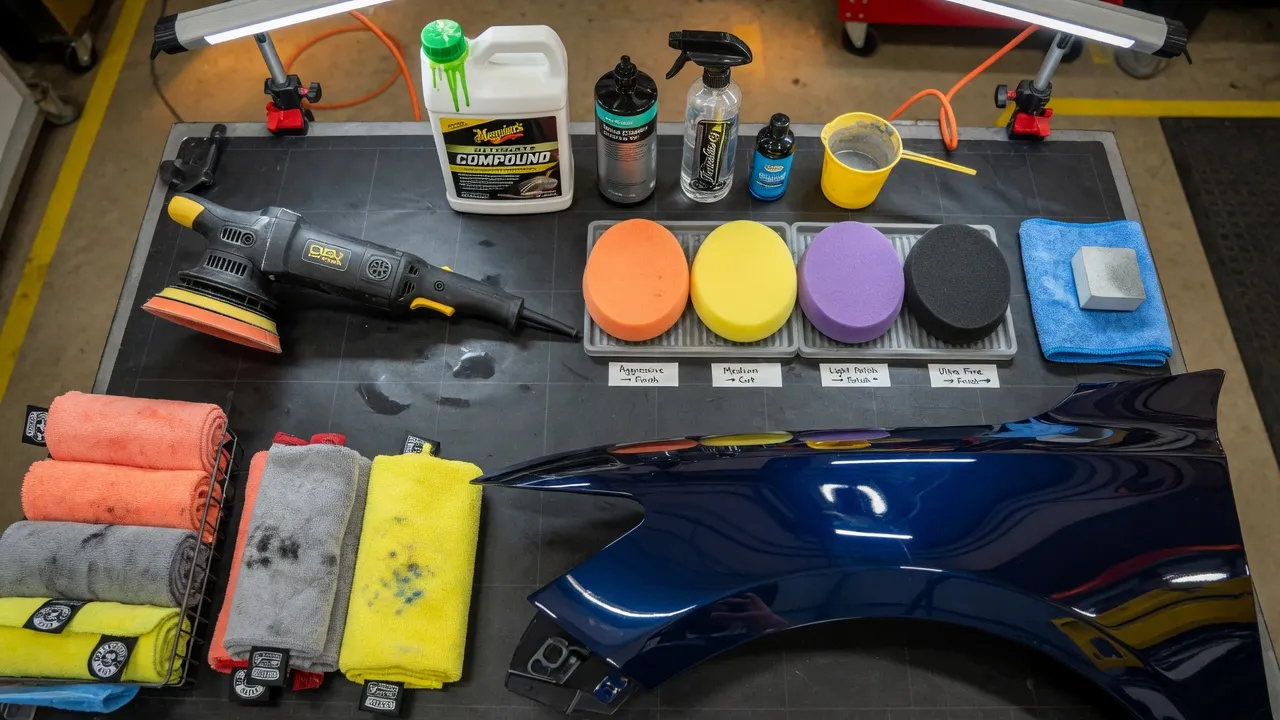
The best car polishing kit for restoring shine after body work is the Meguiar's Ultimate Compound and Polish two-step system for beginners, and the Griot's Garage BOSS Correction System for enthusiasts willing to invest in machine polishing. After collision repair, fresh paint needs careful correction and protection to match the rest of your vehicle's finish. The right kit depends on whether you're hand-polishing a single repaired panel or machine-correcting the entire car, and how much you're willing to spend.
Key Takeaways
- Meguiar's Ultimate Compound + Ultimate Polish ($25–$35 for both) is the most forgiving two-step system for first-time users and delivers noticeable results by hand or machine.
- Chemical Guys VSS Scratch & Swirl Remover ($15–$20) is the best single-product option for light correction on freshly repaired panels.
- Griot's Garage BOSS Correction System ($150–$300 with polisher) is the best enthusiast-grade kit, with dedicated compound, polish, and finishing products designed for their G9 polisher.
- Rupes LHR15 Mark III ($350–$450) is the professional standard for dual-action polishing and delivers the most defect-free finish, but has the steepest learning curve and price.
- Wait 30 to 90 days after body repair before polishing fresh paint , new clear coat needs time to fully cure before abrasive correction.
What Polishing Actually Does After Body Work
Body shops sand and buff repaired panels before returning your car, but the finish rarely matches the rest of the vehicle perfectly. You'll often see orange peel texture, sanding marks at blend lines, or a slight haze where the new clear coat meets the original paint. Polishing removes a microscopic layer of clear coat to level these imperfections and restore uniform gloss.
The process has three distinct steps, and understanding them matters before you buy a kit:
- Compounding uses a coarser abrasive to cut through deeper defects like sanding marks, oxidation, and heavy swirl marks. This is the correction step.
- Polishing uses a finer abrasive to remove the haze left by compounding and bring out full clarity and depth.
- Waxing or sealing adds a protective layer on top of the corrected paint to guard against UV damage, water spots, and contamination.
Some kits combine steps. A one-step product like Chemical Guys VSS acts as both compound and polish in a single pass. Two-step systems (Meguiar's) separate compound from polish for more control. Three-step professional systems (Griot's BOSS, Rupes) add a dedicated finishing polish for maximum gloss. More steps mean more work but better results.
Best Polishing Kits: Our 4 Picks
Meguiar's Ultimate Compound + Ultimate Polish: Best for Beginners
Meguiar's has been the entry point for car care for decades, and the Ultimate Compound and Ultimate Polish pairing remains the most forgiving system for someone who has never polished a car. The compound handles moderate swirl marks, water spots, and light sanding haze without requiring a machine , it works by hand with a foam applicator pad. The polish follows up to restore full gloss.
- Price: $12–$18 per bottle, $25–$35 for both
- Best for: First-time users, hand application, single-panel touch-ups after body repair
- Limitations: Won't remove deep sanding marks or heavy orange peel without a machine polisher. Hand application takes significantly longer than machine polishing.
- What's included: Compound and polish only. You'll need to buy applicator pads and microfiber towels separately.
Chemical Guys VSS Scratch & Swirl Remover: Best One-Step Solution
If you want a single bottle that does the work of both compound and polish, Chemical Guys VSS is the most effective one-step option. It uses diminishing abrasive technology , the particles start coarse and break down to finer grits as you work them, so one product handles correction and finishing in a single pass. It works well by hand and even better with a dual-action polisher.
- Price: $15–$20 for 16 oz
- Best for: Light to moderate correction, people who want simplicity, post-repair blend lines
- Limitations: One-step products always compromise. VSS won't match a dedicated two-step system on severely swirled paint or deep defects.
- What's included: Polish only. Chemical Guys sells a 14-piece Arsenal Builder Kit ($40–$60) that includes VSS plus applicator pads, towels, and their Butter Wet Wax for protection.
Griot's Garage BOSS Correction System: Best Enthusiast Kit
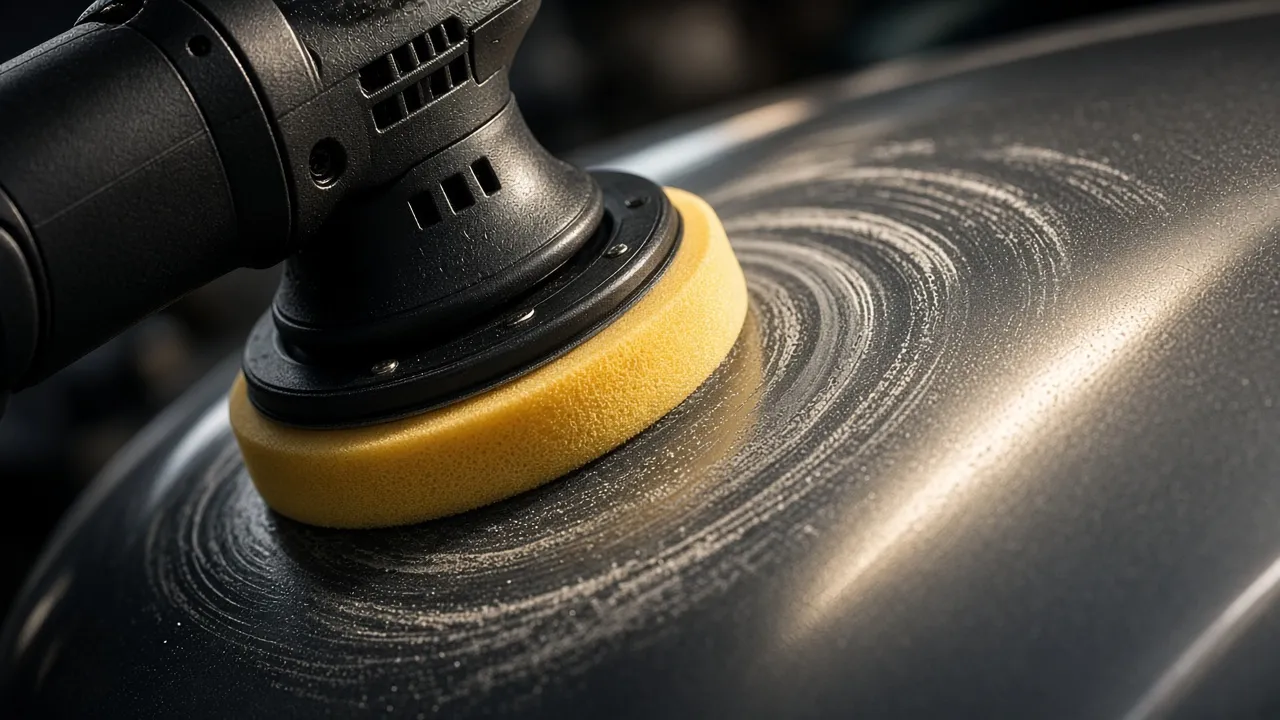
Griot's Garage designed the BOSS (Best of Show System) line specifically for their G9 Random Orbital Polisher, and the combination delivers results that approach professional quality. The system includes three products , BOSS Fast Correcting Cream for heavy defects, BOSS Perfecting Cream for refinement, and BOSS Finishing Sealant for protection , each engineered with specific abrasive grades that work in sequence.
- Price: $150–$300 depending on whether you need the G9 polisher ($130 alone) or just the products ($60–$80 for the three-product set)
- Best for: Enthusiasts who want near-professional results, full-car correction after body work, anyone willing to learn machine polishing
- Limitations: Requires the polisher investment. The G9 is beginner-friendly as random orbitals go, but there's still a learning curve.
- What's included: Depends on the kit configuration. The full system includes the polisher, three BOSS products, and a pad assortment. Products and polisher are also sold separately.
Rupes LHR15 Mark III: Professional Standard
The Rupes LHR15 Mark III is the polisher professional detailers reach for, and for good reason. Its 15mm random orbital throw covers more area per pass than competitors (most use 8–12mm), and its 500-watt motor with anti-spinning technology prevents the kind of high-speed rotation that can burn through clear coat. Paired with Rupes yellow polishing pads and Rupes Keramik compound, it delivers the most defect-free finish available outside a professional detail shop.
- Price: $350–$450 for the polisher alone; $500–$650 for a full kit with pads, compounds, and carrying case
- Best for: Serious enthusiasts, side-business detailers, anyone correcting an entire vehicle after major body work
- Limitations: The price. The LHR15 costs 3x what the Griot's G9 does, and the results difference is meaningful but incremental for most car owners. The larger 15mm throw also requires more practice to control on tight contours.
- What's included: Polisher only in the base configuration. Rupes sells complete correction kits that include pads and compounds at a bundle discount.
How to Polish a Car After Body Repair: The Right Process
Wait for the paint to cure
This is the step most people skip, and it's the one that matters most. Fresh automotive paint takes 30 to 90 days to fully cure, depending on the paint system and environmental conditions. Polishing before the clear coat has hardened can cause the abrasives to dig into soft paint, creating damage that's worse than what you started with. Most body shops recommend waiting at least 60 days before applying any abrasive product.
Wash and decontaminate
Before polishing, wash the car thoroughly with a pH-neutral car wash soap. Then clay bar the surface to remove embedded contaminants like rail dust, tree sap residue, and industrial fallout. Polishing over contamination grinds particles into the paint instead of removing them.
Compound first, then polish
If you're using a two-step or three-step system, start with the compound on a cutting pad (usually orange or microfiber). Work in 2-foot-by-2-foot sections, applying moderate pressure on the first two passes and lighter pressure on the following two. Wipe the residue with a clean microfiber towel and inspect under direct light. Switch to the polishing step with a softer pad (usually white or black) and repeat the process to remove the haze left by compounding.
Seal the corrected paint
After polishing, wipe the surface with an isopropyl alcohol (IPA) solution (a 1:1 mix of IPA and water) to strip any polish oils that mask remaining defects. Then apply your protection product , wax, sealant, or ceramic coating , to lock in the correction and protect against future damage. For long-term protection after a costly body repair, a ceramic coating offers 1 to 2 years of durability versus 2 to 3 months for traditional wax.
Machine Polishing vs Hand Polishing: Which Do You Need?
Hand polishing works for single-panel touch-ups and light defects. If your body shop repaired one fender and you just need to blend the transition line, a bottle of Meguiar's Ultimate Compound and 20 minutes of hand work will handle it. But hand polishing can't generate the consistent speed and pressure needed for serious paint correction across larger areas.
Machine polishing with a dual-action (DA) random orbital polisher is the standard for full correction. The random orbit pattern means the pad never rotates in the same direction for more than a fraction of a second, which makes it nearly impossible to burn through clear coat , even for beginners. This is why every kit on our list except Meguiar's is designed around machine application.
If your car just came back from a major collision repair involving multiple panels, machine polishing is the right approach. The investment in a $130–$150 DA polisher pays for itself compared to paying a detailer $300–$500 for a full paint correction. For more on the costs involved, see our guide to car paint repair costs.
Common Mistakes That Ruin Your Results
- Polishing in direct sunlight. Heat causes compounds to dry before they can be worked, leaving residue that's difficult to remove and can stain light-colored paint. Work in a garage or shaded area.
- Using a dirty pad. Dried compound and paint residue on a used pad create new scratches. Clean or swap pads every 2 to 3 sections.
- Skipping the IPA wipe. Polish oils fill in micro-scratches and make the surface look better than it's. The IPA wipe reveals the true correction level before you apply protection.
- Working too large an area at once. Compound dries out before you can work it properly. Stick to 2-foot squares and overlap edges by 50%.
- Using a rotary polisher without experience. Rotary polishers spin in one direction at high speed and can burn through clear coat in seconds. Stick with a dual-action random orbital unless you've been trained on rotary technique.
For guidance on cleaning your car after body repair, including the full wash-decontaminate-polish-protect sequence, check our dedicated guide.
Which Kit Should You Buy?
Match the kit to your situation:
- Single repaired panel, minor blending needed: Meguiar's Ultimate Compound + Ultimate Polish ($25–$35). Hand application is fine.
- Quick fix, don't want to think about it: Chemical Guys VSS or Arsenal Builder Kit ($15–$60). One product, decent results.
- Multiple panels repaired, want professional results: Griot's Garage BOSS System with G9 polisher ($150–$300). Best value for machine polishing.
- Full vehicle correction or starting a detailing side business: Rupes LHR15 Mark III ($350–$450+). The professional standard.
If you're also looking to protect your investment further, a quality dash cam helps document any future incidents for insurance claims, and blind spot mirrors or parking sensors reduce the chance of another trip to the body shop altogether.
Frequently Asked Questions
How long should I wait to polish my car after body work?
Wait 30 to 90 days after body repair before polishing. Fresh automotive paint needs time to fully cure, and polishing too early can damage soft clear coat. Most body shops recommend waiting at least 60 days. You can wash the car normally during the curing period, but avoid any abrasive products, wax, or sealants until the paint has hardened completely.
Can I polish my car by hand or do I need a machine?
Hand polishing works for single-panel touch-ups and light defects like minor swirl marks or haze at blend lines. For correction across multiple panels or the full vehicle, a dual-action random orbital polisher delivers dramatically better results because it generates consistent speed and pressure that hands can't replicate. Entry-level DA polishers like the Griot's Garage G9 start around $130 and are designed to be safe for beginners.
What's the difference between compound, polish, and wax?
Compound is an aggressive abrasive that removes deeper defects like sanding marks and heavy swirl marks by cutting into the clear coat. Polish is a finer abrasive that removes the haze left by compounding and restores full gloss and clarity. Wax is a protective layer with zero or minimal abrasive content that shields corrected paint from UV damage, water spots, and contaminants. You use them in that order: compound, polish, then wax or sealant.
Will polishing remove orange peel texture from a body shop paint job?
Polishing alone removes light orange peel, but moderate to heavy orange peel requires wet sanding with 2000 to 3000 grit sandpaper before polishing. Wet sanding levels the texture mechanically, and polishing restores the gloss afterward. This is an advanced technique that risks cutting through the clear coat if done incorrectly, so most car owners are better off asking the body shop to correct heavy orange peel before accepting the car back.
How often should I polish my car to maintain the finish?
Polish your car no more than once or twice per year. Every polishing session removes a thin layer of clear coat, and modern vehicles have only 1.5 to 2 mils of clear coat total. Over-polishing thins this protective layer and eventually exposes the base coat. Between polishing sessions, maintain the finish with regular washing, a spray sealant or quick detailer every few weeks, and a full wax or sealant application every 2 to 3 months.