Car paint repair cost is one of the most common questions car owners face after a collision. Paint damage ranges from a small scuff on a single panel to entire-vehicle refinishing, and the price difference between those extremes is enormous. Without a baseline understanding of how pricing works, it can be hard to know whether a shop's estimate is fair.
This guide breaks down what car paint repair costs at each scope level, how body shops match colors, the types of paint systems involved, and the factors that push prices up or down. The goal: give you a clear picture of what to expect before you walk into a shop.
For related context on the full scope of damage repair, see this complete guide to collision repair.
Car paint repair costs at a glance
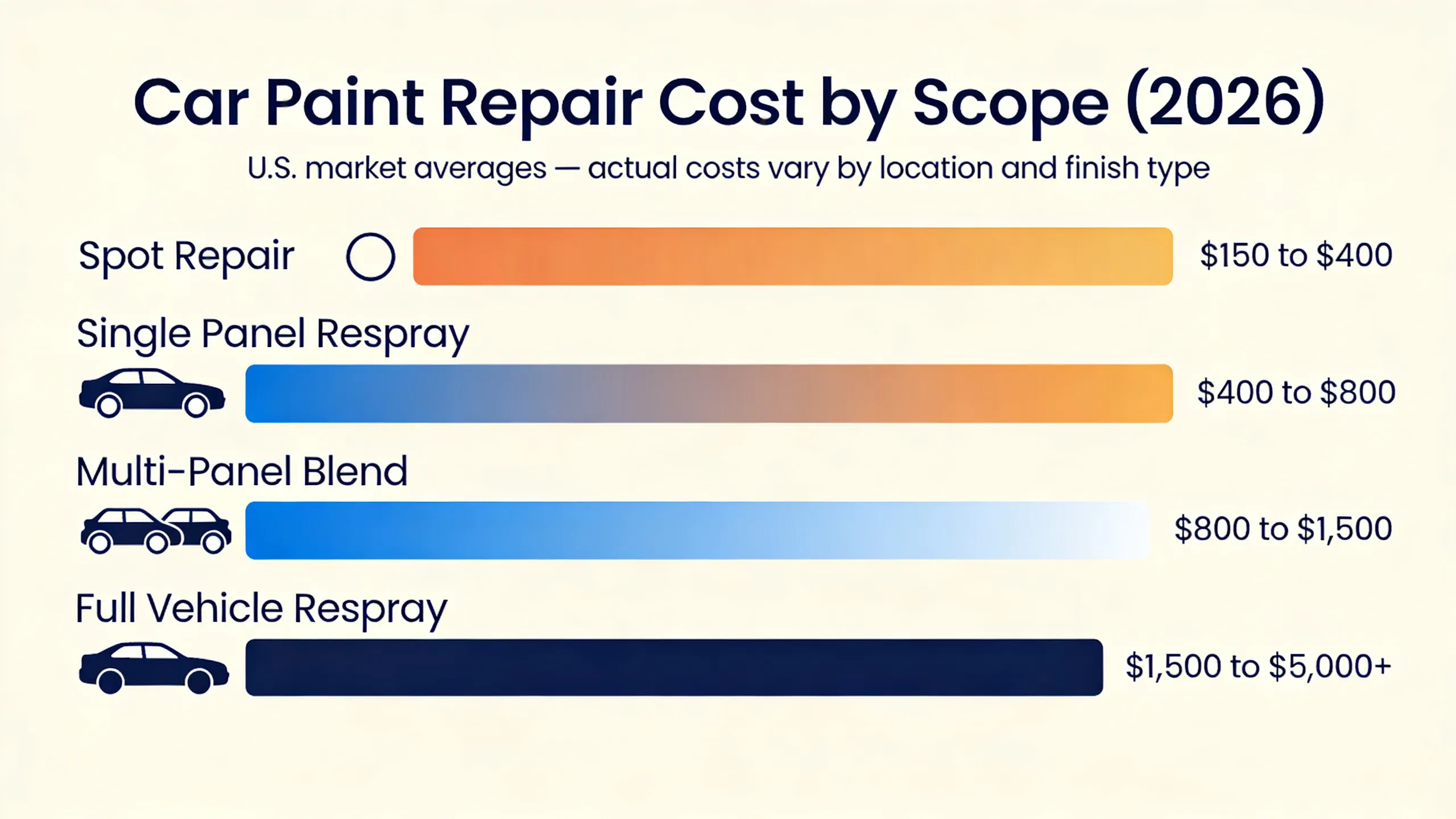
Car paint repair cost ranges from $150 to $400 for a small spot repair to $1,500–$5,000+ for a full vehicle respray. Single-panel resprays, the most common post-collision scope, typically run $400 to $800. Finish complexity, panel count, and local labor rates are the primary cost drivers.
Auto paint repair cost varies widely based on how many panels are involved and how extensive the prep work is. The table below summarizes 2026 market ranges across the four main repair scopes.
| Repair scope | Typical cost range | What's included |
|---|---|---|
| Spot repair | $150–$400 | Small area on one panel; touch-up and blend |
| Single panel respray | $400–$800 | Full panel removal, prep, prime, paint, clear |
| Multi-panel blend | $800–$1,500 | Two or more adjacent panels; blending for match |
| Full vehicle respray | $1,500–$5,000+ | All panels; extensive prep; body filler if needed |
These ranges reflect labor and materials at average U.S. market labor rates. Costs in high-rate markets such as Los Angeles or New York City can run 30–50% above these figures. Specialty finishes, tri-coat, pearl, matte, or custom colors, add cost at every scope level.
Body shop paint job cost also depends on paint quality selected. Economy-grade paint systems cost less but may fade faster. Premium manufacturer-affiliated paints (PPG, Axalta, BASF) carry higher material costs but typically offer better durability and a longer warranty.
How color matching works
Getting a newly painted panel to match the surrounding original paint is the central challenge of any collision paint repair. Color matching is a technical discipline, not guesswork, and shops use multiple tools to achieve accurate results.
Spectrophotometer technology
A spectrophotometer (sometimes called a paint meter) scans the vehicle's existing paint and measures the precise light wavelengths it reflects. The instrument converts that measurement into a formula that paint mixing systems can replicate. This is the most accurate method for car paint color matching and is standard at most professional body shops.
The technology matters because paint looks different under different lighting. A match that appears identical under shop fluorescents may show a mismatch in sunlight. Spectrophotometers account for this by measuring color across multiple light angles, a process called "goniospectrophotometry" on advanced tools. The result is a formula that holds under more conditions.
Paint code lookup
Every vehicle has a paint code, usually found on a label in the door jamb, engine bay, or trunk. Paint suppliers maintain databases that translate codes into base mixing formulas. Technicians start with that formula, then use the spectrophotometer reading to fine-tune the mix for the specific vehicle.
Paint codes are a starting point, not an endpoint. Manufacturers adjust pigment formulations over the life of a model year, so two cars with the same code may have slightly different factory colors from different production runs.
Why perfect matches are hard
Even with accurate spectrophotometry, achieving a clean color match on aged paint is difficult. Several reasons explain why.
Sun fade and oxidation. Original paint degrades over time. UV exposure breaks down pigments gradually and unevenly. A panel facing south for eight years will be measurably lighter than a door that was mostly shaded. Mixing paint to match the original code doesn't account for this fade.
Metallic and pearl finishes. These paints contain metallic flakes or mica particles that reflect light directionally. The angle at which flakes lie in the dried paint affects how the color looks from different angles. Replicating this orientation during spray application requires precise technique and sometimes multiple test sprays.
Age of vehicle. Older vehicles have more color shift from years of exposure. Some shops keep historical correction data for common colors on aging platforms, but results are never guaranteed on vehicles more than 10 years old.
Blending: the difference between visible and invisible
When a repaired panel is repainted, the new paint edges meet the original paint at some point. Visible edges mean the repair looks unfinished. "Blending", also called "feathering out", extends new paint into adjacent panels and gradually fades it into the existing finish so no sharp boundary shows.
Blending is standard practice in professional collision paint repair. It adds cost because adjacent panels must be prepped, masked, and refinished, but it's often the difference between a repair that looks right and one that doesn't. Most multi-panel estimates include blending for exactly this reason.
Types of paint repair after a collision
Not every collision produces the same paint damage. The repair scope determines both the process and the auto paint repair cost.
Spot repair (localized touch-up)
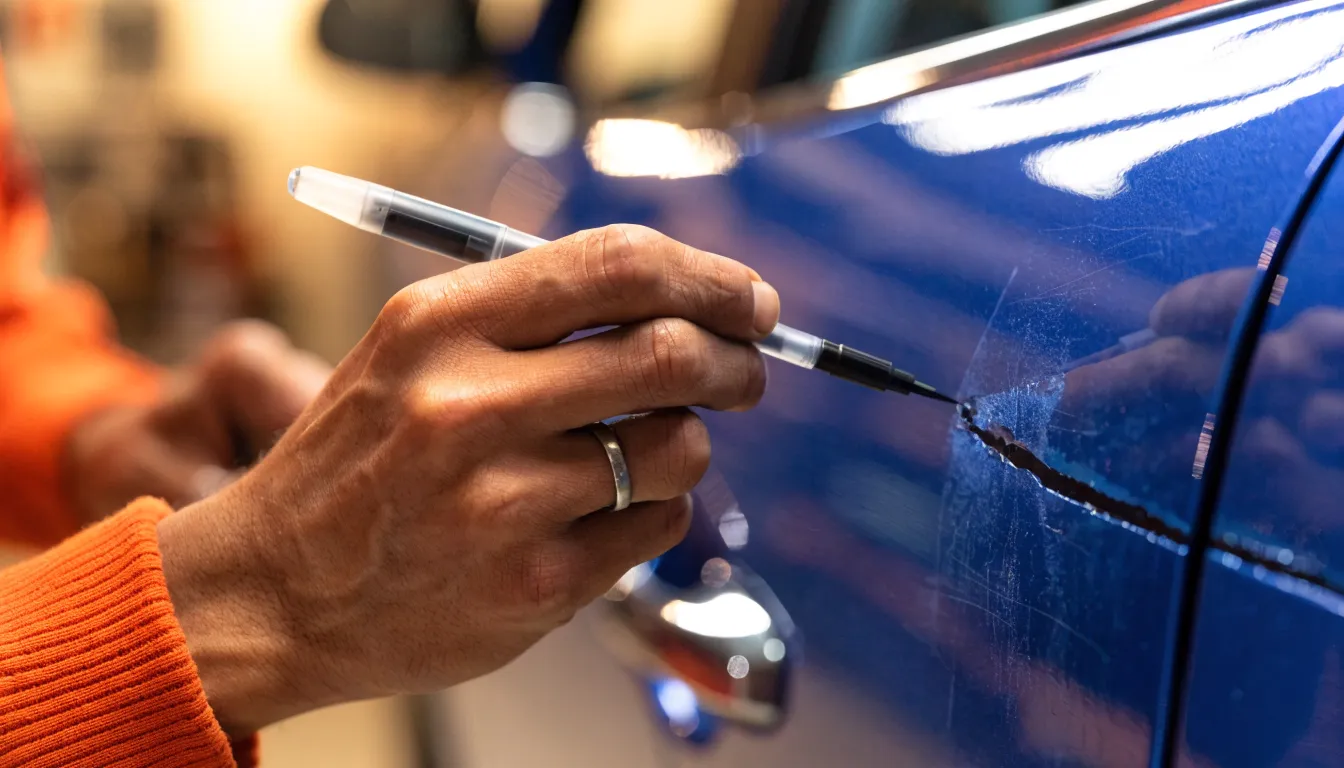
Spot repair addresses a small, defined area, typically a stone chip, a minor scrape, or a parking lot scratch that hasn't exposed bare metal or caused structural damage. The technician sands and preps only the affected area, applies primer and color, and blends the edges into surrounding undamaged paint.
Spot repair is the least expensive option, typically $150 to $400, but it carries the highest risk of a visible boundary. On newer vehicles with clean paint, results can be very good. On older or faded paint, spotting the repair is more likely.
Single panel respray
A single panel respray covers the full surface of one panel, a door, fender, quarter panel, or bumper cover. The panel may be removed from the vehicle or masked in place. Technicians prep the full surface, apply primer, spray color coats, apply clear coat, then wet-sand and polish the finished surface.
This scope is common after side-swipe collisions, minor rear-end impacts, or isolated dents with paint damage. Cost typically runs $400 to $800 for a standard finish. Specialty finishes, complex prep, or high labor rate markets push this higher.
For services related to scratch and paint damage on individual panels, see scratch repair services and the auto painting services directory.
Multi-panel blend
When damage spans a corner of the vehicle, say a rear-quarter panel and an adjacent door, a multi-panel blend is typically required. The damaged panels get a full respray, and the adjacent panels are blended to hide the color transition.
This is the most common scope for moderate-severity collision claims. Cost ranges from $800 to $1,500 depending on panel count, finish type, and prep complexity. Insurance estimates frequently cover this scope when damage is documented thoroughly.
Full vehicle respray
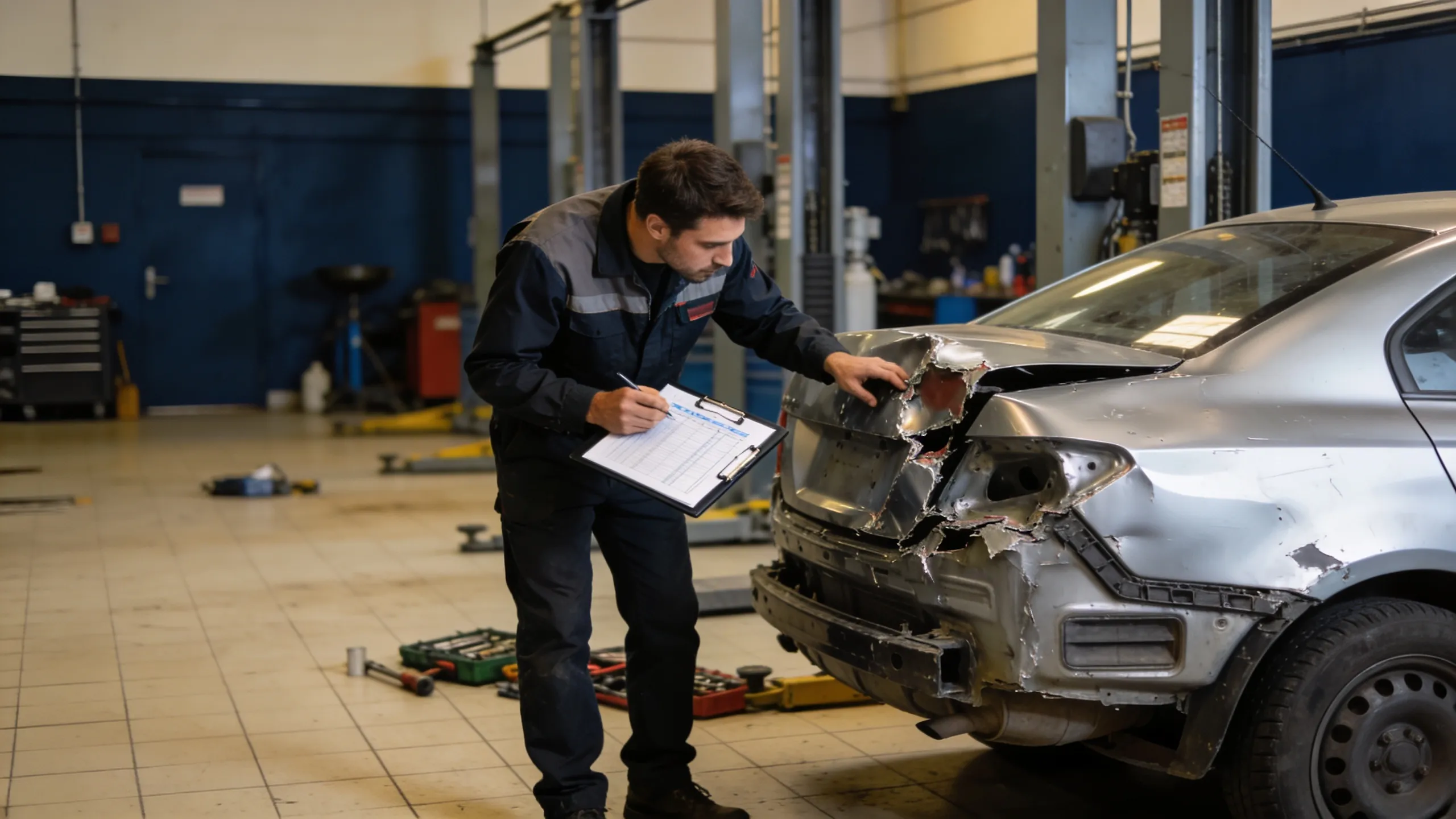
A full vehicle respray, sometimes called a "full reskin", involves refinishing every exterior panel. This scope is typically reserved for vehicles with widespread paint damage, major accident repairs that affect many panels, or older vehicles where localized repairs would produce too many color mismatches across the body.
Body shop paint job cost for a full respray starts around $1,500 for an economy-grade result on a simple vehicle and can exceed $5,000 on complex finishes, luxury vehicles, or high-quality premium paint work. Show-quality resprays with paint correction, multiple coats, and careful prep cost more still.
Paint systems explained
The type of paint system on the vehicle affects both the repair process and the car paint repair cost. Modern vehicles use several different systems, and each requires specific products and techniques.
Basecoat/clearcoat systems
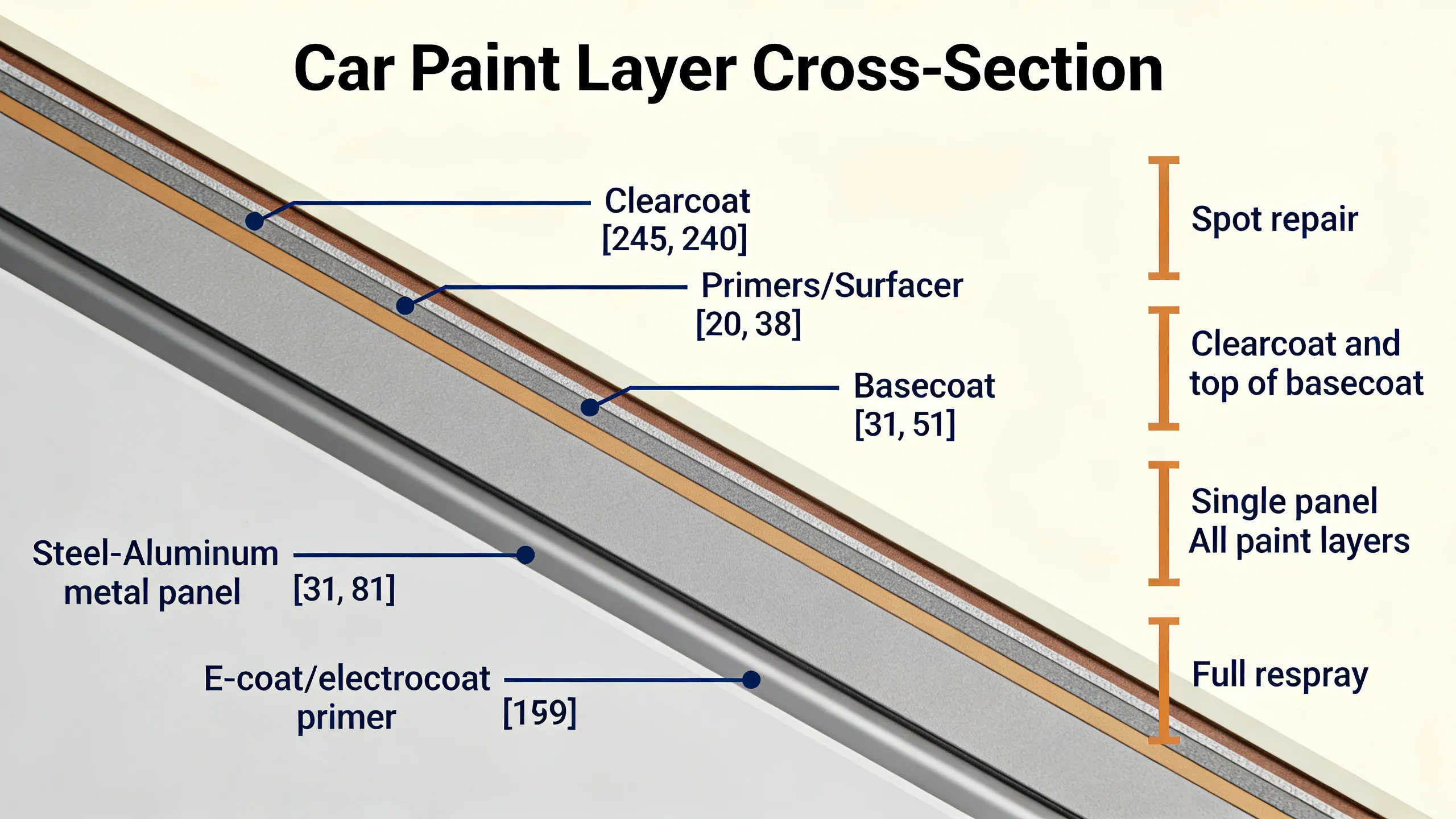
Most vehicles manufactured since the mid-1990s use a two-stage basecoat/clearcoat system. The basecoat carries all the color and any metallic or pearl particles. The clearcoat, a transparent protective layer applied on top, provides gloss, UV protection, and hardness.
When clearcoat is damaged (scratched, cloudy, or peeling), the basecoat underneath may still be intact. In those cases, technicians may be able to reapply clearcoat without repainting the color layer, which reduces cost. If both layers are damaged, both must be stripped and reapplied correctly.
Single-stage paint (older vehicles)
Pre-1990s vehicles and some commercial vehicles use single-stage paint, where color and gloss are combined in one layer. Matching single-stage paint is more difficult because the available color formulas are older and fade patterns are more pronounced. Technicians who specialize in classic vehicle work tend to have the most experience with these systems.
Tri-coat and pearl finishes (why they cost more)
Tri-coat finishes add a third layer, typically a translucent pearl or tinted midcoat, between the basecoat and clearcoat. This produces depth and color shift effects (colors that appear to change slightly as viewing angle changes). These finishes are common on white pearl, gold, and certain specialty colors from manufacturers.
Tri-coat repairs cost more because they require a third material layer, precise color-matching of the pearl layer, and more application time. A single-panel tri-coat respray may cost 20–40% more than the same repair on a standard basecoat/clearcoat vehicle. Multi-panel tri-coat work can add hundreds of dollars to the total estimate.
What affects car paint repair cost?
Several factors explain why two estimates for seemingly similar paint damage can differ by hundreds of dollars.
Color complexity
Standard solid colors (white, black, silver) are the least complex to match and apply. Metallic paints require more precision in application angle and speed to orient flakes consistently. Pearl and tri-coat finishes involve additional layers and matching challenges. Specialty or low-volume colors, certain saturated reds, greens, and blues, may require more mix adjustments to achieve an accurate match.
Color complexity affects both material cost (specialty pigments cost more) and labor time (more test sprays and verification steps).
Number of panels
Each additional panel adds prep time, materials, and labor. Even a straightforward single-color vehicle takes significantly more total time to refinish across five panels than across one. Multi-panel estimates also often include blending time on adjacent panels not directly damaged.
Prep work required
Paint prep, sanding, feathering existing paint edges, applying filler where needed, and priming, often accounts for 40–60% of the total labor in a paint repair. Vehicles with rust, pitting, poorly adhered previous repairs, or heavy environmental contamination require more prep time than clean, well-maintained paint.
Skipping or rushing prep produces paint that peels, bubbles, or shows visible defects within months. Quality prep is not optional. It's the foundation of a durable repair. Car owners comparing estimates should ask specifically how much prep time is included.
Paint quality (economy vs. premium)
Body shops typically offer paint products at multiple quality tiers. Economy systems use adequate but shorter-lived materials and may carry limited warranties. Mid-grade systems from major manufacturers (such as PPG Envirobase or Axalta Waterborne products) offer better durability, color-matching database support, and longer warranties. Premium products intended for high-end applications add more cost still.
The paint tier selected affects both the material line on the estimate and the long-term durability of the repair. Shops aligned with major paint manufacturers often use those products as their standard, worth asking about when comparing quotes.
For context on the broader collision repair process, see collision repair services and the collision repair cost guide.
How to evaluate car paint repair quality
Knowing what good paint work looks like, and what common defects signal, helps you review the finished repair with confidence.
What good paint work looks like
A quality paint repair should meet these standards:
- Color match: The repaired panel should match adjacent panels closely under multiple lighting conditions, indoor fluorescent, outdoor daylight, and overcast sky. Minor variation is normal on aged vehicles; visible mismatch is not acceptable.
- Surface quality: The finished surface should be smooth, glossy, and free of visible texture irregularities. Running a clean fingernail gently across the surface should feel uniform.
- Blend transition: Blended areas shouldn't show a visible line or color boundary where new paint meets original paint.
- Edge finish: Panel edges, door openings, and trim transitions should be clean, with no overspray or paint buildup in gaps.
Common paint defects after repair
Several paint defects can appear if preparation or application is inadequate:
Orange peel is a texture pattern resembling the surface of an orange, caused by paint droplets that dry before fully flowing out. Minor orange peel is normal and can be polished out. Heavy orange peel indicates a process problem.
Color mismatch is visible when the repaired panel is a noticeably different shade, hue, or lightness than adjacent original panels. Mismatch may be caused by inaccurate spectrophotometer reading, incorrect formula adjustment, or failure to account for fade.
Paint runs occur when too much paint is applied in one area, causing wet paint to sag before it dries. Runs appear as drips or ridges in the paint film.
Solvent pop produces small pinholes or craters in the paint surface, usually caused by trapped solvents escaping too quickly during drying.
Peeling or lifting develops over months when adhesion was inadequate, usually due to insufficient surface prep, contamination, or incompatible primer.
When to speak up
You have the right to a complete repair that restores the vehicle to pre-loss condition. If a delivered repair shows visible defects, return to the shop and request correction before accepting the vehicle. Most reputable shops carry a warranty on paint work, ask about the specific terms before work begins.
Review the vehicle in daylight, not just under the shop's interior lights, before accepting delivery. Color mismatches and surface issues that aren't obvious indoors often show immediately outside.
Frequently asked questions
How much does it cost to repaint a car after an accident?
Repainting after a collision costs $400 to $1,500 for one to two panels in most cases, depending on damage scope, finish type, and local labor rates. Full vehicle repaints start around $1,500 and increase significantly for complex finishes or premium quality work.
How do body shops match paint color?
Shops use a spectrophotometer to scan the vehicle's existing paint and generate a precise color formula. That reading is then used to adjust the manufacturer's base formula for the specific vehicle's color as it currently appears, accounting for any fade or color shift that has developed over time.
Why does my repaired panel look different?
Color mismatch after repair is typically caused by sun fade in the original paint that the mixed color didn't fully account for, metallic flake orientation differences, or inadequate blending on adjacent panels. A good shop will identify these issues before releasing the vehicle. If the mismatch is visible, returning for correction is the right next step.
How long does car paint repair take?
Single panel repairs typically take one to three business days including prep, paint, cure time, and final polish. Multi-panel repairs commonly run three to five business days. Full vehicle resprays may take seven to 14 business days or more depending on prep complexity.
Is factory paint better than body shop paint?
Factory (OEM) paint is applied under controlled conditions with specialized equipment that's difficult to replicate in a shop environment. However, high-quality shop refinishing using premium paint systems from the same manufacturers that supply automakers. PPG, Axalta, BASF, can produce durable, well-matched results. The key factors are paint product quality, thorough prep, and technician skill.
Can I choose a different color for my repaired panel?
A single panel or partial repair in a different color will result in visible mismatch and isn't recommended unless the entire vehicle is being resprayed. Full vehicle resprays can be completed in any color, though changing from the original requires informing the insurer and updating registration documentation in some states.
Key takeaways
Car paint repair cost in 2026 ranges from $150 for a spot touch-up to $5,000 or more for a full vehicle respray. The main cost drivers are repair scope (number of panels), finish complexity, prep work required, and local labor rates.
Color matching is a technical process that relies on spectrophotometry and formula adjustment, not guesswork. Even with accurate tools, matching aged or faded paint is challenging, which is why professional blending into adjacent panels is standard practice on collision repairs.
Paint systems vary across vehicles. Basecoat/clearcoat is standard on modern vehicles. Tri-coat and pearl finishes require additional layers and cost 20–40% more to repair correctly. Single-stage paint on older vehicles presents its own matching challenges.
When evaluating a completed repair, check the color match under outdoor daylight, inspect the surface texture for orange peel or runs, and verify the blend transition shows no visible line. Reputable shops warranty their paint work, asking about warranty terms before authorizing work is a reasonable step.
To explore local options for collision paint repair, find auto body shops near you for smaller paint damage.
For further reading on paint standards and technology, see:
- PPG automotive refinish technology
- I-CAR refinish training standards