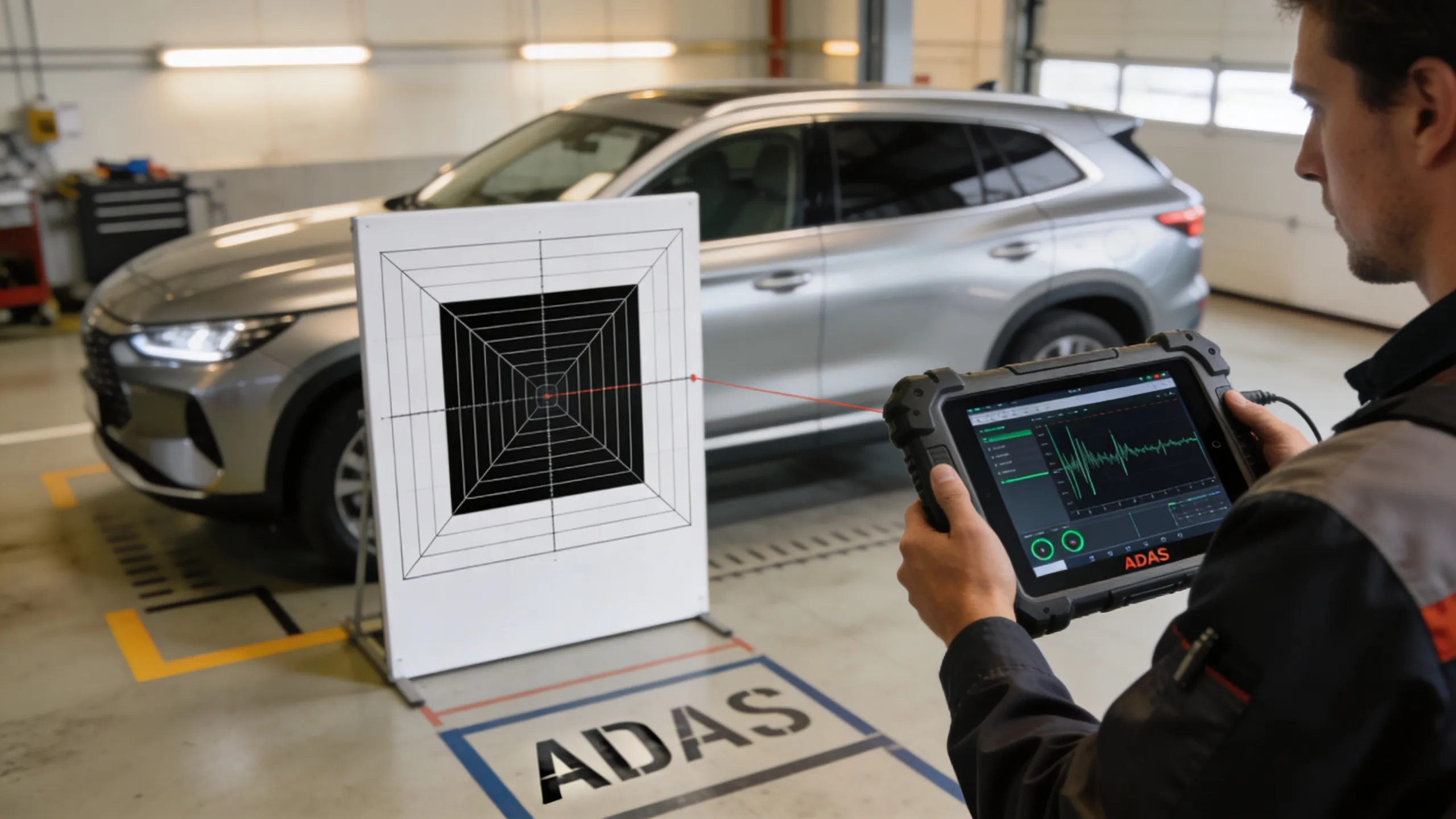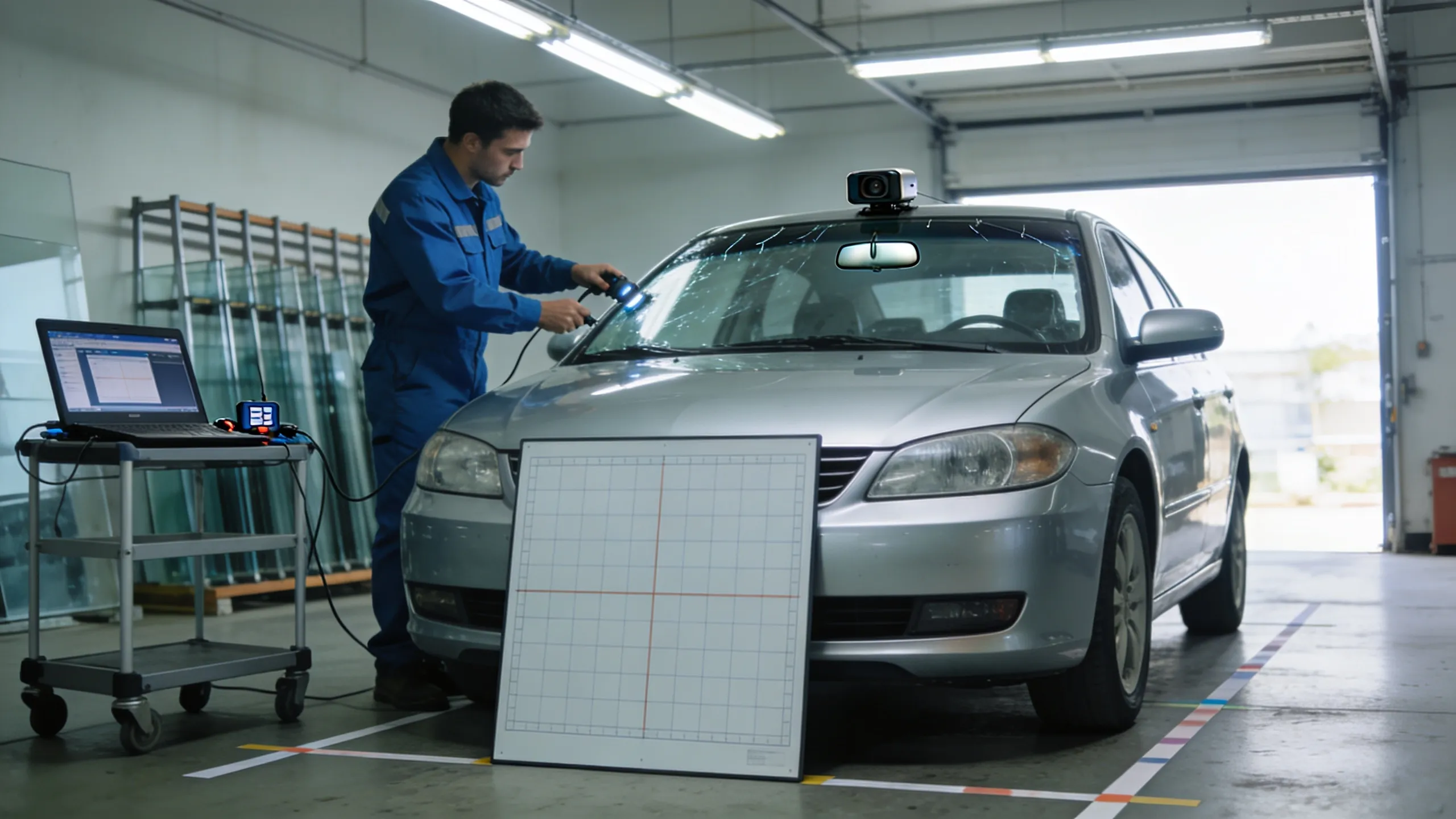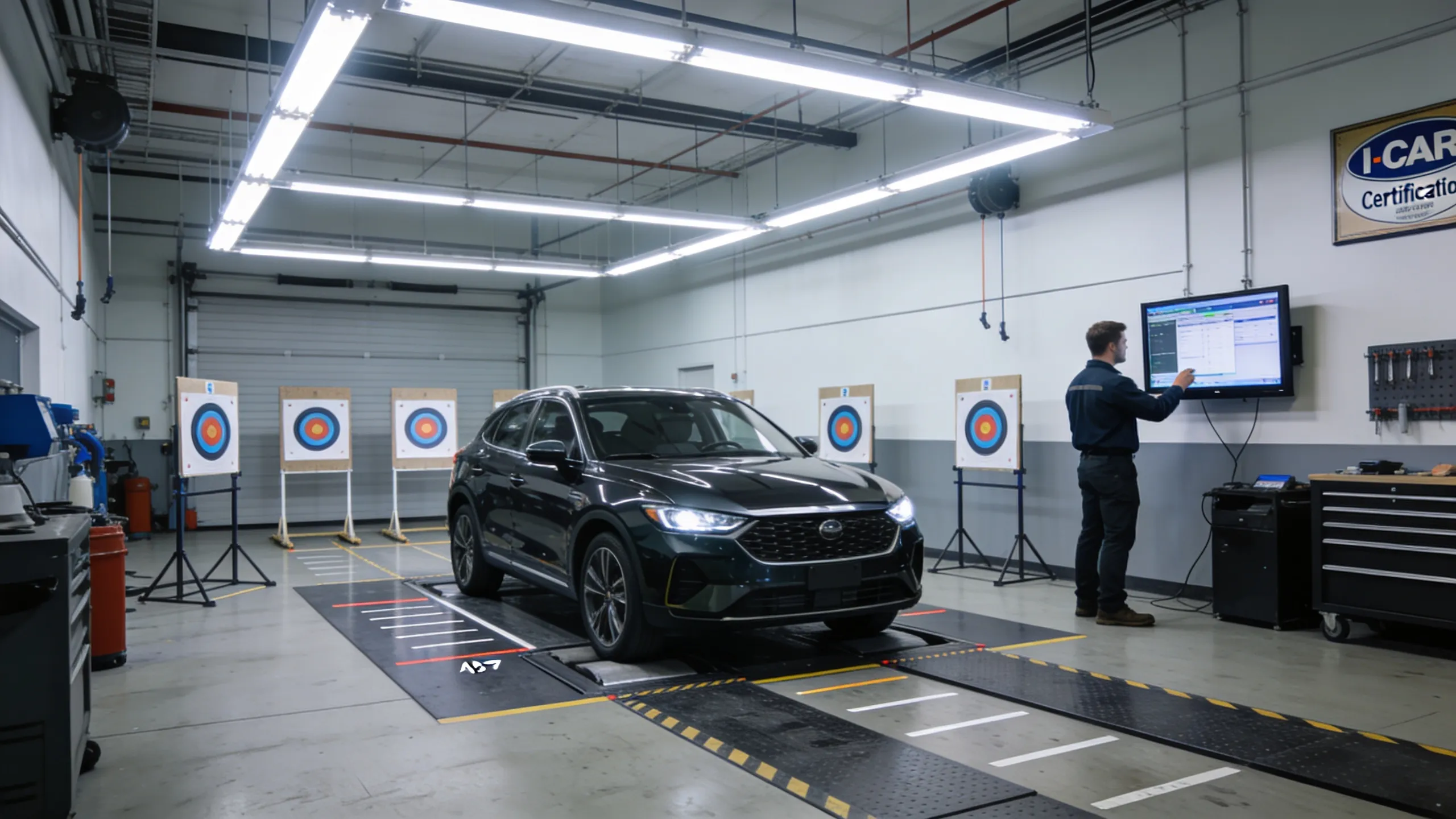
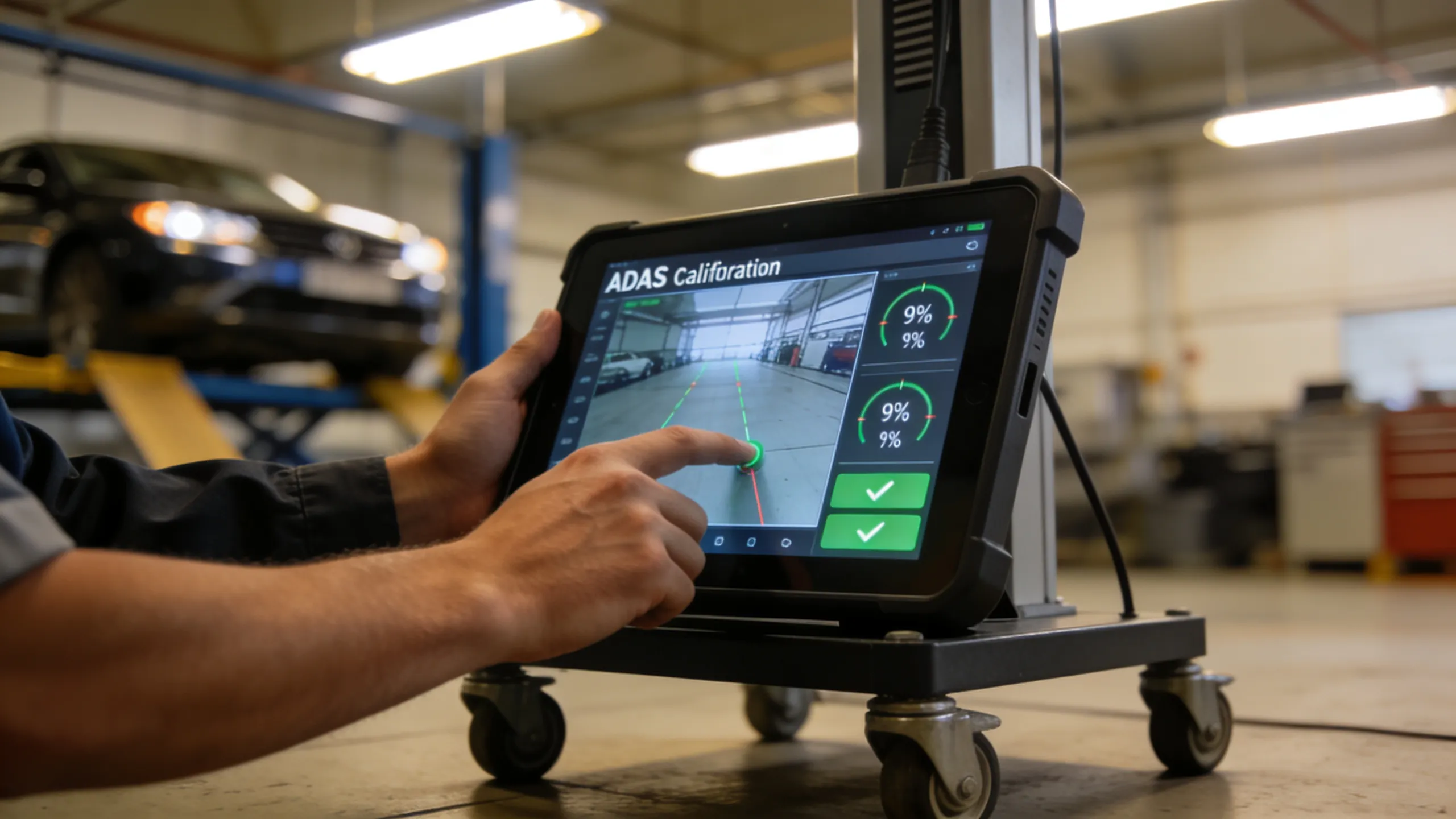
ADAS calibration cost is now part of normal repair planning, not a niche add-on. ADAS stands for Advanced Driver Assistance Systems, which includes lane departure warning, forward collision warning, automatic emergency braking, and blind spot alerts. When sensors are moved during repair, calibration resets their aim and measurement accuracy. Without it, safety features may trigger late, trigger early, or fail.
In 2026, market data shows calibration volume and pricing are still rising. More 2023+ vehicles use multi-sensor layouts, and calibration appears on more repair estimates than ever. But bills still vary a lot by vehicle, system type, and shop capability. Some owners pay $250. Others see $900+ after major repairs. This guide breaks down the numbers, what drives ADAS calibration cost, what insurance usually pays, and where car owners can trim cost without cutting safety.
For background on process and timing, see this ADAS calibration guide.
How Much Does ADAS Calibration Cost?
ADAS calibration cost in 2026 typically falls between $200 and $800. Single-system jobs, like one camera or radar, often run $250-$500. Multi-system recalibration after collision repair can reach $400-$800 or more. Final pricing depends on sensor type, vehicle brand, calibration method, and local labor rates.
That short answer helps with budgeting, but it hides where money really goes. A quote usually includes setup labor, scan fees, target alignment tools, road-test time for dynamic procedures, and post-calibration documentation. In many markets, labor is now the largest share of ADAS recalibration cost.
And there’s a big trigger most people miss. Shops don’t choose calibration just to pad invoices. OEM repair procedures often require calibration after windshield replacement, bumper replacement, suspension work, wheel alignment, steering angle reset, and many rear body repairs. If a procedure says calibration is required, skipping it can put drivers at risk and create claim disputes later.
A second budgeting issue: estimates can start low, then rise after teardown scanning. Pre-repair scans sometimes miss hidden bracket movement or mounting tolerance shifts. Once technicians inspect deeper, a second or third sensor may need setup. That’s why two estimates for the same crash can differ by $300-$600 in ADAS calibration price.
ADAS Calibration Cost by Sensor Type
The fastest way to estimate ADAS calibration cost is to map each repaired area to the sensor in that zone. Front glass work points to camera calibration cost. Front impact work points to radar. Rear quarter and rear body work can trigger blind spot or rear camera procedures.
| Sensor Type | Cost Range | Common Trigger |
|---|---|---|
| Forward-facing camera | $250-$500 | Windshield replacement |
| Front radar | $250-$450 | Bumper repair/replacement |
| Blind spot monitoring | $200-$350 | Rear quarter panel repair |
| Rear camera | $150-$300 | Rear-end collision repair |
| Multi-system calibration | $400-$800 | Major collision repair |
| LiDAR (if equipped) | $500-$1,000+ | Any sensor-area repair |
Here’s how to read this table in real life:
- Forward-facing camera: This is the most common ADAS calibration cost line item because camera modules are often mounted near the windshield. Data from repair networks shows 9 out of 10 late-model vehicles need recalibration after glass replacement. See ADAS calibration after windshield replacement for a full breakdown of that specific trigger, and related service context on auto glass repair.
- Front radar: Radar modules behind the bumper are sensitive to bracket angle and mounting depth. Even small bumper cover or absorber changes can affect aim.
- Blind spot systems: Side and rear corner repairs often move panels near sensors. Minor body pull or quarter replacement can trigger recalibration.
- Rear camera: Rear camera calibration cost is usually lower than front camera pricing, but costs climb when harnesses, liftgates, or camera mounts are replaced.
- Multi-system jobs: After medium or heavy collision repair, shops may calibrate camera + radar + blind spot together. Total ADAS calibration cost can move fast in these cases.
- LiDAR-equipped vehicles: Still a smaller share of the fleet, but calibration tooling and procedure time can be much higher.
One practical way to avoid surprises is to ask for sensor-by-sensor pricing before repair authorization. A single total number can hide where ADAS calibration cost is coming from.
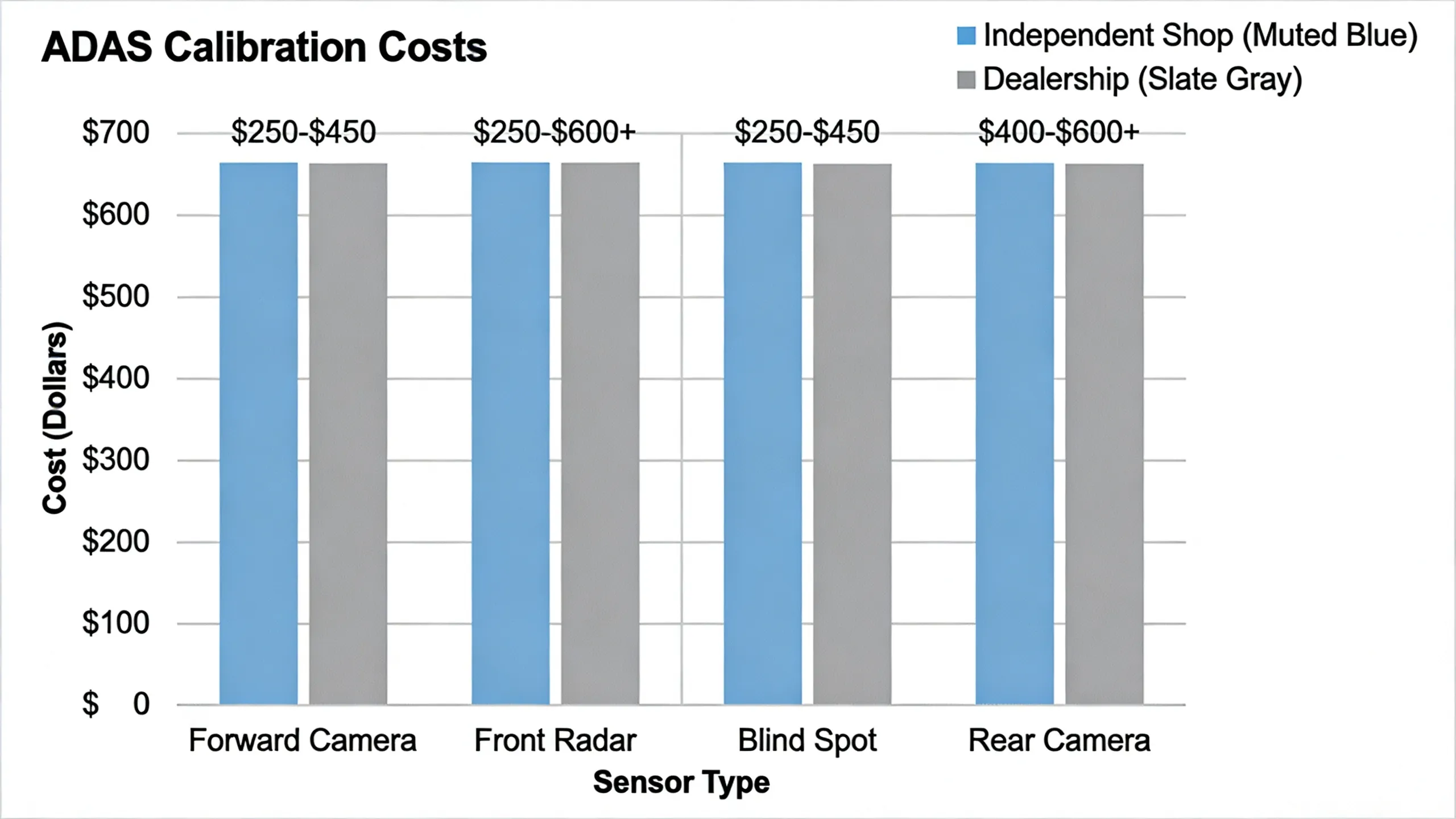
Dealership vs Independent Shop Pricing
Shop type has a clear effect on ADAS calibration cost. Both dealers and independent facilities can do quality work. The difference is usually labor rate, equipment utilization, and workflow speed.
Dealership Costs ($400-$600+ per system)
Dealership invoices often run higher for ADAS calibration cost, especially on luxury brands. In many cities, dealer labor rates sit at the top end of the local market, and some dealer service departments route calibration through dedicated ADAS teams with fixed minimum charges.
Typical range by system: $400-$600+, with premium brands sometimes exceeding this range when static and dynamic calibrations are both required.
Why dealer pricing trends higher:
- Higher posted labor rates.
- Brand-specific tool subscriptions and scan licenses.
- Higher overhead in metro markets.
- Limited scheduling blocks for non-dealer-body-shop vehicles.
Dealer calibration can still be the right call, especially for newer or rare models where procedures, targets, and software support are tightly brand-controlled. Don't rule it out based on price alone.
Independent Shop Costs ($250-$450 per system)
Independent ADAS-capable shops usually price lower, with many systems falling between $250 and $450. In competitive markets, bundled calibration pricing after collision repair can lower total ADAS recalibration cost by another 10-20% compared with stand-alone calibration bookings.
Typical range by system: $250-$450, with higher totals for multi-system or luxury platforms.
Why independent pricing trends lower:
- Lower labor rates in many markets.
- Higher throughput on mixed-brand vehicles.
- Flexible package pricing when repair and calibration stay in one workflow.
- Local competition on camera calibration cost and radar calibration lines.
But not every independent shop has full capability. Industry data shows only about one in four repair shops is fully equipped for modern ADAS work. Lower price only helps when the shop follows OEM procedure and provides proof of completion. A cheap quote from an unqualified shop isn't a deal.
Which Is Better for Your Situation?
For most drivers, the best choice is the shop with verified capability, clear documentation, and fair pricing. Not simply the lowest or highest quote.
Dealership may fit better when:
- Vehicle is very new, exotic, or software-sensitive.
- A specific OEM calibration setup is required.
- Warranty concerns are a top priority.
Independent may fit better when:
- Pricing transparency matters.
- Vehicle is mainstream and procedure support is mature.
- Repair and calibration can be bundled to reduce total ADAS calibration price.
For local options, a city directory can help compare providers: find a body shop near you. For location-specific pricing data, see ADAS calibration shops near me.
What Affects ADAS Calibration Cost?
When drivers ask “how much does ADAS calibration cost,” the honest answer is: it depends. Five measurable factors explain most of the quote differences across markets.
Vehicle Make and Model (luxury vehicles cost more)
Vehicle platform is one of the strongest cost drivers. Luxury and performance brands often need tighter tolerances, model-specific targets, and longer procedure sequences. That raises labor time and setup complexity.
Example patterns seen in 2026 estimates:
- Mainstream compact SUV forward camera: often $275-$425.
- Luxury SUV forward camera: often $400-$650.
- Mainstream front radar: often $250-$400.
- Luxury front radar: often $350-$600.
Same sensor type. Very different ADAS calibration cost.
Number of Systems Needing Calibration
A single sensor calibration might look manageable. But repairs often affect multiple systems at once.
Common multi-system scenarios:
- Windshield replacement + forward camera + lane-centering sensor checks.
- Front bumper repair + radar + camera verification.
- Rear body repair + blind spot + rear camera setup.
Each additional sensor adds labor time, scan workflows, and documentation steps. That’s why multi-system ADAS calibration price commonly lands between $400 and $800, with higher totals on advanced platforms.
For readers comparing repair scopes, this collision repair service overview explains how damage type influences procedure count.
Static vs Dynamic Calibration Requirements
Calibration methods affect price directly.
- Static calibration: done in the shop using physical targets, controlled lighting, and precise floor measurements.
- Dynamic calibration: done during road testing at specific speeds and lane conditions.
Some vehicles need only one method. Others need both. When both are required, ADAS calibration cost rises because technician time and validation steps increase.
Static setups can fail if floor level or lighting is out of tolerance, which adds rework time. Dynamic procedures can also require longer test routes in dense traffic regions. That’s one reason camera calibration cost in crowded urban markets can run above national averages.
Geographic Location (labor rates vary 40-60% by market)
Location matters more than many drivers expect. Labor rates can vary 40-60% between low-cost and high-cost regions.
Illustrative 2026 labor examples:
- Smaller markets: $90-$130/hour.
- Mid-sized metros: $130-$180/hour.
- High-cost metros: $180-$240+/hour.
If a calibration requires 1.5 to 3.0 labor hours plus scan and setup fees, ADAS calibration cost can shift by hundreds of dollars based on ZIP code alone.
And local competition changes pricing behavior. Markets with more ADAS-capable independents usually show tighter quote ranges and lower average ADAS recalibration cost.
Hidden Costs of Skipping ADAS Calibration
Some owners try to reduce the repair bill by declining calibration. That's a gamble with real downside.
Safety risk comes first. A misaligned camera or radar can delay warning and braking events by fractions of a second. At highway speed, that distance adds up fast. IIHS reports that front crash prevention systems with automatic braking reduce rear-end crashes by about 50% when functioning as designed (IIHS research).
Legal and insurance exposure is next. Litigation tied to ADAS repair quality has risen sharply, from 3 recorded cases in 2018 to 61 in 2024. When post-repair documentation is missing, liability arguments become harder for owners and repairers.
Claim friction also shows up later. If another incident occurs and calibration records are missing, insurers may question whether the vehicle was restored to pre-loss condition. Settlements slow down, and negotiating power drops.
Then there's the premium hit. Some policyholders report increases after preventable follow-up incidents, with total added costs often estimated at $1,000-$2,000 over three years.
Skipping a $300-$600 calibration to avoid short-term ADAS calibration cost can produce a much larger three-year expense profile.
Does Insurance Cover ADAS Calibration Costs?
In many collision claims, insurance does cover ADAS calibration cost when calibration is required to return the vehicle to safe pre-loss condition. But it's not automatic. Coverage depends almost entirely on documentation.
Common cases where insurers pay:
- Covered collision claim with sensor-area repairs.
- Covered comprehensive claim involving windshield replacement and required camera calibration.
- Documented OEM procedure showing calibration is mandatory after specific repair steps.
Cases where disputes are more common:
- No documentation linking repair operation to calibration requirement.
- Estimate only says “scan” without calibration details.
- Shop invoice lacks before/after scan proof or calibration completion records.
Documentation that helps support payment:
- OEM procedure excerpts tied to VIN and repair operations.
- Pre-scan and post-scan reports.
- Itemized invoice listing each ADAS calibration price line.
- Final calibration result report with timestamps.
To improve approval odds, owners should ask the shop to include calibration from the first draft estimate, not as a late supplement unless teardown proves additional need. Adjusters are more likely to accept ADAS recalibration cost when procedure logic is visible from the start.
For a deeper walkthrough, see does insurance cover ADAS calibration.
How to Save Money on ADAS Calibration
Car owners can lower ADAS calibration cost without cutting safety by focusing on process and documentation.
- Get at least three quotes for the same repair scope.
Use the same vehicle info and damage summary for each shop. Quote differences of $150-$400 are common, especially for camera calibration cost.
- Ask for itemized pricing, not one bundled line.
Request separate entries for scans, each sensor calibration, and validation. Itemization reveals whether ADAS calibration price is reasonable for each system.
- Check whether calibration is bundled with repair labor.
When repair and calibration stay in one workflow, total ADAS recalibration cost can be lower than outsourcing to a second facility.
- Verify insurance position before work starts.
Ask adjusters to confirm whether calibration is covered when OEM procedure requires it. Written confirmation helps prevent billing surprises.
- Compare dealer and independent options.
On mainstream vehicles, high-quality independents often deliver lower ADAS calibration cost with equivalent procedure compliance.
- Confirm shop capability before scheduling.
Ask whether the shop has in-house targets, level floor certification, scan tools, and trained technicians for the exact vehicle platform.
- Avoid duplicate charges.
Some invoices include repeated scan or setup lines. Review carefully and ask questions before final payment.
- Request final records package.
Proof matters. Keep scan reports and calibration completion documents for future claims, resale, and liability protection.
For more on selecting qualified facilities, this resource helps: how to choose an ADAS-capable repair shop.
Key Takeaways
ADAS calibration cost in 2026 usually falls between $200 and $800. Higher totals show up on luxury vehicles, multi-system repairs, and high-rate metro markets. Single camera or radar jobs often land in the $250-$500 range. Major repairs can push well past that.
The biggest pricing drivers are vehicle platform, number of affected sensors, calibration method, and labor rate by region. That’s why two valid estimates for the same vehicle can differ by several hundred dollars. It’s not unusual.
For most owners, tracking ADAS calibration cost line by line is the fastest way to avoid overpaying.
Skipping calibration can cost more than paying for it. Safety system performance can drop, claim disputes can rise, and legal risk has increased as ADAS-related lawsuits moved from 3 cases in 2018 to 61 in 2024.
Insurance often covers ADAS calibration cost when documentation is complete and procedure requirements are clear. The best defense against overpaying is simple: compare quotes, insist on itemized billing, and keep final calibration records.
One final tactic: separate required operations from optional diagnostics before authorizing work. If a shop can tie each charge to an OEM procedure, ADAS calibration cost is easier to evaluate and negotiate. If it can’t, that’s a reason to pause and ask for more detail.
Clear paperwork speeds claim handling and cuts supplement disputes. Documentation quality often matters as much as raw ADAS calibration price (it affects reimbursement, resale confidence, and post-repair liability). Worth keeping every report.
For broader context on standards and repair readiness, review:
- AAA research and repair cost analysis
- IIHS crash prevention effectiveness findings
- I-CAR ADAS calibration best practices
ADAS calibration cost is now a normal part of safe modern repair. The owners who manage it well use data, ask better questions, and document every step.