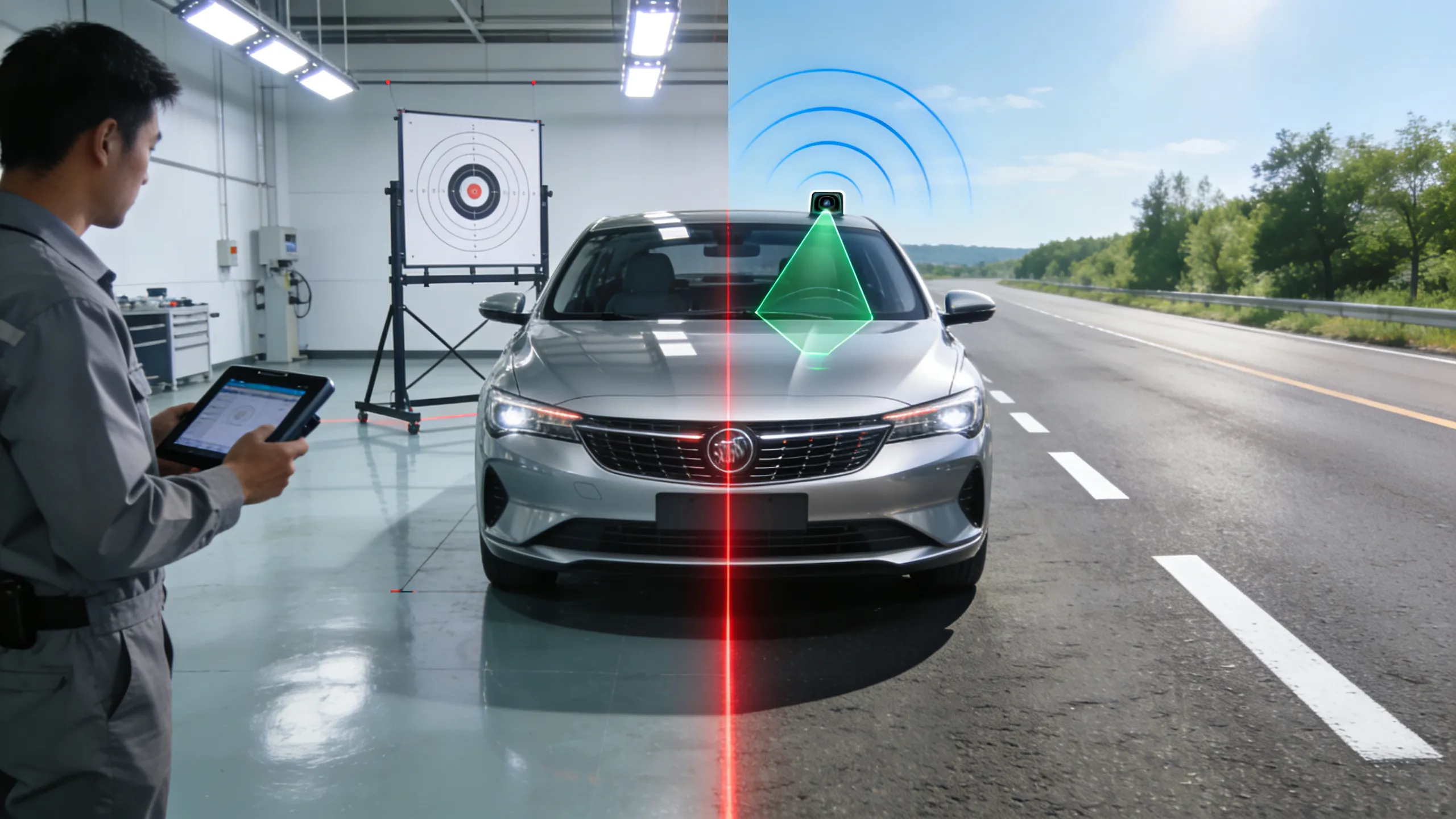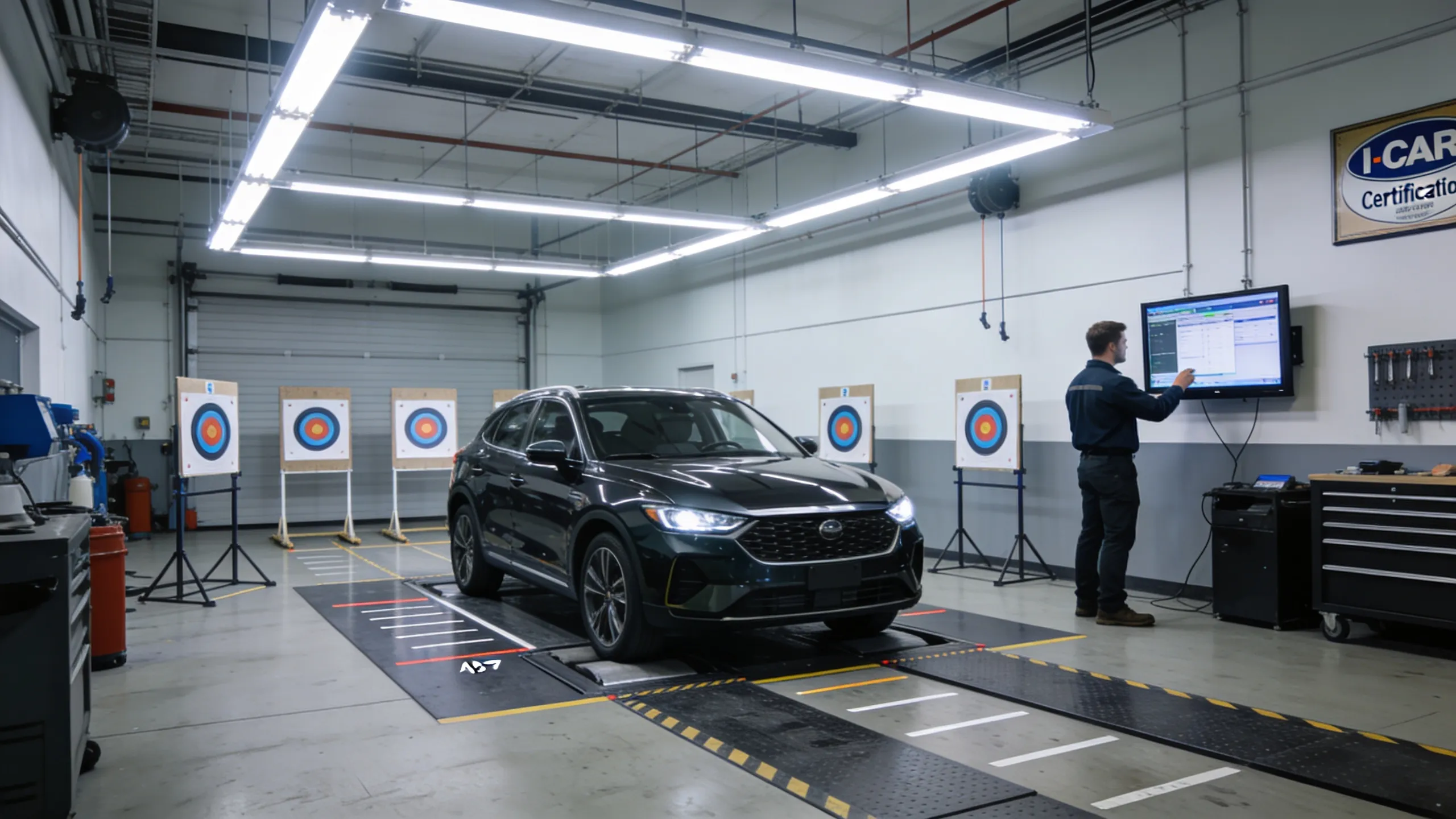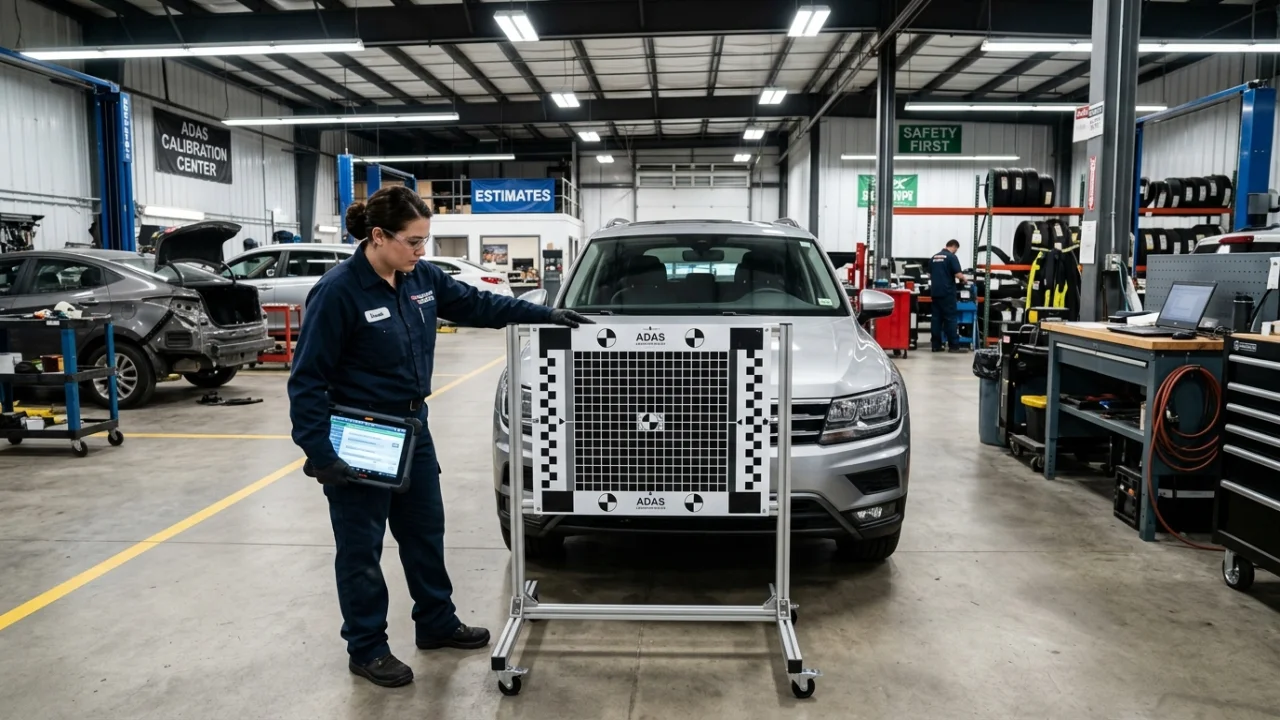
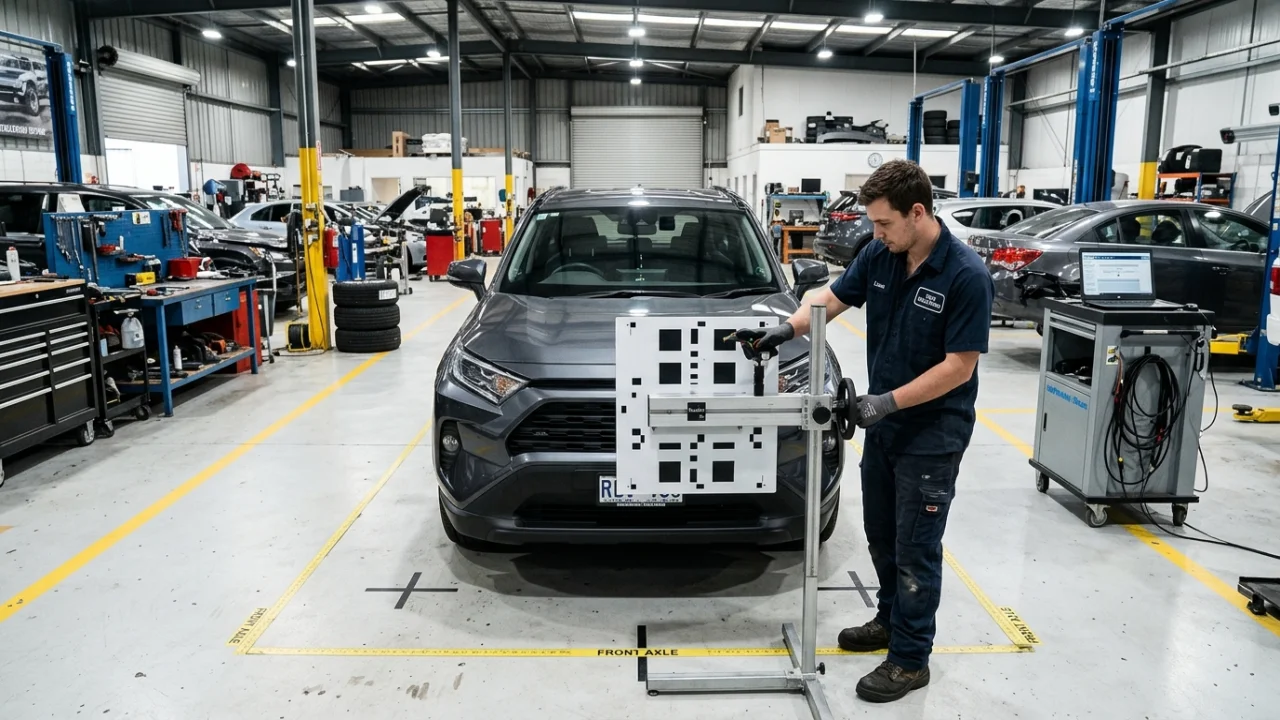
The fastest way to verify whether a body shop can actually calibrate your ADAS systems is to ask three questions: what calibration equipment do you own, which I-CAR or OEM training have your technicians completed, and do you perform calibrations in-house or sublet them to a third party. A shop that answers all three confidently — and can show you the equipment — is almost certainly capable. A shop that hesitates, deflects to "we send it out," or can't name specific tools and certifications is telling you everything you need to know.
Key Takeaways
- Approximately 65% of collision repairs now require at least one ADAS calibration, yet many body shops still sublet the work to mobile providers without disclosing it (CCC Intelligent Solutions, "State of Calibrations," 2026).
- Proper static calibration requires a dedicated space of at least 30×50 feet with level floors, controlled lighting, and OEM-specified target positioning — not a general service bay.
- Look for technicians with I-CAR Platinum ADAS certification or ASE L4 (ADAS Specialist) credentials, plus OEM-specific training for your vehicle's make.
- Shops that perform calibrations in-house typically charge $150–$400, while subletting adds markup and removes your shop's direct quality control over the process.
- Always ask for post-calibration documentation — a verified report showing system status, calibration type performed, and confirmation that all targets were within OEM specifications.
Why ADAS Calibration Verification Matters More Than Ever
Advanced driver assistance systems — forward collision warning, automatic emergency braking, lane departure warning, blind spot monitoring, adaptive cruise control — rely on cameras, radar, and lidar sensors mounted in precise positions on your vehicle. When a collision shifts the body structure, when a windshield is replaced, or when a wheel alignment changes, those sensors can fall out of calibration by fractions of a degree. At highway speeds, a camera misaligned by just one degree can read lane markings several feet off at 100 yards ahead.
The problem for consumers is straightforward: not every shop that claims to handle ADAS work actually has the equipment, training, or facility to do it properly. Some shops sublet every calibration to a mobile provider without telling you. Others use generic scan tools that confirm system communication but don't perform the actual recalibration procedure. And a small number skip calibration entirely, hoping the existing sensor alignment is close enough. None of these shortcuts are acceptable when the system in question controls your car's emergency braking.
The industry is catching up. I-CAR now includes ADAS education across all Gold Class technician roles and has built a dedicated Platinum training path for ADAS specialists (I-CAR, "ADAS Courses," 2026). But certification is not yet legally required in most states, which means the burden of verification falls on you.
What Equipment a Real ADAS Shop Needs
Calibration equipment is the single biggest investment a shop makes when bringing ADAS work in-house. If a shop has spent $30,000 to $80,000 on calibration hardware, they're serious. Here's what to look for.
Static calibration systems
Static calibration is performed inside the shop using physical targets — printed panels, reflective boards, and pattern plates — positioned at exact distances and angles from the vehicle. The major systems include the Autel MaxiSys ADAS (with the IA900WA frame), the Hunter HawkEye ADAS system, the John Bean Tru-Point, and the Bosch DAS 3000. Each uses a rolling frame or wall-mounted system with interchangeable OEM-specific targets. Ask the shop which system they use by name. A shop that can't tell you the brand and model of their calibration frame likely doesn't own one.
Dynamic calibration capability
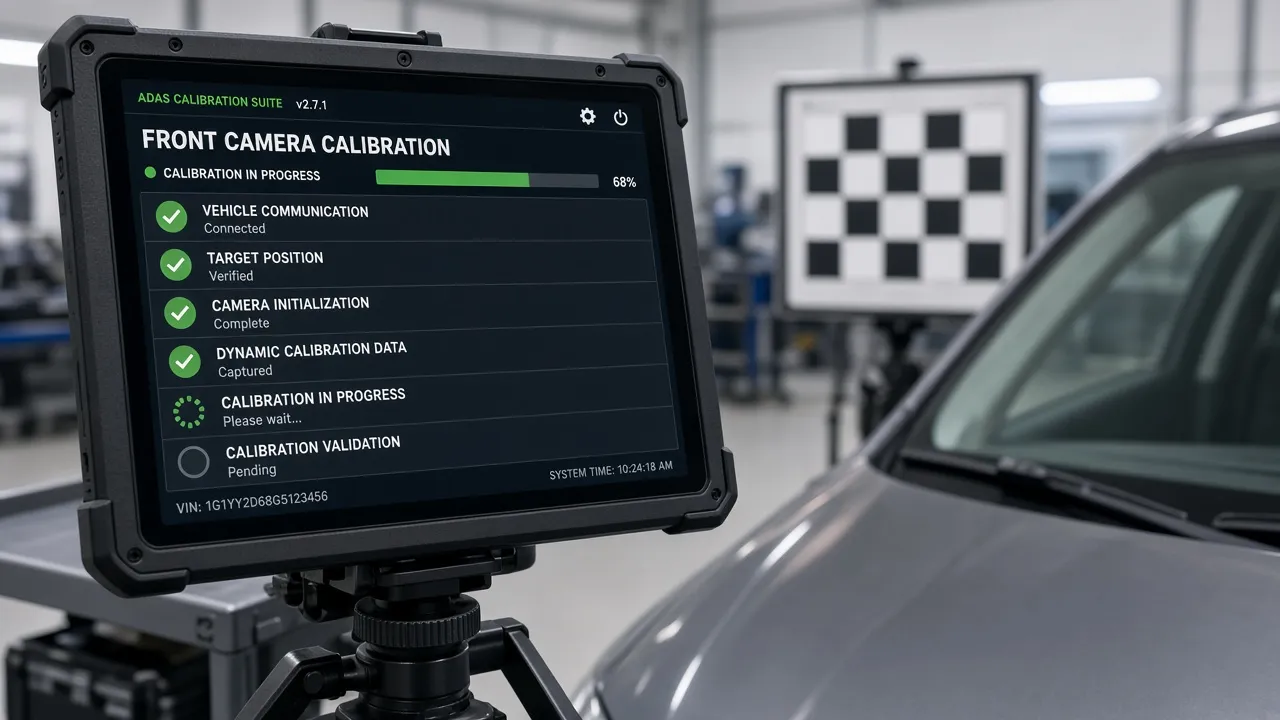
Some ADAS systems — particularly radar-based adaptive cruise control and certain camera systems — require dynamic calibration, meaning the vehicle must be driven at specific speeds on specific road types while the diagnostic tool relearns sensor parameters. A shop that handles dynamic calibration needs a diagnostic tablet with the correct OEM protocols (Autel Ultra II, Launch X-431 ADAS, or the OEM's own dealer tool) and a defined test route. Ask whether they perform dynamic calibrations or only static ones.
The space requirement
This is the detail most consumers overlook and many shops underestimate. Proper static calibration requires a dedicated bay with at least 25 to 35 feet of clear space in front of the vehicle, a perfectly level floor (verified to within 3mm over the calibration distance), controlled lighting with no direct sunlight or reflective surfaces, and enough room to position targets at OEM-specified distances. A general repair bay with cars on both sides, fluorescent overhead lights casting shadows, and an uneven concrete floor does not meet these requirements (Body Shop Business, "ADAS Space: Think Inside the Box," 2025). If you visit a shop and their "calibration area" is a corner of the general shop floor, that's a red flag.
Certifications and Training to Look For
Equipment alone doesn't guarantee a proper calibration — the technician operating it needs training on OEM procedures that change with every model year. Here are the credentials that matter.
I-CAR ADAS training
I-CAR's Platinum ADAS Technician path is the industry's most recognized credential for calibration specialists. It covers scanning protocols, calibration procedures across multiple makes, and the relationship between structural repair and sensor alignment. I-CAR Gold Class shops are now required to include ADAS education for all technician roles, with enhanced requirements taking effect for 2027 renewal (I-CAR, 2026). Ask whether the shop holds Gold Class status and whether their calibration technicians have completed the Platinum ADAS path specifically.
ASE L4 certification
The ASE L4 (Advanced Driver Assistance Systems Specialist) certification tests knowledge of ADAS components, diagnostic procedures, and calibration requirements. It's a voluntary certification, but shops that invest in it signal a commitment to the work. Not every great ADAS technician holds this credential, but its presence is a positive indicator.
OEM-specific certifications
Vehicle manufacturers run their own certification programs: Ford's ADAS Calibration Certification, Toyota's T-TEN program, Honda's ProFirst Collision Repair Facility designation, and similar programs from GM, Subaru, and others. If your vehicle is a specific make, ask whether the shop holds that OEM's certification. OEM-certified shops receive direct access to updated repair procedures, calibration software updates, and factory-approved targets for that manufacturer's systems.
Seven Questions to Ask Before You Book
When you call or visit a body shop about ADAS calibration, these questions separate shops with genuine capability from those that are improvising.
- Do you perform ADAS calibrations in-house or sublet them? Neither answer is automatically disqualifying, but you need to know. In-house means faster turnaround and direct accountability. Subletting means a third party is doing the work — ask who, and verify their credentials independently. For a deeper look at how this choice affects your repair bill, read about in-house vs sublet calibration.
- What calibration equipment do you use? You want a specific answer: "Autel MaxiSys ADAS with the IA900WA frame" or "Hunter HawkEye." A vague answer like "we have the latest tools" means they either don't own dedicated equipment or don't know what they have.
- Can I see your calibration area? A shop with a proper setup will be proud to show it. Look for a clean, open area with a level floor, calibration targets stored on racks, and markings on the floor for positioning. If the area doubles as a general storage space or parking overflow, the shop isn't treating calibration as a dedicated process.
- What ADAS training have your technicians completed? Listen for specific programs: I-CAR Platinum ADAS, ASE L4, or OEM certifications. "We've been doing this for years" without naming a credential is a yellow flag.
- Do you follow OEM calibration procedures for my vehicle's make? The correct answer references accessing OEM repair information systems (like Honda's i-SRS or Toyota's TIS). Generic "we calibrate all makes" without mentioning OEM procedure lookup is a concern, because calibration steps genuinely differ between manufacturers and even model years.
- What documentation will I receive after calibration? You should receive a printed or digital report showing each system calibrated, whether it passed, and any fault codes before and after. If the shop can't provide this, they may be using a scan tool that confirms communication rather than one that actually performs the calibration sequence.
- Is ADAS calibration itemized on my estimate? Calibration should appear as a separate line item, not bundled into "electronic diagnosis" or hidden in labor hours. Typical charges range from $150 for a single-system static calibration to $400 or more for multi-system work. If you don't see it on the estimate but the shop says they'll "handle it," ask how.
Red Flags That Should Make You Walk Away
Certain responses or observations should end your consideration of a shop for ADAS work.
The shop says calibration "isn't necessary" after your repair. If your vehicle was in a collision that affected any body panel near a sensor, or if your windshield was replaced, calibration is almost certainly required by the vehicle manufacturer. A shop that dismisses this is either unfamiliar with ADAS requirements or trying to avoid the work. The risks of skipping calibration are well documented, including compromised emergency braking and lane-keeping failure.
They use a generic OBD-II scan tool and call it calibration. A standard scan tool can read and clear ADAS fault codes, but it cannot perform the actual recalibration procedure. Calibration requires OEM-specific software sequences, physical targets at precise positions, and system-specific confirmation routines. If the shop's "calibration" consists of plugging in a scan tool and showing you a green light, the sensor positions haven't actually been recalibrated.
There's no dedicated calibration space. Calibration in a crowded general bay, in a parking lot, or on uneven pavement cannot meet OEM specifications for target distance, surface levelness, or lighting control. Mobile calibration providers who work in controlled environments are legitimate. Mobile providers who set up targets on your driveway or in an alley are not.
The shop can't name their equipment or their calibration technician. Legitimate shops know exactly who on their team performs calibrations and what tools they use. Vagueness here typically means the work gets handed to whoever is available, using whatever tool is nearby.
In-House vs Mobile vs Sublet: What Consumers Should Know
Not every body shop needs to own $50,000 in calibration equipment. Some shops partner with specialized mobile ADAS providers who bring equipment to the shop, set up in a controlled area, and perform calibrations on-site. This model works well when the mobile provider has proper equipment, trained technicians, and a quality-controlled setup process.
The issue for consumers is transparency. MOTOR magazine reported in 2026 that many body shops sublet ADAS calibrations without disclosing it to the customer, adding markup while losing direct quality control over the process (MOTOR, "ADAS Calibration: Sublet or In-House?," March 2026). Your shop's name stays on the repair order and your shop retains the liability regardless of who performs the work.
Ask directly, and if the shop sublets, ask who their provider is. Then verify that provider's credentials independently. A shop that partners with a reputable mobile provider like Revv, Car ADAS, or an OEM-affiliated service is making a reasonable business decision. A shop that can't tell you who performs their calibrations is a shop you should avoid.
For older vehicles without ADAS systems, this entire discussion is moot. But if your car was built after 2018 and has any form of driver assistance, calibration after collision repair is a safety requirement, not an upsell. For vehicles that lack factory ADAS but where you'd like some assistance features, consider aftermarket blind spot mirrors as a lower-cost alternative.
How to Find Verified ADAS-Capable Shops Near You
Start with these resources to identify shops that have verifiable ADAS credentials.
- I-CAR's Gold Class shop locator filters for shops that meet current training requirements, including ADAS education for all roles. Gold Class represents the top tier of I-CAR recognition.
- OEM certified shop finders — most manufacturers maintain online directories. Search for "[your make] certified collision repair" to find shops with specific OEM ADAS training.
- Our directory lists shops with verified capabilities. For a curated list in a major market, see ADAS calibration shops in Philadelphia as an example of what's available in a metro area.
- Ask your insurer which DRP shops on their network have confirmed ADAS calibration capability. Insurers increasingly verify this as part of their DRP agreements.
Regardless of how you find the shop, verify in person using the seven questions above. A listing or certification confirms the shop has invested in the work. Your visit confirms they're still doing it properly.
Sources
- NHTSA ADAS Safety Technologies — advanced driver assistance system standards
- I-CAR — ADAS calibration repair procedures
Frequently Asked Questions
How do I know if my car needs ADAS calibration after a collision repair?
If your vehicle has any ADAS features — forward collision warning, automatic emergency braking, lane departure warning, adaptive cruise control, or blind spot monitoring — and the collision affected body panels near sensors (front bumper, windshield area, rear bumper, side mirrors), calibration is almost certainly required by the manufacturer. Your body shop's repair procedures should reference the OEM position statements for your make and model. When in doubt, ask the shop to check the OEM repair information system for calibration requirements specific to the damage your vehicle sustained.
What's the difference between an ADAS scan and an ADAS calibration?
A scan reads the vehicle's ADAS modules to check for fault codes and system status — it tells you whether the system thinks it's working. A calibration actually adjusts the sensor parameters to match OEM specifications using physical targets, software sequences, or a combination of both. Think of it this way: a scan is a thermometer reading, while a calibration is adjusting the thermostat. Both are necessary after a collision repair, but a scan alone does not restore sensor accuracy.
How much should ADAS calibration cost at a body shop?
Single-system static calibration typically costs $150 to $300, while multi-system calibrations (camera plus radar, for example) can run $300 to $500 or more. Dynamic calibrations that require a road test may add $100 to $200. If your shop sublets the work, expect a markup of 10% to 20% over the sublet provider's base rate. The cost should be itemized separately on your repair estimate, and in most cases your auto insurance covers ADAS calibration as part of the collision repair claim.
Can a mobile ADAS calibration service do the job properly?
Yes, if the provider uses proper equipment, employs trained technicians, and sets up in a controlled environment that meets OEM specifications for space, floor levelness, and lighting. Reputable mobile providers bring rolling calibration frames with OEM-approved targets and verify conditions before beginning. The key is that the mobile service meets the same standards as a fixed in-shop setup. A provider who sets up targets in an open parking lot with uneven asphalt and direct sunlight cannot meet those standards, regardless of their equipment quality.
What certifications should an ADAS calibration technician have?
The strongest credentials are I-CAR's Platinum ADAS Technician designation, the ASE L4 (Advanced Driver Assistance Systems Specialist) certification, and OEM-specific certifications for the make of vehicle being calibrated. No single certification is legally required in most states, which is why consumer verification matters. A technician with any of these credentials has completed formal training on calibration procedures, equipment operation, and the relationship between vehicle structure and sensor alignment. Ask to see credentials if you're uncertain.