Whether a body shop calibrates your ADAS systems in-house or sublets the work to a third party directly affects your repair bill — often by $150 to $300 per calibration event. In-house calibration typically costs $150 to $350 because the shop owns the equipment and absorbs no middleman markup. Sublet calibration, where the shop sends your vehicle to a mobile technician or dealer, commonly runs $300 to $600 after the shop adds its handling fee. Understanding which model your shop uses helps you anticipate costs, timelines, and quality control before you approve the repair.
Key Takeaways
- In-house ADAS calibration typically costs $150–$350 per event, while sublet calibrations run $300–$600 after the shop's markup.
- Sublet markups of 15–25% are standard, but some shops charge 40% or more — adding $100–$200 to each calibration line item.
- In-house shops complete calibration the same day as the repair. Sublet adds 1–3 business days for scheduling and transport.
- Equipment investment for in-house ADAS ranges from $8,000 for entry-level Autel systems to $100,000+ for full Hunter setups.
- Ask your shop directly: "Do you calibrate ADAS here, or do you send it out?" The answer tells you more about your final bill than the estimate does.
What In-House ADAS Calibration Means
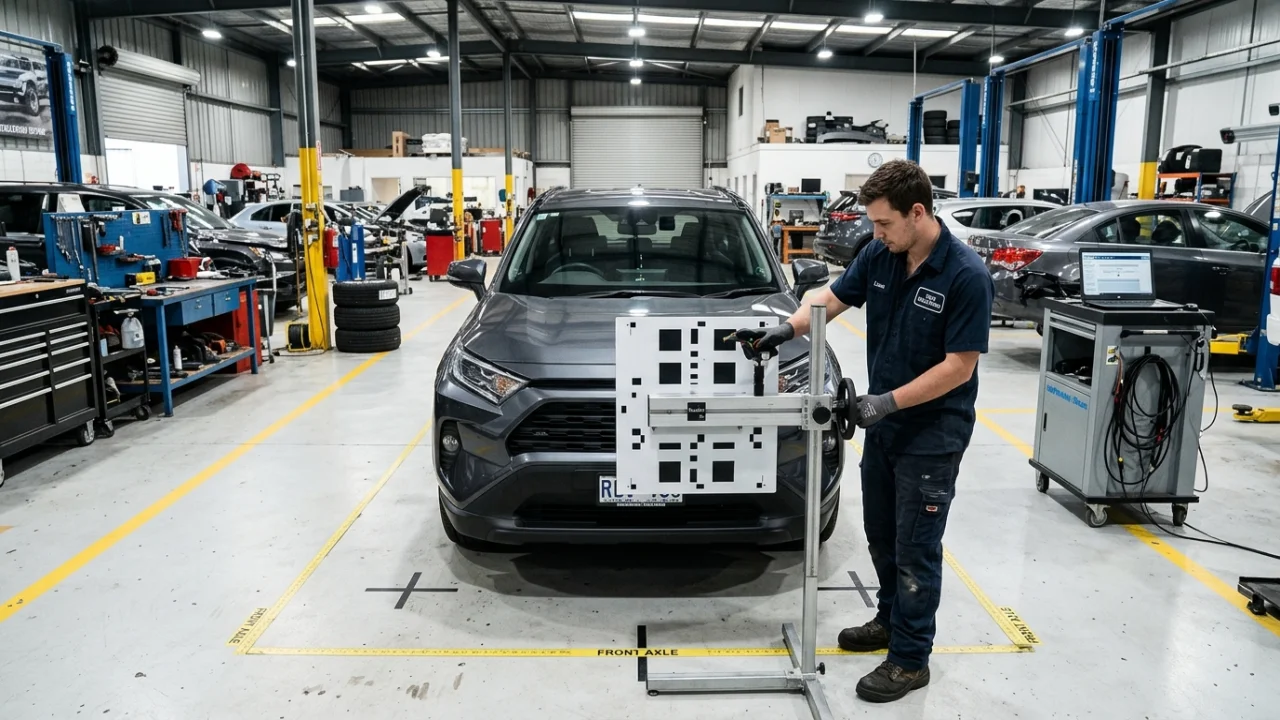
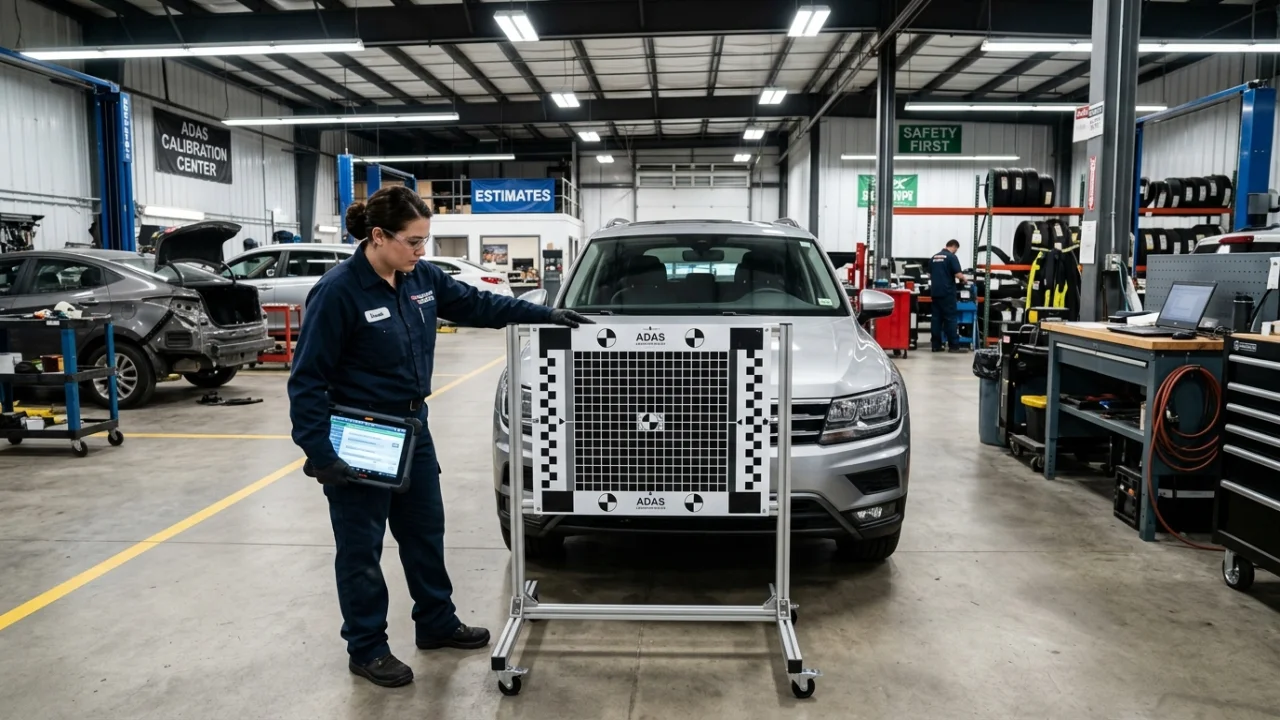
An in-house calibration means the body shop owns ADAS calibration equipment and performs the work on-site, in its own bays, with its own technicians. The shop has invested in calibration frames, OEM-specific targets, a diagnostic scan tool (typically an Autel MaxiSys, Hunter HawkEye, or Bosch DAS 3000), and the dedicated floor space required for static calibration — usually a flat, level area of at least 20 by 30 feet with controlled lighting.
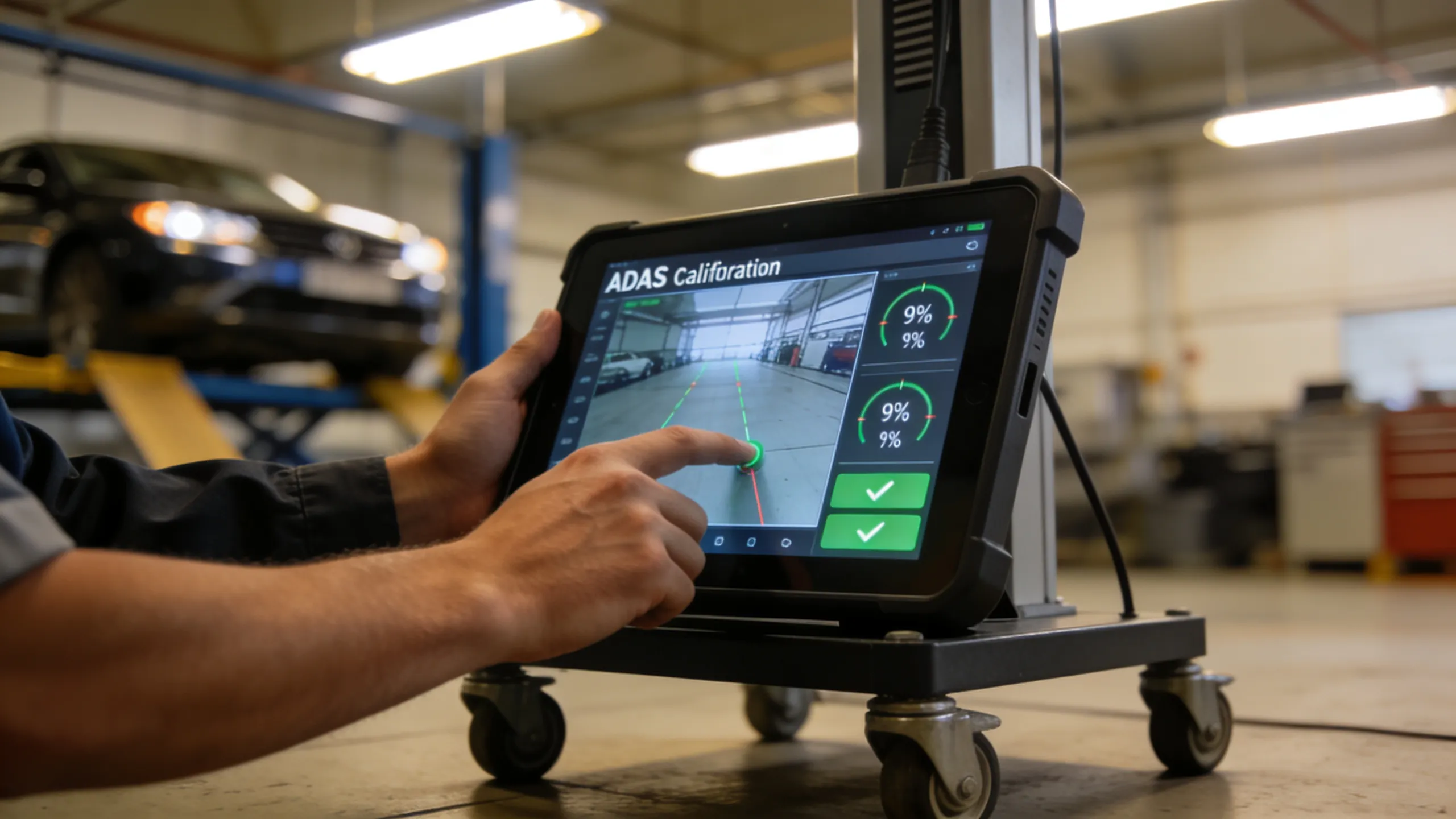
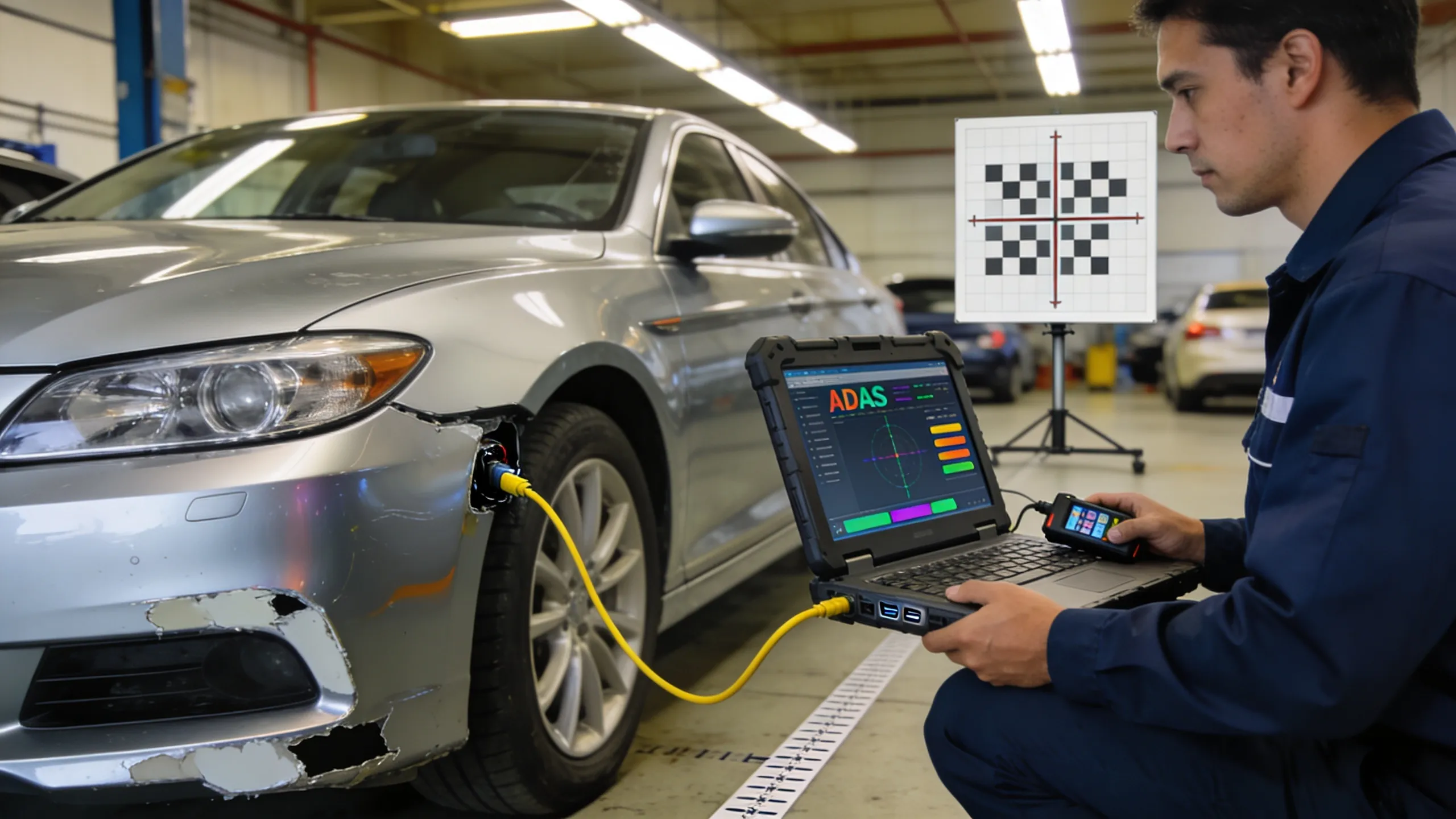
When a shop calibrates in-house, the process happens as part of the normal repair workflow. Your car gets reassembled after collision repair, the technician rolls it into the calibration bay, sets up the targets at OEM-specified distances and heights, and runs the calibration procedure through the diagnostic tool. The entire calibration typically takes 30 to 90 minutes depending on how many systems need recalibration — forward-facing camera, radar, blind spot monitoring, parking sensors, or a combination.
The financial advantage for the shop is straightforward. According to industry data reported by MOTOR Magazine, shops performing in-house calibrations generate an average of $21,509 per month in ADAS revenue, with 74% reporting calibrations as a net profit generator (MOTOR, "ADAS Calibration: Sublet vs. In-House," March 2026). For the consumer, the advantage is equally clear: no middleman markup, faster turnaround, and the same shop that repaired your car is responsible for the calibration.
What Sublet ADAS Calibration Means
Sublet calibration means the body shop does not own the equipment or employ trained calibration technicians. Instead, it contracts the work out to a third party — either a mobile ADAS calibration service that comes to the shop, a dedicated calibration center the car is transported to, or the vehicle's dealership.
The sublet workflow adds steps. After your repair is complete, the shop schedules an appointment with the sublet provider, which may take one to three business days depending on availability. If the provider is mobile, a technician arrives with portable equipment and performs the calibration in the shop's parking lot or an open bay. If the provider is off-site, the shop transports your vehicle — adding logistics time and liability during transit.
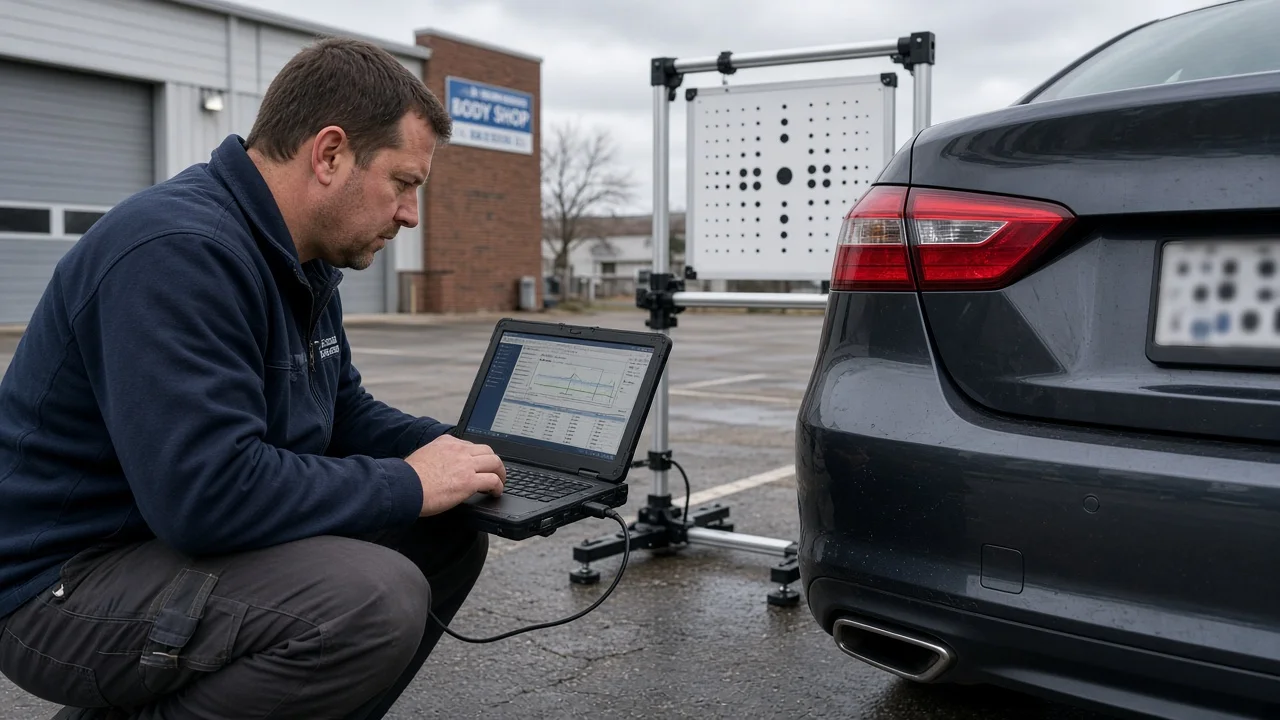
The shop then marks up the sublet invoice before passing it to you or your insurance company. Industry surveys show sublet markups typically range from 15% to 25%, though some shops apply markups of 40% or more (Repairer Driven News, "Who Pays: Sublet Markup Trends," 2018 — a benchmark still cited in 2026 industry discussions). A calibration that costs the shop $250 from the sublet provider might appear on your invoice at $350 to $400.
How the Cost Difference Breaks Down
The price gap between in-house and sublet calibration comes from three layers: the base calibration fee, the markup, and the hidden costs.
Base calibration fees
Mobile and third-party calibration providers typically charge the shop $200 to $400 per calibration event, depending on the vehicle platform and how many systems are involved (Revv HQ, "Mobile ADAS Calibration Providers Guide," 2026). A single forward-camera calibration sits at the low end. A multi-system calibration (camera, radar, blind spot, surround view) pushes toward $400 or beyond.
Shop markup on sublet work
The shop adds its margin. At a 25% markup, a $300 sublet becomes $375 on your bill. At 40%, it becomes $420. For a repair requiring two or three separate calibrations — which is common on modern vehicles with front radar, forward camera, and blind spot systems — the cumulative markup can add $200 to $400 to your total repair cost.
In-house pricing comparison
Shops with in-house equipment price calibrations based on their own cost structure — equipment depreciation, technician time, and consumables. Because they have already absorbed the capital expense, their per-calibration cost is substantially lower. Entry-level Autel calibration systems start around $3,000 to $3,500 for the IA700 frame and targets, while full-featured systems like the Autel IA900 run $15,000 to $20,000 (Autel Diagnostic Tools, "ADAS Calibration Equipment Buyer's Guide," 2026). A shop performing 10 calibrations per week at $250 each can recoup even a $20,000 investment in four to six weeks.
Timeline Differences That Affect Your Repair
The cost difference gets the attention, but the timeline difference is what affects your daily life. When calibration happens in-house, it is part of the repair schedule. Your car comes out of the paint booth, gets reassembled, goes through calibration, and is ready for pickup — all within the shop's projected completion date.
Sublet calibration adds wait time. The shop must coordinate with the provider's schedule, and mobile technicians often serve multiple shops across a region. A one-day scheduling gap is optimistic; two to three business days is common, especially during busy periods. If the sublet provider discovers an issue during calibration — a sensor that was not properly reinstalled, a bracket that is slightly misaligned — the car goes back to the body shop for correction, and the calibration appointment must be rescheduled.
For ADAS calibration cost transparency, ask the shop upfront whether the calibration timeline is included in their repair estimate or treated as a separate scheduling event.
Quality Control: Who Is Accountable?
This is where the in-house advantage becomes most significant. When the same shop that performed your ADAS recalibration after collision repair also calibrates the systems, there is a single point of accountability. If your lane-departure warning drifts, your automatic emergency braking behaves oddly, or a warning light appears after pickup, you go back to one shop that owns the entire repair.
With sublet work, accountability fragments. The body shop may blame the calibration provider. The calibration provider may say the repair was not done correctly. Your insurance adjuster may not distinguish between the two. This finger-pointing is not hypothetical — it is one of the most common complaints in post-repair ADAS disputes.
Shops that invest in verified ADAS calibration capability commit to owning the outcome. That commitment signals something broader about how the shop approaches repair quality.
How to Find Out What Your Shop Does
Most shops will not volunteer whether they calibrate in-house or sublet. You need to ask directly. Here are the questions that get you clear answers:
- "Do you perform ADAS calibration in your shop, or do you send it out?" A straightforward question. If they hesitate or say "we work with a partner," that means sublet.
- "What calibration equipment do you use?" A shop with in-house capability can name the system — Autel MaxiSys ADAS, Hunter ADASLink, John Bean V2300. A shop that sublets will not have an answer.
- "Is the calibration included in my repair timeline, or does it add extra days?" An in-house shop includes it. A subletting shop will add scheduling time.
- "Is the calibration cost on your estimate, or will it be a separate invoice?" Separate invoicing often indicates sublet work with markup applied.
- "Who is responsible if a calibrated system does not work correctly after I pick up?" You want the answer to be "we are" — not "you'll need to contact the calibration company."
For shops in the Philadelphia area with confirmed in-house ADAS capability, see our guide to ADAS calibration in Philadelphia.
When Sublet Calibration Is the Right Call
Sublet calibration is not inherently worse. There are situations where it makes sense, and a good shop using a reputable sublet provider can still deliver excellent results.
Sublet is appropriate when the vehicle requires OEM-specific calibration that the shop's equipment does not support. Some luxury and European makes (Mercedes-Benz, BMW, certain Volvo systems) require proprietary diagnostic connections that aftermarket tools cannot replicate. In these cases, dealer-level calibration through a sublet arrangement is the correct approach.
Sublet also makes sense for shops that perform only occasional ADAS-equipped vehicle repairs. A shop handling five or fewer calibrations per month cannot justify a $15,000 to $60,000 equipment investment and the ongoing training costs. Using a qualified sublet provider keeps the work accessible without the capital burden.
The key is transparency. A shop that openly explains it sublets calibration, names its provider, and does not bury an excessive markup in the invoice is acting in good faith. A shop that charges $500 for a calibration it pays $200 for, without disclosing the arrangement, is not. Whether your insurance covers ADAS calibration costs may also depend on whether the insurer considers the sublet markup reasonable.
What Insurance Companies Think About Sublet Markups
Insurance companies have increasingly scrutinized ADAS calibration charges, and sublet markups are a frequent point of dispute. Many insurers restrict sublet markup to 0% to 15%, arguing that the shop is not performing the work and therefore should not profit from it. Shops counter that coordinating, scheduling, and quality-checking sublet work requires administrative effort that deserves compensation.
In practice, this means your insurance payout may not cover the full sublet markup. The difference comes out of your pocket or becomes a negotiation between the shop and the insurer. In-house calibration sidesteps this dispute entirely — the shop bills for calibration as part of the repair, and there is no sublet line item for the insurer to challenge.
Several states, including Illinois and California, have introduced legislation in 2025 and 2026 requiring shops and glass companies to disclose whether ADAS calibration was performed and by whom (Autobody News, "Illinois House Committee Advances ADAS Calibration Disclosure Bill," 2026). This transparency trend suggests the industry is moving toward clearer disclosure of in-house versus sublet practices.
Sources
- NHTSA ADAS Safety Technologies — advanced driver assistance system standards
- I-CAR — ADAS calibration repair procedures
Frequently Asked Questions
How much more does sublet ADAS calibration cost than in-house?
Sublet calibration typically costs $150 to $300 more per event than in-house calibration. In-house calibrations generally run $150 to $350, while sublet calibrations cost $300 to $600 after the shop applies its markup of 15% to 40%. On a repair requiring multiple calibrations, the difference can exceed $400.
How can I tell if my body shop sublets ADAS calibration?
Ask directly: "Do you calibrate ADAS systems here in your shop, or do you send it out?" A shop with in-house capability can name its equipment (Autel, Hunter, Bosch). If they mention a "calibration partner" or say the car needs to go to another facility, that is sublet work. A separate calibration invoice or added days on the timeline are also indicators.
Is sublet ADAS calibration lower quality than in-house?
Not necessarily. A reputable mobile calibration provider using proper equipment and OEM procedures can deliver the same result as an in-house shop. The quality risk comes from fragmented accountability — if something goes wrong, you may get caught between the body shop and the calibration provider. In-house calibration keeps one shop responsible for the entire repair and calibration outcome.
Will my insurance cover the sublet markup on ADAS calibration?
Many insurance companies restrict sublet markups to 0% to 15%, and some refuse to pay any markup on sublet ADAS calibration. If your shop applies a higher markup, the difference may come out of your pocket. Ask your insurance adjuster specifically about sublet markup coverage before approving the repair. In-house calibration avoids this issue because there is no sublet line item to dispute.
How much does it cost a body shop to set up in-house ADAS calibration?
Entry-level Autel calibration systems (IA700 frame and targets) start around $3,000 to $3,500. Mid-range systems like the Autel IA900 run $15,000 to $20,000. Full Hunter ADASLink setups can reach $100,000 or more. Beyond equipment, shops need a flat, level calibration space of at least 20 by 30 feet with controlled lighting, which may require $5,000 to $15,000 in facility modifications.