A collision repair estimate breaks into four sections: labor operations (what the shop charges per repair step), parts costs (OEM vs aftermarket, new vs used), paint and materials, and sublet work (specialty tasks sent to another facility). Understanding these line items helps you catch overcharges, question insurer cost-cuts, and verify the repair is done right.
An auto body repair estimate isn't just a price quote. It's a technical specification for how the shop plans to restore the vehicle. Every line describes a specific operation, part, or material. Car owners who know what to look for can ask sharper questions, catch missing operations, and avoid paying for work the estimate doesn't actually cover.
This guide walks through every section of a typical collision repair estimate, from header to totals, and explains what each entry means, how parts are priced, why estimates change after work begins, and what to do when two shops give very different numbers. For a broader overview of the repair process, see the collision repair guide.
Why understanding your collision repair estimate matters
A collision repair estimate is a technical document listing every labor operation, replacement part, and material needed to restore a vehicle. It determines repair scope, part quality, and final cost. Car owners who can read it accurately can catch missing operations, question parts choices, and avoid unexpected charges at pickup.
Most car owners hand their estimate to an insurance adjuster and wait. That approach leaves important decisions to others, and can lead to disputes, delays, and repairs that don't fully restore the vehicle.
Reading a collision repair estimate isn't about second-guessing the shop. It's about informed consent. A repair plan might substitute aftermarket parts for OEM (Original Equipment Manufacturer) parts without explanation. Labor hour totals might not account for related operations that turn up at teardown. Understanding the document lets you engage with the shop, insurance adjuster, and any supplement discussions from an informed position.
The stakes are higher than a single bill. A poorly documented or incomplete repair can affect resale value, safety performance, and future insurance claims. The estimate is the paper trail for all of it.
Anatomy of a collision repair estimate
A standard body shop estimate follows a predictable structure. Most shops use one of two major estimating platforms. CCC Intelligent Solutions or Mitchell International, which produce estimates in similar layouts. Understanding that structure applies across most shops and insurers.
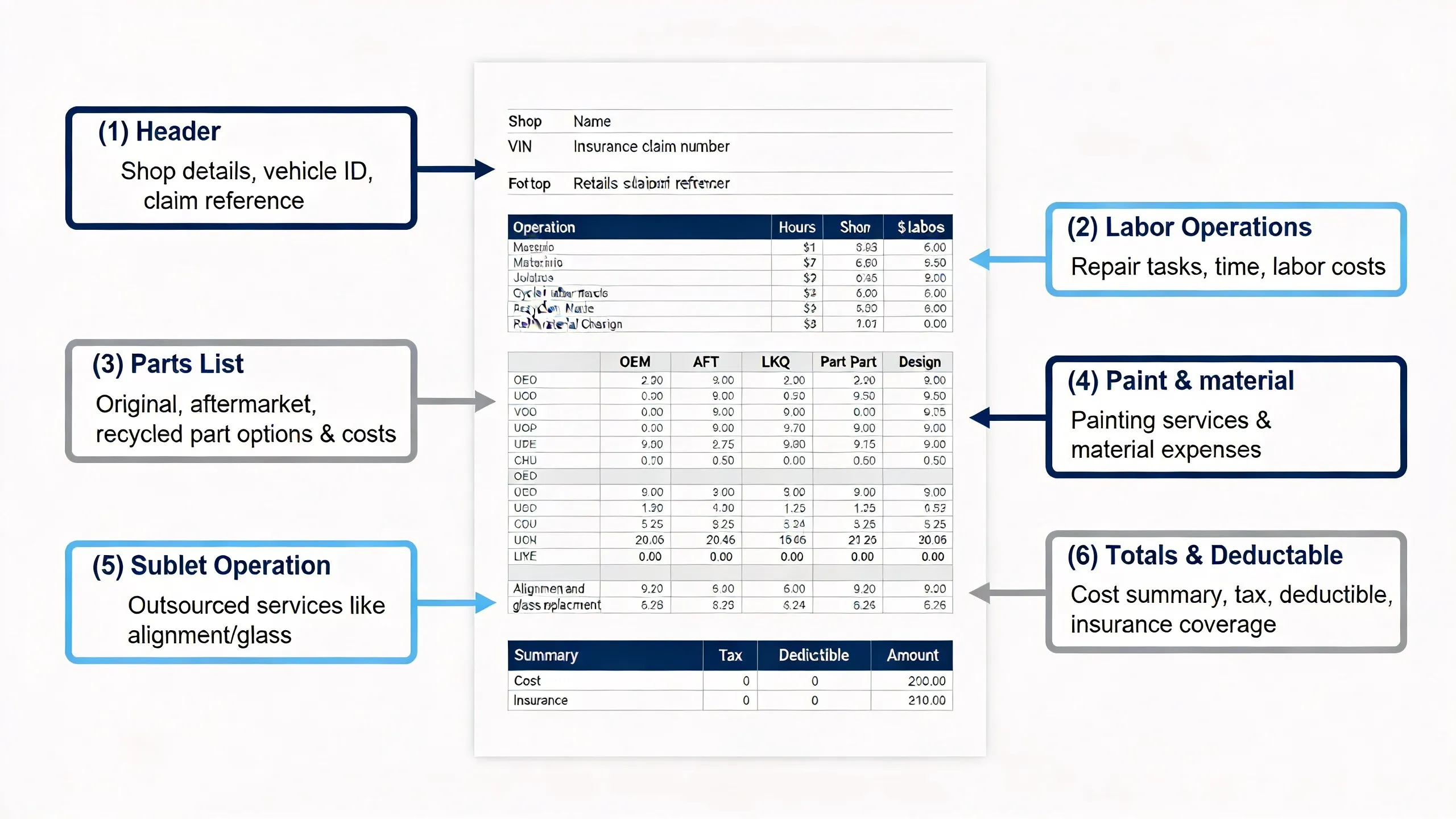
Header information: shop, vehicle, insurance
The top section of every estimate identifies the parties and the vehicle. It typically includes:
- Shop name, address, and license number: the facility performing the work
- Estimator name: the person who assessed the damage
- Claim number: assigned by the insurance company for the claim
- Insurance company and adjuster contact: the carrier handling the claim
- Vehicle information: year, make, model, trim, VIN, mileage, color code, and production date
The color code and production date are not decorative. Paint fades over time, and a shop needs the exact production date to blend new paint into surrounding panels accurately. A missing or wrong production date is worth flagging before work begins, this causes color mismatch more often than people expect.
The VIN also matters. Estimating software pulls vehicle-specific labor times and OEM part numbers based on the VIN. If the VIN was entered incorrectly, part numbers and labor allowances may not match the actual vehicle.
Labor operations and hours
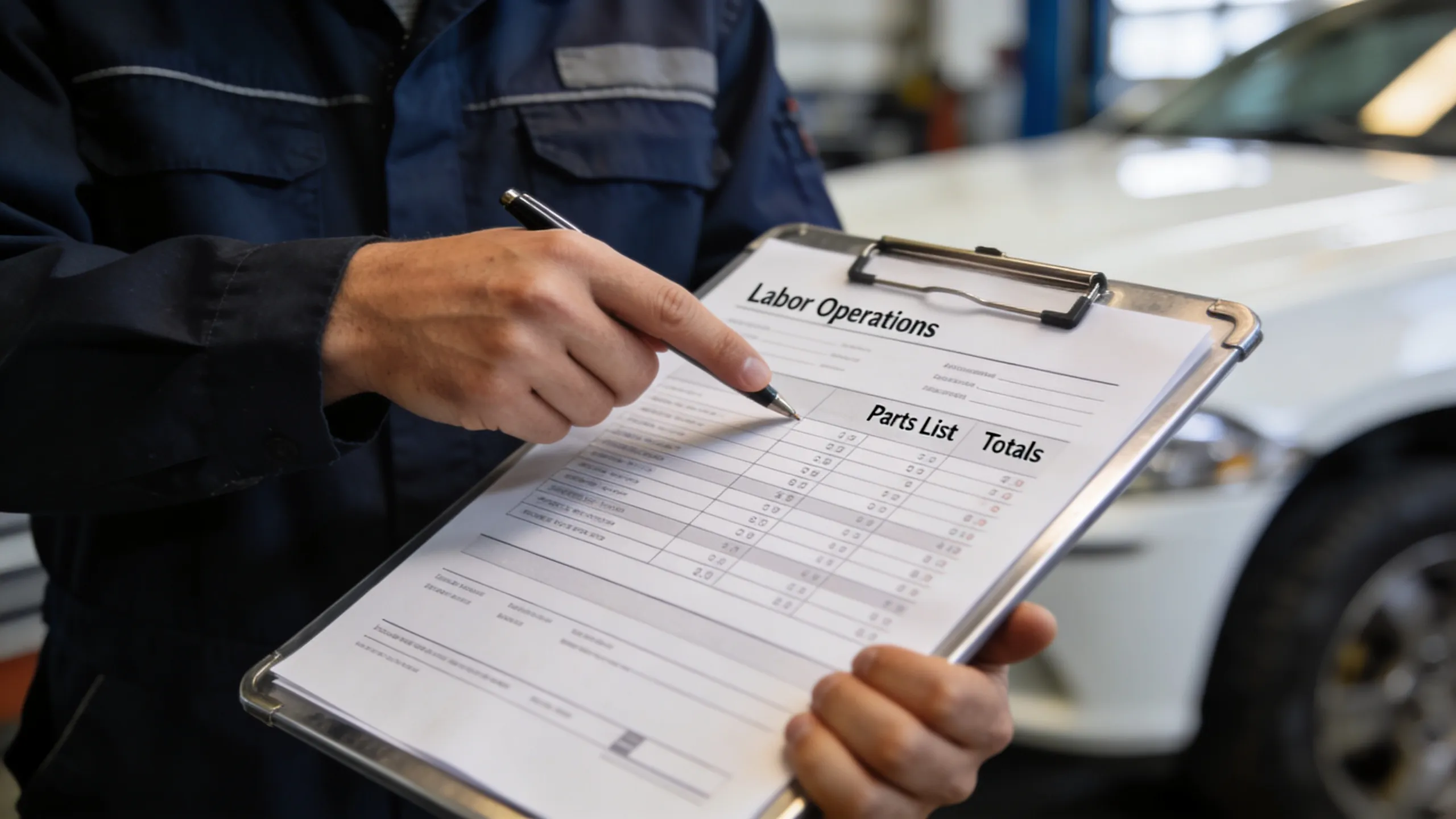
The labor section is the heart of a collision repair estimate. Each line item lists an operation (such as "R&I front bumper cover"), a labor category (body, paint, or mechanical), and an estimated number of hours.
Labor hours in estimating systems aren't arbitrary. Both CCC and Mitchell use published database times, averages derived from industry studies of how long qualified technicians take to complete specific operations on specific vehicles. These are called "book times." Actual shop rates then multiply those hours to produce a dollar figure.
A typical line might read:
R&I front bumper cover | Body | 1.5 hrs | $187.50
"R&I" means remove and install, the bumper is taken off so the damaged area behind it can be repaired, then reinstalled. "R&R" means remove and replace, the part is removed and a new one is installed.
Understanding this distinction matters when reviewing the estimate. An R&I charge makes sense if the bumper itself is undamaged but must move to access other parts. An R&R charge means that part is being replaced entirely.
Parts list: OEM, aftermarket, and recycled
The parts section lists every component being replaced, along with its source and price. Most estimates use a color-coded or abbreviated notation to identify part type:
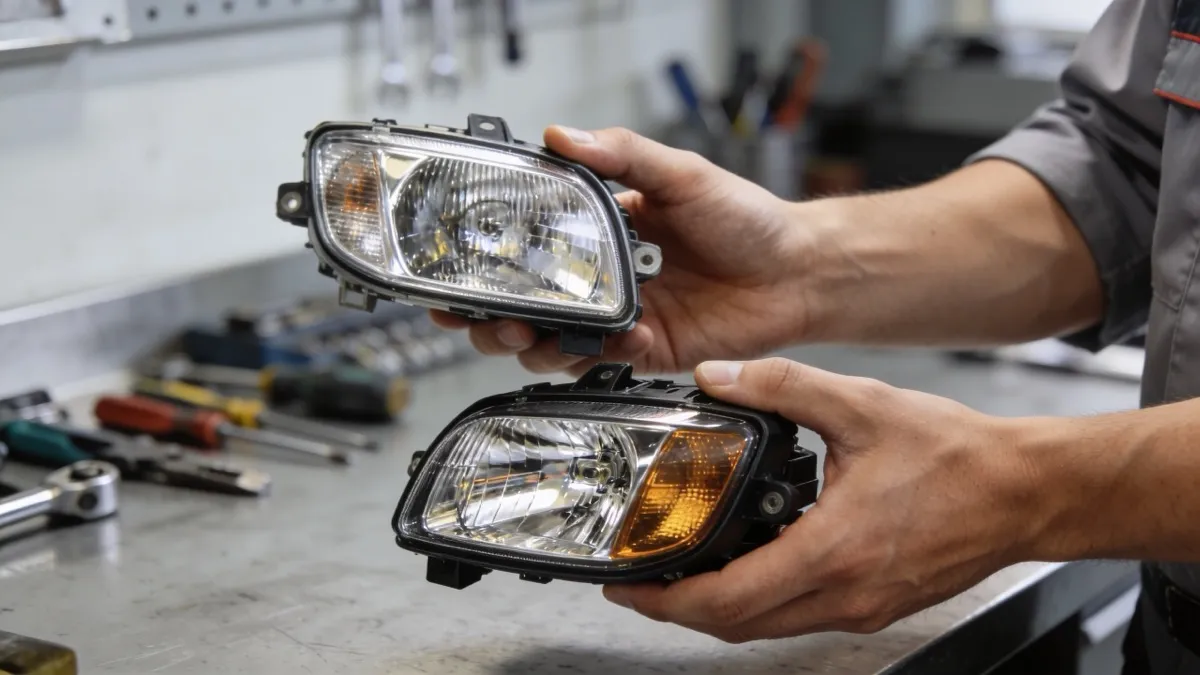
- OEM (Original Equipment Manufacturer): Parts sourced directly from the vehicle manufacturer or their distribution network. Guaranteed to fit the vehicle exactly. Usually the most expensive option.
- Aftermarket: Parts made by third-party manufacturers. Typically less expensive than OEM. Quality varies significantly by supplier and part type.
- Recycled / LKQ (Like Kind and Quality): Used parts pulled from salvage vehicles. Often deeply discounted. Most appropriate for older or lower-value vehicles.
- Remanufactured: Rebuilt components, common for mechanical or electronic parts.
Each parts line typically shows the part number, description, quantity, and price. The estimate may also show a "list" price (the manufacturer's suggested retail) and a negotiated price or discount.
Materials and paint
The materials section covers paint and refinishing supplies: primer, base coat, clear coat, paint thinner, masking materials, and related consumables. This section is often listed as a per-panel charge or a flat rate based on the refinishing labor hours.
Paint materials cost is calculated using a formula tied to labor hours in most estimating systems. A refinish labor hour typically includes a proportional materials allowance. Shops may also add a separate line for environmental or hazardous materials disposal, which covers the cost of handling paint waste in compliance with EPA regulations.
One term that appears here is "blend." A blend in auto body painting means new paint is gradually faded into the existing paint on adjacent panels so the repaired area matches the rest of the vehicle. Blending adds materials and labor cost. It's typically necessary when the color difference between fresh paint and aged paint would be visible without it, especially on vehicles over two to three years old.
Sublet operations
Sublet refers to work the body shop sends out to a specialized vendor rather than completing in-house. Common sublet operations include:
- Wheel alignment (sent to a tire shop)
- Glass replacement (sent to a glass shop or mobile glass service)
- Wheel repair or refinishing
- Upholstery repair
- Mechanical work beyond the shop's certification
Each sublet line shows the vendor, the operation, and the quoted cost. The body shop typically passes the charge through to the estimate, sometimes with a small markup. Confirm that sublet work is going to a qualified provider and that the shop is responsible for the final result even when subcontracted. That accountability often requires asking directly.
Totals, deductible, and payment breakdown
The bottom of the estimate summarizes all costs and shows the payment split:
- Parts total: All replacement components combined
- Labor total: All labor operations combined
- Materials total: Paint and refinishing supplies
- Sublet total: Any contracted work
- Tax: Applied to parts in most states
- Estimated total: The full repair cost before any deductions
- Deductible: The car owner's out-of-pocket share under their insurance policy
- Insurance amount: What the insurer is expected to pay
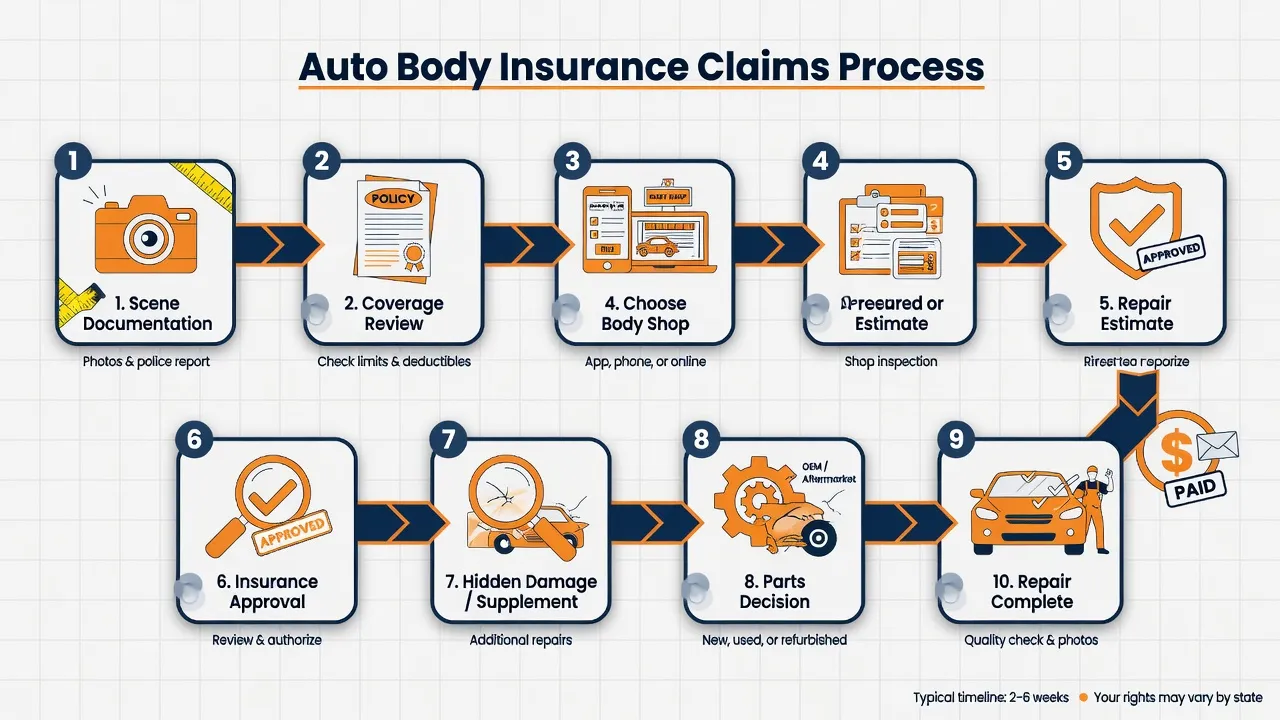
The difference between the estimated total and the deductible is what the insurer owes, assuming the estimate covers everything and no supplements are needed. Supplements are addressed in a later section. For a deeper explanation of how insurance intersects with the repair process, see how insurance claims work for collision repair.
Understanding labor categories
Labor in a body shop estimate falls into three distinct categories, each with its own rate and tracking.
Body labor vs. Mechanical labor vs. Paint labor
Body labor covers structural and cosmetic work, straightening panels, pulling dents, repairing metal, and fitting replacement panels. This is the primary category on most estimates. Body labor rates typically run from $60 to $100 per hour in lower-cost markets and $100 to $160+ per hour in major metro areas.
Mechanical labor applies when collision damage affects drivetrain, suspension, steering, or other mechanical systems. Shops that perform mechanical repair typically charge a separate mechanical labor rate, which is often higher than the body rate. Some body shops sublet mechanical work to a partner facility.
Paint labor (also called refinishing labor) covers surface preparation, masking, primer application, base coat, clear coat, and polishing. Paint labor rates are usually comparable to body rates. The number of refinishing hours drives the materials cost calculation.
These three categories shouldn't be mixed in billing. Verify that each operation is billed at the appropriate rate. Billing mechanical labor at the paint rate, or vice versa, is a discrepancy worth questioning directly.
Labor rates: what is normal?
Labor rates vary widely by market. According to industry data, the national average for body labor was approximately $60 to $75 per hour in smaller markets and $130 to $180 per hour in high-cost metros as of early 2026. Labor rates in California, New York, and similar markets can exceed $200 per hour at certified shops. Car owners in New York can browse auto body shops in New York to compare local labor rates and certified shop options.
Insurers sometimes use "prevailing rate" arguments to push labor costs down. Know that the shop has the right to charge its posted rate. The insurer's obligation is to pay for a complete, proper repair, not simply the cheapest one.
"Overlap" and "included" operations
Two notations that confuse most car owners are "overlap" and "included" operations.
Overlap means two adjacent operations share labor time because they're performed simultaneously. If a technician is already removing a door panel to repair the door skin, some labor to access door-adjacent trim components overlaps with that removal. Estimating systems automatically calculate overlap deductions so the shop isn't double-billing for the same time.
Included means an operation is covered within the labor time of a larger procedure and isn't billed separately. If the database time for replacing a fender already accounts for removing a certain bracket, that bracket removal appears as "included" rather than as an additional line.
Both notations reduce the total bill. They're not errors, they're how industry databases prevent double billing. You might notice these and wonder if work is being skipped. It isn't. The labor time is just consolidated into adjacent operations.
Parts on your estimate
The parts section often drives the biggest cost and quality differences between estimates. Understanding how parts are categorized and priced helps you evaluate what you're actually getting.
Decoding OEM, aftermarket, and recycled notations
On most printed estimates, part type is noted with an abbreviation or color code. Common notations:
| Abbreviation | Meaning |
|---|---|
| OEM or NEW | New factory-spec part |
| AFT or AM | Aftermarket (new, non-OEM) |
| LKQ or USED | Recycled part from salvage |
| REMAN | Remanufactured part |
If the abbreviations aren't clear, the estimator should explain each part choice before work begins. You have the right to know what type of parts will be used on your vehicle.
Some states require disclosure when non-OEM parts are used. Several states also give car owners the right to request OEM parts on newer vehicles covered by a manufacturer's warranty. Checking with the state insurance department about local rules is worth the time, these protections vary significantly.
For a full breakdown of the trade-offs, see OEM vs. Aftermarket parts for collision repair.
Parts pricing and markup
Body shops typically purchase parts at a discount from the listed price, then charge the customer the list price or a negotiated rate. The margin between purchase price and billed price is how parts contribute to shop revenue.
On insurance-covered repairs, parts pricing is usually subject to insurer review. Insurers maintain their own databases of regional parts prices and may challenge charges above the prevailing rate. Car owners paying out of pocket have more leverage to negotiate parts pricing directly.
Recycled and aftermarket parts are often pushed on older or lower-value vehicles to keep repair costs below the vehicle's actual cash value (ACV). If a shop is using recycled parts on a newer vehicle without explanation, asking for the reason is completely reasonable.
Questioning parts choices
You're not obligated to accept any parts choice without discussion. Before authorizing repairs, ask:
- Why is an aftermarket part being used instead of OEM?
- How does the supplier's quality certification compare with OEM?
- Is a recycled part appropriate for this vehicle's age and value?
- If aftermarket or recycled parts fail, who is responsible for correcting the repair?
A reputable shop will answer these without hesitation. Reluctance to answer is itself informative. For guidance on evaluating shops before choosing one, see how to choose a collision repair shop.
Why collision repair estimates change: the supplement process
One of the most common sources of confusion after leaving a vehicle for repair is receiving a revised, and higher, bill partway through the job. This is the supplement process, and it's a normal part of collision repair.
Hidden damage discovered at teardown
A collision repair estimate is written based on visible damage. Once the shop begins disassembling the vehicle, additional damage often appears that couldn't be seen from the outside. Common examples:
- Bent inner structural components hidden behind undamaged exterior panels
- Corroded or damaged fasteners that must be replaced
- Damaged wiring harnesses behind a repaired door
- Mounting brackets bent by impact energy that traveled through the structure
None of this is the shop's fault or an attempt to add charges. Impact energy travels through a vehicle in ways that make pre-teardown inspection incomplete. Estimating systems flag likely hidden damage based on vehicle structure, but actual findings can only be confirmed once disassembly is underway.
How supplements work
When hidden damage is found, the shop writes a supplement, an addendum to the original estimate that adds newly discovered operations, parts, or materials. The supplement goes to the insurance adjuster for approval before the additional work proceeds.
Supplements are standard practice. Multiple supplements on a single claim aren't unusual for significant collisions. The insurer's adjuster may inspect the vehicle or review photos to verify the supplement items before approving payment.
Ask to see supplements as they're written. Understanding what was added, and why, prevents bill shock at pickup and helps you catch any discrepancies between what was found and what's being charged.
Your rights during supplements
You have the right to be informed of any supplement before it's executed. Reputable shops won't complete additional work without either the car owner's or the insurer's documented approval.
If a shop completes supplement work without notifying you, that's a billing practice worth addressing directly, and, in some cases, reportable to the state insurance department or consumer protection office. The collision repair service overview describes how the overall repair process is structured, including consumer rights checkpoints.
Getting multiple collision repair estimates
Industry guidance and consumer advocacy organizations consistently recommend getting more than one estimate for any significant collision repair. Understanding why estimates differ is as important as collecting them.
How many estimates do you actually need?
For minor damage under $1,500, two estimates are typically sufficient. For major collision damage, structural repairs, multiple panels, airbag deployment, three estimates give a more reliable range.
I-CAR, the Inter-Industry Conference on Auto Collision Repair, recommends consumers use certified shops and understand the differences in certifications and capabilities before choosing based on price alone.
Insurance companies may direct car owners to specific shops in their Direct Repair Program (DRP). A DRP shop has agreed to the insurer's labor rates and parts pricing guidelines. You're not required to use a DRP shop, you have the legal right to choose any qualified repair facility. Using a non-DRP shop may require additional coordination with the adjuster, but it's not prohibited.
Why estimates vary between shops
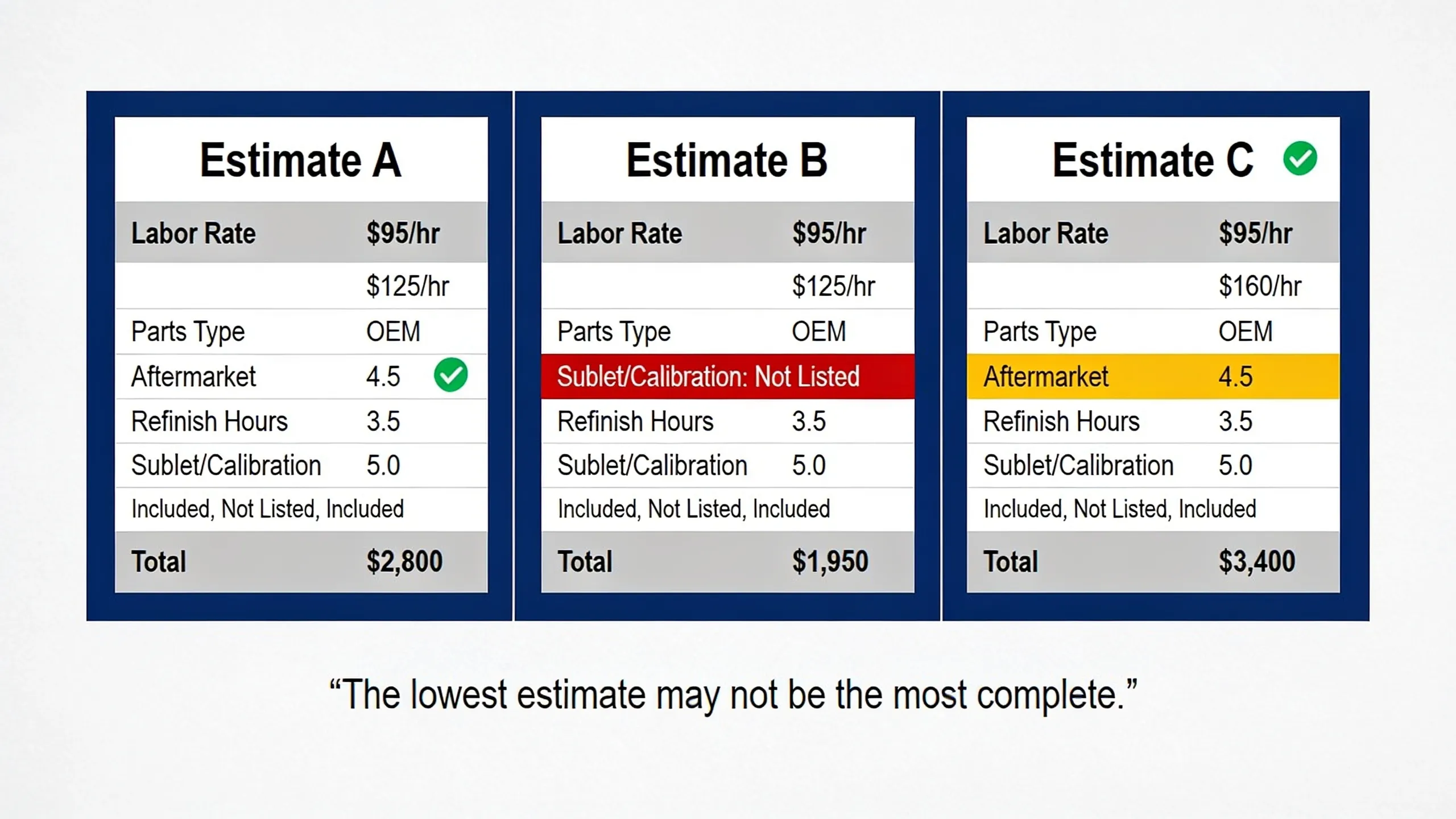
Two body shop estimates for the same vehicle can differ by hundreds or even thousands of dollars. Common reasons:
- Different labor rates: A shop in a higher-cost market charges more per hour than one in a lower-cost area.
- Different parts choices: One shop specifies OEM parts; another specifies aftermarket or recycled.
- Different damage assessment: One estimator identifies more damage than another based on experience and inspection depth.
- Different repair methods: One shop plans to repair a panel; another plans to replace it entirely.
- Missing operations: A lower estimate may omit required procedures, such as ADAS calibration after a bumper repair, that will eventually show up as supplements.
A significantly lower estimate isn't necessarily better. If one estimate is 30% to 40% below the others, finding out what's different or missing in that estimate is worth the time.
Red flags in low-ball estimates
Some indicators that a lower estimate may not deliver equivalent results:
- No mention of pre- and post-repair scanning for electronic systems
- Aftermarket or recycled parts specified without explanation on a newer vehicle
- Missing alignment, calibration, or sublet operations that other estimates include
- Unusually low refinishing labor hours for the panels being replaced
- No mention of structural measurement or sectioning procedures on a damaged rocker or frame rail
A complete, accurate estimate may cost more upfront, but it reduces the likelihood of supplements, disputes, and return visits after pickup.
Digital vs. In-person estimates
Digital photo-based estimates have become more common, especially after the pandemic accelerated remote inspection adoption. They offer convenience but come with trade-offs worth understanding.
Photo estimates: convenient but incomplete
A photo estimate allows you to submit damage photos through an insurer's app or web portal. An algorithm or remote appraiser generates an initial estimate without requiring an in-person visit.
Advantages:
- Faster turnaround for straightforward, visible damage
- No travel required to an insurer's preferred location
- Lets you start claims paperwork quickly
Limitations:
- Photos can't capture hidden damage behind panels
- Lighting, angle, and image quality affect accuracy
- Paint color matching requires accurate color-code documentation, which is harder to verify remotely
- Photo estimates are almost always subject to significant supplements once teardown begins
For minor damage with no structural involvement, photo estimates can work as starting points. For any collision involving multiple panels, airbag deployment, or structural impact, an in-person inspection produces a more complete initial document.
Why in-person is usually more accurate
An experienced estimator conducting an in-person inspection can flex panels, probe edges, check alignment across panel gaps, and use a paint gauge to measure existing finish thickness. None of that's possible from a photo.
In-person estimates at the repair shop, rather than at an insurer's drive-in facility, give the shop's technicians the chance to flag concerns before the vehicle is disassembled. When the estimator and the technicians work in the same building, discrepancies between the written estimate and the actual damage are identified earlier in the process.
For most significant repairs, getting the in-person estimate from the shop that will perform the work is the most reliable starting point. Car owners can use the AutoBodyShopNear.com directory to find qualified auto body shops near them and request in-person estimates.
Labor: Where Most of the Cost Lives
Labor typically runs 40-60% of a collision repair estimate. It's broken into three categories, each billed at a different rate.
Body Labor
This covers the actual metalwork — removing damaged panels, straightening dents, welding, and fitting replacement parts. Body labor rates range from $48-75/hour depending on your market. Major metro areas run higher.
Paint Labor
Prep, prime, base coat, clear coat, color matching. Paint labor is usually billed at the same hourly rate as body labor, but the hours are calculated differently. Watch for "blend" operations — these feather new paint into adjacent panels so the color transition is invisible. If blend isn't on the estimate, the new paint may look noticeably different from the original in sunlight.
Frame/Structural Labor
If the impact hit structural components — rails, aprons, pillars — frame labor covers measuring, pulling, and realigning. This is typically billed $5-15 more per hour than body labor because it requires specialized equipment and more training.
Parts: OEM, Aftermarket, and Recycled
The parts section lists every component being replaced. Each part shows a type code that tells you where it came from:
- OEM (O or OE): Original equipment from the vehicle manufacturer. Best fit and finish, highest cost. A single OEM fender runs $400-800.
- Aftermarket (A or AM): Third-party reproductions. 20-50% cheaper than OEM, but fit can be inconsistent. CAPA-certified aftermarket parts meet quality standards.
- Recycled/Used (R or U): Salvage parts pulled from other vehicles. Good option for expensive components like headlight assemblies. Make sure they're undamaged and the right color if visible.
- Reconditioned (Recon): Used parts that have been repaired or refinished. Common for bumper covers and wheels.
Materials and Paint Supplies
Materials cover sandpaper, primer, sealer, adhesives, masking tape, and paint. Some estimates list materials as a flat rate; others itemize each supply. Either way, this section typically runs $200-500 on a standard repair.
Watch for "hazardous waste disposal" or "environmental fees." These are legitimate charges — body shops are legally required to handle and dispose of chemical waste properly, and that has a real cost.
Sublet Work
Sublet charges cover work the body shop sends out to specialists. Common sublet items:
- Wheel alignment: $80-150, required after any front-end impact
- ADAS calibration: $200-500, required when the windshield, bumper, or grille is replaced on vehicles with driver-assist sensors
- Glass replacement: Windshield and side glass, usually handled by a mobile glass company
- Mechanical work: AC recharging, coolant systems, suspension — anything beyond body repair
What to Check on Any Estimate
- Blend operations: If one panel is being repainted, adjacent panels should show a "blend" line item. Without it, the new paint won't match the original under sunlight.
- Corrosion protection: Any bare metal exposed during the repair should get treatment. Look for "cavity wax" or "corrosion protection" line items.
- R&I vs R&R: R&I means remove and reinstall the same part. R&R means remove and replace with a new one. Make sure the estimate uses the right operation for each component.
- Scanning and calibration: Modern vehicles (2015 and newer) need pre- and post-repair diagnostic scans. These should appear as specific line items — not assumed to be included somewhere else.
The total matters, but the line items matter more. Two shops can quote the same price with completely different repair plans.
Frequently asked questions
What's included in a collision repair estimate?
A collision repair estimate includes labor operations (body, paint, mechanical), replacement parts (OEM, aftermarket, or recycled), paint and refinishing materials, sublet work, and applicable taxes. Each line item specifies the operation or part, labor category, hours or quantity, and price. The header identifies the shop, vehicle VIN, and insurance claim number.
Why did my estimate change after the shop started work?
Estimates are based on visible damage before disassembly. Once the vehicle is opened up, hidden damage often appears that wasn't visible from outside. The shop writes a supplement, a formal addendum, documenting additional work. Supplements require insurance adjuster or owner approval before proceeding. Multiple supplements on one claim are normal for significant collisions.
How many estimates should I get for collision repair?
Two estimates are typically enough for minor cosmetic damage under $1,500. For major damage, structural components, multiple panels, airbag deployment, three estimates give a more accurate picture of true scope and cost. Using shops with I-CAR Gold Class or OEM-certified technicians produces more complete and comparable documents.
What's a supplement in auto body repair?
A supplement is a formal written addendum to an original collision repair estimate. Supplements are issued when hidden damage is found during teardown, when parts prices change between estimate and order, or when a repair method changes after the vehicle is disassembled. Supplements are submitted to the insurance adjuster for review and approval. Car owners should ask to receive copies of any supplement written on their vehicle.
Should I get an in-person or photo estimate?
In-person estimates are more accurate for almost any collision repair. An estimator can physically inspect panel gaps, probe edges, and identify damage impossible to see in photos. Photo estimates work for simple cosmetic damage but consistently require significant supplements on anything more complex. For structural impact, airbag deployment, or multiple panels, in-person inspection is the better starting point.
Key takeaways
Understanding a collision repair estimate gives you a meaningful role in the repair process, and a factual foundation for any conversations with the shop or insurer.
The main sections to review: header information (verify the VIN, color code, and shop license), labor operations (confirm correct categories and R&I vs. R&R designations), parts list (note OEM vs. aftermarket vs. recycled), materials (check paint and blending entries), sublet operations (confirm qualified vendors), and the totals and payment breakdown.
Estimates change during repairs because hidden damage is nearly always found at teardown. Supplements are standard and legitimate. The key is receiving written notice and approval authority before extra work proceeds.
Multiple estimates remain the most reliable way to verify that a repair scope is complete and pricing is consistent with the market. A lower estimate that omits required operations will cost more in the end than a thorough estimate that captures the full job upfront.
Car owners working through a claim can also review how to handle a collision repair insurance claim and the full collision repair cost guide for broader financial and procedural context.
Insurance processes, labor rates, and parts regulations vary by state and insurer. The information in this guide reflects general industry practices. Consult your insurance policy and a licensed repair professional for guidance specific to your situation.