Collision repair costs range from $500 for minor cosmetic damage to $10,000+ for structural work, takes 1 day to 8+ weeks depending on severity, and is covered by insurance if you carry collision coverage (minus your deductible). This guide walks through the full process — from the moment of impact through choosing a shop, navigating insurance, and verifying the finished repair.
Collision repair is one of the most expensive, high-stakes repair decisions most drivers ever face. Yet most car owners walk into it completely cold. This guide covers everything: how collision damage gets assessed, how repairs are actually done, what things cost, how to pick the right shop, and what rights you have once insurance gets involved.
No sales pitch. No shop recommendations. Just straightforward information so you can handle auto body work without getting taken advantage of.
What Is Collision Repair?
Collision repair is the process of restoring a vehicle to its pre-accident condition after crash damage. That means structural work, panel repair, metal straightening, painting, and reassembly of body components. Most of this work happens at a dedicated auto body shop, a facility with specialized tools, trained technicians, and equipment that's specific to crash damage.
It's worth knowing the difference between collision repair and mechanical repair. A general mechanic handles engines, transmissions, brakes, drivetrain systems. A body shop focuses on the vehicle's structure, panels, finish, and safety geometry. Many collision jobs involve both, because crashes can damage mechanical components alongside body panels. Don't be surprised if your body shop tells you the repair also needs a mechanical partner.
Types of Collision Damage
Not all collision damage looks or behaves the same. The type of damage determines how a repair gets handled and what it costs.
Cosmetic damage includes scratches, scuffs, dents that don't break through to bare metal, and surface paint damage. It doesn't affect safety or structural integrity. But it does affect appearance and resale value, and that matters at trade-in time.
Structural damage involves the vehicle's body frame or unibody, the load-bearing skeleton that holds everything together and distributes crash forces. Modern vehicles are built with crumple zones that intentionally absorb impact, so structural damage in a crash is sometimes by design. The problem: structural collision repair requires precise measurement and specialized equipment to restore safety geometry. Not every shop has it.
Panel damage covers dents, creases, and deformation in outer body panels, doors, fenders, hoods, quarter panels, bumper covers. Depending on severity, panels can be repaired or replaced.
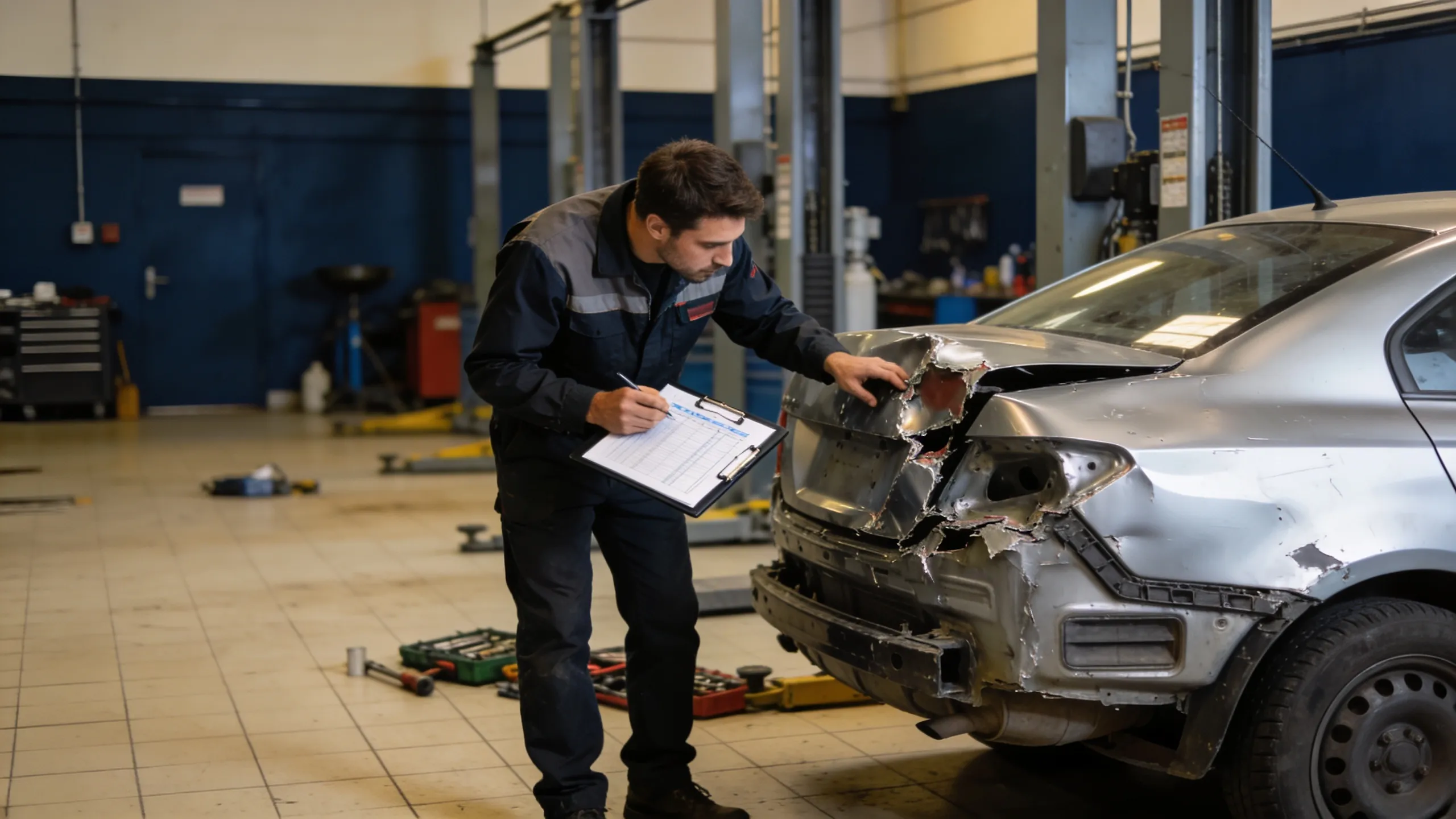
Hidden damage is arguably the most important concept in all of auto body work. What you see on the outside is almost never the full picture. Sensors, brackets, wiring, crash bars, and structural components behind panels regularly absorb damage that only shows up once disassembly starts. Good shops factor this into their process. Inexperienced shops get surprised by it mid-repair.
When You Need a Body Shop vs. A Mechanic
Car owners sometimes wonder whether a general mechanic can handle body damage. Rarely.
Body shops are equipped with frame measuring systems, paint mixing and spray equipment, metalworking tools, and access to OEM (Original Equipment Manufacturer) repair procedures. General mechanics typically aren't. Some mechanical work, replacing ADAS sensors, repairing airbag systems, fixing suspension damage, may need to happen alongside collision repair. A body shop will either sublet that work to a mechanical partner or handle it in-house if they're certified to do so.
If your collision caused any structural damage, panel deformation, paint damage, or deployed airbags, start with a dedicated auto body shop. For collision repair services, look for shops that combine structural repair capability with paint and refinishing.
The Collision Repair Process Step by Step
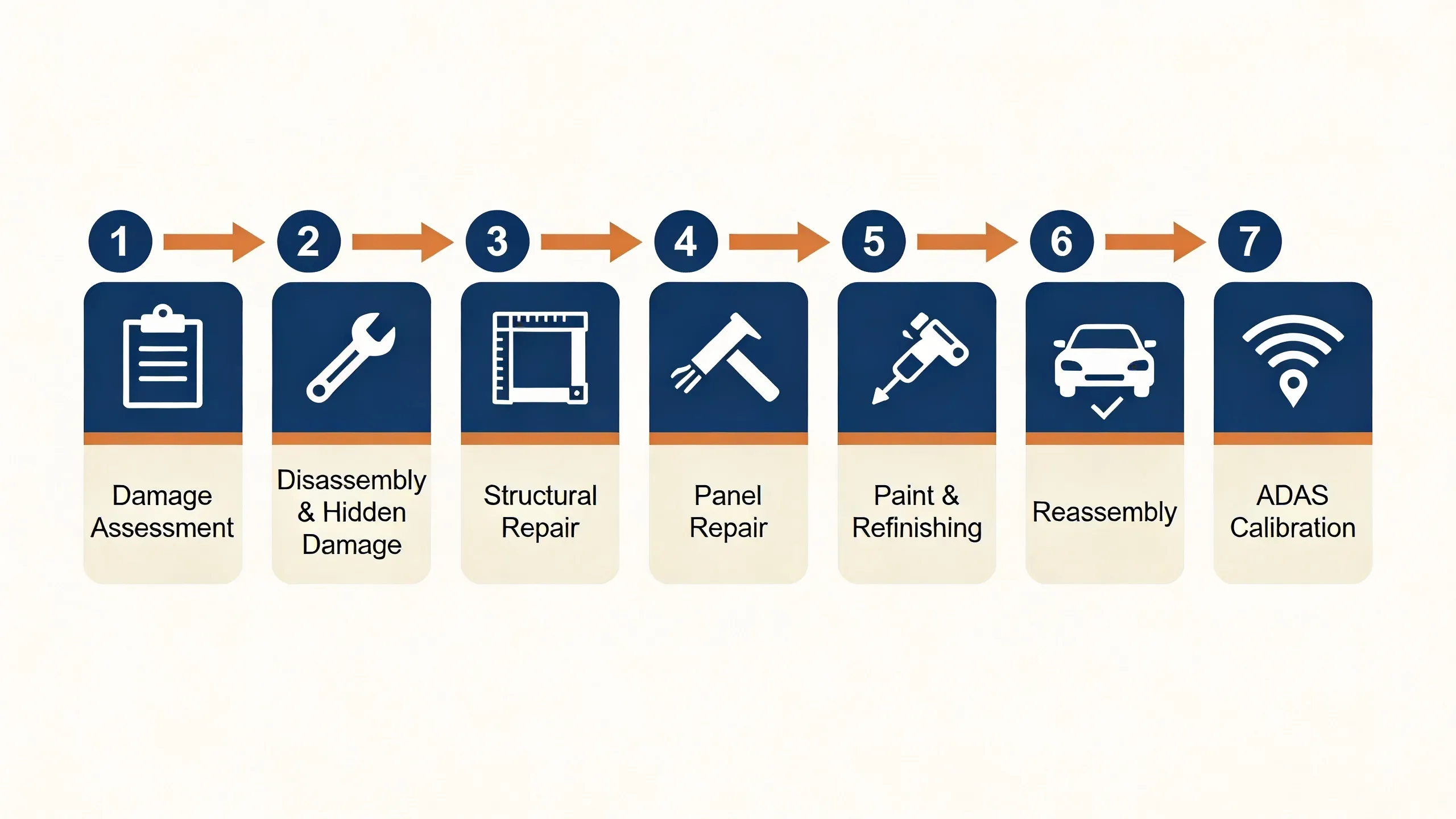
Understanding what actually happens to your car during collision repair helps you set realistic expectations and ask better questions. The process follows a consistent sequence. Timelines vary significantly by damage severity.
Damage Assessment and Estimating
Every collision repair starts with a damage assessment. A shop technician (sometimes called an estimator) inspects the vehicle and documents the damage. The result is a written estimate: a line-by-line breakdown of parts, labor hours, and materials needed to complete the repair.
Most estimates get generated using industry-standard software (CCC, Audatex, or Mitchell) that prices parts and labor based on the vehicle's year, make, and model. Insurance companies use those same platforms. That's why shop and insurer estimates tend to be close, but they're almost never identical.
Get at least two estimates. It gives you a basis for comparison and helps flag missing line items on either side.
Disassembly and Hidden Damage
Once work begins, the shop disassembles the damaged area to expose what's underneath. This step almost always reveals damage that wasn't visible in the initial estimate. Almost always.
Hidden damage discovery isn't a red flag. It's an expected part of the process. Crash energy travels through panels and structures in ways that surface inspection can't fully capture. When shops find additional damage during teardown, they document it in a supplement: an updated estimate submitted to the insurer (or to you, if you're paying out of pocket) for approval before the extra work proceeds.
Ask about supplement communication upfront. It's the main reason timelines extend and bills grow, and knowing how the shop handles it saves a lot of frustration.
Structural and Frame Repair
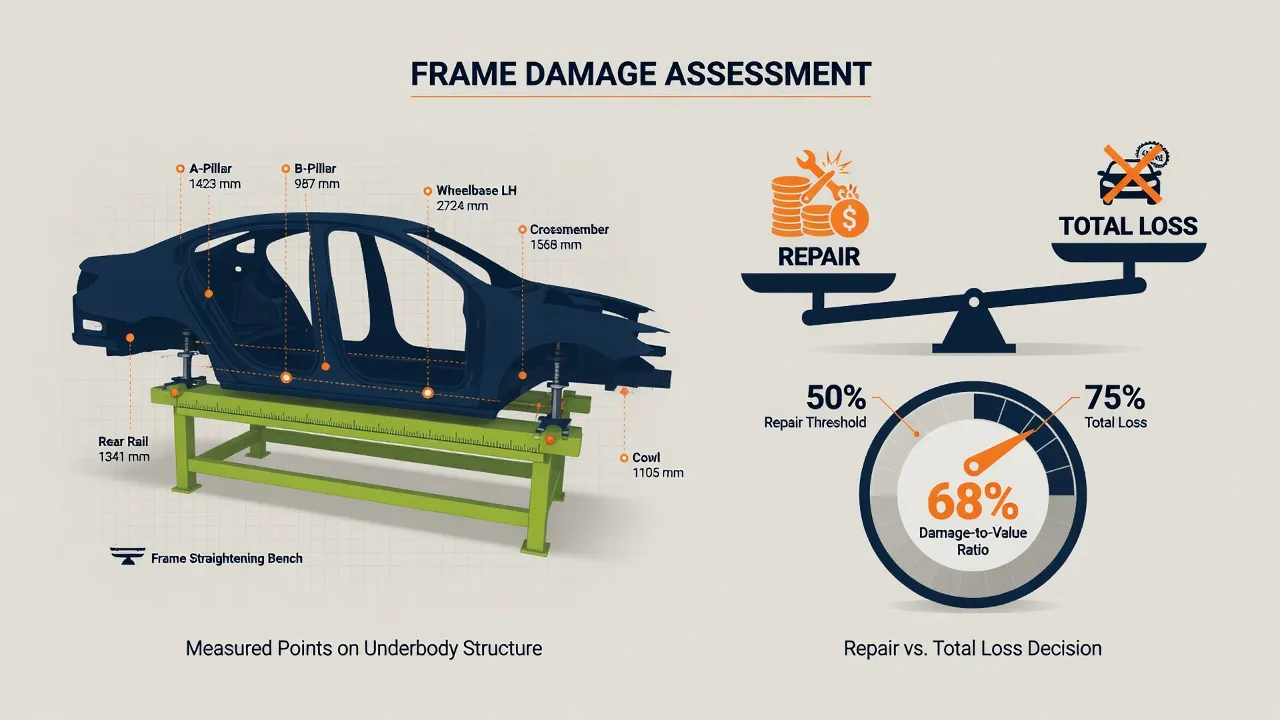
If the vehicle's structure or frame took a hit, this is the most critical phase of the entire repair. Shops use computerized measuring systems to compare the vehicle's actual dimensions against OEM factory specs.
Most modern vehicles use a unibody design, meaning the body structure and frame are integrated into one unit, not a separate body sitting on a separate frame. Structural repair for unibody vehicles involves strategic pulling, sectioning, and welding to bring geometry back within factory tolerances. Body-on-frame vehicles (trucks, older SUVs) use traditional frame straightening.
This work directly affects vehicle safety. A car with unrepaired or improperly repaired structural damage may behave differently in a future crash, may not protect occupants as designed, and in some states, may fail a safety inspection.
For a deeper look at what structural damage means and when it tips into total loss territory, see frame and structural repair services.
Body Panel Repair and Replacement
Once structure is addressed, technicians move to outer body panels. Depending on damage severity, a panel may be:
- Repaired in place: straightened, filled, and finished without removal
- Removed and repaired: taken off the vehicle, worked on a bench, and reinstalled
- Replaced entirely: swapped for a new, recycled, or aftermarket panel
The repair-versus-replace decision depends on damage depth, panel location, and cost-efficiency. Newer vehicles increasingly use high-strength steel and aluminum alloys (most common on 2019+ models) that are difficult to repair without compromising material integrity. Replacement is now more common than it was a decade ago, and some shops won't attempt panel repair on these materials at all.
Panels adjacent to the damaged area may also need to be blended during painting to achieve a smooth color match, even if they weren't directly damaged in the collision.
Paint and Refinishing
Auto body painting involves multiple layers applied in sequence. A professional paint job typically includes:
- Primer: seals bare metal and gives the color coat something to adhere to
- Base coat: the color layer, matched precisely to the vehicle's original paint code
- Clear coat: a transparent protective layer that provides gloss and UV protection
Color matching is both technical work and something closer to an art form. Modern shops use spectrophotometers (electronic color-reading devices) to measure the exact shade of surrounding panels. That matters because all paint fades over time, even a perfect paint-code match needs human adjustment to blend naturally with aged adjacent panels.
A blend is when new paint is gradually faded into the original paint on neighboring panels. Standard practice. A natural finish. Any shop that tells you blending isn't necessary on a partial repair is cutting corners.
For more on how auto body painting works and what separates good results from bad, see auto painting services.
Reassembly and Quality Checks
Once paint has cured, technicians reassemble everything: trim pieces, badges, lighting, sensors, and any mechanical components removed during repair. Panel gaps and alignments should match factory tolerances. Doors should open, close, and seal properly. Lighting should work.
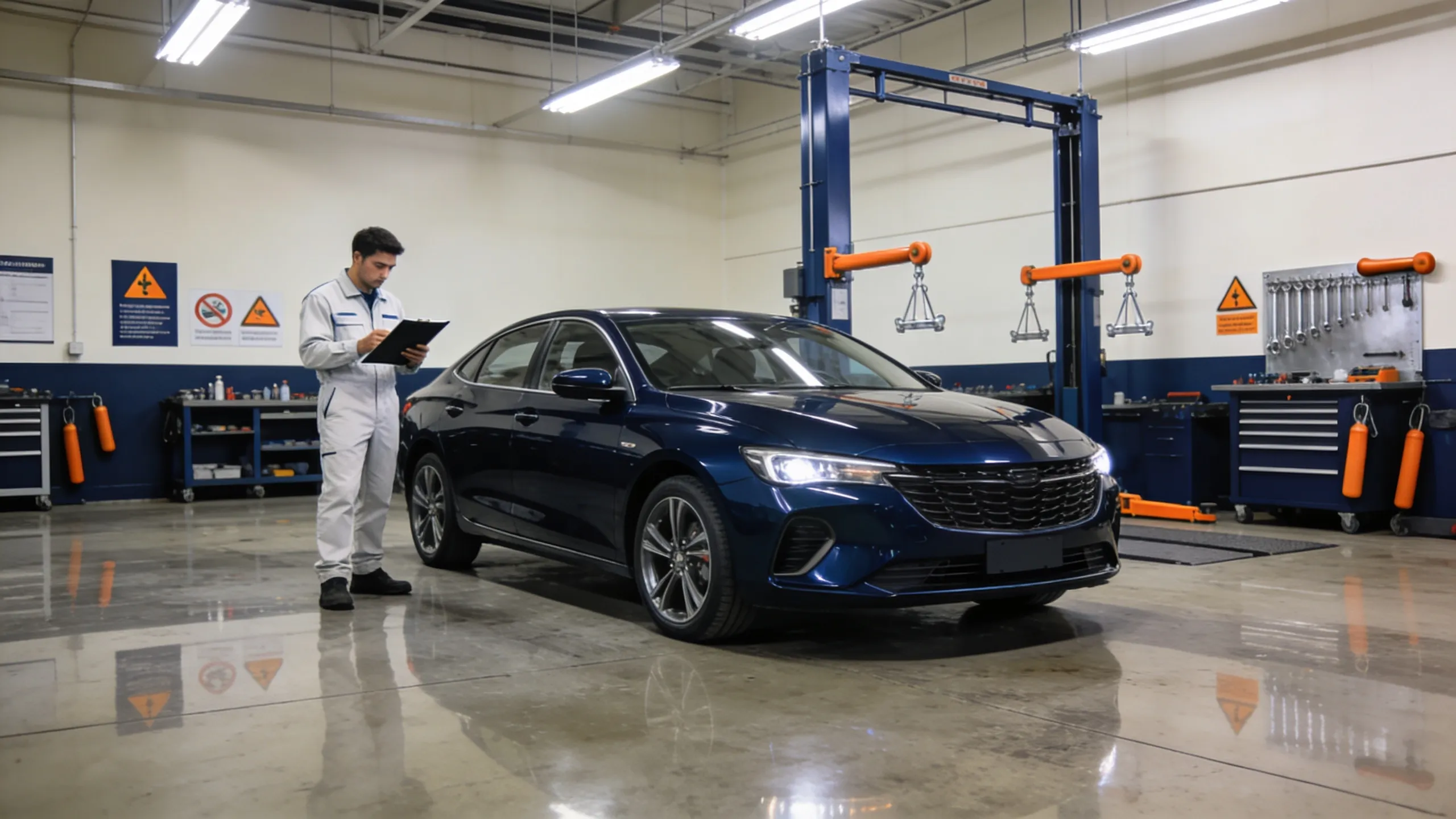
A proper pre-delivery inspection involves both visual checks and functional tests. Reputable shops test all systems that the repair touched, verify paint and finish quality under proper lighting, and confirm that panel gaps meet OEM specs.
Ask whether the shop runs a pre-delivery inspection checklist. Good shops do, and they'll share it if you ask.
ADAS Calibration After Repair
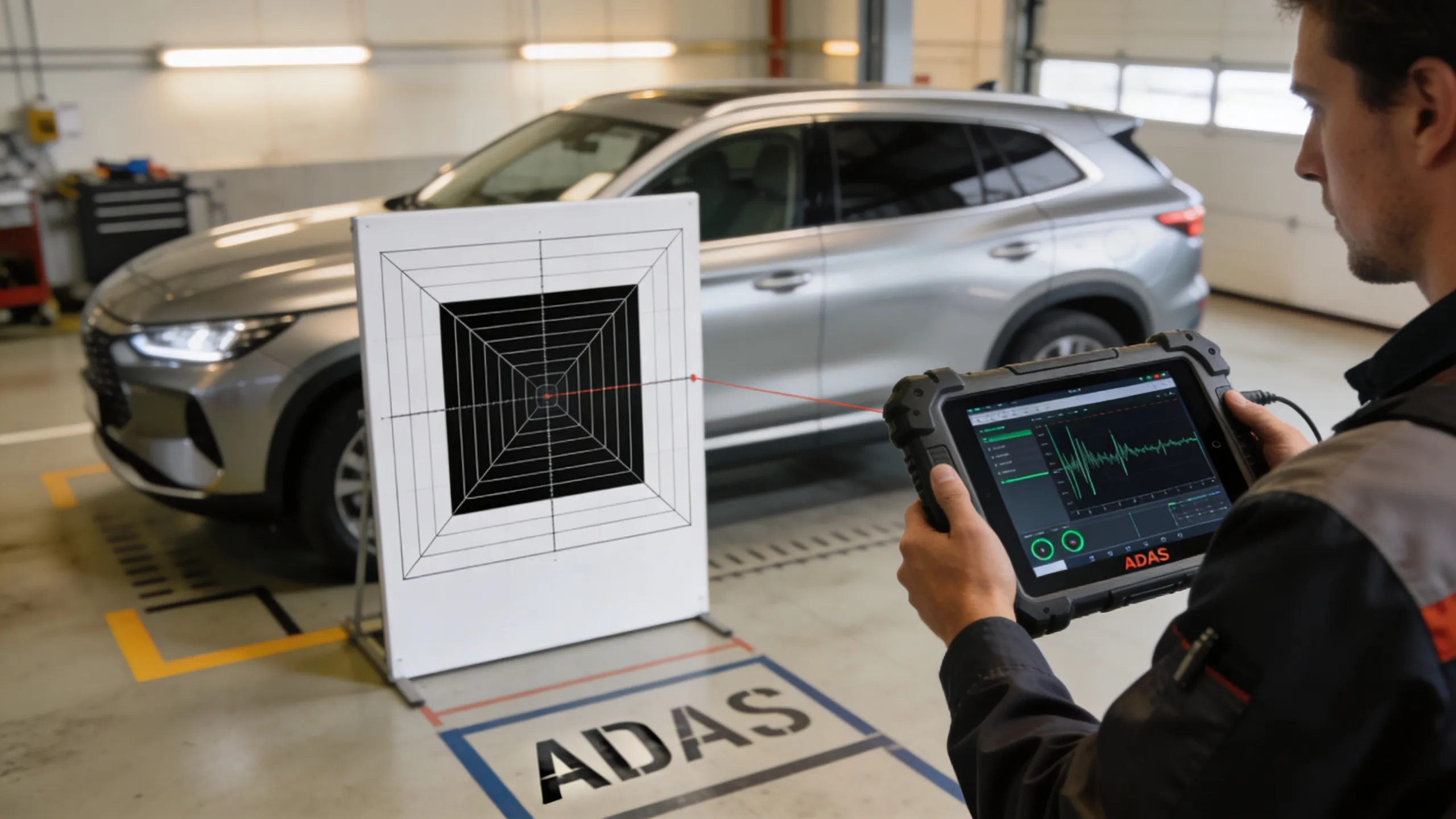
ADAS calibration is one of the most important steps in modern collision repair. It's also one of the most commonly skipped.
ADAS stands for Advanced Driver Assistance Systems: the technology behind automatic emergency braking, lane departure warnings, adaptive cruise control, and blind spot monitoring. These systems rely on sensors, cameras, and radar physically mounted in bumpers, windshields, quarter panels, and mirrors.
When those components are repaired or replaced, the sensors behind them must be recalibrated to factory specifications. Skip the calibration and the system may react too late, too early, or not at all. Often without triggering any warning light.
About 28% of all repairable appraisals now include an ADAS calibration line item, and that number keeps climbing as more vehicles come equipped with these systems. Source: I-CAR ADAS training and research.
For any repair touching bumpers, windshields, or quarter panels, confirm your shop addresses ADAS calibration. For a full breakdown of when calibration is required, what it costs, and how to verify it was actually done, see the ADAS calibration complete guide.
How Much Does Collision Repair Cost?
Collision repair cost is one of the most-searched questions car owners have after an accident. It's also one of the hardest to answer with a single number. Costs span a wide range based on damage severity, vehicle type, geographic market, and which shop does the work.
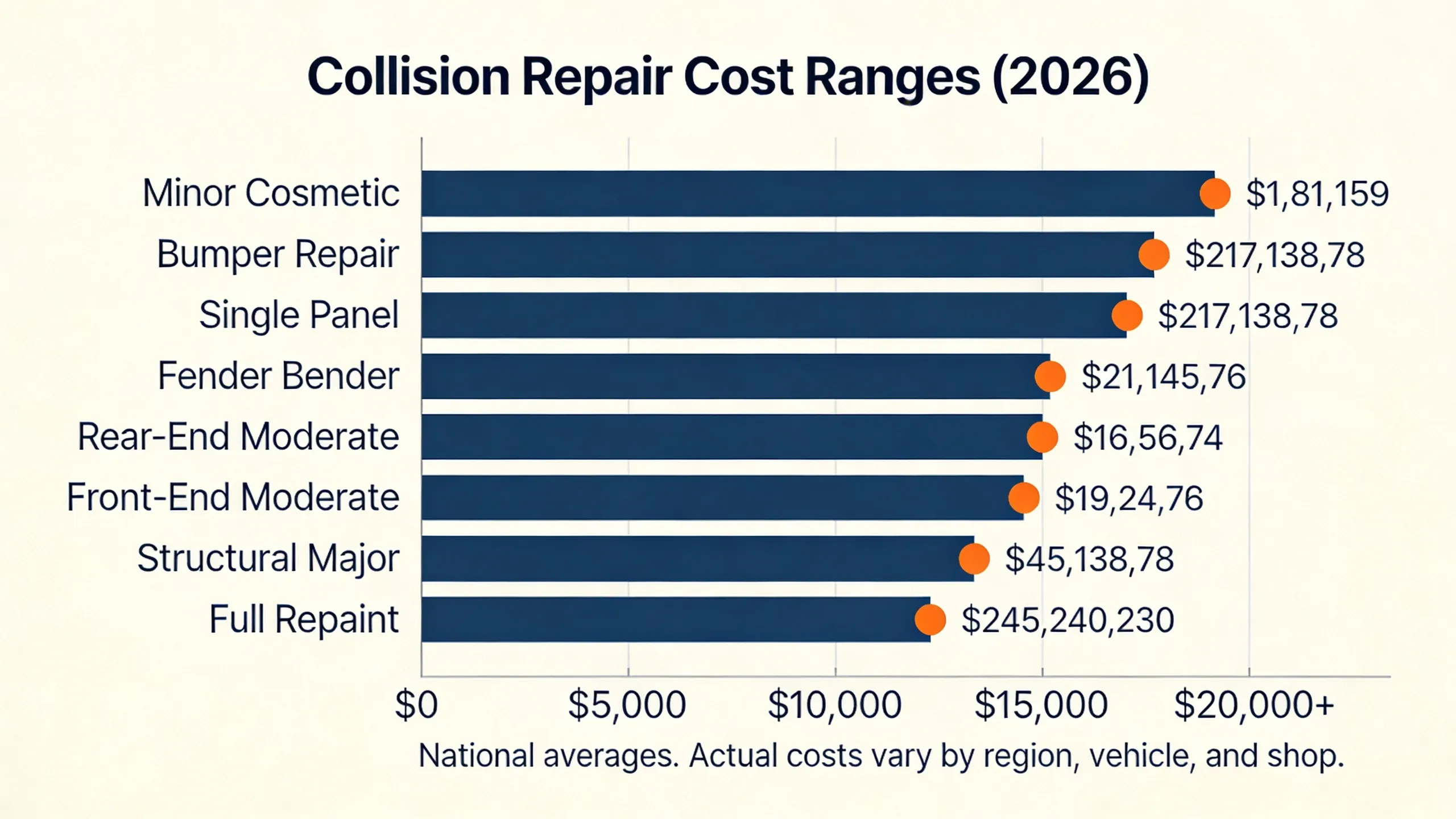
The ranges below reflect national averages for 2026 based on industry data from estimating software platforms and published repair benchmarks. Use them as a starting point, not a quote.
Cost by Damage Type
| Damage Type | Typical 2026 Cost Range | Notes |
|---|---|---|
| Minor cosmetic (scuffs, small dents) | $150–$500 | Often out-of-pocket; may qualify for PDR |
| Bumper repair (minor crack/scuff) | $300–$700 | Depends on bumper material and sensors |
| Bumper replacement (new part + paint) | $800–$2,000 | Sensor relocation and ADAS calibration may add cost |
| Single door dent repair | $400–$1,200 | PDR or conventional depending on severity |
| Single panel replacement (fender, door) | $900–$2,500 | Includes paint blend on adjacent panels |
| Hood replacement | $1,000–$2,500 | Includes repaint; aluminum hoods cost more |
| Fender bender (low-speed, minor) | $500–$1,800 | May hide suspension or sensor damage |
| Quarter panel repair | $1,500–$4,000 | Difficult to access; often requires blending |
| Rear-end collision (moderate) | $2,000–$5,000 | Can include trunk, suspension, ADAS sensors |
| Front-end collision (moderate) | $3,000–$8,000 | Structural, radiator support, and ADAS common |
| Severe collision (multi-panel, structural) | $8,000–$20,000+ | May approach or exceed vehicle value |
| Full repaint | $3,000–$10,000+ | Varies by vehicle size, paint type, shop quality |
These collision repair cost ranges are starting points. The actual cost depends on vehicle-specific factors, parts availability, and your shop's labor rate, and it can move significantly in either direction.
For a dedicated deep dive into pricing by damage type and vehicle class, see the complete collision repair cost guide.
Labor Rates by Region
Labor rates are one of the biggest drivers of cost variation. Auto body labor rates across the United States differ dramatically by geography. Where you live can matter more than which shop you pick.
| Region | Typical Labor Rate (per hour) | Notes |
|---|---|---|
| Rural Midwest and South | $65–$90 | Lower cost of living, lower overhead |
| Suburban markets | $85–$120 | Mid-range pricing |
| Major metro areas | $110–$155 | New York, Chicago, Seattle range |
| California | $130–$175+ | Highest rates in the country |
| Texas | $85–$115 | Varies by city; Dallas/Houston higher |
California consistently ranks among the highest in the country for auto body labor rates, driven by regulatory compliance costs, higher wages, and real estate overhead. If you're in California, budget on the higher end and compare estimates carefully. Find auto body shops in California to compare local options.
Texas labor rates are more moderate overall, though Houston and Dallas trend higher. Texas is also one of the most active states for hail damage repair, which adds seasonal demand pressure that can push rates up in spring and early summer. Find auto body shops in Texas if you're dealing with hail or storm damage.
Factors That Affect Your Final Bill
Several variables shape what your collision repair actually costs:
Vehicle make and model. European luxury vehicles and late-model domestic trucks often cost significantly more to repair than mainstream sedans. Aluminum-intensive construction (common in F-150s, Silverados, and many EVs) requires specialized tooling and adds labor hours.
Parts type. OEM parts typically cost 30–60% more than aftermarket alternatives, though they guarantee exact fit. Insurance companies often specify aftermarket parts to keep costs down. You have options in that negotiation, more on that in the insurance section.
Paint complexity. Two-stage metallic, pearl, tri-coat, and matte finishes cost more to blend than solid colors. More materials, more skill, more time.
Hidden damage. Additional damage found during disassembly adds to the total bill. Vehicles with prior damage, rust, or deferred maintenance tend to reveal more surprises.
ADAS calibration needs. Modern vehicles with extensive sensor packages can add $400 to $1,200 in calibration costs on top of body repair, depending on which systems were disturbed and whether the shop does it in-house.
Shop certification and overhead. OEM-certified shops and I-CAR Gold Class facilities typically charge higher labor rates. Often because their training, tooling, and quality standards are higher. Worth knowing the difference before choosing on price alone.
Choosing the Right Collision Repair Shop
Not all auto body shops are equal. Equipment, training, parts sourcing, and quality standards vary widely, more than most drivers realize until something goes wrong. Choosing the right shop protects your vehicle and your investment.
Certifications That Matter (I-CAR, OEM, ASE)
Certifications signal that a shop has invested in training. The three that matter most in collision repair:
I-CAR (Inter-Industry Conference on Auto Collision Repair) is the primary training organization for the collision repair industry. The I-CAR Gold Class designation goes to shops where all repair technicians complete ongoing annual training. It's a meaningful baseline indicator that the staff is keeping pace with how vehicles are changing. Source: I-CAR Gold Class program.
OEM Certification Programs come directly from vehicle manufacturers: GM, Ford, Toyota, BMW, Tesla, and others. An OEM-certified shop has completed brand-specific training, follows the manufacturer's repair procedures, and often has direct access to OEM parts and technical support. These programs matter most for luxury, European, and newer tech-heavy vehicles where the repair procedures are more complex.
ASE (Automotive Service Excellence) certifications cover a range of repair competencies, including collision-specific credentials. ASE-certified technicians have passed standardized exams in their area of work. More common in mechanical repair, but body shop certifications exist and indicate a floor of technical competency. Source: ASE certification information.
No certification guarantees a perfect repair. But certified shops have made a documented commitment to training, which is a real differentiator from shops with no credentials at all.
Questions to Ask Before Dropping Off Your Car
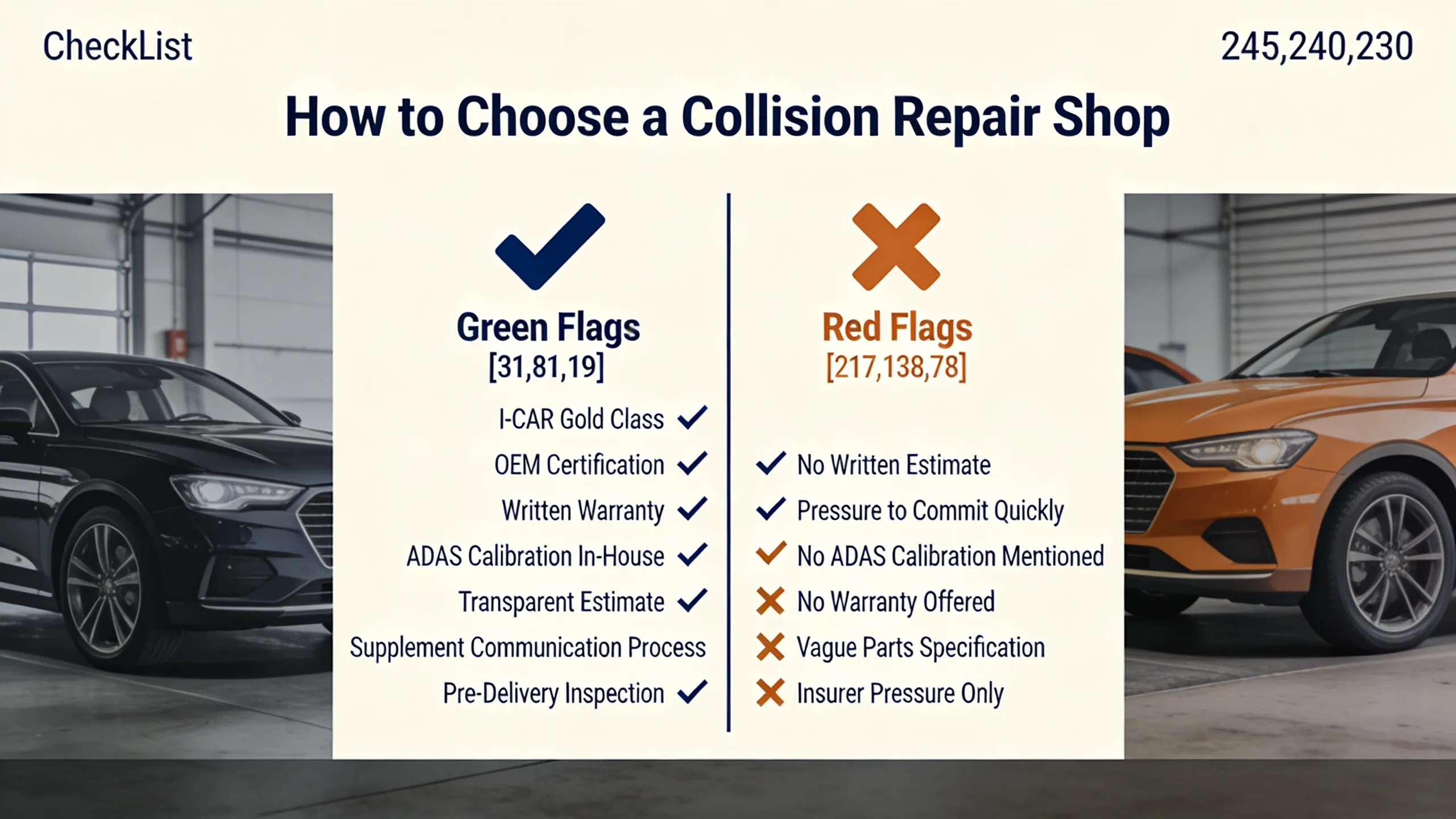
Before you authorize work, get clear answers to these questions:
- What certifications do your technicians hold? Look for I-CAR Gold Class and relevant OEM certifications for your vehicle brand.
- Will you use OEM, aftermarket, or recycled parts? Get the answer in writing.
- How do you handle hidden damage found during teardown? A good shop explains the supplement process without hesitation.
- What's your warranty on workmanship and paint? Written warranties only, verbal promises don't hold up.
- Do you have ADAS calibration capability in-house? If not, who handles it, and how is it documented?
- What does your pre-delivery inspection look like? Ask if they'll share the checklist.
- What's your estimated timeline, and how do you communicate delays? Set expectations before the car goes in.
Getting answers in writing protects you if a dispute comes up later.
Red Flags to Watch For
Some practices are worth walking away from:
- Pressure to commit before seeing a written estimate: reputable shops never start work without one
- Vague or incomplete estimates: missing labor, parts, or materials line items usually means underbidding, not efficiency
- No mention of ADAS calibration on a vehicle with modern safety systems, either they don't know it's required, or they plan to skip it
- No written warranty: verbal assurances don't protect you; industry-standard shops offer written workmanship and paint warranties
- Cash-only or strong discouragement of insurance involvement: not always a problem, but it deserves scrutiny
- Pressure toward the insurer's "preferred" shop without explaining your alternatives: you have the legal right to choose your own shop, full stop (see next section)
Insurance and Collision Repair
Insurance adds complexity to collision repair that trips up a lot of car owners. Understanding how the claims process works, and knowing your rights going in, prevents most of the common problems.
Filing a Claim Step by Step
Filing an auto insurance claim after a collision generally follows this sequence:
- Document the scene. Photograph all damage, the other vehicle (if applicable), license plates, and the scene from multiple angles. Get the other driver's insurance information.
- Notify your insurer. Contact your insurance company promptly, most policies have a notification window. The insurer assigns a claim number and adjuster.
- Get an estimate. Either through a shop of your choice or the insurer's process. If the insurer uses an in-house adjuster or a Direct Repair Program (DRP) shop, you're still entitled to your own estimate.
- Review the estimate. Know what's included, what parts are specified, and whether ADAS calibration is covered.
- Authorize repairs. Once you're satisfied with the estimate and have confirmed your shop, give the go-ahead.
- Manage supplements. If additional damage turns up, the shop submits a supplement to your insurer. Stay in the loop during this phase.
- Inspect before accepting. Look carefully at the finished repair before you sign off. Issues found after acceptance are much harder to address.
Coverage and deductibles vary by policy. Confirm whether the repair falls under collision coverage, comprehensive coverage, or a third-party liability claim, the process differs slightly for each.
Note: Insurance processes vary significantly by state and carrier. Consult your specific policy and speak with a licensed insurance professional for guidance on your situation.
Your Right to Choose Your Own Shop
Here's the most important thing to know: in all 50 states, you have the legal right to choose your own collision repair shop. Insurance companies cannot require you to use a specific shop.
Insurers operate Direct Repair Programs (DRP), which are networks of pre-approved shops that agree to streamlined claims processes in exchange for referral volume. These shops aren't inherently bad, and the DRP process can move faster. But you're not obligated to use them.
If an adjuster implies that using a non-DRP shop will delay your claim or create problems, that's inaccurate. Source: NHTSA vehicle and repair rights resources.
If you have a shop you trust, or if your vehicle requires OEM-certified collision repair, you can direct your claim there. The insurer's recommendation is just that, a recommendation.
OEM vs. Aftermarket Parts in Insurance Repairs
Parts selection is a common source of tension between car owners and insurers. Worth knowing the landscape before your claim is filed.
OEM parts are manufactured by or for the vehicle's original manufacturer. Guaranteed fit. Meet factory specifications. Typically the most expensive option.
Aftermarket parts come from independent manufacturers. Quality varies widely. Some meet or approach OEM standards; others don't fit precisely, lack corrosion protection, or affect sensor performance. The Insurance Institute for Highway Safety has documented fit and quality issues in aftermarket crash parts. Source: IIHS parts quality research.
Recycled (used OEM) parts come from salvage vehicles. Genuine manufacturer parts at lower cost. Generally a solid middle-ground option for older vehicles.
Many states require insurers to disclose when aftermarket parts are specified and, in some cases, to use OEM parts on newer vehicles. You can request OEM parts in writing, many insurers will accommodate it, sometimes with you covering the cost difference.
For new vehicles within their warranty period, OEM parts are worth pushing for. Aftermarket parts on a car still under factory warranty can create complications if something fails later.
Common Types of Collision Repair
Collision repair covers a range of specialized services. Here's what you should know about the most common types and when each one applies.
Bumper Repair and Replacement
Bumpers are among the most frequently damaged components in low-speed collisions, parking lot impacts, and fender benders. Modern bumpers are more complex than they look: a plastic cover over a foam energy absorber, a steel or aluminum reinforcement bar, and on most new vehicles, multiple sensors and radar modules mounted inside.
A minor scuff or surface crack can often be repaired and repainted. More severe damage, or anything that shifts sensor mounting locations, typically requires full replacement. Bumper replacement on a sensor-equipped vehicle also triggers ADAS calibration, which adds cost, but isn't optional.
For a detailed breakdown of repair vs. replacement decisions and costs, see bumper repair services.
Fender and Quarter Panel Repair
Fenders and quarter panels (the rear side panels that blend into the trunk area) are common collision damage zones. Fenders are typically bolt-on panels that can be replaced without major surgery. Quarter panels are often welded into the vehicle structure, making replacement significantly more involved and expensive.
Both require paint blending into adjacent surfaces. Quarter panel work is particularly labor-intensive. Costs often run higher than the parts cost alone suggests, don't be surprised when the estimate comes in above your initial expectation.
Paintless Dent Repair (PDR)
Paintless Dent Repair (PDR) is a technique for removing dents without painting. Technicians use metal rods and specialized tools to push dents out from behind the panel, working with the metal's natural flex to restore the original contour, without breaking through the clear coat.
PDR works best when the paint surface is intact, the metal hasn't creased sharply, and the dent is accessible from behind. It's the standard approach for hail damage repair and works well for door dings and minor impacts.
It's faster and cheaper than conventional dent repair. A small PDR-eligible dent can be repaired same-day for $75 to $300, compared to $400 or more for conventional methods that involve filling, sanding, and painting.
PDR has real limitations, though. It can't fix sharp creases, paint damage, or dents near panel edges where metal access is blocked. For more on when PDR is the right call, see paintless dent repair services.
Frame Straightening
Frame straightening returns a vehicle's structural geometry to factory specifications after a collision. It's performed on a frame rack, a calibrated measuring platform with anchoring points that holds the vehicle while hydraulic equipment applies controlled force to straighten deformed metal.
Modern unibody vehicles require computerized measuring systems to verify that structural dimensions match OEM tolerances after straightening. Pulling metal straight isn't enough. The measurements have to confirm that crumple zones, suspension mounting points, and body geometry are correct.
Frame straightening isn't always possible. Severely damaged structures may require sectioning: cutting out damaged metal and welding in new sections using OEM-approved procedures. Others exceed repair thresholds entirely and result in a total loss determination. For more detail on structural repair options, see frame repair services.
Full Repaint and Color Matching
A full vehicle repaint comes up after major collision repairs affecting multiple panels, after fire or chemical damage, or when an owner wants a color change. It's a significant investment, typically $3,000 to $10,000 or more at a professional shop, depending on vehicle size, paint type, and quality level.
Color matching for partial repairs relies on paint code lookup plus spectrophotometer measurement and manual adjustment by the painter. For tri-coat, pearl, or metallic finishes, matching aged, weathered paint is especially challenging. Not every shop gets it right the first time.
If paint quality matters to you, ask about the shop's paint brand and curing process. Shops that use high-quality basecoat systems and allow full cure time before delivery tend to produce more consistent, durable results than shops rushing cars out the door. For a full overview of professional auto painting, see auto painting services.
After Your Repair: What to Check
Picking up your vehicle is not the final step. Do a thorough inspection at delivery, and know your rights afterward, it makes a real difference if problems surface later.
Inspecting the Work
Before signing off, run through this checklist:
Panel alignment: All gaps between doors, hoods, fenders, and trunk lids should be even and consistent. Uneven gaps can mean improper reassembly or an underlying structural issue that wasn't fully corrected.
Paint quality: Look in good lighting (natural light or bright overhead) for orange peel texture, fish-eye blemishes, dirt in the paint, color mismatch, or visible blend lines. Some light texture variation is normal. Significant defects are not.
Mechanical function: Open and close every door. Test windows, locks, and mirrors. Confirm that any systems affected by the collision, steering, sensors, lights, work correctly.
ADAS systems: Activate the safety features that were affected. Lane departure warning, adaptive cruise, blind spot monitoring. If any show "unavailable" or a fault code, the repair isn't complete.
Cleanliness: A quality shop returns your car clean. Overspray on windows, trim, or wheels is unacceptable, and easy to spot.
If anything isn't right, note it in writing before leaving. Most shops will fix legitimate issues. It's much harder once the car is gone.
Understanding Your Warranty
Reputable auto body shops offer written warranties on their workmanship and paint. Industry standard is a lifetime warranty on labor and paint workmanship, meaning the shop will redo any work that fails due to their error at no charge, as long as you still own the vehicle.
Parts warranties are separate. They're governed by the parts manufacturer's coverage, which typically runs one year to lifetime depending on the part type.
Before leaving, make sure you:
- Have the warranty in writing
- Understand what's covered and what isn't (wear and tear, damage from subsequent accidents, etc.)
- Know how to make a warranty claim if you need to
Large national chains often offer transferable warranties, meaning the warranty moves with the vehicle if you sell it. Independent shops typically don't. Worth factoring in if you sell cars relatively often.
If a shop won't give you a written warranty, that's a significant red flag.
Impact on Vehicle Value
Collision damage and collision repair history affect vehicle value even when the repair was done properly. This financial impact has a name: diminished value (sometimes called loss of value). It's the difference between what your vehicle was worth before the accident and what it's worth after, even with a high-quality repair.
Diminished value exists because the used vehicle market discounts accident history. Buyers and dealers use Carfax and AutoCheck to identify prior claims, and they adjust their offers accordingly. A well-documented repair from a certified shop minimizes this discount. It rarely eliminates it.
In most states, you can file a third-party diminished value claim against the at-fault driver's insurer if you weren't at fault. It's separate from the repair claim. The process requires a diminished value appraisal and repair documentation. State laws and insurer policies vary significantly on how these claims get handled.
If you're paying out of pocket on an older, higher-mileage vehicle, factor this in. Even an excellent repair may reduce resale value, and that affects the calculus on whether repair makes financial sense at all.
FAQ
How much does collision repair cost on average?
Average collision repair costs in 2026 range from $150 for minor cosmetic fixes to over $20,000 for severe structural damage. Most insurance claims fall between $2,500 and $5,000. Minor dents and bumper repairs often cost $300 to $1,500 out of pocket, depending on damage severity and local labor rates.
How long does collision repair take?
Timeline depends on damage severity. Minor repairs, scuffs, small dents, bumper work, typically take two to five business days. Moderate collision damage (single panel replacement, one-zone structural repair) usually takes one to two weeks. Severe multi-panel or structural repairs can take three to six weeks, and parts delays or insurance supplement approvals often extend timelines further.
Do I have to use my insurance company's recommended shop?
No. In all 50 states, car owners have the legal right to choose their own collision repair shop, regardless of what the insurance company recommends or which shops are in their Direct Repair Program (DRP) network. Insurers can't legally require a specific shop, though they may have administrative preferences.
What is the difference between OEM and aftermarket parts for collision repair?
OEM (Original Equipment Manufacturer) parts are factory-produced and guaranteed to fit. Aftermarket parts are made by independent manufacturers, quality varies widely, and fit may not be identical to OEM. Insurance companies often specify aftermarket parts to reduce costs. Car owners can request OEM parts in writing; some states require disclosure when aftermarket parts are used.
Does collision repair affect my car's resale value?
Yes. Vehicles with documented accident and collision repair history typically sell for less than comparable vehicles with clean histories, even after a high-quality repair. This is called diminished value. The reduction depends on damage severity, repair quality, and vehicle age. Third-party diminished value claims may be available against an at-fault driver's insurer.
What certifications should I look for in a collision repair shop?
The most important certifications are I-CAR Gold Class (indicates technicians complete ongoing industry training), OEM certification programs (brand-specific training for vehicles like BMW, GM, Ford, and Tesla), and ASE credentials in relevant areas. Certifications don't guarantee perfect work, but they signal a documented commitment to training and proper repair methods.
Key Takeaways
Collision repair is complex, high-stakes, and touches safety, finances, and legal rights all at once. Here are the most important things to take away:
-
Collision repair covers a broad range of auto body work, from cosmetic fixes to structural reconstruction. Understanding what type of damage a vehicle has is the first step toward realistic expectations.
-
The repair process follows a consistent sequence, assessment, disassembly, structural repair, panel work, painting, reassembly, and quality checks. ADAS calibration is now a required step in most modern collision repairs involving sensors or cameras.
-
Costs vary widely, national averages range from $150 for minor cosmetic damage to $20,000 or more for severe structural repairs. Labor rates, vehicle type, and parts choices are the biggest cost variables.
-
Certifications matter when choosing a shop, I-CAR Gold Class, OEM certifications, and ASE credentials indicate shops that have invested in proper training and repair methods.
-
Car owners have rights, The right to choose their own shop, the right to OEM parts (negotiable with most insurers), and the right to dispute estimates that seem incomplete or inaccurate.
-
Insurance and repair interact, Understanding the claims process, the supplement system, and the OEM parts debate helps car owners get complete, quality repairs rather than minimum-cost fixes.
-
Document everything, Written estimates, supplement approvals, parts specifications, warranty terms, and ADAS calibration records protect car owners in every phase of the repair and beyond.
If you're dealing with damage right now, the next step is simple: get at least two written estimates from certified shops and understand your insurance coverage before you authorize anything. That pause, even when the situation feels urgent, consistently leads to better outcomes.
Last updated: June 2026. Repair costs reflect 2026 national averages. Regional rates and specific vehicle pricing may vary. Insurance coverage details vary by policy and state.