Collision repair cost is usually the first question after an accident, and the range is genuinely wide. A repair bill can run $150 for a minor scratch or $12,000+ for serious structural damage. Understanding what drives those numbers helps you budget realistically, make smarter insurance decisions, and avoid getting overcharged.
This guide breaks down average collision repair costs by damage type, explains what actually moves the price, and covers the insurance math that determines what you write a check for. No sponsored shops, no upsells, just data.
For a full overview of the repair process start to finish, see the complete collision repair guide.
Key Takeaways
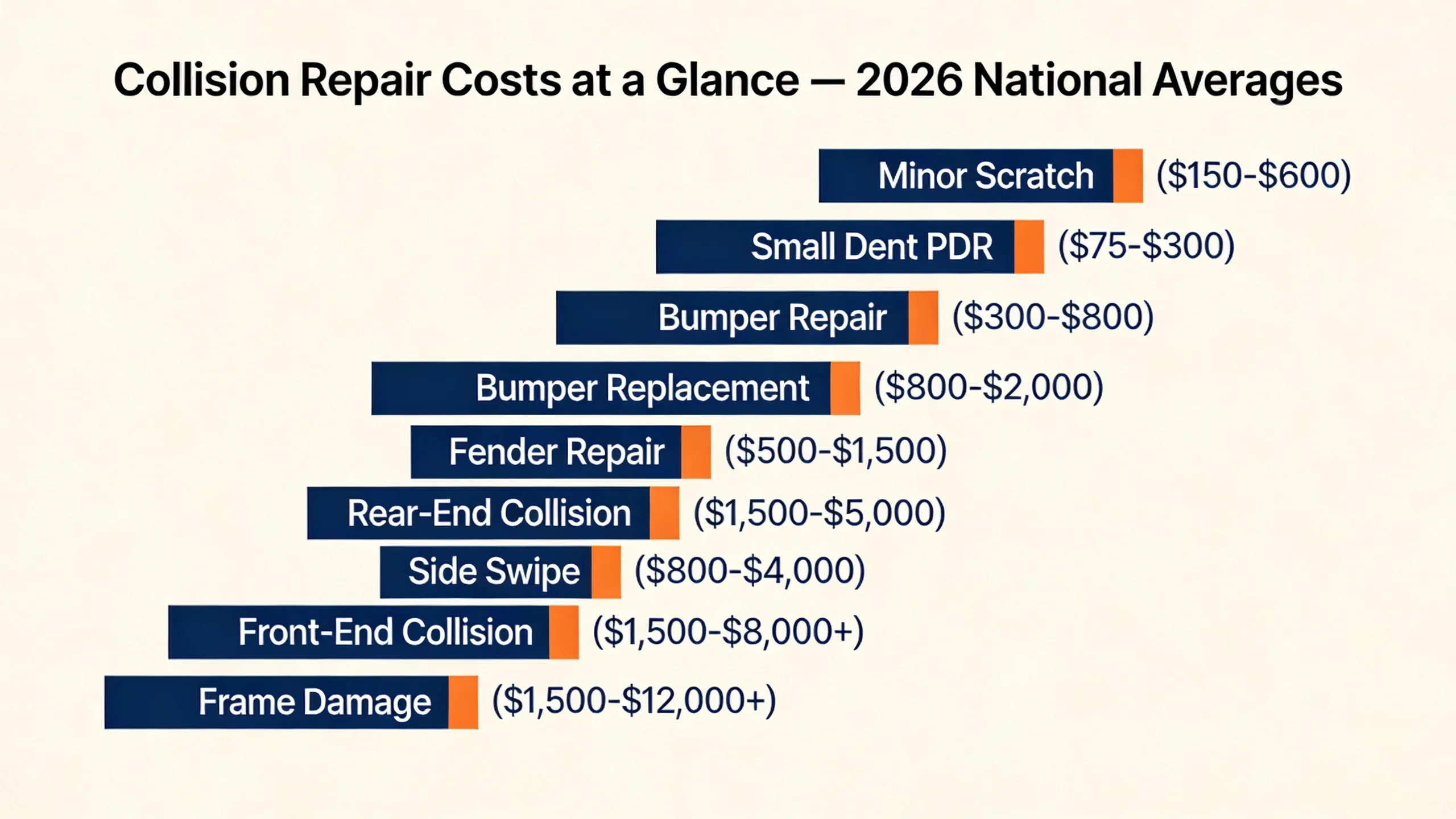
- Most collision repairs cost $1,500 to $3,000 based on CCC Intelligent Solutions industry data. Minor fender benders run $300 to $1,000; structural damage reaches $3,000 to $12,000+.
- Parts selection is the second-biggest variable: OEM parts cost 20 to 50% more than aftermarket alternatives.
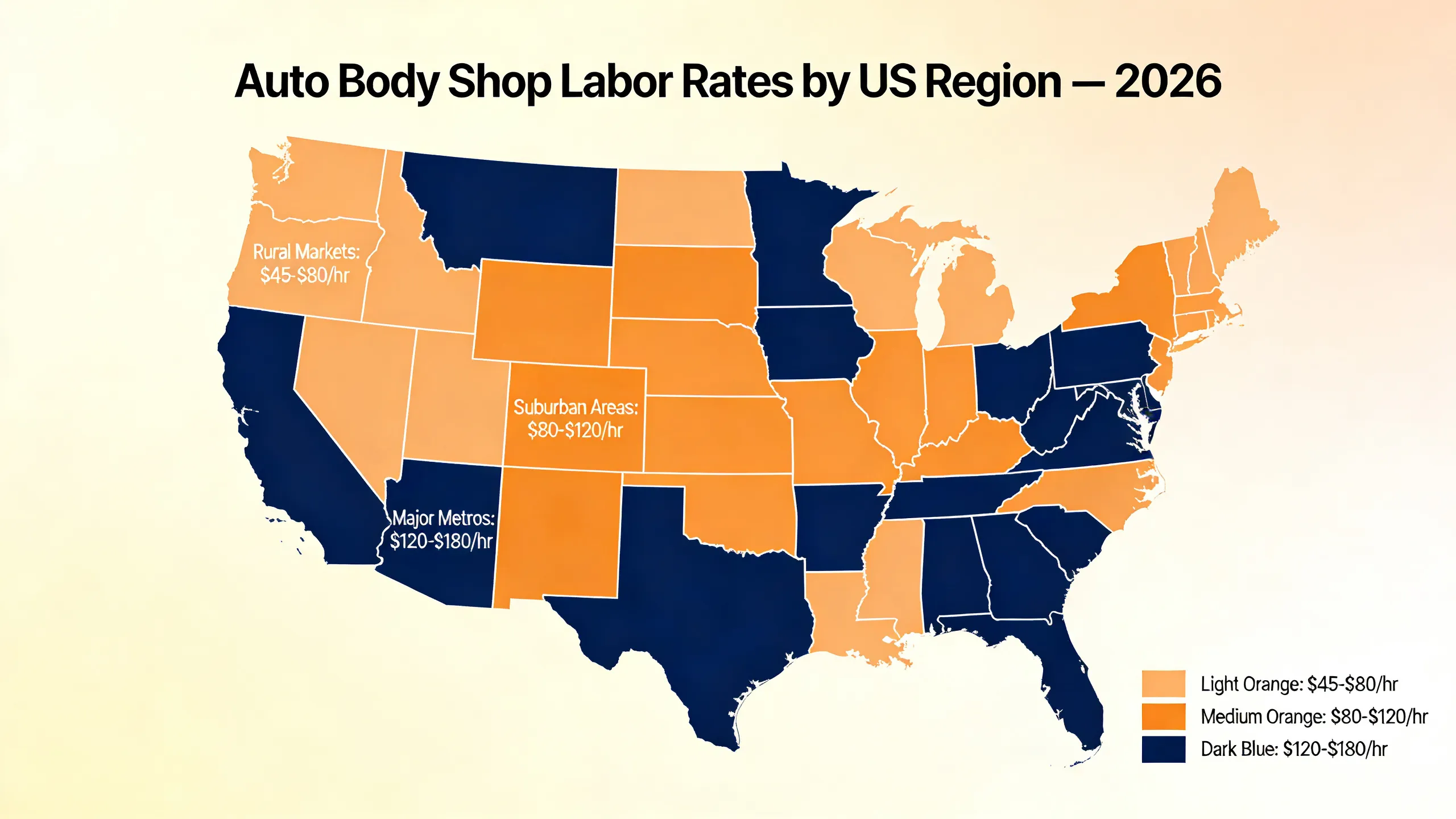
- Labor rates vary 40 to 60% by region, from $45/hr in rural markets to $180/hr in NYC and LA.
- Filing a claim isn't always worth it when the repair cost is close to your deductible and premium increases are factored in.
- Paintless dent repair (PDR) costs 60 to 70% less than traditional repair for dents without paint damage.
Average Collision Repair Costs by Damage Type
The ranges below come from national industry repair data, including estimates from CCC Intelligent Solutions and Mitchell International, two of the largest collision estimating platforms in North America. These are starting points. Your actual cost depends on vehicle type, location, and shop labor rates.
| Repair Type | Low Estimate | High Estimate | Notes |
|---|---|---|---|
| Minor scratch / scuff | $150 | $600 | Touch-up or paint correction |
| Small dent (no paint damage) | $75 | $300 | PDR-eligible; no filler needed |
| Large dent (paint damage) | $300 | $1,200 | May require filler and repaint |
| Bumper repair (minor) | $300 | $800 | Plastic repair and blend |
| Bumper replacement | $800 | $2,000 | Parts + paint + installation |
| Fender repair | $500 | $1,500 | Straightening, filler, paint |
| Paint, single panel | $400 | $1,200 | Color match and clear coat |
| Paint, full vehicle repaint | $2,500 | $7,500+ | Labor intensive; varies by size |
| Frame / structural damage | $1,500 | $12,000+ | Depends on severity and method |
| Windshield replacement | $200 | $600 | Higher with ADAS recalibration |
| Rear-end collision | $1,500 | $5,000 | Trunk, bumper, quarter panels |
| Side-swipe damage | $800 | $4,000 | Door panels, mirrors, quarter |
| Front-end collision | $1,500 | $8,000+ | Hood, grille, radiator support |
These ranges capture the broad middle of the market. Luxury vehicles, EVs, and vehicles with advanced safety systems commonly run above the high end. Older vehicles with widely available parts can come in below the low end.
For bumper-specific pricing, see bumper repair. For structural concerns, see frame repair. For scratch-only damage without denting, see car scratch repair cost.
What Drives Collision Repair Costs?
No two collision repair jobs are identical, even when the damage looks the same from the outside. Several variables combine to set the final price. Knowing what they are helps you evaluate estimates and recognize when something's off.
Damage Severity
The most obvious cost driver is how bad the damage actually is. Cosmetic damage (scratches, minor dents, small paint chips) typically stays in the $150 to $800 range. Once damage reaches metal, affects panel shape, or compromises structural components, costs climb fast.
Damage that looks minor on the surface can hide deeper problems. A bumper cover dent that seems purely cosmetic may have cracked the underlying foam absorber, bent the impact bar, or damaged mounting brackets. Shops find this during teardown. It's the main reason estimates sometimes increase after work begins, not because the shop is padding the bill, but because the surface inspection can't show what's underneath.
Vehicle Make and Model
The same repair on two different vehicles can cost very different amounts. Parts availability, labor time, and repair complexity all vary by model, sometimes dramatically.
Luxury vehicles (BMW, Mercedes-Benz, Audi, Lexus) typically run 30 to 60% more than mainstream equivalents for comparable repairs. Parts cost more, labor procedures are more detailed, and some brands require dealer-sourced components for specific systems.
EVs are a separate cost category entirely. High-voltage battery systems, specialized aluminum structures, and dense ADAS sensor packages all increase labor time and parts cost. According to CCC Intelligent Solutions, EV collision repair costs average roughly 25% higher than comparable gas-powered vehicles. If you drive an EV, budget accordingly.
Parts: OEM vs. Aftermarket
Parts selection has a direct effect on the final number. Three options exist:
- OEM parts (Original Equipment Manufacturer): made by or for the vehicle manufacturer. Guaranteed fit and finish. Typically 20 to 50% more expensive than alternatives.
- Aftermarket parts: made by third-party suppliers. Lower cost, but fit quality varies by manufacturer and model. Often a strong value on older vehicles where exact fit matters less.
- Recycled / used parts: pulled from salvage vehicles. Lowest cost option. Condition varies and availability is model-dependent.
Insurance companies typically specify aftermarket or recycled parts to control costs. You have the right to request OEM parts in many states, though you may need to cover the price difference. Have this conversation upfront. It avoids billing surprises later.
Labor Rates by Region
Labor is often the largest single line item on an estimate, and it varies more than most people expect. National repair data shows labor rates differ by 40 to 60% between the lowest- and highest-cost U.S. markets.
| Region | Typical Labor Rate | Notes |
|---|---|---|
| Rural / small market | $45–$80/hr | Lowest overhead, high availability |
| Midwest / South | $65–$100/hr | Mid-market; competitive pricing |
| Mountain / Southwest | $75–$120/hr | Growing markets; moderate rates |
| Pacific Northwest | $90–$140/hr | High cost-of-living areas |
| Northeast (non-NYC) | $90–$130/hr | Variable; urban vs. suburban |
| Major metros (NYC, LA, etc.) | $120–$180/hr | Highest labor rates in the country |
California operates in one of the highest labor rate environments in the country, a factor that pushes collision repair costs well above the national average. Find auto body shops in California to compare local estimates. Texas markets often run 10 to 25% below the national average in major metros like Dallas and Houston. Browse auto body shops in Texas for regional pricing context.
Standard repair jobs include a fixed labor hour count based on industry guides (published by Mitchell, CCC, and Audatex). Shops can request "additional" time when the actual procedure runs long due to vehicle complexity, prior damage, or hidden damage discovered during teardown. That's a legitimate and common reason why the final bill exceeds the initial estimate.
Paint and Materials
Paint costs appear on nearly every collision repair estimate. A single-panel repaint typically runs $400 to $1,200, depending on paint type, panel size, and color complexity.
A few things push paint costs higher than expected:
- Specialty finishes: pearl, metallic, tri-coat, and matte finishes need more materials and more precise application
- Color matching: blending new paint into surrounding panels adds labor and materials. It's the step that takes skill, not just time
- Clear coat: the protective top layer adds material cost and a separate cure step
- Panel complexity: doors, quarter panels, and hoods with complex curves need more setup time and material
Full vehicle repaints start around $2,500 for basic single-stage paint and climb to $7,500 or more for premium multi-stage work. See auto painting for a full breakdown, or our cost to paint a car guide for detailed tier-by-tier pricing.
Insurance vs. Out-of-Pocket: What You'll Actually Pay
The repair bill and what you actually pay are two different numbers. Insurance coverage, deductibles, and the decision of whether to file at all combine to set your real out-of-pocket cost.
When to File a Claim
Filing a claim makes sense in most situations involving significant damage, particularly when the repair cost exceeds the deductible by a meaningful margin and another party was at fault. It's less clear-cut when the damage is minor, you were at fault, and a claim would push your premiums up.
Factors that favor filing a claim:
- Repair estimate significantly exceeds the deductible
- Another driver was at fault and their insurance may cover the cost
- Injuries occurred (separate from property damage coverage)
- Multiple vehicles or property were damaged
Factors that favor paying out of pocket:
- Estimate is close to or below the deductible
- Car owner has a claims-free discount worth protecting
- Vehicle is older with lower actual cash value (ACV)
- Cosmetic damage that doesn't affect vehicle function or safety
Note: Insurance processes vary by state and carrier. Review the specific policy terms before making a decision. A licensed insurance agent can help evaluate the claim trade-off for a specific situation.
Deductible Math: When Paying Yourself Makes Sense
The deductible is what you pay before insurance covers the rest. Common amounts: $250, $500, and $1,000.
Example: Repair estimate is $1,200, deductible is $500.
- Insurance pays: $700
- You pay: $500
- Premium increase risk: possible, depending on carrier and fault determination
The breakeven math: If filing raises your premiums by $150/year for three years, that's $450 in added premiums plus the $500 deductible, totaling $950 in real dollars, versus $1,200 out of pocket. Filing saves money here. But if the premium increase is larger, or if adding a claim affects your future coverage availability, paying out of pocket can be the better long-term move.
The right answer depends on your specific carrier, your claims history, and your state's insurance market. Talk to your insurer or an independent agent before filing. It takes five minutes and saves second-guessing later.
How Insurance Companies Estimate Repairs
When a claim is filed, an insurance company sends an adjuster (sometimes called an insurance inspector) to assess the damage. The adjuster uses one of the major estimating platforms (CCC ONE, Mitchell RepairCenter, or Audatex) to calculate expected repair cost based on standardized parts pricing and regional labor rates.
Insurance estimates often start lower than shop estimates for two consistent reasons:
- Initial inspections miss hidden damage that only shows up during teardown. The gap between the insurance estimate and the final repair cost is called a "supplement." Most collision repairs involve at least one.
- Estimating platforms use market-average rates that may not match what your shop actually charges.
You have the right to choose your own repair facility regardless of what the insurance company recommends. That's a consumer protection that applies in all 50 states (source: NHTSA consumer resources). If your shop's estimate differs from the insurer's, the shop and insurer negotiate a supplement. Legitimate shops do this routinely.
How to Get an Accurate Collision Repair Estimate
The estimate is where real collision repair cost information comes from, and where the biggest variation between shops shows up.
Getting Multiple Estimates
Getting two or three estimates for the same repair is the single most effective thing you can do to understand fair pricing. Estimates can legitimately differ due to parts sourcing, labor rate, and how each shop accounts for likely hidden damage.
When comparing, make sure all shops are assessing the same scope of damage. A lower estimate that doesn't account for likely supplements isn't savings. It's a deferred cost that shows up once work starts.
What to Look for in an Estimate
A thorough written estimate should include:
- Labor hours for each operation, listed separately from parts
- Parts list with part numbers, types (OEM, aftermarket, recycled), and unit prices
- Paint materials as a separate line item, not buried in labor
- Sublet operations (work sent out to a specialist, like frame straightening or glass) listed separately
- Tax calculated on parts
- Totals that actually add up
Vague estimates with a single line total ("collision repair, $2,400") tell you almost nothing. You can't compare them to other estimates and you can't negotiate with them. Ask for itemization.
Hidden Costs to Watch For
Several costs tend to surface after the initial estimate:
- Hidden structural damage: only visible once panels come off during teardown
- ADAS recalibration: required after many repairs on vehicles with cameras, radar, or sensors; adds $200 to $800+
- Rental car costs: often covered by insurance, but most policies have per-day caps
- Diminished value: the reduction in resale value after a collision, even after a clean repair; some states let you claim this from the at-fault party's insurer
- Storage fees: if the vehicle sits at a tow yard or shop past a certain number of days
Ways to Save on Collision Repair Cost
Reducing the total bill doesn't mean accepting worse work. Several practical approaches lower your costs without compromising repair quality.
Compare Shops, Not Just Prices
The cheapest estimate is not automatically the best deal. A shop with a lower quote but incomplete processes may miss hidden damage, use poor-quality parts, or deliver a paint match that fades in a year. A higher upfront cost from a shop with documented quality standards often ends up cheaper when you factor in rework.
When evaluating shops, consider alongside price:
- I-CAR Gold Class certification, which means technicians complete ongoing training
- OEM certifications for your specific vehicle brand
- Written repair warranty (reputable shops typically offer lifetime warranties on body work)
- Documented experience handling insurance supplements
Ask About Parts Options
Ask the shop to quote the same repair with different parts options: OEM, aftermarket, and recycled. The price difference is often significant. On a vehicle that's a few years old with decent mileage, quality aftermarket or recycled parts can produce a functionally equivalent repair at meaningfully lower cost.
For vehicles still under manufacturer warranty, stick with OEM. Aftermarket parts on a car under factory warranty can create complications if something fails later.
Consider Paintless Dent Repair
For dents that haven't broken the paint surface, paintless dent repair (PDR) is almost always the most cost-effective option. PDR technicians use specialized tools to massage metal back into shape from behind the panel. No filler, no repainting.
PDR runs $75 to $300 per dent, versus $300 to $1,200 for traditional repair that involves filler and paint. Not every dent qualifies: deep creases, sharp impact points, and dents on structural panels often don't work. But for parking lot dings, door hits, and minor hail damage, PDR saves real money.
Negotiate Supplements
When hidden damage pushes the repair scope beyond the initial estimate, the additional cost is called a supplement. Insurance covers legitimate supplements when they're documented and tied to the original incident. Most of the time.
You can stay involved in the supplement process by:
- Asking the shop to document all additional damage with photos before proceeding
- Requesting a copy of the supplement submitted to your insurer
- Following up with the adjuster to confirm it was reviewed and approved
Staying engaged reduces surprise charges and tends to speed up insurance reimbursement.
FAQ
How Much Does Collision Repair Cost on Average?
The national average for collision repair falls between $1,500 and $3,000 for most incidents, based on CCC Intelligent Solutions industry data. Minor fender benders with cosmetic damage run $300 to $1,000. Front-end or rear-end collisions with structural involvement commonly reach $3,000 to $8,000 or more.
Is Collision Repair Worth It on an Older Car?
If the repair cost exceeds 75 to 80% of the vehicle's actual cash value (ACV), most financial advisors consider the car a practical total loss. A vehicle worth $5,000 with a $4,200 repair estimate is difficult to justify economically, especially if the insurer declares it totaled.
How Much Does a Fender Bender Cost to Fix?
A minor fender bender, typically involving bumper damage, small dents, and surface scratches, usually costs $500 to $2,500 depending on the number of panels affected, whether parts need replacement, and local labor rates. Bumper-only repairs often fall in the $500 to $1,500 range.
Why Is Auto Body Repair So Expensive?
Auto body repair combines skilled labor (most shops charge $65 to $180/hour), costly parts, specialized equipment, and materials like paint, primer, and clear coat. Modern vehicles with aluminum panels, high-strength steel, and integrated sensors require more time and precision than older vehicle designs, which pushes costs higher.
Does Insurance Cover All Collision Repair Costs?
Collision insurance typically covers the repair minus the deductible, up to the vehicle's actual cash value. Full coverage applies to non-collision events like hail or theft. Not all policies include both. Gap coverage, rental reimbursement, and diminished value are separate considerations. Review the specific policy for exact coverage terms.
How Can I Reduce My Collision Repair Bill?
The most effective strategies are: getting at least two or three estimates, asking shops to quote OEM versus aftermarket parts separately, checking whether paintless dent repair (PDR) is an option for dent-only damage, and staying engaged during the insurance supplement process. None of these require accepting lower-quality repairs.
What is the most expensive part of a car to repair after a collision?
Frame and structural damage is the most expensive collision repair, costing $2,000 to $10,000+. Other costly repairs include transmission damage ($3,000 to $5,000), suspension rebuilds ($1,500 to $3,000), and full paint/panel replacement ($2,000 to $4,000). When repair costs exceed 70 to 80% of the car's value, insurers total it.
Sources: CCC Intelligent Solutions collision repair industry data; Mitchell International repair cost benchmarks; NHTSA crash statistics (nhtsa.gov); I-CAR technical training standards (i-car.com).