Frame damage repair cost is one of the largest, and most misunderstood, expenses car owners face after a collision. A minor bend in a single frame rail might cost $600. A multi-point structural failure can push $10,000 or result in a total loss declaration.
That range is real. And the decisions that follow are among the most consequential in the entire repair process.
Unlike a dented door or a cracked bumper, structural damage affects how the vehicle performs in a future crash, whether the suspension stays aligned, and whether the car is even worth repairing. Insurance companies, shops, and car owners tend to view frame damage very differently, and those differences frequently lead to disputes over repair scope, cost, and total loss thresholds.
This guide covers what frame damage repair costs in 2026, the damage types that drive pricing, the difference between repairable and irreparable structural damage, and how insurance handles these claims. If you're dealing with frame damage for the first time, you'll also find guidance on your rights and what to watch for after the repair is done.
For broader context on collision claims and repair options, the collision repair guide covers the full post-accident process from first steps through final delivery.
Frame damage repair costs at a glance
Frame damage repair cost varies sharply by severity, vehicle type, and local labor market. The table below reflects current industry estimates for both unibody and body-on-frame vehicles.
| Damage severity | Estimated repair cost | Notes |
|---|---|---|
| Minor bend (single point) | $600–$1,000 | Frame straightening on one section, no cutting |
| Moderate damage (1-2 sections) | $1,000–$3,500 | Hydraulic pulling, possible sectioning |
| Severe/multi-point damage | $3,500–$10,000+ | Structural sectioning, welding, part replacement |
| Total loss threshold | Varies by state | Typically 70–80% of ACV triggers total loss |
These are national averages. Labor rates vary significantly by region, shops in major metro areas often charge 40-60% more per hour than shops in smaller markets. Vehicle make also matters: luxury vehicles and late-model cars built with advanced high-strength steel (AHSS) typically cost more due to specialized tooling and strict OEM procedure requirements.
For full cost context across all collision repair types, see the guide to collision repair costs.
Types of frame damage
Frame damage doesn't all look the same. Body shops use specific terminology to describe how a structure deformed on impact. Knowing these categories helps you follow the repair conversation and ask sharper questions.
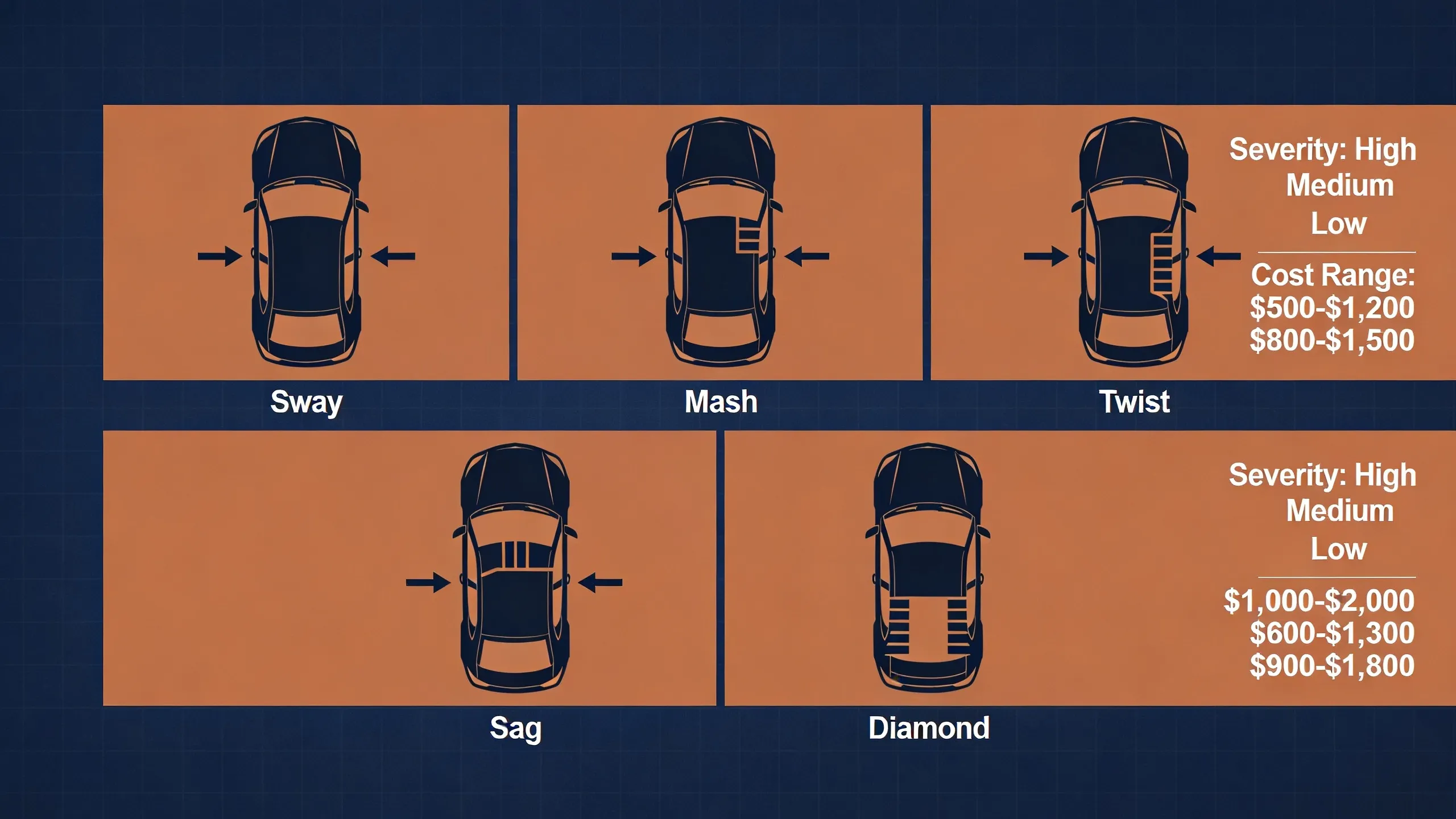
Sway damage (side impact)
A side-impact force pushes the frame out of square laterally, the front or rear structure shifts left or right relative to the center line. On a unibody vehicle, this shows up as misaligned strut towers, uneven door gaps, and shifted quarter panels. Repair involves measuring the deviation, attaching hydraulic anchoring equipment, and pulling the structure back to spec.
Mash damage (front or rear impact)
Mash damage compresses the frame or crumple zones along the front-to-back axis. Front-end collisions commonly mash the front frame rails inward. It's one of the most frequent types of structural damage simply because it follows the impact direction of most crashes. Cost depends on how many sections are compressed and whether the firewall or passenger compartment got involved.
Twist damage (multi-point impact)
Twist damage happens when forces hit the vehicle at two or more points in different directions, causing the frame to rotate out of plane. Think of one corner of a table being pushed down while the opposite corner is pushed up, that torsional distortion is what twist does to a vehicle structure. It's one of the hardest types to fully correct and often shows up as persistent misalignment even after multiple straightening passes.
Sag damage (undercarriage or center impact)
Sag means the center of the frame or unibody has dropped relative to the front and rear reference points. Causes include severe undercarriage impacts, overloading, or high-speed collisions that exceeded the structure's designed absorption limits. Correcting it requires precise measurement and significant pulling force at multiple attachment points simultaneously.
Diamond damage (offset corner impact)
Diamond damage occurs when a corner impact shifts the entire frame out of its rectangular geometry, the structure takes on a parallelogram shape when viewed from above rather than a rectangle. Common in oblique and offset collisions. One of the more expensive types to correct because it requires simultaneous pulls at multiple points working against each other.
Unibody vs body-on-frame: why it matters
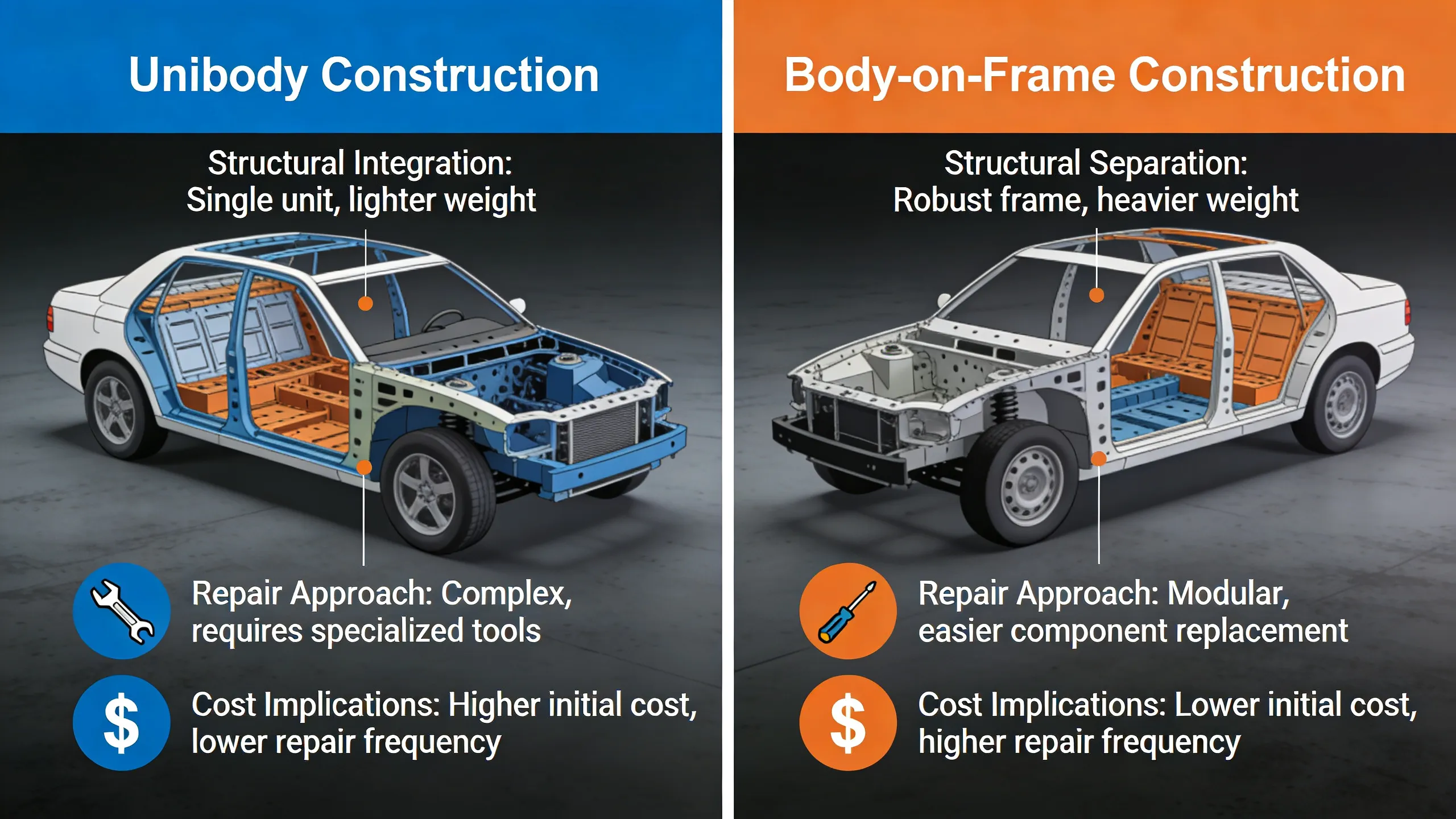
Vehicle construction type directly affects both repair cost and the approach required. These are fundamentally different structures with different failure modes, the repair isn't the same on a Tacoma as it is on a Camry.
How unibody vehicles handle impact
Most passenger cars, crossovers, and many SUVs use unibody construction. No separate frame, body panels, floor pan, and structural members are all welded together as one integrated unit. Designated crumple zones are built in to absorb and redirect crash energy away from the passenger compartment.
The design is intentional: controlled deformation during a crash. That means moderate to severe collisions deliberately crush specific sections. Repair means straightening, sectioning, or replacing those sections while preserving the passenger compartment's geometry. Straightening too aggressively or applying heat where it shouldn't be can weaken the metallurgy, which is exactly why OEM repair procedures specify how each section gets treated.
How body-on-frame vehicles handle impact
Trucks, full-size SUVs, and commercial vehicles use a separate ladder frame that supports the body from below. Two distinct structures. Damage may involve frame rails, crossmembers, or the body mounts connecting them.
Because the frame is standalone, minor damage is sometimes more straightforward to repair, the frame can be pulled, straightened, and measured without cutting into body structure. But severe frame rail damage on these vehicles can cost more than equivalent unibody damage because the rails are thicker steel and require higher-tonnage pulling equipment.
What this means for cost
Unibody repairs tend to run higher for moderate damage because the sectioning and welding process is more intricate, and more components (rocker panels, floor structure, strut towers) are often involved. Body-on-frame repairs can be cheaper for minor damage but escalate fast when rails need sectioning or replacement. On either type, frame damage repair cost climbs significantly when damage has migrated toward the firewall, passenger compartment, or wheel wells.
Is frame damage repairable? The safety question
In many cases, yes, frame damage is repairable. Single-point and moderate structural damage can be corrected to OEM specifications using straightening, sectioning, and welding.
But damage that has migrated into the passenger compartment, A or B pillars, or sections designated non-repairable by OEM procedures is a different story. The question of whether the vehicle is safe to drive after repair is the most important question in the entire process, and the answer depends on what was damaged, how it was repaired, and whether OEM procedures were followed.
What makes a frame repair safe
A properly executed frame repair restores the vehicle's structural geometry within OEM tolerances. The frame dimensions, measured at multiple datum points using computerized measuring systems, fall within manufacturer specifications after repair. When those measurements check out:
- Suspension geometry is restored, so wheels track and steer correctly
- Crumple zone performance is preserved, the structure will absorb energy as designed in a future crash
- ADAS sensors that depend on vehicle geometry (front radar, camera systems) can be accurately recalibrated
The qualifier there is "properly executed." A shop that straightens without measuring, sections without following OEM procedures, or skips post-repair verification cannot confirm the vehicle is safe. And neither can you.
When frame damage is too severe
Not everything is fixable. Damage that has migrated into the passenger compartment, A-pillars, B-pillars, floor structure, or roof structure is generally beyond the scope of straightening. Deformation in those areas raises serious questions about whether the vehicle can protect occupants in a future collision.
There's a material issue too. High-strength and ultra-high-strength steel (UHSS) sections in modern vehicles cannot be heat-straightened. OEM procedures for these materials specify cut and splice (sectioning), not heat. A shop that heat-straightens UHSS may make the damage look corrected, but the metal is compromised at a metallurgical level and won't perform as designed when it matters most.
OEM repair procedures and sectioning
OEM repair procedures specify exactly where a section can be cut, how new material must be spliced, what weld type is required, and which areas can't be repaired at all. These rules exist because different sections of the vehicle are engineered to manage crash energy in specific ways, replace or restore them incorrectly and you change that behavior.
Sectioning (cutting out a damaged section and welding in new OEM-equivalent steel) is the industry standard for moderate to severe structural damage. The I-CAR organization publishes training standards for structural sectioning that qualified technicians complete as part of ongoing professional development (I-CAR structural repair training).
The frame repair process
Knowing what the frame repair process actually involves helps you evaluate shop capability and ask the right questions before authorizing work.
Measuring and mapping the damage
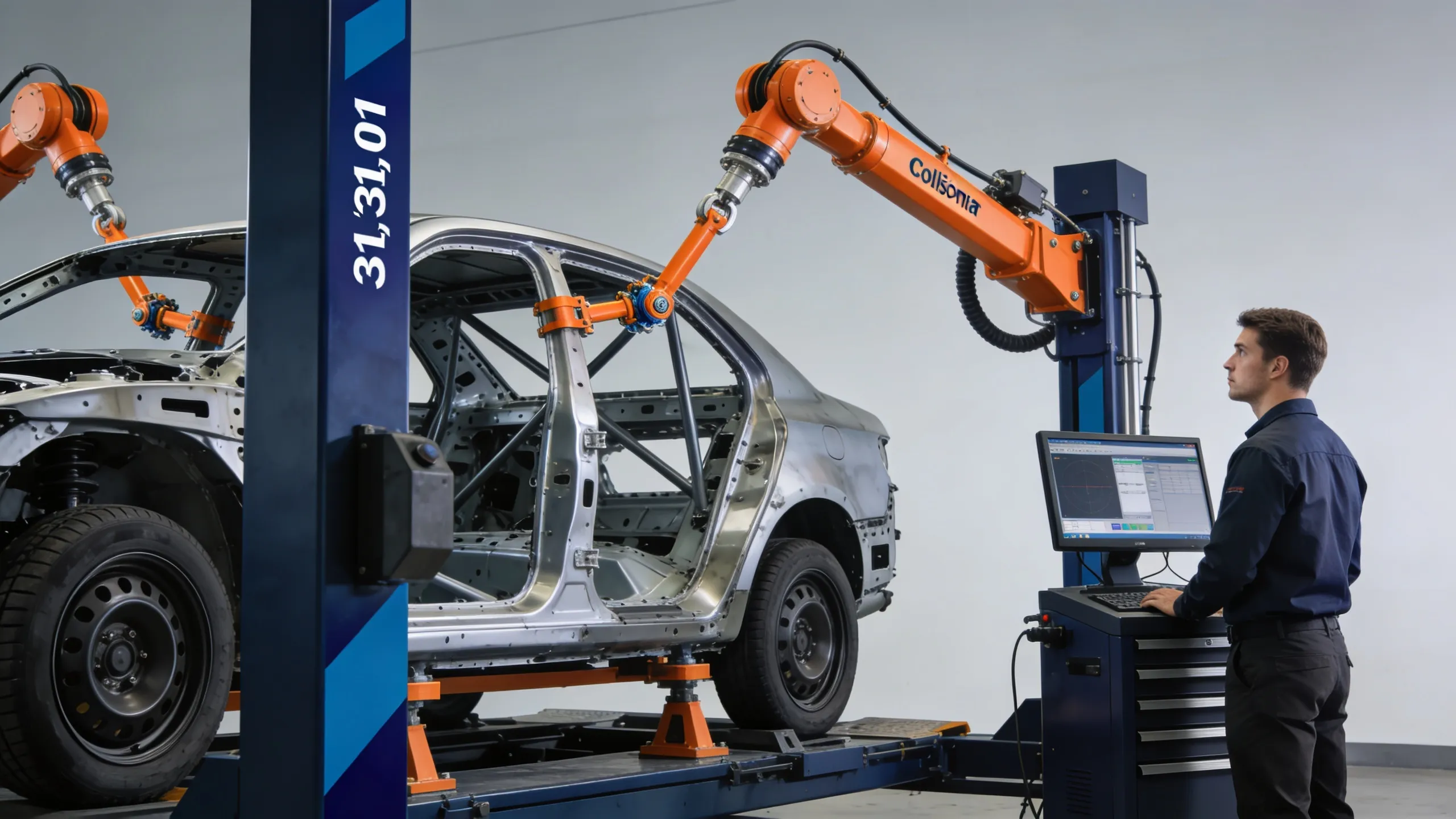
Before any pulling or cutting starts, a qualified shop measures the vehicle against OEM reference dimensions. Either a laser-based or mechanical tram gauge system captures reference points across the underbody, firewall, strut towers, and rear structure. The measurements don't just show where damage is visible, they also surface secondary displacement. A front impact that looks localized to the driver's side rail may have pushed the firewall slightly out of square on the passenger side. You'd never know without measuring.
Frame straightening equipment
Straightening uses a dedicated anchoring system that secures the vehicle to a pulling bench or floor system, with hydraulic towers applying measured force to deformed sections. The technician attaches pulling chains or clamps to the target structural member, sets pull direction and angle, and applies force incrementally while the measuring system monitors movement.
Not a single pull. A series of incremental adjustments, each one followed by measurement verification.
Welding and sectioning
When a section can't be straightened to spec, it gets cut out and replaced. Weld type, location, and process are specified in OEM procedures. MIG brazing, for example, is required in certain high-strength steel sections where full-penetration welds would compromise the material. Sectioning is the technically correct solution for moderate to severe damage, not a shortcut.
Post-repair measurements and documentation
After pulling and sectioning are complete, the vehicle is re-measured against all OEM reference points. A qualified shop documents pre-repair measurements, intermediate pulls, and final verified measurements. This documentation matters for insurance, for diminished value claims, and for any future incident where understanding the vehicle's repair history becomes relevant. Ask for it.
Frame damage and insurance
Frame damage claims are among the most complex interactions car owners have with their insurers. Knowing how these claims work, and what rights you have, consistently produces better outcomes.
Total loss thresholds by state
When repair cost approaches or exceeds a set percentage of the vehicle's Actual Cash Value (ACV, the pre-loss market value), the insurer may declare a total loss rather than authorizing repair. The threshold varies by state.
Most states use 70-80% of ACV. In a total loss, the insurer pays ACV (minus your deductible) instead of repair costs. Frame damage is often the deciding factor: a car worth $12,000 with $9,500 in frame and collision damage may hit the threshold in a 75% ACV state.
Some states use a "Total Loss Formula" (TLF) that weighs repair cost plus salvage value against ACV rather than a fixed percentage. Check your state's specific rule, it directly determines whether your vehicle gets repaired or totaled. The NHTSA vehicle safety resources provide context on structural repair standards for reference.
Diminished value claims
Even after a clean frame repair, a vehicle with documented structural damage on its history report typically sells for less than a comparable car without that history. The gap between pre-accident value and post-repair market value is called diminished value.
In most states, you have the right to file a diminished value claim against the at-fault party's liability insurance, separate from the collision repair claim itself. It requires documentation of the repair, a professional appraisal of post-repair value, and comparable vehicle data. For a full breakdown of how that process works, see the guide to insurance claims and collision repair.
Rights when you disagree with a total loss determination
If the insurer declares a total loss and you disagree with the ACV offered, you have options. Most state insurance regulations allow you to:
- Request documentation of how ACV was calculated, including comparable sales used
- Submit independent vehicle listings that support a higher value
- Hire an independent appraiser to conduct a formal appraisal
- Invoke the appraisal clause in your policy, triggering a formal arbitration process
You also have the right to retain a totaled vehicle and accept a reduced payout (ACV minus salvage value). The title becomes salvage in most states, which affects registration, insurance eligibility, and future resale.
After frame repair: what to know
The car leaving the shop after frame repair isn't done with the process. A few follow-up steps directly affect both safety and long-term performance.
ADAS recalibration
Modern ADAS systems, forward collision warning, automatic emergency braking, lane departure warning, adaptive cruise, rely on sensors positioned precisely relative to the vehicle's structural geometry. Frame repair that changes that geometry means those sensors need recalibration.
That includes radar modules behind the front bumper, forward-facing cameras near the windshield or rearview mirror, and blind spot sensors in the rear quarters. Skip recalibration and these systems may trigger at the wrong time or fail to trigger when needed. For cost details and a full explanation of the process, see the ADAS calibration cost guide.
Alignment and suspension
Even when frame repair restores OEM measurements within tolerance, adjacent components, control arms, tie rods, strut assemblies, may have been stressed or displaced in the original impact. A full four-wheel alignment check is mandatory after any structural repair. In some cases, suspension components need replacement because they can't be realigned without new parts.
Steering components need inspection too, especially if the subframe, steering rack, or mounting points were near the damage zone. Alignment and suspension issues that get missed after frame repair show up as tire wear, handling pull, or vibration, sometimes months later if the initial check was incomplete.
Long-term vehicle safety
A properly documented frame repair, performed to OEM specifications, is considered safe by industry standards. That said, a few long-term factors are worth keeping in mind.
Vehicles with prior structural damage on their history can show reduced crashworthiness in research contexts, specifically in cases where the repair wasn't performed or documented correctly. That's not an argument against frame repair. It's an argument for making sure the repair is done right, documented thoroughly, and verified with post-repair measurements.
If the vehicle is ever in another significant collision, first responders and repair technicians benefit from knowing the prior structural history. Keep the records, pre- and post-repair measurements, welding documentation, ADAS recalibration records. They matter more than most people realize.
To find qualified shops with the structural repair capability and equipment for this type of work, browse frame repair and collision repair services in your area.
Key takeaways
Frame damage repair cost in 2026 runs $600 for a minor single-point bend up to $10,000+ for multi-point structural damage, with total loss a real possibility when repair cost approaches 70-80% of the vehicle's Actual Cash Value.
The five damage types (sway, mash, twist, sag, diamond) each have distinct causes and repair approaches. Vehicle construction (unibody vs. body-on-frame) affects both cost and process. Modern unibody vehicles require strict adherence to OEM procedures, especially in sections with high-strength or ultra-high-strength steel.
Safe frame repair means precise measurement, proper equipment, correct sectioning and welding, and verified post-repair measurements. Documentation isn't paperwork, it's evidence that the repair met the standard.
Insurance handling involves total loss thresholds, ACV determination, and diminished value rights that most car owners don't know about. You can question total loss valuations, request documentation, and invoke the appraisal process if a settlement doesn't hold up.
After repair, ADAS recalibration and a full alignment check aren't optional. Skipping either creates safety risk that may not surface until the next crash.
Frame damage is not just a cost question. It's a safety question. Car owners who understand both sides of that make better decisions, for their car, their family, and their wallet.
Frequently asked questions
How much does it cost to repair frame damage on a car?
Frame damage repair cost in 2026 typically falls between $600 and $10,000 depending on severity. Minor single-point damage costs $600 to $1,000. Moderate damage involving one or two sections costs $1,000 to $3,500. Severe multi-point damage requiring sectioning and welding costs $3,500 to $10,000 or more. Vehicle type and local labor rates affect the final number.
Is a car with frame damage safe to drive?
A car with unrepaired frame damage is not safe to drive, structural misalignment affects handling, suspension geometry, and crash protection. After a properly executed repair verified with post-repair measurements that confirm OEM tolerances are met, the vehicle is considered safe. Documentation of the repair is essential proof that the work was done correctly.
Does frame damage always mean total loss?
No. Insurers declare a total loss when repair cost approaches or exceeds the state's total loss threshold, typically 70% to 80% of Actual Cash Value. A $20,000 vehicle with $5,000 in frame damage is well below that threshold. A $8,000 vehicle with $7,000 in damage may be at or above it. Both the repair cost and the vehicle's pre-accident market value determine the outcome.
Can frame damage be fully repaired?
In many cases, yes. Single to moderate frame damage can be repaired to OEM specifications using straightening, sectioning, and welding. The repair is complete when post-repair measurements confirm the structure is within OEM tolerances. Exceptions include damage to the passenger compartment, A or B pillars, and sections OEM procedures designate as non-repairable.
Does frame damage show up on Carfax?
Frame damage appears on a Carfax report when reported through an insurance claim or by a participating repair facility. However, cash repairs or repairs at non-reporting shops may not appear. Buyers reviewing a vehicle with prior collision history should request repair documentation directly from the seller rather than relying solely on history reports.
How long does frame damage repair take?
Frame damage repair typically takes 5 to 10 business days for moderate damage and up to 3 weeks or more for severe damage requiring sectioning, replacement parts, and full collision repair. Parts availability, shop workload, and additional hidden damage discovered during teardown all affect timing. ADAS recalibration and alignment verification add time at the end.
For broader research on frame repair standards, these resources provide authoritative context: