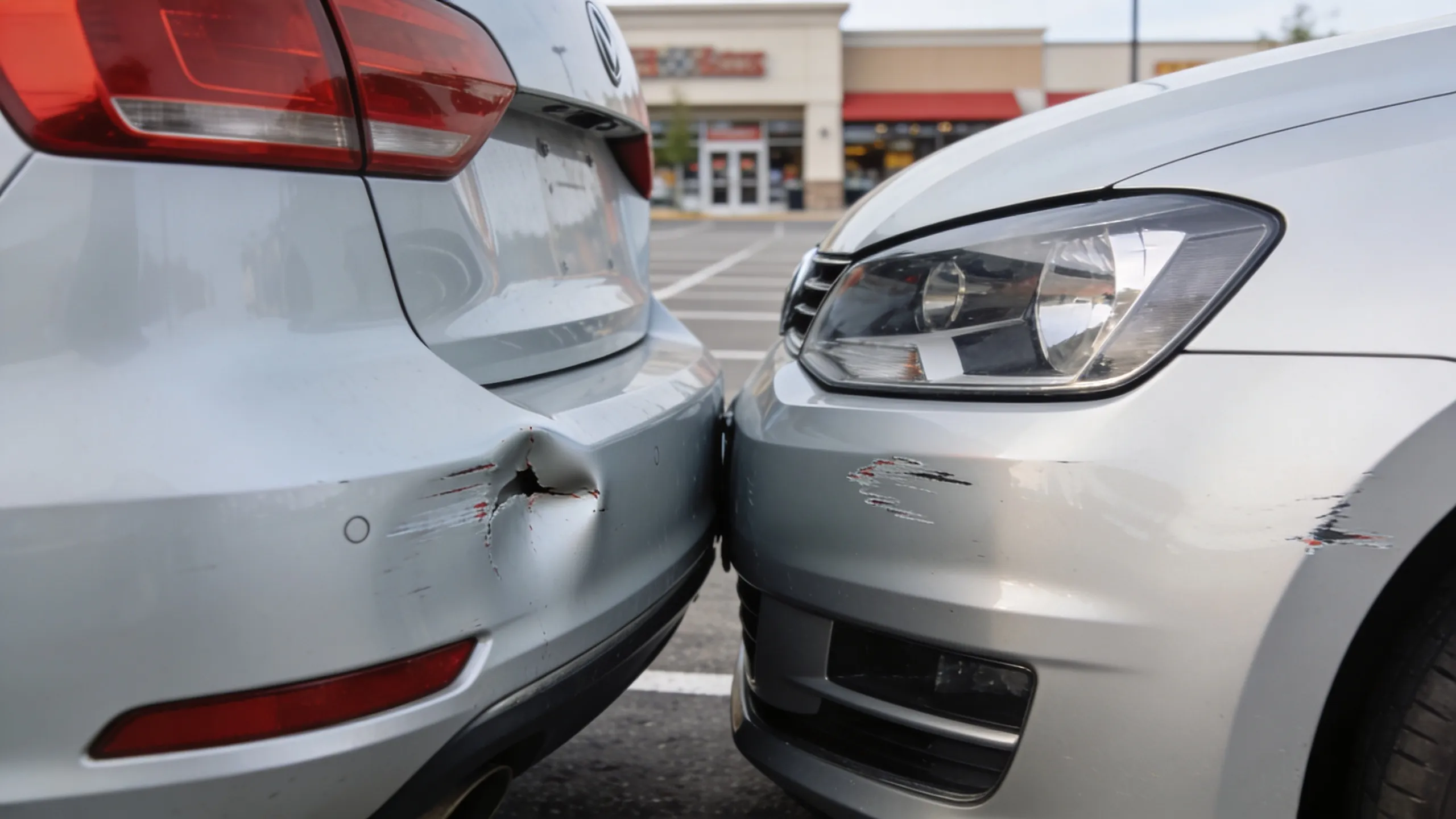
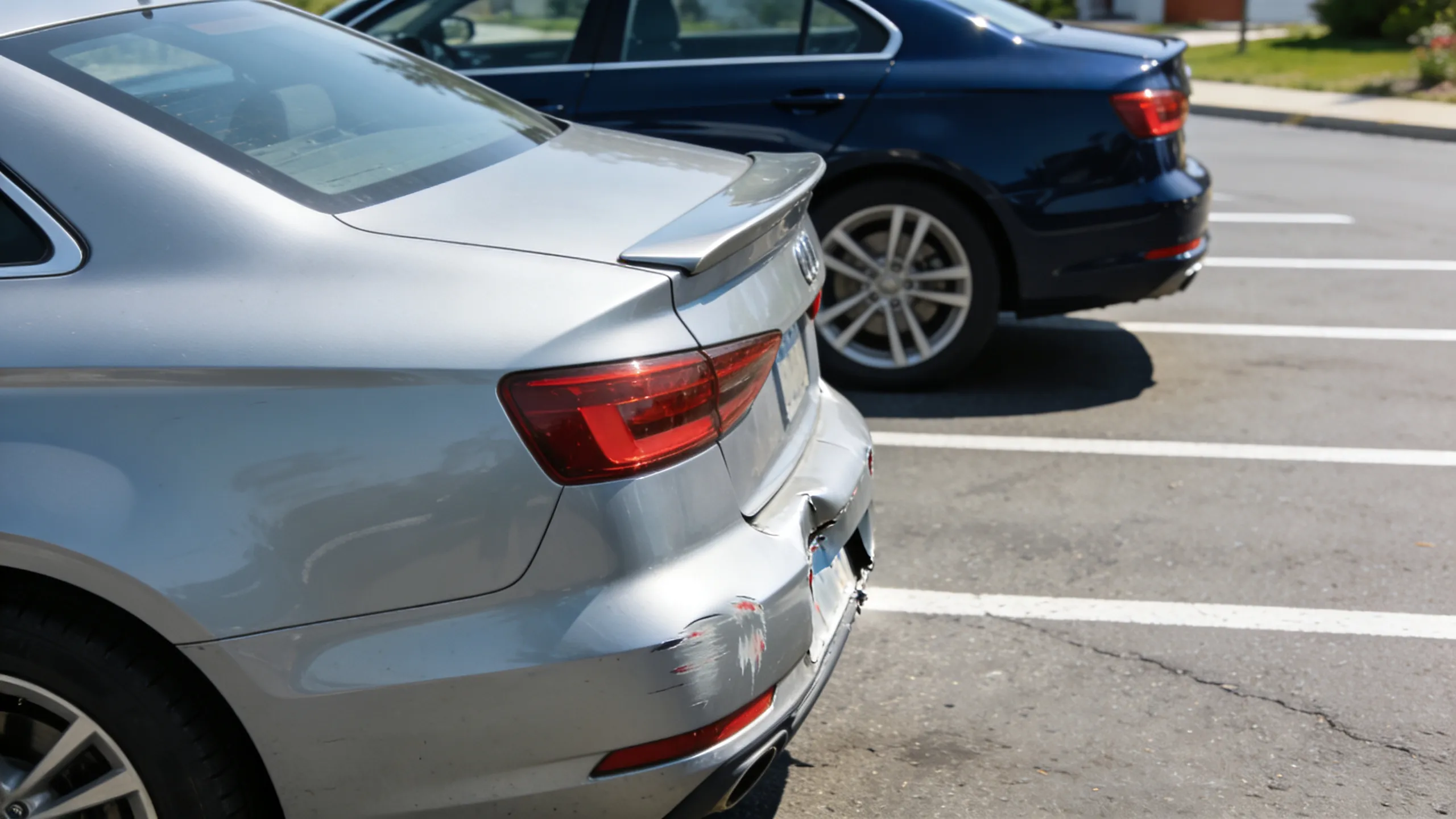
A parking lot tap or low-speed rear-end collision can look like nothing, a scuff, a slight crease, maybe a cracked corner of a bumper cover. But fender bender repair cost tends to surprise car owners who expect a quick, inexpensive fix.
The national average for minor collision repair ranges from $500 to $1,500 for straightforward cosmetic damage. When structural components, hidden sensors, or multiple panels are involved, costs can reach $3,000 to $4,000 or more. Understanding what drives those numbers is the difference between filing a smart insurance claim and overpaying for something avoidable, or underpaying for a repair that leaves safety problems behind.
This guide covers how fender bender repair cost is calculated, what counts as a fender bender, why minor collisions often cost more than they appear, the repair process from start to finish, and how to handle the insurance decision.
Fender bender repair costs by damage type
Fender bender repair cost varies significantly based on what was actually damaged. A cosmetic scratch and a rear bumper hit that misaligned an Advanced Driver Assistance Systems (ADAS) sensor are both "fender benders" by common usage, but they sit at opposite ends of the cost spectrum.
| Damage type | Estimated cost range | What drives the cost |
|---|---|---|
| Cosmetic only (scuff, scratch, paint transfer) | $200–$600 | Paint correction, spot refinishing |
| Dent + repaint (single panel) | $500–$1,200 | Dent repair, color matching, blending |
| Structural involvement (bumper absorber, reinforcement bar) | $1,200–$3,000+ | Part replacement, labor, alignment check |
| Multiple panels affected | $1,500–$4,000+ | Extended labor, paint blending across panels |
These ranges reflect typical national averages as of 2026. Labor rates vary by 40% to 60% between rural markets and major metro areas, so the same repair done in Atlanta and San Francisco will carry meaningfully different price tags. Dealership body shops tend to run 20% to 30% higher than independent shops for identical work.
Vehicle type also matters. Luxury vehicles and trucks with larger, more complex bumper systems cost more to repair than compact sedans. Some premium vehicles require OEM (Original Equipment Manufacturer) replacement parts for certain structural components, which adds both parts cost and labor time.
What counts as a fender bender?
The term "fender bender" is informal but widely understood. It describes a low-speed collision that causes minor to moderate vehicle damage, the kind of incident that happens in parking lots, intersections, and residential streets rather than on highways.
Low-speed impact definition
Insurance adjusters and the repair industry generally define low-speed collisions as impacts occurring below 15 mph. The Insurance Institute for Highway Safety (IIHS) conducts standardized low-speed crash tests at 3 to 5 mph and 10 mph to measure bumper performance and repair costs under these conditions.
IIHS findings consistently show that even 5 mph impacts, slow enough that occupants feel only a mild jolt, can cause hundreds or thousands of dollars in structural damage to bumper systems, particularly on vehicles with plastic covers concealing foam absorbers and steel reinforcement bars.
Common fender bender scenarios
Most fender benders fall into a few predictable patterns:
- Parking lot impacts: Slow backing or pulling forward into another vehicle, a post, or a curb. These frequently affect rear bumpers, corner panels, and bumper mounting hardware.
- Stop-and-go traffic: Following too closely at low speed and making contact with the vehicle ahead. Common cause of rear bumper damage and potential ADAS sensor disruption.
- Backing out of driveways: Contacting a mailbox, wall, or passing vehicle during a reverse maneuver. Often causes damage to rear quarter panels and corners.
- Shopping cart and door dings: Generally cosmetic, but in dense parking areas, these can multiply across several panels.
Not all of these carry the same repair costs. A door ding on flat sheet metal repaired through paintless dent repair, a technique that reshapes metal from behind without paint, costs far less than a rear bumper impact with structural involvement.
Why fender bender repair cost exceeds the estimate
The most common reason fender bender repair cost exceeds initial estimates is hidden damage. What's visible from outside the vehicle, a scuffed cover, a slight crease, tells only part of the story.
The hidden structure behind the bumper cover
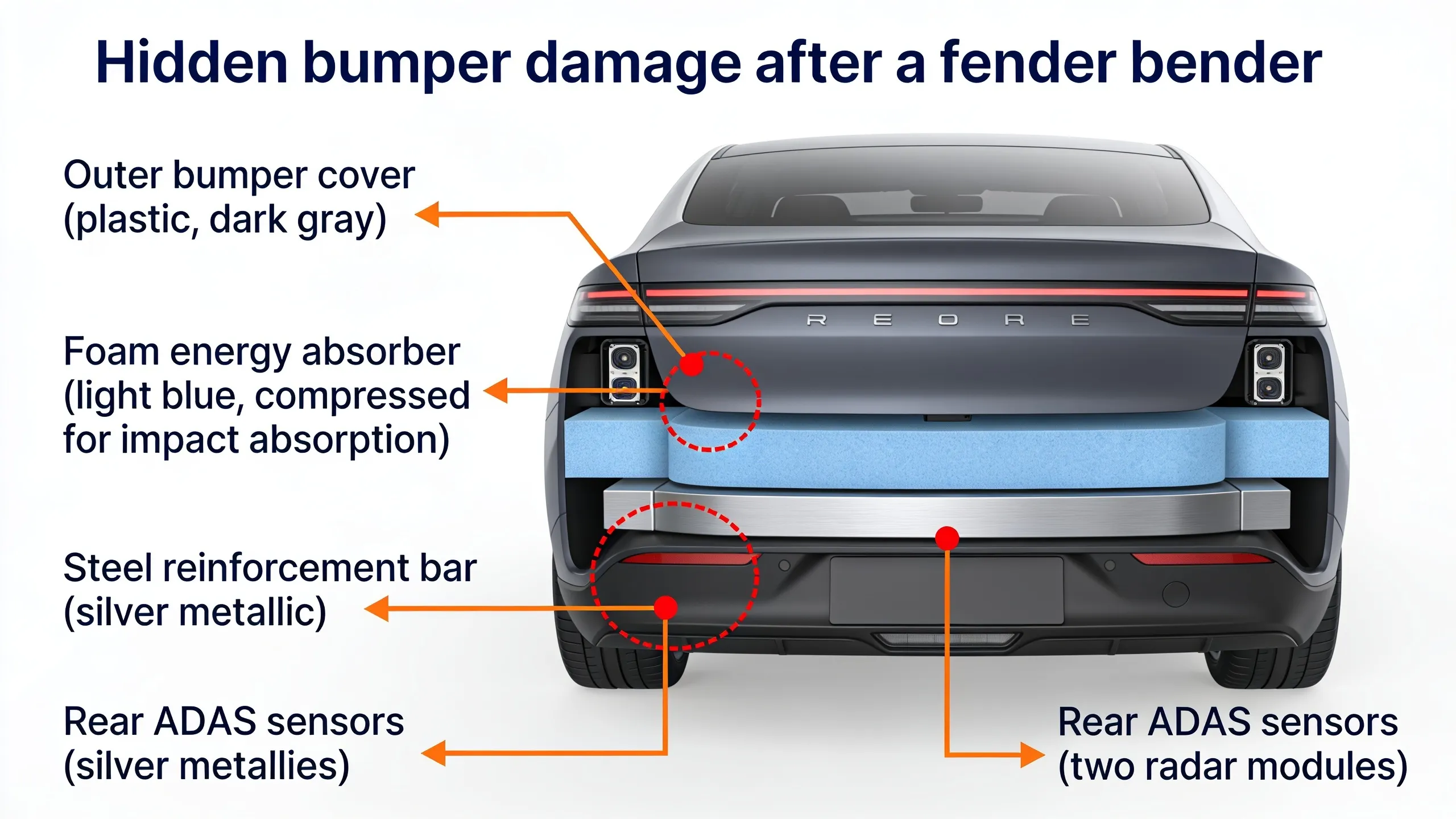
Modern vehicle bumpers are layered systems, not solid components. The outer cover is typically plastic. Behind it sits a foam energy absorber designed to compress and absorb impact force. Behind that is a steel or aluminum reinforcement bar bolted to the vehicle's frame rails. Each layer can sustain independent damage that isn't visible without removal.
Shops are required to provide a teardown estimate, a cost assessment after the bumper cover is removed and the underlying components are inspected, before committing to a final repair price. The difference between an external estimate and a teardown estimate can be significant. According to industry data, teardown inspections reveal additional damage in roughly 30% to 40% of apparent low-damage cases.
Bumper absorber and reinforcement bar damage
The foam energy absorber that sits between the plastic cover and the reinforcement bar is the part most commonly underestimated. At 5 to 10 mph, this absorber may compress, crack, or deform substantially. It's a single-use component, once compressed significantly, it must be replaced, not repaired.
Absorber replacement typically adds $150 to $400 to a repair bill. Reinforcement bar replacement, when needed, runs $200 to $700 depending on vehicle make and whether OEM or aftermarket parts are used. Together, these components convert what looked like a $400 bumper repair into a $1,000 to $1,500 job.
For more on bumper system repair costs and what to expect, see the bumper repair guide.
ADAS sensor displacement
Many vehicles built since 2018 integrate ADAS sensors, including forward radar, backup cameras, blind-spot monitors, and parking sensors, behind or within bumper assemblies, grilles, and lower trim pieces. A bump that shifts a bumper cover even a few millimeters can alter sensor aim enough to affect system accuracy.
I-CAR, the industry training organization, recommends that any repair involving bumper, grille, or rear panel areas include a post-repair scan and calibration check when ADAS components are present. Calibration costs typically range from $250 to $500 per system, and some vehicles require multiple systems recalibrated after a single impact.
This is covered in detail in the article on ADAS calibration after a fender bender, which covers which scenarios require recalibration and how to confirm the work is documented properly.
Trunk and door alignment issues
Rear-end impacts, even at low speed, can misalign trunk lids, hatchbacks, or rear doors. When panel gaps become uneven after a fender bender, it typically signals that the underlying structure absorbed some of the impact force. This may involve bent rear frame rails or displaced panel attachment points.
Correcting misalignment requires structural measurement using computerized frame analysis equipment. If the vehicle needs frame straightening, that adds $500 to $1,500 to repair costs and moves the job from a cosmetic repair to structural collision repair, which changes how insurance handles it, how long repair takes, and whether the vehicle's structural integrity warrants closer inspection.
The repair process for fender benders
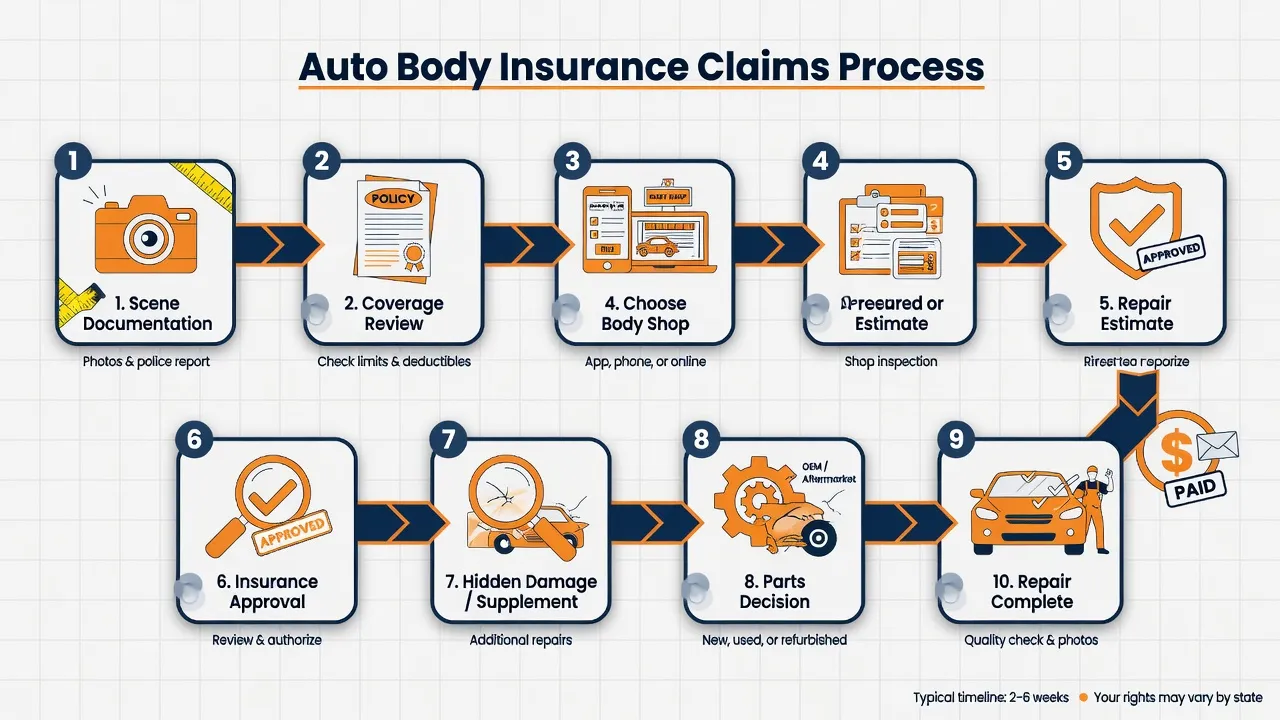
Understanding the repair sequence helps set accurate expectations for both cost and timeline. Fender bender repair isn't a single step, it follows a structured process that can take anywhere from one day to one week depending on the damage found.
Assessment and teardown
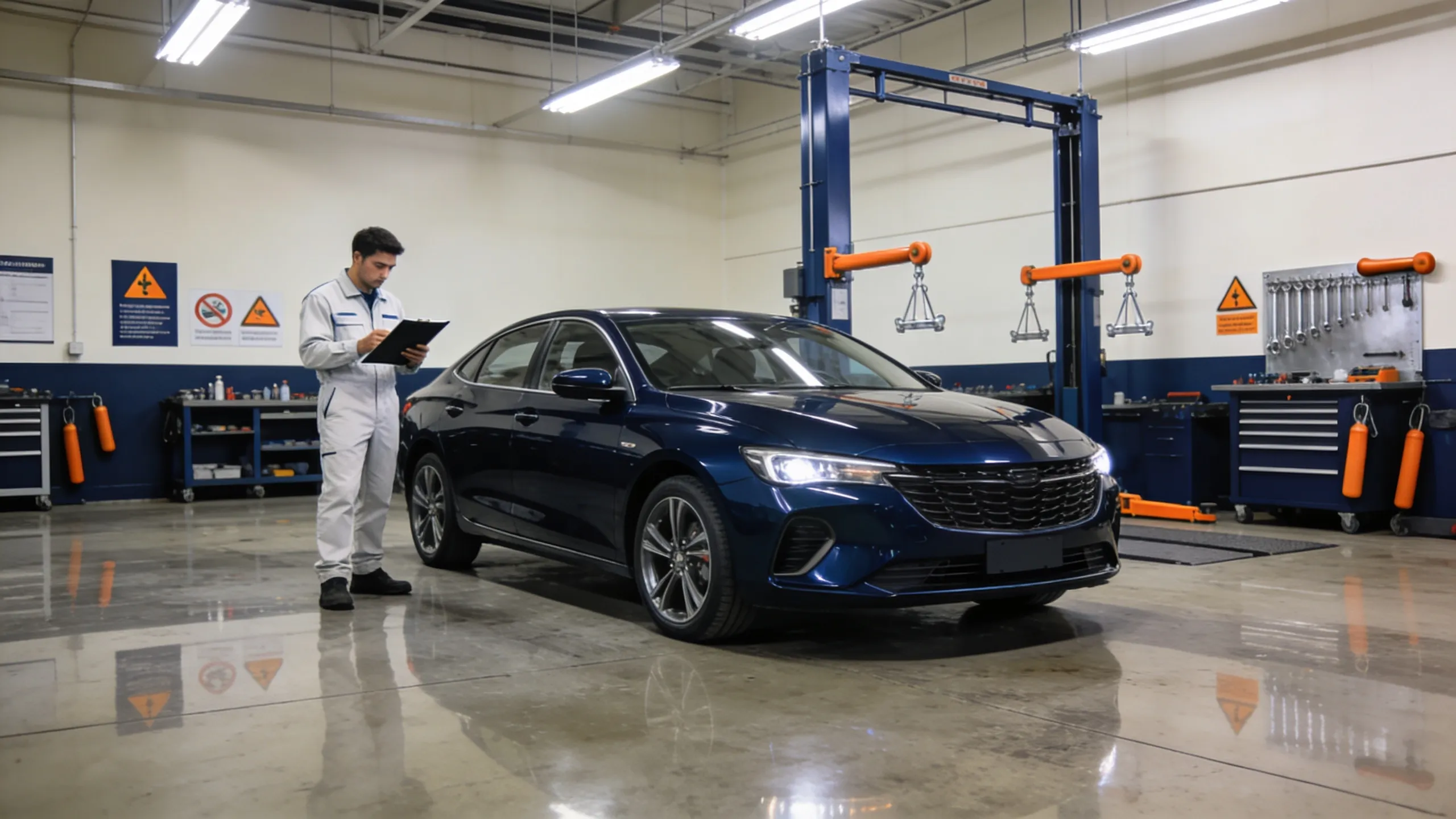
The first step at any body shop is a visual assessment to document visible damage. The shop then produces an initial estimate. For anything beyond a surface scratch or shallow paint scuff, a proper teardown, removing the affected panels to inspect underlying components, is the next required step.
Shops that skip teardown and quote based only on surface inspection risk underbidding the repair, which typically leads to supplement requests later (additional charges added after the original estimate). You're better served by requesting teardown-based estimates from the start, even if it takes a day longer to receive.
Repair vs. replace decision
Once damage is fully visible, the shop determines whether each component should be repaired or replaced. The threshold generally follows this logic:
- Repair is appropriate when a component can be restored to like-new condition at a cost lower than replacement.
- Replace is appropriate when damage is too extensive, when safety is a factor, or when repair would cost as much as a new or quality used part.
For structural components like reinforcement bars and brackets, replacement is almost always the correct choice, these parts are engineered to absorb impact once and replaced thereafter. For sheet metal panels with limited deformation, skilled technicians may achieve excellent results through repair.
Paint matching and blending
Any repair involving panel repaint requires color matching, matching the new paint to the existing paint on the vehicle. More complex than it appears. Vehicle paint fades and oxidizes over time, so factory color codes no longer match the actual appearance of older vehicles.
Professional shops use spectrophotometer tools to measure the existing paint's color wavelength and adjust the mix accordingly. Even with precise matching, the difference between new and old paint can be visible at certain angles. This is why shops often "blend", feathering the new paint into adjacent panels so the transition is invisible rather than abrupt.
Blending adds labor cost (typically $100 to $300 per adjacent panel) but produces noticeably better visual results. When comparing estimates, check whether blending is included.
ADAS recalibration (when needed)
If ADAS components were affected or potentially displaced, calibration is the final step before delivery. Static calibration is performed indoors using targets positioned at specific distances in front of or behind the vehicle. Dynamic calibration requires driving the vehicle under controlled conditions until the system re-learns its reference points.
The National Highway Traffic Safety Administration (NHTSA) maintains vehicle safety data and supports the position that driver assistance systems must function as designed after repair. Skipping calibration to cut a repair bill can leave automatic emergency braking, lane keeping, or blind-spot detection operating incorrectly, which carries real safety implications.
Insurance for fender benders
The insurance decision is often the most consequential part of managing a fender bender. The wrong choice can result in unnecessary rate increases or out-of-pocket costs that exceed what a claim would have covered.
Claim vs. out-of-pocket: the $1,000 rule
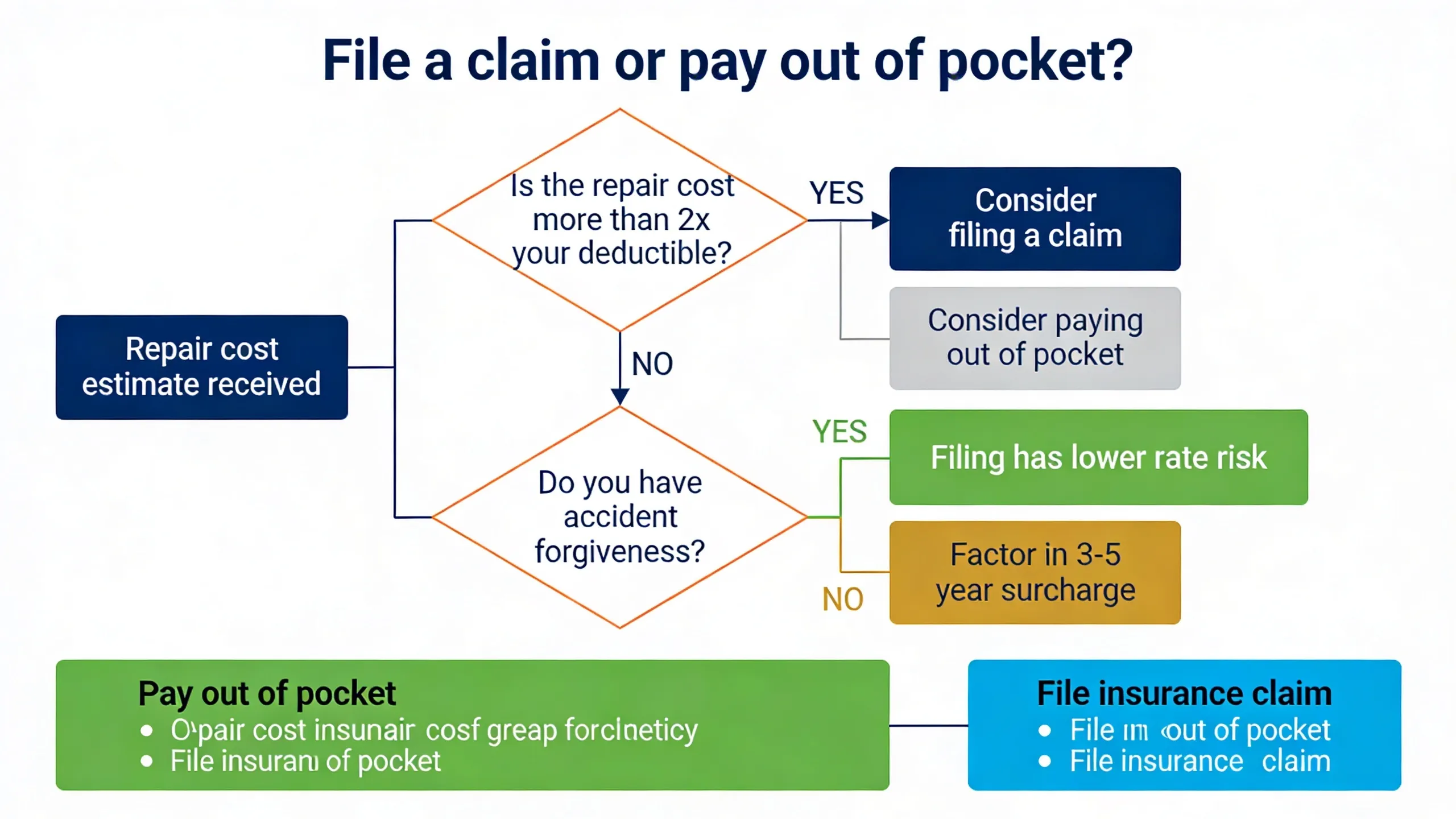
A commonly used decision framework: if the repair cost is less than twice the deductible, paying out of pocket is usually the better financial choice. This heuristic accounts for the rate increase that typically follows a filed claim.
Example: With a $500 deductible, the insurance break-even point is roughly $1,000 in repair cost. If the repair is $800, paying directly saves the insurance record. If the repair is $2,500, filing the claim makes financial sense.
This is a simplified model. Actual rate increases vary by carrier, state, claim history, and the insurer's individual pricing algorithms. Some carriers offer accident forgiveness for first incidents, which changes the calculation significantly. Verify your specific policy terms before deciding.
The complete framework for this decision is covered in the insurance claim guide for collision repair.
At-fault vs. not-at-fault scenarios
When another driver caused the fender bender, the claim process runs through their liability insurance rather than the car owner's policy. In this scenario, filing a claim doesn't affect the non-at-fault driver's premium in most states.
Key steps for not-at-fault claims:
1. Collect the other driver's insurance information, license, and vehicle details at the scene.
2. Document damage with photographs before any vehicle is moved.
3. File directly with the at-fault driver's carrier, not your own.
4. Retain the right to choose your own repair facility, insurance companies can't legally require car owners to use a specific shop in most states.
When fault is disputed or the other driver is uninsured, the claim may route through the car owner's own policy (collision coverage for at-fault or contested accidents; uninsured motorist property damage coverage for uninsured drivers).
Rate increase reality
Filed claims for fender benders typically result in premium increases that last three to five years, depending on the insurer and state regulations. Industry data suggests a first at-fault collision claim raises premiums by an average of 28% to 41%. On a $1,200 annual policy, that increase could cost $336 to $492 per year, or $1,000 to $2,500 over the surcharge period.
This is why fender bender repair cost decisions aren't just about the repair bill. The total cost of a filed claim includes the premium surcharge over the full surcharge period, which can exceed the repair cost for moderate damage.
Important: Insurance processes, consumer rights, and surcharge rules vary by state and carrier. Consult your specific policy documents and your state's department of insurance for accurate information.
Can you drive after a fender bender?
Whether a vehicle is safe to drive after a minor collision depends on what was damaged. Cosmetic damage, paint scuffs, minor dents, generally doesn't affect drivability. Structural or mechanical damage may.
Safety checklist before driving
Before driving away from a minor collision, check the following:
- Fluid leaks: Look under the vehicle for any pooling or dripping fluid. Coolant, oil, or brake fluid leaks indicate mechanical damage that makes the vehicle unsafe.
- Tire condition: Verify all four tires are properly inflated and undamaged. A low-speed impact can damage a rim or sidewall.
- Lighting: Confirm all brake lights, taillights, and turn signals function normally. Non-functioning lights are a traffic violation and safety hazard.
- Panel clearance: Ensure no body panels are rubbing against tires during steering. A bent fender or bumper that contacts a tire can cause rapid tire failure.
- Warning lights: Check the dashboard for any newly illuminated warning lights, including ADAS warning indicators.
- Door and trunk operation: Confirm all doors and the trunk or hatch open and close normally without binding.
If any of these checks reveal a problem, don't drive the vehicle until a qualified technician inspects it.
When you need a tow
Certain conditions require towing rather than driving the vehicle:
- Any fluid is leaking from the vehicle
- A tire or wheel is damaged
- A body panel is contacting a tire
- The vehicle pulls sharply to one side under normal steering input
- The hood is difficult to latch after a front-end impact
- Any warning light related to braking, steering, or powertrain is illuminated
Driving with any of these conditions risks additional damage or a secondary accident. Most auto insurance policies include roadside assistance or towing coverage, check the policy before assuming out-of-pocket towing costs.
Immediate steps after a fender bender
Step 1: Move to safety
If vehicles are drivable and blocking traffic, move to a safe area and turn on hazard lights.
Step 2: Check for injuries
Even low-speed collisions can cause soft-tissue injuries like whiplash. Call 911 if anyone reports pain, dizziness, or confusion.
Step 3: Call the police if needed
Many states require police reports when property damage exceeds $500–$1,000. An official record protects you against future insurance disputes.
Step 4: Document everything
Photograph damage from all angles—wide shots and close-ups both. Capture license plates, VINs, and environmental details. Get witness contact information while you're there.
Step 5: Exchange information
Collect the other driver's name, phone, insurance details, license plate, driver's license number, and vehicle information. Give them yours in return.
Step 6: Notify your insurance company
Contact your insurer promptly. Reporting doesn't obligate you to file a formal claim. It just gets the process started.
How fender bender repair actually works
Disassembly and damage mapping
Shops remove damaged panels or bumpers to access underlying structures. This often reveals additional damage that wasn't visible externally. Your estimate may go up after teardown—that's normal, not a scam.
Metal work and panel repair
Technicians reshape dented metal fenders using pulling tools and hammers. When reshaping would compromise structural integrity, replacement is the better call. Plastic or TPO bumper covers can be heat-reshaped for minor damage. Cracked or severely deformed covers get replaced.
Paintless Dent Repair (PDR): the cost-saving option for minor dents
PDR uses long metal rods to massage dents from behind panels without touching the factory paint. It works best when paint is intact and metal isn't sharply creased. PDR typically costs 50–70% less than traditional repair and often finishes same-day.
Priming, painting, and final reassembly
After metalwork or panel installation, shops apply primer, body filler (if needed), and sealer before painting. Technicians match color using paint codes from door jamb stickers. Blending feathers new paint into adjacent factory panels to prevent visible mismatches. Clear coat goes on, cures, and then trim gets reassembled and inspected.
Choosing a shop for fender bender repair
Written estimates. Always request itemized written estimates listing each damaged component, labor hours, parts (OEM or aftermarket), and paint materials. Verbal estimates protect nobody if the final bill comes in higher.
Warranty. Reputable shops provide written warranties covering physical repairs and paint finish. Lifetime paint warranties are common. One to three-year terms are also standard. Get it in writing.
Certifications. I-CAR Gold Class certification means technicians complete ongoing collision repair training. OEM certifications from manufacturers mean the shop meets specific equipment and training requirements. For newer ADAS-equipped vehicles, OEM-certified shops matter more.
Frequently asked questions
How much does it cost to fix a fender bender?
Fender bender repair cost ranges from $200 to $4,000 or more depending on damage severity. Cosmetic-only repairs typically cost $200 to $600. Damage involving the bumper absorber, reinforcement bar, or ADAS sensors commonly runs $1,000 to $3,000. Multiple affected panels can push costs above $4,000. Teardown inspection is the only way to produce an accurate estimate.
Should I file insurance for a fender bender?
It depends on the repair cost relative to the deductible and the potential rate increase. A useful benchmark: if the repair costs less than twice the deductible, paying out of pocket often makes financial sense when accounting for the premium surcharge a filed claim generates. Verify actual policy terms and state regulations before deciding.
Can a fender bender cause frame damage?
Yes. Rear-end impacts at low speed can bend rear frame rails or structural floor sections. Modern unibody vehicles integrate their frame into the body structure, so impact force distributes widely. Trunk misalignment, uneven panel gaps, or steering pull after a minor collision are warning signs that warrant structural measurement.
How long does fender bender repair take?
Minor cosmetic repairs are typically completed in one to two business days. Repairs requiring parts ordering, paintwork, and ADAS calibration take three to five business days. Parts on backorder can extend timelines to one to two weeks. Ask the shop for a parts availability estimate before dropping off the vehicle.
Do fender benders need ADAS recalibration?
Frequently, yes. Any impact that disturbs a bumper, grille, rear panel, or mirror assembly may displace ADAS sensors that require calibration to factory specifications. A diagnostic scan after repair is the only reliable way to confirm whether calibration is needed, ask the shop to document the result before vehicle delivery.
Key takeaways
Fender bender repair cost is rarely what the damage looks like from the outside. A scuffed bumper can conceal hundreds of dollars in absorber damage, structural displacement, or sensor misalignment that only a teardown inspection reveals.
- Get a teardown estimate before accepting any repair quote based only on external inspection.
- Understand total claim cost before filing insurance, rate increases over three to five years often exceed the repair cost for moderate damage.
- Confirm ADAS recalibration is included in any repair that touched sensor-bearing panels.
- Check safety conditions before driving a vehicle away from any low-speed collision.
- Retain the right to choose your own repair facility: insurers can't require a specific shop in most states.
For a deeper look at how collision repair estimates work and what a complete repair should include, see the complete collision repair guide and the collision repair cost breakdown.
Car owners can find qualified auto body shops in their area using the auto body shop directory to compare local options and request estimates.
Insurance processes, repair costs, and consumer rights vary by state and carrier. Cost ranges reflect national averages as of 2026. Consult your specific policy and a qualified repair professional for guidance on your situation.
Sources: IIHS low-speed crash test research, NHTSA vehicle safety, I-CAR repair procedures