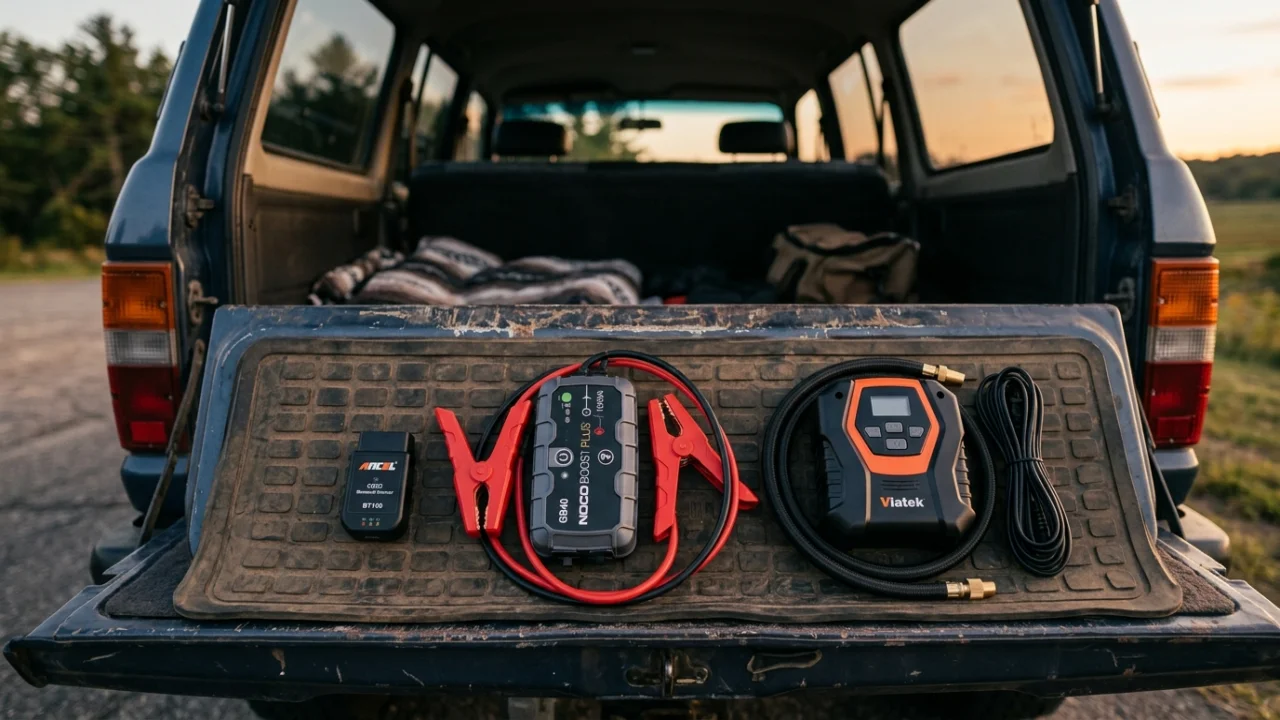
Three car emergency tools handle the overwhelming majority of roadside problems: an OBD2 scanner, a portable jump starter, and a tire inflator. Dead batteries, low tire pressure, and mystery warning lights are the issues that strand drivers most often, and all three are fixable in a parking lot with gear that fits in a glove box or a trunk cubby. Buy the top pick in each category and you'll spend under $250 total, which is less than a single tow plus a diagnostic fee in most cities. Everything else in a well-stocked trunk is useful, but these three do the heavy lifting.
Key Takeaways
- Three tools handle roughly 80% of common roadside problems: an OBD2 scanner, a portable jump starter, and a tire inflator.
- Total investment for all three top picks is under $250, less than one tow truck call in most cities.
- An OBD2 scanner like the BlueDriver (around $100) can save $100 or more per diagnostic visit by telling you what the check engine light means before you book anything.
- Modern lithium jump starters weigh 2 to 3 pounds and fit in a glove box, so there's no reason to carry jumper cables that need a second car.
- For collision damage, frame issues, or ADAS calibration, professional auto body repair is the right call. No scanner substitutes for a shop.
Why Car Breakdowns Are More Common Than You Think
AAA responds to roughly 32 million roadside assistance calls in a typical year, and the reasons repeat with remarkable consistency: dead batteries, flat or underinflated tires, lockouts, and cars that won't start for reasons the driver can't identify. None of those are exotic mechanical failures. They're the ordinary consequences of a battery reaching year four, a tire losing a pound of pressure a month, or a loose gas cap tripping an evaporative emissions code.
What makes them expensive isn't the failure, it's the response. A tow runs $75 to $125 for a short local hookup, and considerably more if you're outside a service radius or need a flatbed. Shops commonly charge $100 to $200 just to plug in a scanner and read a code, and that fee applies whether the fix turns out to be a $12 sensor connector or a $900 catalytic converter. Add the time cost of a car sitting at a shop for a day and a single dead battery on a Tuesday morning can easily become a $300 problem.
Being prepared changes the math. If your car won't crank in a grocery store parking lot, a jump starter turns a two hour wait into a two minute fix. If a tire pressure warning lights up on the highway, an inflator gets you to a tire shop under your own power instead of on a hook. If the check engine light comes on during a road trip, a scanner tells you in thirty seconds whether you're looking at a loose gas cap or a misfire that means pulling over now.
Knowing what's wrong before you call anyone also puts you in a different negotiating position. You walk into a shop saying "P0442, small evap leak, I already checked the gas cap" instead of "there's a light on," and that single sentence changes the conversation and, often, the estimate.
The Three Tools That Cover 80% of Roadside Problems
These picks are curated based on Amazon ratings, review volume, and how consistently each product shows up as a recommendation in owner communities. We haven't bench-tested them ourselves, so treat this as a shortlist built from what verified buyers report at scale rather than a lab comparison.
OBD2 Scanners: Read Your Car's Warning Lights
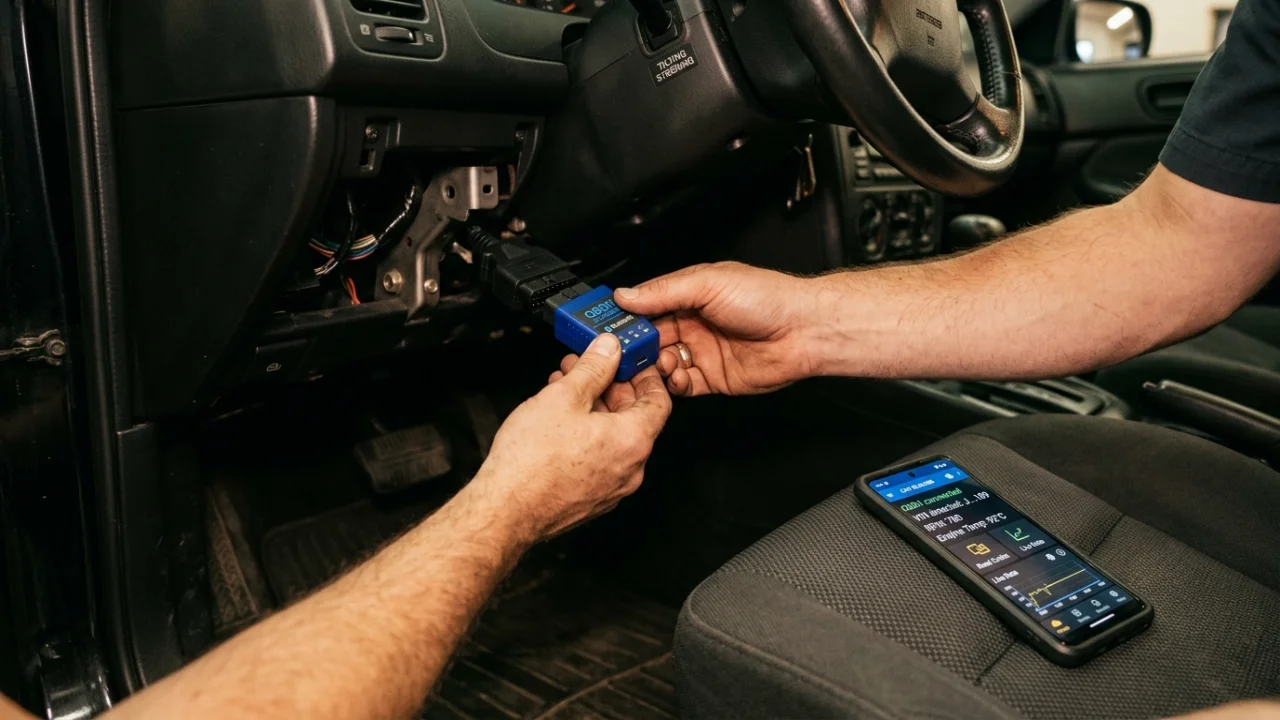
Every car sold in the United States since 1996 has an OBD2 port, usually under the dash near the driver's knee. Plug a scanner into it and you get direct access to the diagnostic trouble codes your engine computer has stored, plus live sensor data in most cases. It's the same port the shop uses. The difference is that a shop charges you for the privilege.
The practical value shows up in two moments. The first is when a light comes on and you need to know whether it's an emergency. A steady check engine light with a stored evaporative emissions code means finish your trip and deal with it this weekend. A flashing check engine light with misfire codes means pull over, because raw fuel is heading into your catalytic converter. A scanner tells you which one you're in. The second moment is buying a used car, where a thirty second scan reveals codes the seller cleared last week but that haven't finished their readiness monitors yet.
Our top pick is the BlueDriver Bluetooth Pro. It's a small dongle that pairs with your phone, and the app pulls from a database of manufacturer-specific fixes rather than just spitting out a five character code and leaving you to search it. It reads ABS, airbag, and transmission codes on most makes, which cheaper generic readers usually can't touch. At around $100 it costs about what one shop diagnostic fee costs, so the payback period is a single use.
If you want the full breakdown of what separates a $25 code reader from a $100 professional-grade tool, including which models handle bidirectional controls and manufacturer-specific systems, read our guide to the best OBD2 scanners for DIY car diagnostics. It covers budget picks, mid-range options, and the features that actually matter depending on how deep you plan to go.
Portable Jump Starters: Never Wait for a Tow
Dead batteries are the single most common reason drivers call for help, and the traditional answer, jumper cables, has an obvious flaw: it requires a second car and a stranger willing to stop. That works in a busy parking lot at noon. It works considerably less well in an empty lot at 11pm or a trailhead with no cell service.
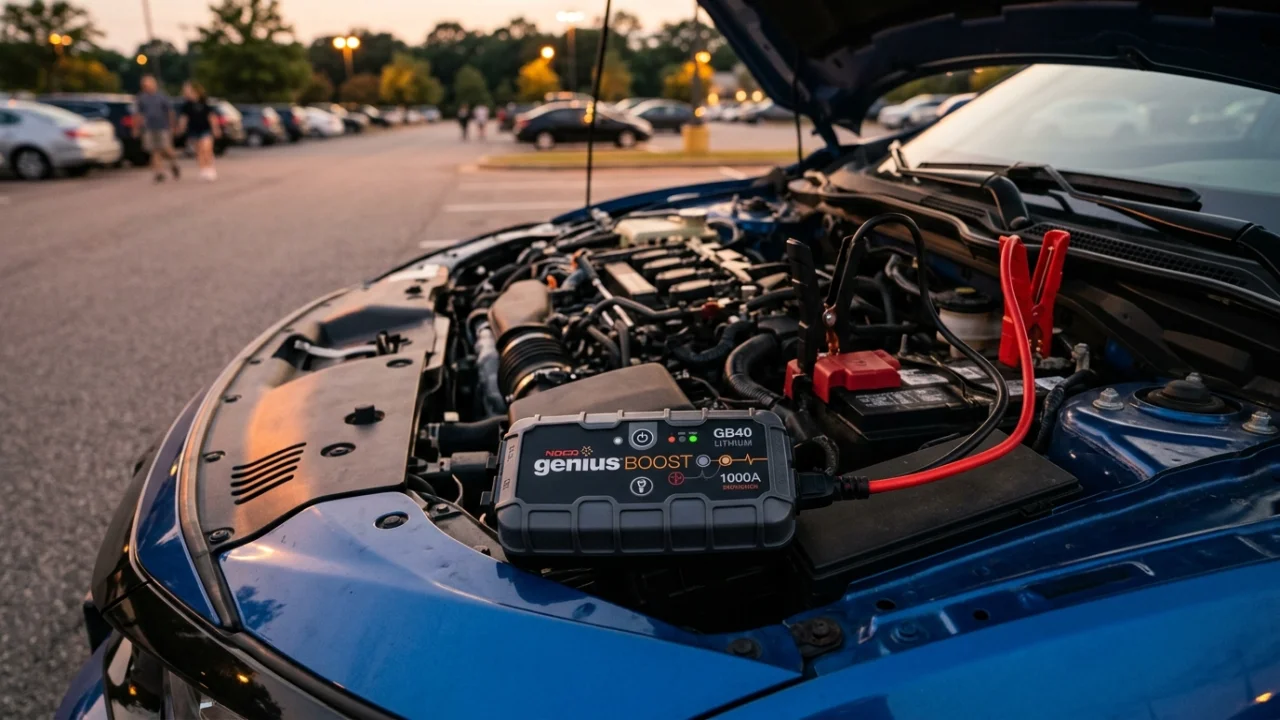
Lithium jump starters removed that dependency. A unit the size of a paperback holds enough stored energy to crank a four or six cylinder engine several times over, and modern ones include reverse polarity protection and spark-proof clamps so you can't damage anything by connecting them backward. Most double as a power bank with USB ports, which turns them into a phone charger the other 364 days of the year.
Our top pick is the NOCO Boost Plus GB40. It delivers 1000 amps, weighs about 2.4 pounds, and handles gas engines up to roughly 6 liters and diesels up to 3 liters, which covers most sedans, crossovers, and light trucks. It holds a charge for months in storage, and the built-in flashlight is genuinely useful when you're squinting at terminals in the dark. Around $100 puts it in the same price band as a single tow.
Sizing matters here. A GB40 is right for most drivers, but a diesel pickup or a big V8 wants more capacity, and someone who only drives a compact commuter can go smaller and cheaper. Our guide to the best portable jump starters covers how to match peak amps to engine displacement, what the marketing numbers actually mean, and which models hold their charge best over a cold winter.

Tire Inflators: Handle Low Pressure Anywhere
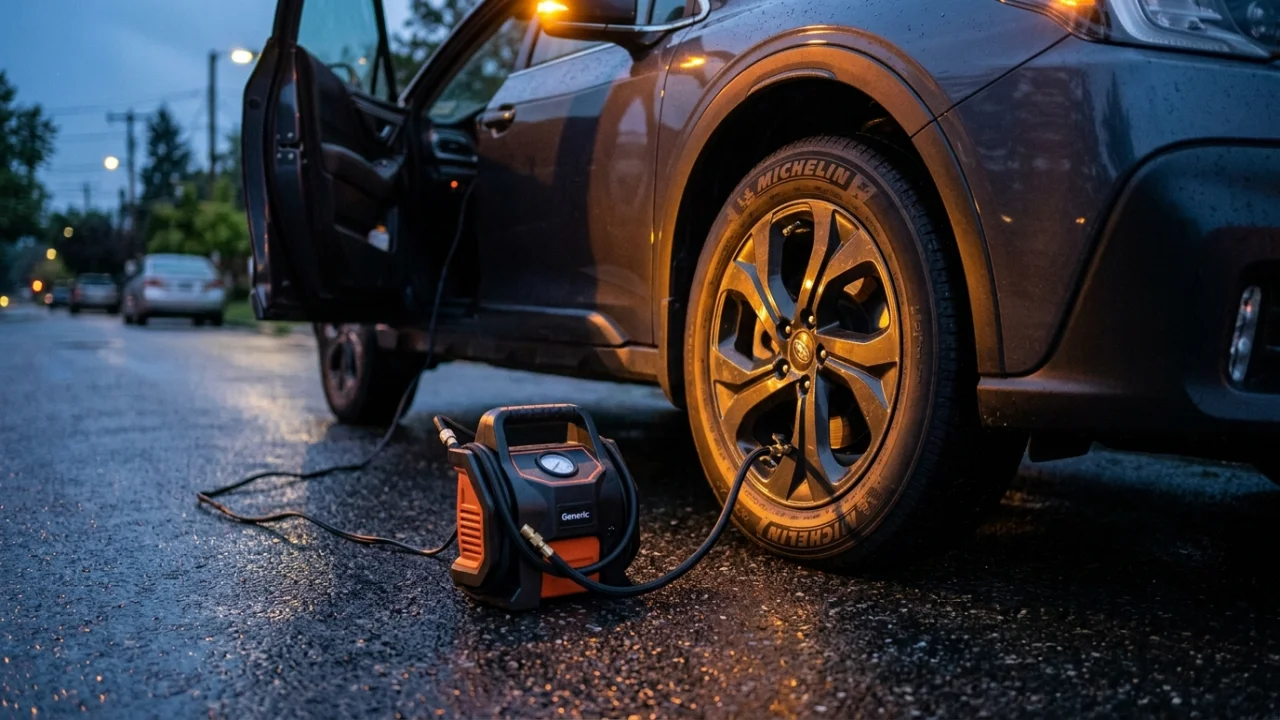
Tires lose about one PSI per month through normal permeation, and roughly another PSI for every 10 degree drop in ambient temperature. That's why so many TPMS warnings appear on the first cold morning in November. The tire isn't damaged, it's just cold and a little low, and the fix is ninety seconds with a compressor.
A portable inflator also buys you options with a slow leak. A nail in the tread often loses air slowly enough that you can top off, drive to a tire shop, and have it patched for $25 instead of destroying the sidewall by driving on it flat. Without an inflator, that same nail means a spare, a donut speed limit, or a tow.
Our top pick is the VIAIR 88P. It's a 12V compressor that clamps directly to the battery terminals rather than running off a cigarette lighter socket, which is why it can fill a truck or SUV tire without overheating or tripping a fuse. It's rated to 120 PSI, includes a proper gauge, and is built to a standard that's closer to shop equipment than to the small plastic units sold at checkout counters. Expect to pay around $70 to $90.
If you drive a sedan and mostly need to top off from 30 to 35 PSI, a smaller cordless unit may serve you better and take up less space. Our guide to the best portable tire inflators compares cordless versus 12V models, explains why duty cycle matters more than max PSI, and flags which models actually hit their advertised fill times.
What Else Belongs in Your Trunk
The three tools above solve mechanical problems. A complete kit also covers visibility, weather, injury, and the simple fact that you may be standing on a shoulder in the dark waiting for someone.
At minimum, add reflective triangles or LED flares so oncoming traffic sees you well before they're on top of you, a headlamp that leaves both hands free, work gloves, a basic first aid kit, and a tire pressure gauge that doesn't rely on the inflator's built-in one. A quart of your car's oil, a gallon of coolant, and a small funnel handle the two fluids most likely to run low far from a parts store. A multi-tool, a roll of duct tape, and a few zip ties fix a surprising number of things temporarily, including a dangling splash shield or a loose bumper cover.
Climate should shape the rest. Anyone driving through winter should carry a blanket, a folding shovel, and traction aids, because the real danger in a snowbound breakdown is exposure, not mechanical failure. Hot climate drivers should carry extra water and think about how long the interior of a stopped car stays survivable in August. Our car emergency kit checklist walks through the full list item by item, including what to keep in the cabin versus the trunk and how often to check expiration dates on the perishable items.
One habit matters more than any single item: test your gear on a schedule. Charge the jump starter every three months, run the inflator for thirty seconds to confirm it still holds pressure, and open the scanner app once in a while so it isn't downloading a firmware update while you're stranded. Equipment that's never been checked is a guess, not a plan.
DIY Diagnostics vs Professional Repair
Knowing where the line sits is what makes these tools valuable rather than dangerous. A scanner reads codes. It doesn't diagnose. A P0301 tells you cylinder one is misfiring, and that could be a coil pack, a plug, an injector, a vacuum leak, or a compression problem. The code narrows the search from the whole car to one cylinder, which is enormously helpful, but the last step still takes judgment and often equipment you don't own.
Handle these yourself: reading and clearing codes, replacing a gas cap, topping off fluids, jump starting, adding air, swapping a wiper blade. The failure mode of doing them wrong is usually "it didn't work" rather than "something broke."
Hand these to a shop: anything involving the braking system, suspension or steering components, airbags and other restraint systems, anything you have to get under a jacked-up car to reach, and any repair where a mistake shows up at 70 mph. Structural and cosmetic damage belongs in the same category. If you've been in an accident, a code reader tells you nothing about whether the frame is square or whether the crumple zones behaved as designed, and that's exactly what determines how the car performs in the next impact. That work needs a shop with measuring equipment, which is why auto body repair is a specialty rather than a weekend project.
Advanced driver assistance systems have raised the stakes further. Cameras and radar sensors mounted in windshields, grilles, and mirrors need recalibration after a repair that moves them even slightly, and a mis-aimed sensor can leave automatic emergency braking reacting late or not at all. Your scanner may not even see those modules, and clearing a stored code doesn't recalibrate anything. After any impact, a shop that handles collision repair should confirm which systems need recalibration and document that it was done.
The right mental model is triage. Your tools tell you what happened and whether you can move the car safely. A shop tells you what to do about it when the answer involves structure, safety systems, or anything you'd bet your life on.
Frequently Asked Questions
What are the three most important car emergency tools?
An OBD2 scanner, a portable jump starter, and a tire inflator. These three map directly onto the three most common reasons drivers get stranded: an unexplained warning light, a dead battery, and low or leaking tire pressure. Everything else in a trunk kit supports those situations or handles comfort and safety while you wait, but these three are what let you actually solve the problem and drive away.
How much should I spend on car emergency tools?
Budget $200 to $250 for quality versions of all three. The top picks here run roughly $100 for the BlueDriver scanner, $100 for the NOCO GB40 jump starter, and $70 to $90 for the VIAIR 88P inflator. You can assemble a functional set for under $120 with budget alternatives, and that's a reasonable choice for a second car or a low-mileage commuter. The thing to avoid is the bottom of the market, where a jump starter that won't hold a charge for six months costs you the one time you need it.
Can these tools replace a roadside assistance membership?
Not entirely. They cover the failures you can fix yourself, which is most of them, but they do nothing for a blown tire with no usable spare, a transmission that won't engage, a lockout, or a car in a ditch. Many drivers find the tools reduce how often they call for help rather than eliminating the need, and roadside coverage bundled with an insurance policy or a credit card is often cheap enough that keeping both makes sense. Think of the tools as the first line and the membership as backup for the situations that require a truck.
Do I need different emergency tools for different vehicles?
Mostly the tools are the same, but capacity should match the vehicle. A jump starter sized for a four cylinder sedan may struggle with a large diesel, so match peak amps to engine displacement rather than buying the smallest unit available. Tire inflators face the same issue: filling a light truck tire from low pressure demands a duty cycle that small cordless units can't sustain without overheating. OBD2 scanners are the most universal of the three, since the port and the core protocol are standardized, though manufacturer-specific codes and module access still vary by make.
Where should I store car emergency tools?
Keep the scanner in the glove box or center console, since it's small and you'll want it the moment a light appears. The jump starter also fits in a glove box and does better in the cabin than the trunk, because lithium cells lose usable capacity in extreme cold and the cabin swings less than an unheated trunk. The inflator and the rest of the kit go in the trunk or a cargo area bin. Use a soft-sided organizer so nothing rolls loose, and don't bury the kit under luggage you'd have to unload on a shoulder in the rain. Anything with a battery should come inside during a hard freeze or a heat wave if the car sits parked for weeks.