The VIAIR 88P is the best portable tire inflator for most drivers, at around $45 with a 4.5-star Amazon rating. It runs off your car battery with alligator clips instead of a cigarette lighter socket, which means it pulls enough current to fill a full-size tire without cooking itself. If you want something cheaper that plugs into the 12V socket, the EPAuto 12V DC at about $32 covers the same job for casual use. Both will get a low tire back to spec on the shoulder of a road, which is the whole point.
Key Takeaways
- The VIAIR 88P ($45, 4.5 stars) is the best portable tire inflator for most drivers.
- 12V corded inflators plug into your car's cigarette lighter; cordless models run on rechargeable batteries.
- Proper tire pressure improves fuel economy by up to 3% and extends tire life.
- Auto-shutoff at a preset pressure prevents overinflation, a feature worth paying for.
- Sidewall damage, bulges, or repeated slow leaks need a professional tire inspection, not just air.
Why You Need a Portable Tire Inflator
Most drivers don't think about tire pressure until the TPMS light shows up on the dash. That amber horseshoe symbol means at least one tire has dropped roughly 25% below its recommended pressure, and by the time the sensor triggers, you've already been driving underinflated for a while. A portable inflator turns that warning from a detour into a five-minute stop.
Slow leaks are the most common reason. A roofing nail or a screw can sit in your tread for weeks, bleeding out a couple of PSI at a time. The tire doesn't go flat; it just keeps getting softer. If you can top it off in your driveway, you can drive to a shop on a properly inflated tire instead of chewing up the sidewall on the way there.
Spare tires are the quiet failure. A compact spare in your trunk is supposed to hold around 60 PSI, and nobody checks it. Spares lose pressure sitting still, so plenty of drivers who do everything right, jack the car up, swap the wheel, discover their spare is at 25 PSI and useless. An inflator makes the spare actually work.
Then there's weather. Air contracts as it cools, and tire pressure drops roughly 1 PSI for every 10-degree Fahrenheit drop in temperature. The first cold snap of the season lights up TPMS warnings across entire parking lots. That's normal physics, not a puncture, and it's fixed with two minutes of air.
Best Portable Tire Inflators for 2026
These picks are curated based on Amazon ratings, review volume, and published specs rather than first-hand testing. We looked at duty cycle, how the unit draws power, whether it has auto-shutoff, and how well it holds up according to long-term reviewers.
VIAIR 88P: Best Overall
The VIAIR 88P is the one to buy if you only buy one. It connects directly to your battery terminals with alligator clips, which lets it draw far more current than a cigarette lighter socket can safely supply, and that's why it fills a truck tire without stalling out or blowing a fuse. It's rated to 120 PSI with a 33% duty cycle at 30 PSI, so it handles four tires in a row without needing a long cool-down. Reviewers who own trucks and SUVs consistently pick it over cheaper units for exactly this reason. The tradeoff is that you have to pop the hood, and it has no auto-shutoff, so you watch the gauge yourself. At roughly $45 with a 4.5-star rating, it's the best combination of speed and durability in this price range.
EPAuto 12V DC: Best Value
The EPAuto plugs into your 12V socket, sets a target pressure on a digital display, and shuts off automatically when it gets there. That last part matters more than the price. Set it to 35 PSI, walk around the car, come back, and it's done without overinflating. It's slower than the VIAIR on large tires and it's not built for back-to-back-to-back use on a dually, but for a sedan, crossover, or minivan it's completely adequate. At about $32 with a 4.4-star rating across a very large review base, it's the default recommendation for drivers who want convenience over raw output.
AstroAI Portable: Best Compact
The AstroAI is the one that actually stays in your car, because it's small enough that you don't resent the trunk space. It's another 12V corded unit with a digital preset and auto-shutoff, an LED work light for nighttime roadside stops, and a form factor that fits in a door pocket or under a seat. It's rated to 100 PSI and includes nozzle adapters for bikes and sports balls. Output is modest, so expect a longer fill on light truck tires, but for topping off a car tire that's down 8 PSI it does the job. Around $30 with a 4.4-star rating.
Avid Power Cordless: Best Cordless
The Avid Power runs on a rechargeable lithium battery, so there's no cord to route and no dependence on your car's electrical system. That's the case for it: you can inflate a bike tire in the garage, air up a wheelbarrow, or help someone whose car battery is dead, none of which a 12V corded unit can do. It also accepts a 12V cord as a backup when the battery runs down. The catch is what all cordless tools share, which is that the battery self-discharges in storage, so an inflator that's been sitting in your trunk for six months may not have the charge you need. If you'll remember to top it off every couple of months, it's the most flexible option here. Roughly $55 with a 4.3-star rating.
12V Corded vs Cordless Tire Inflators
The split between these two types comes down to where the power comes from, and that single difference drives everything else.
A 12V corded inflator draws from your car, either through the cigarette lighter socket or straight off the battery. It has unlimited runtime as long as the engine's running, it costs less, and it's always ready because there's no battery to maintain. The limits are real, though. A cigarette lighter socket is typically fused at 15 amps, which caps how much air the pump can move, and that's why socket-powered units are slower on big tires. Units that clip to the battery, like the VIAIR, skip that ceiling entirely. Corded models are the better default for pure roadside use in your own vehicle.
A cordless inflator carries its own battery. It works away from the car, it works when the car won't start, and there's no cord to trip over or wear through. But it has a finite runtime per charge, it costs more, it's heavier, and it needs maintenance you'll forget about. A dead inflator battery in an emergency is worse than no inflator, because you thought you were covered.
The honest answer for most people is corded, with cordless making sense if you also work on bikes, trailers, sports gear, or a second vehicle in the driveway. Some drivers keep a cheap 12V unit in the car and a cordless one in the garage, which is not a bad split.
How to Use a Portable Tire Inflator
The process is short, but a couple of details make the difference between an accurate fill and a guess.
First, pull somewhere flat and safe, and turn on your hazards. If you're on a highway shoulder, get as far right as you can and stand on the side of the car away from traffic.
Second, find your target pressure. It's on the sticker inside the driver's door jamb, not on the tire sidewall. The sidewall number is the tire's maximum safe pressure, which is usually well above what your car actually calls for. Most passenger cars want 32 to 35 PSI. Compact spares are the exception and typically want around 60 PSI, printed right on the spare.
Third, check pressure cold if you can. Tires heat up as you drive and the pressure reads 3 to 5 PSI higher when warm. If you've just driven 20 miles, you'll be inflating to a warm number, which means you'll be slightly underinflated once it cools. Adding 3 PSI over target on a hot tire is a reasonable correction.
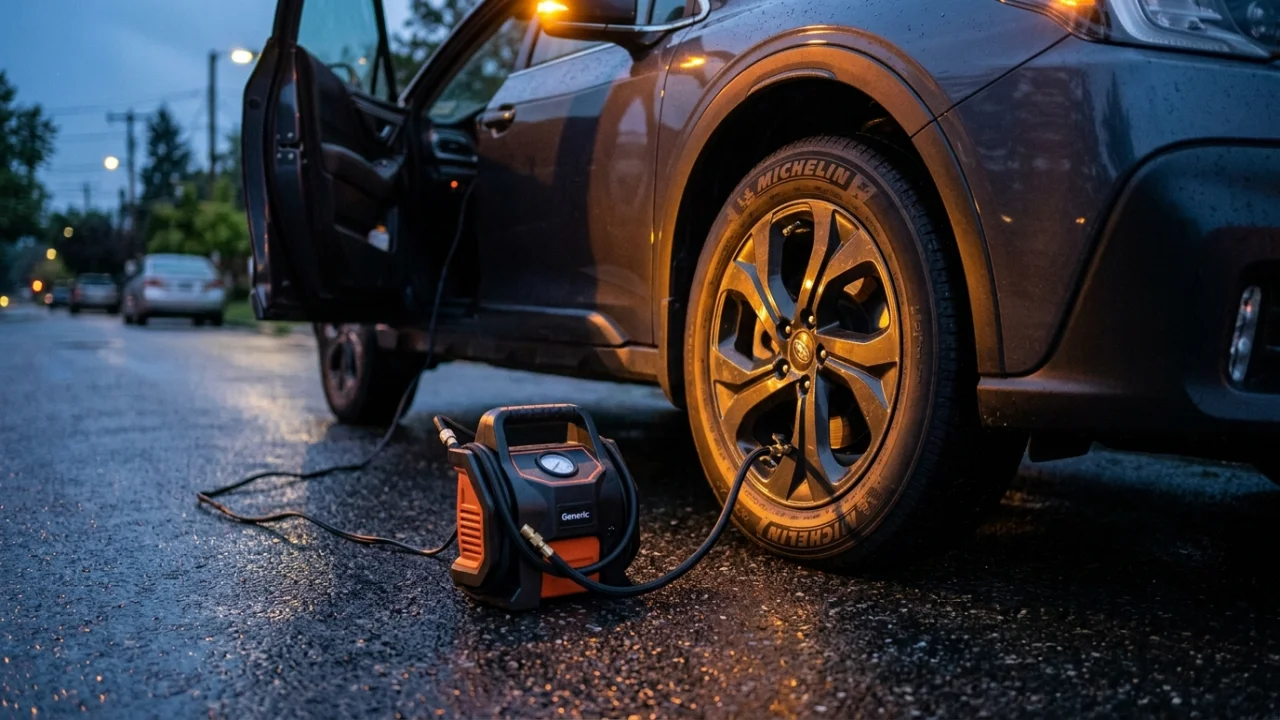
Fourth, unscrew the valve cap, press the hose fitting onto the valve stem, and lock the lever if your unit has one. A hiss when you attach it usually means the fitting isn't seated square. Then start the engine before running a 12V unit so you're not draining the battery, set your target pressure if the model supports it, and turn it on.
Fifth, verify with a separate gauge. Built-in gauges on budget inflators can be off by a few PSI, and a $6 pencil or digital gauge is more trustworthy than a $30 compressor's display. Then replace the valve cap, which keeps grit out of the valve core.
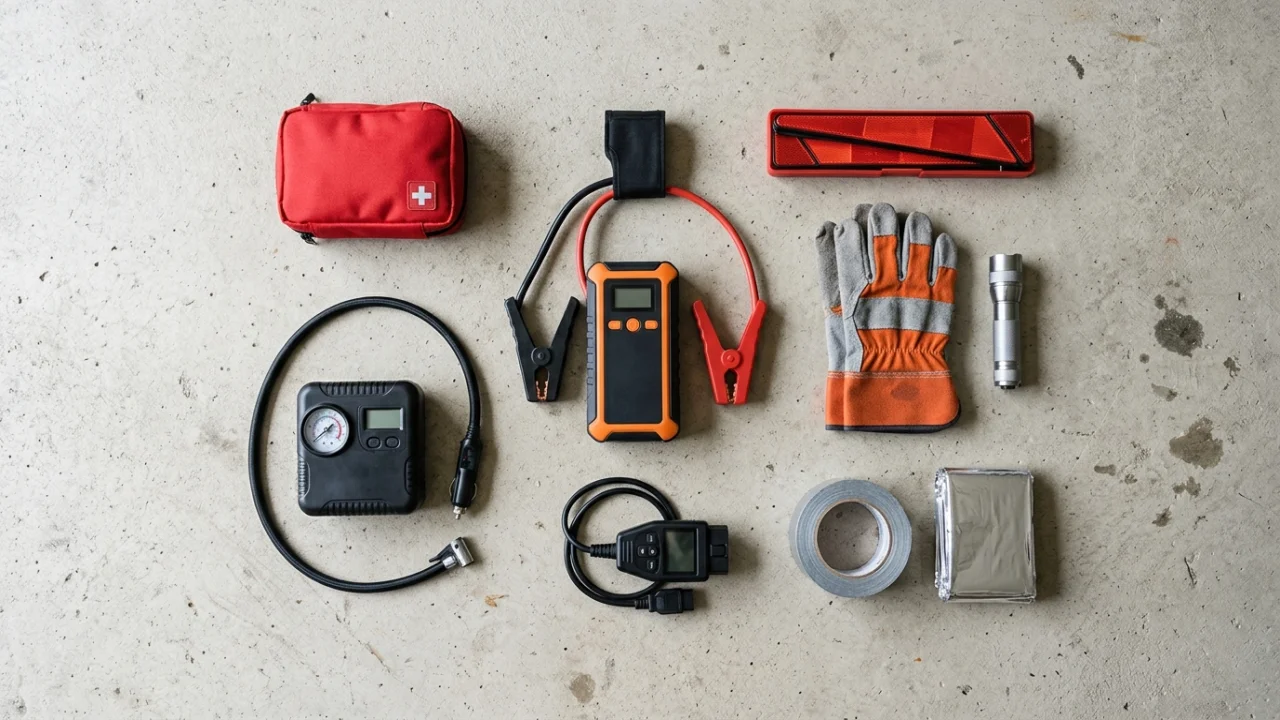
If the tire won't hold pressure for more than a day or two, you have a leak that needs a shop, not more air. An inflator is a bridge, not a repair. Pairing one with a set of best OBD2 scanners and one of the best portable jump starters covers most of what strands drivers, and our car emergency kit checklist walks through what else belongs in the trunk.
When a Tire Needs More Than Air
Air fixes low pressure. It does not fix damage, and there are a few situations where reaching for the inflator is the wrong move.
Sidewall damage is the clearest one. Cuts, gouges, or exposed cords on the sidewall cannot be repaired, period. The sidewall flexes constantly while you drive and no plug or patch holds there. Same with a visible bulge or bubble, which means the internal belts have separated and the tire is one pothole away from a blowout. Inflating a bulged tire makes it more likely to let go, not less.
A puncture in the shoulder, the curved area between tread and sidewall, is also unrepairable by industry standards. Only punctures in the central tread area, under about a quarter inch across, can be properly patched from the inside.
Repeated slow leaks in the same tire point at a corroded wheel bead, a bad valve stem, or a crack you can't see. If you're adding air every week, a tire shop needs to dismount the tire and look at it.
A blowout at speed is a different problem entirely. Beyond the tire, a shredding tread can tear up your wheel well, fender liner, rocker panel, and bumper cover on the way out, and a loss of control can put the car into a guardrail. If a tire failure did body damage, you'll need auto body repair for the panel work, and anything involving an impact usually means collision repair to check that the frame and suspension geometry are still true. Cosmetic damage is the visible part; alignment and structural issues are what actually cost you later.
If you're building out what you carry, our guide to essential car emergency and diagnostic tools covers how an inflator fits alongside the rest.
Frequently Asked Questions
How long does it take to inflate a car tire with a portable inflator?
Topping off a passenger car tire from 25 PSI to 35 PSI usually takes 2 to 4 minutes with a typical 12V unit. Filling a fully flat tire from zero takes considerably longer, often 8 to 15 minutes, and on a truck or SUV tire it can exceed 20 minutes with a socket-powered inflator. Units that clip directly to the battery, like the VIAIR 88P, are meaningfully faster because they aren't limited by the 15-amp socket fuse. Watch the duty cycle rating too: many budget compressors need a cool-down break after 10 minutes of continuous running.
Can a portable tire inflator fix a flat tire?
No. An inflator adds air; it doesn't seal anything. If a tire has a small puncture, an inflator can get it back up to pressure long enough to drive to a shop, which is genuinely useful. If the tire is fully flat from a large puncture or the bead has unseated from the wheel, an inflator won't hold pressure and won't reseat the bead. Some drivers carry a tire plug kit alongside the inflator for small tread punctures, but a plug is still a temporary repair until a shop can patch it properly from the inside.
What PSI should I inflate my tires to?
Use the number on the sticker in your driver's door jamb, not the number molded into the tire sidewall. The door jamb figure is what your vehicle's manufacturer specifies for the car's weight and suspension, typically 32 to 35 PSI for passenger cars. The sidewall number is the tire's maximum safe pressure and inflating to it will give you a harsh ride and uneven center-tread wear. Compact spare tires are the exception and usually call for around 60 PSI, printed on the spare itself.
Are cordless tire inflators as powerful as 12V corded ones?
Most cordless models produce similar maximum pressure, often 100 to 150 PSI, but they can't sustain it as long. A cordless unit is limited by battery capacity, so a typical charge fills two to four car tires before it needs recharging, and output can taper as the battery drains. A corded unit running off the car has effectively unlimited runtime with the engine on. For raw sustained output on large tires, a battery-clamp model like the VIAIR 88P still leads. Cordless wins on convenience and on working away from the vehicle.
Can I use a portable tire inflator for bike tires and sports equipment?
Yes, and nearly all of them ship with the adapters for it. Most include a Presta or Schrader needle adapter for bike tires plus a cone-shaped nozzle for basketballs, soccer balls, and pool floats. Be careful with pressure settings, though: road bike tires often run 80 to 110 PSI while a basketball wants about 8 PSI, so set the target low and check frequently on low-pressure items. Inflators with digital auto-shutoff make this much safer than manual units, since a compressor will happily burst a soccer ball in seconds if you walk away.