Most collision repair warranties cover workmanship defects — paint peeling, panel misalignment, faulty welds — for the life of the repair, but they do not cover parts failure, normal wear, or new accident damage. The warranty’s real value depends on whether the shop honors it nationwide, whether parts carry a separate guarantee, and whether you kept your repair documentation.
Understanding what a body shop warranty actually covers, how long it lasts, and what can void it helps car owners make smarter choices before repair work begins, not after a dispute starts. This guide breaks down warranty types, standard coverage, common exclusions, and the process for filing a claim if something goes wrong.
For context on the broader repair process, see this collision repair overview or the complete collision repair guide.
What Is a Collision Repair Warranty?
A collision repair warranty is a written or verbal commitment from a body shop that they'll fix specific defects in their work at no charge to the customer, for a defined period after the repair. It's a guarantee of workmanship and, in some cases, parts quality.
Warranties protect car owners from two main failure points: defective workmanship (the shop did something wrong) and parts failure (a part supplied by the shop failed). What they don't cover is almost as important as what they do.
Industry Standard Terms
There's no national legal standard that mandates what a collision repair warranty must include. Industry practice, however, has produced common baseline expectations:
- Workmanship coverage: Most shops stand behind their labor (bodywork, painting, and assembly) for a minimum of one year. Many offer longer terms.
- Paint coverage: Auto body paint warranties typically run one to three years for defects like peeling, cracking, or significant fading.
- Parts coverage: When the shop supplies the part, the shop's warranty typically mirrors or exceeds the parts manufacturer's warranty.
Shops with Direct Repair Program (DRP) relationships with insurers, meaning the insurer sends work to them directly, often have additional warranty terms negotiated into their insurance contracts.
Written vs Verbal Warranties
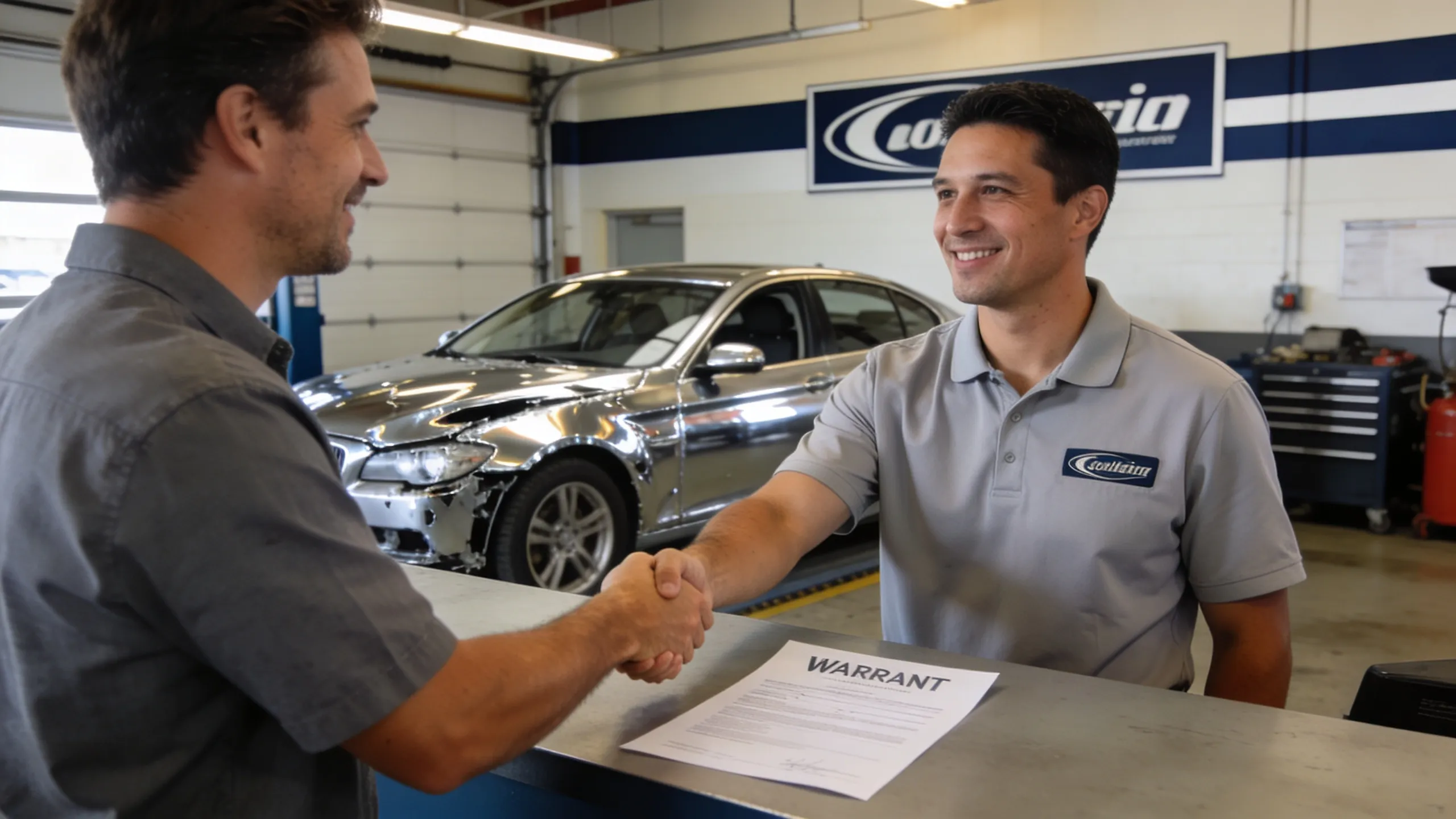
A verbal promise of lifetime coverage is worth very little in a dispute. Any meaningful collision repair guarantee should be documented in writing and should specify:
- What's covered (workmanship, paint, parts, or all three)
- What's excluded (wear, environmental damage, owner-caused issues)
- The duration of coverage
- The process for filing a claim
- Whether the warranty is transferable to a new vehicle owner
Request written warranty documentation before authorizing any repair. If a shop resists providing it in writing, that's a red flag worth noting.
Types of Collision Repair and Body Shop Warranties
Body shop warranties fall into three main categories: lifetime warranties (covering defects for as long as the current owner keeps the vehicle), limited time or mileage warranties (typically 1–5 years), and insurance-backed guarantees from Direct Repair Program shops. Each type has different coverage scope and exclusions.
Not all auto body repair warranties are the same. Understanding the differences helps car owners evaluate shops more accurately and set realistic expectations.
| Warranty Type | Typical Duration | What's Covered | Common Exclusions |
|---|---|---|---|
| Lifetime warranty | Ownership of vehicle | Workmanship defects, paint defects | Wear, new damage, environmental damage, owner-caused issues |
| Limited time warranty | 1–5 years | Workmanship, sometimes paint | Anything outside covered defects, exclusions vary |
| Mileage-based warranty | 12,000–36,000 miles | Workmanship defects | Anything after mileage threshold |
| Parts warranty | Varies by part | Failed parts supplied by shop | Parts supplied by customer, wear |
| Insurance-backed guarantee | Varies by carrier | Workmanship, OEM/approved parts | Non-covered perils, owner modifications |
Lifetime Warranty (What It Really Means)
A lifetime warranty on body work sounds open-ended, but the word "lifetime" refers to the life of your ownership of that specific vehicle, not the life of the car itself. When the vehicle is sold, the warranty typically doesn't transfer to the new owner unless the shop explicitly states otherwise.
Lifetime warranties still contain exclusions. They cover defects in workmanship and materials, not damage from new accidents, environmental factors, or improper care. The practical value is high for common failure modes, such as bubbling paint, panel gaps, or trim that won't stay seated. But a lifetime warranty doesn't make a shop liable for problems unrelated to their original repair.
Limited Warranty (Time or Mileage Based)
Limited warranties define coverage by a specific time period (one year, three years, five years) or by mileage. Once that threshold passes, the warranty no longer applies, regardless of whether the defect originated from the original repair.
Limited warranties are common among independent shops that don't offer lifetime coverage. They're not inherently inferior. What matters most is that the terms are clear and in writing.
Parts Warranty vs Workmanship Warranty
These two coverage types are distinct and both matter:
- Workmanship warranty: Covers errors in how the shop performed the repair: poor panel alignment, uneven paint, loose trim, or incorrect assembly. This is the shop's responsibility regardless of part quality.
- Parts warranty: Covers defects in parts supplied by the shop. If a shop installs a replacement door handle and it breaks under normal use, the parts warranty covers replacement. If the shop used a customer-supplied part that failed, the shop typically accepts no warranty responsibility for that component.
Both coverage types are needed for full protection. A shop may have strong workmanship but offer weak parts sourcing, or vice versa.
What a Collision Repair Warranty Typically Covers
Workmanship (Paint, Body Repair, Assembly)
Workmanship coverage is the foundation of any collision repair warranty. It addresses defects in how the shop completed the job, not defects caused by the car owner or outside events. Common workmanship failures include:
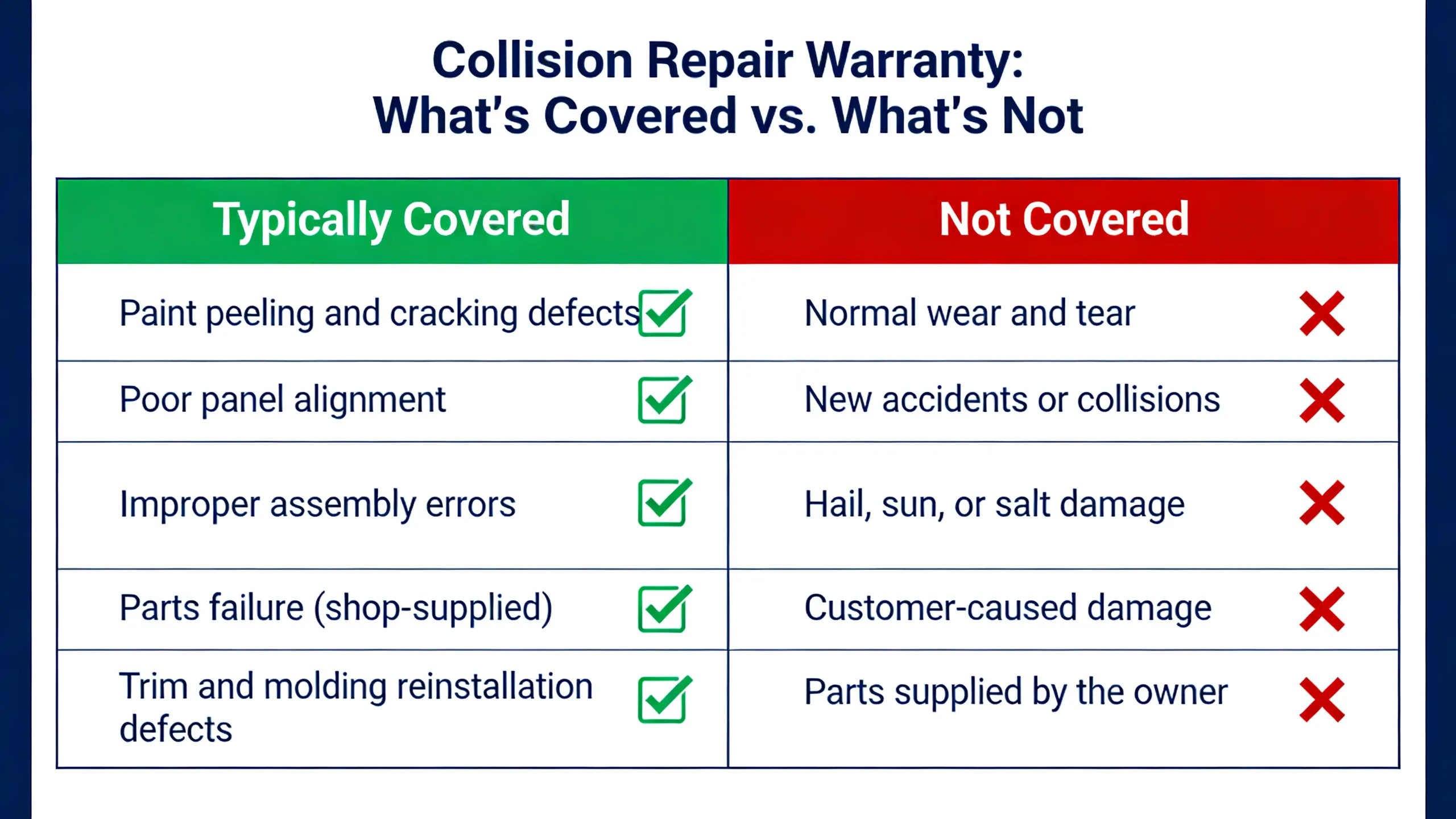
- Paint that peels, cracks, or bubbles due to improper surface preparation or application
- Body panels with poor alignment gaps that the shop failed to correct
- Trim, moldings, or weatherstripping that were reinstalled incorrectly and fail as a result
- Rattles or vibrations traced back to improper assembly during the repair
A workmanship warranty doesn't imply the repair will last forever. It means the shop will fix defects that resulted from their own errors, within the coverage period.
Paint Defects (Peeling, Fading, Orange Peel)
Auto body paint warranties typically cover specific failure modes: peeling, flaking, cracking, significant fading, or obvious texture defects like "orange peel" (a dimpled surface texture caused by improper spray technique or conditions). These are workmanship or materials failures the shop is responsible for.
Moderate sun fading over several years is typically not a warranty claim. That falls under normal environmental wear. But paint that peels within the first year of repair is nearly always a workmanship defect.
Parts Failure (When the Shop Supplied the Part)
When the shop sources and installs a replacement part and that part fails under normal use, the shop's warranty should cover the replacement. The shop is the party responsible for parts quality when they selected the supplier.
This coverage applies to OEM (Original Equipment Manufacturer) parts, aftermarket parts, and reconditioned parts alike, as long as the shop supplied them. The key qualifier is "normal use": a part that fails because of a new accident or abnormal stress falls outside standard warranty coverage.
What a Body Shop Warranty Does NOT Cover
Understanding exclusions is just as important as understanding what a collision repair warranty covers. Disputes most often arise when car owners expect coverage in these areas.
Normal Wear and Tear
Warranties cover defects, not deterioration. Fading paint after five years of sun exposure, worn rubber seals, or aged plastic trim are not warranty claims. The shop's warranty is not an ongoing maintenance contract.
New Damage or Accidents
If a second accident damages the previously repaired area, the original warranty doesn't apply to the new damage. Car owners sometimes expect warranty coverage for a new impact on a repaired panel. That's not how body shop warranties work. New damage requires a new insurance claim or out-of-pocket repair.
Environmental Damage (Hail, Salt, Sun)
Damage caused by environmental forces (hail, road salt, prolonged UV exposure, flood, or fire) is excluded from standard warranty coverage. These are outside the shop's control and are typically covered under comprehensive auto insurance rather than any body shop warranty. For hail-specific repair considerations, see hail damage repair.
Customer-Caused Issues (Wrong Wax, Pressure Washing)
Car owners can void their warranty coverage through improper vehicle care. Common examples include:
- Using abrasive compounds or incorrect polishes on fresh paint
- Pressure washing directly at panel edges or trim seams
- Applying aftermarket coatings not approved by the shop
- Damage from objects placed against repaired surfaces
Shops typically include care instructions with their warranty documentation. Following them protects the coverage.
Parts the Car Owner Supplied
When a car owner provides their own parts, purchased independently or salvaged, and asks the shop to install them, the shop typically warrants the installation labor only, not the part itself. If that part fails, the shop is not responsible for the component, only for whether it was installed correctly.
How to File a Collision Repair Warranty Claim
When a covered defect appears, the process for filing a claim is straightforward, but documentation matters.
Documentation Needed
Before contacting the shop, gather the following:
- Original repair order or invoice showing the repair date, scope of work, and shop name
- Written warranty documentation received at the time of repair
- Photos of the defect, taken from multiple angles in good lighting
- A clear description of when the defect first appeared and how it has changed over time
Having this documentation ready speeds the process and reduces the chance of a dispute about whether the defect existed.
Time Limits and Deadlines
Even lifetime warranties can have procedural deadlines. Most warranties require that the claim be filed while the coverage period is active, which sounds obvious, but also that the vehicle owner contact the shop promptly after discovering a defect. Waiting months to report an issue can complicate the claim, especially if the shop argues that delayed reporting allowed the problem to worsen.
Contact the shop as soon as a potential defect is noticed, even if the investigation takes time.
What If the Shop Refuses?
If a shop declines a warranty claim that appears to be covered by the written terms, car owners have several options:
- Document the refusal in writing: Ask for the denial in writing with a stated reason.
- Contact the insurer: If the repair was part of an insurance claim and the shop is a DRP shop, the insurer may have standing to enforce warranty terms.
- File a complaint with the state attorney general's consumer protection office: Most states have consumer protection statutes that apply to auto repair warranties. The Federal Trade Commission's warranty rights guidance outlines baseline federal protections.
- Contact the state bureau of automotive repair: Many states have licensing boards that handle complaints against body shops.
- Consider small claims court: For lower-value disputes, small claims court is an accessible option when other avenues fail.
DRP Shop Collision Repair Warranties vs Independent Shop Warranties
The type of shop handling the repair affects what warranty backing is available.
Insurance-Backed Guarantees
Direct Repair Program (DRP) shops, facilities that have a preferred relationship with one or more insurers, often provide warranty terms backed by both the shop and the referring insurance company. In these cases, if the shop closes or refuses a valid claim, the insurer may have agreed to step in and ensure the repair is corrected. This structure adds a layer of consumer protection that independent shops generally can't match.
The tradeoff is that DRP shops follow insurer-approved repair procedures and parts guidelines, which may or may not align with the car owner's preferences. For more detail on choosing among shop types, see how to choose a collision repair shop.
National Chain Warranty Portability
National chain body shops, facilities that are part of a branded network, typically offer portable warranties. This means if a covered defect appears and the original shop is no longer accessible (due to relocation, closure, or geography), another location in the network may honor the warranty.
Portability can be valuable for car owners who move frequently or face a claim in a different city than where the repair happened. Always confirm portability terms in writing at the time of repair.
Independent Shop Lifetime Warranties
Many well-established independent body shops offer lifetime workmanship warranties backed solely by their own reputation and business continuity. These warranties carry real value as long as the shop remains in business, but they're only as durable as the shop itself.
Ask independent shops how long they've been in business, whether the warranty is tied to the current ownership, and what happens to coverage if the shop changes hands or closes. For shops with I-CAR (Inter-Industry Conference on Auto Collision Repair) certification or OEM certifications, the warranty commitment often reflects a higher standard of accountability. See certified collision repair for more on certifications to look for.
Questions to Ask About Collision Repair Warranty Before Choosing a Shop
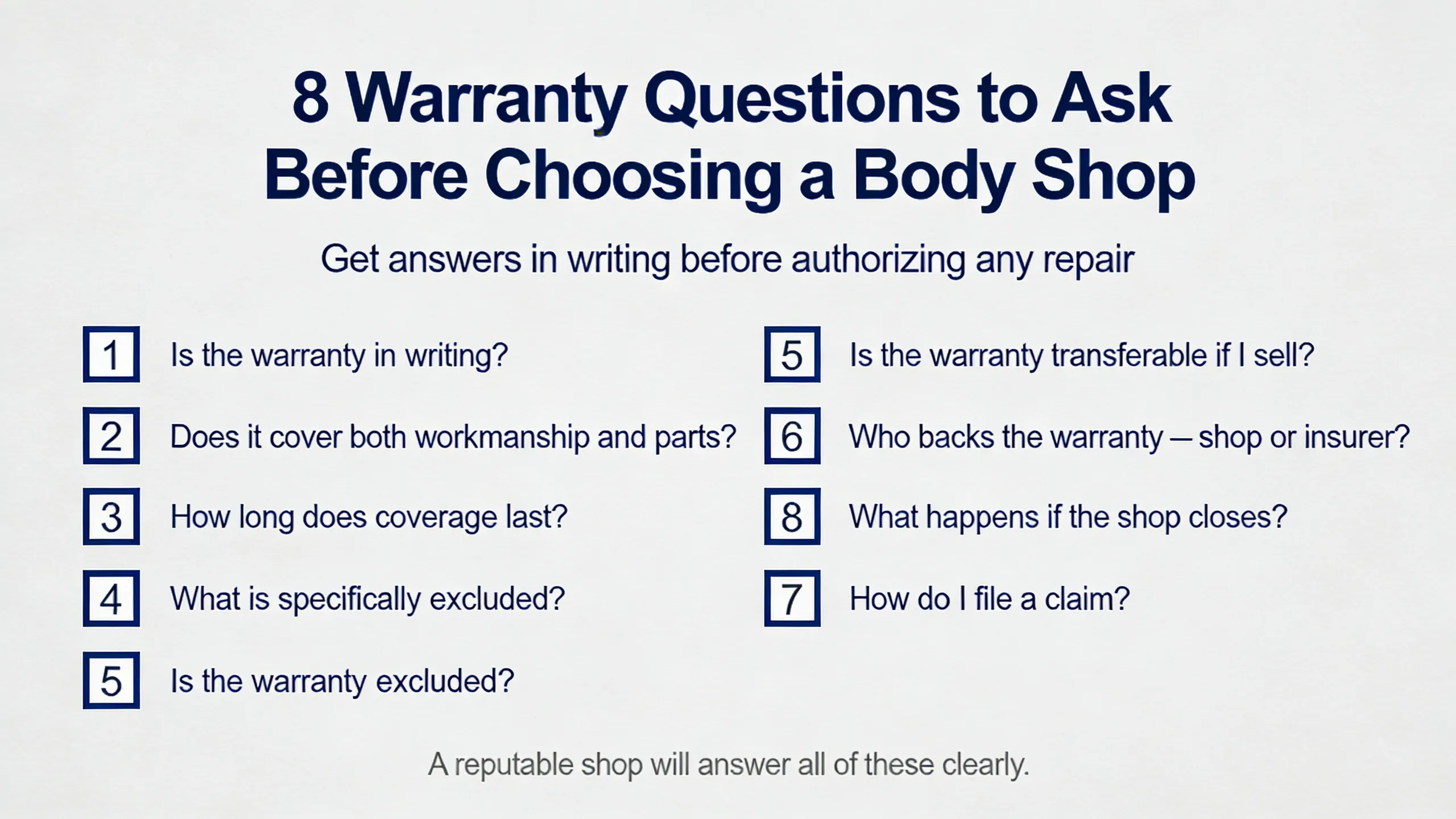
Asking these questions before authorizing repair helps car owners evaluate warranty quality and avoid surprises later.
-
Is the warranty written, and can I receive a copy before work begins? Any shop with a strong warranty will have no objection to providing documentation.
-
Does the warranty cover workmanship, parts, or both, with separate terms for each? Understanding coverage scope prevents confusion when a defect appears.
-
How long does the warranty last, and does it cover the life of my ownership or a fixed time period? Both terms can be reasonable; the key is knowing which applies.
-
What specifically is excluded from coverage? Ask for the exclusion list explicitly. If a shop can't explain what's not covered, that's a concern.
-
Is this warranty transferable if I sell the vehicle? For newer vehicles, a transferable warranty adds resale value and may be a selling point.
-
Is the warranty backed by the shop alone, or does an insurance partner also stand behind it? Understanding who is ultimately responsible matters if the shop faces financial difficulty.
-
What's the process for filing a claim, and what documentation will you need from me? Understanding the process upfront prevents delays if a claim becomes necessary.
-
If the shop closes or changes ownership, what happens to my warranty coverage? This question matters most for independent shops without a network or insurance backing.
For more context on insurance considerations related to repairs, see the insurance claim collision repair guide.
What's Typically Covered Under an Auto Body Warranty
A solid auto body shop warranty covers failures that come directly from the repair work itself:
- Paint peeling, flaking, or bubbling on repaired panels
- Color mismatch that worsens over time (some initial fading is normal)
- Body filler that cracks or separates from the panel
- Panel alignment issues that develop after the repair was made
- Welding failures on structural repairs
- Parts that fail due to manufacturing defects (usually covered by the parts manufacturer directly)
What's NOT Covered
Read the exclusions carefully. This is where many auto body shop warranties fall apart. Common exclusions include damage from new accidents, environmental damage from bird droppings or tree sap, and anything labeled "normal wear and tear."
- Damage from new accidents or impacts after the repair
- Rust caused by stone chips or environmental exposure, not the repair itself
- Fading that matches the rest of the car (natural paint aging over time)
- Damage from automatic car washes with brushes
- Issues caused by modifications made after the repair
- Damage from incorrect products applied to the repaired area (wrong wax, solvent-based cleaners)
The "Lifetime Warranty" Truth
"Lifetime warranty" sounds impressive, but the details matter. Most lifetime warranties only cover workmanship, the shop's labor, not the parts. And "lifetime" means as long as you own the car, not the life of the vehicle itself.
The bigger question is whether the shop will still be around when you need to make a claim. A lifetime warranty from a shop that closes in three years is worth nothing. Established shops with decades behind them back their lifetime warranties because their reputation depends on actually honoring them.
Get the warranty in writing before repairs start. If a shop hesitates to put it on paper, their verbal "lifetime warranty" isn't something you can count on.
Insurance-Backed Guarantees
When you use an insurance company's preferred shop, the insurer often provides their own guarantee on the work, separate from the shop's warranty. This typically covers workmanship for as long as you own the car.
The real advantage of an insurance-backed guarantee is that the insurer won't go out of business. If the original shop closes or refuses to honor the work, the insurer will pay another shop to correct it. That's one genuine benefit of using a direct repair program shop, even if you generally prefer choosing your own.
Protecting Yourself
- Get all warranty terms in writing before you authorize repairs
- Keep every piece of repair documentation, invoices, photos, the written estimate
- Follow any maintenance requirements the warranty specifies (washing methods, avoiding certain products)
- Inspect the repair carefully at pickup and document any concerns on the spot
- Report warranty issues as soon as you notice them, don't wait and hope they resolve
- If a shop won't honor the warranty, contact your state's consumer protection office
"A warranty is only as good as the shop standing behind it. Choose a shop with a track record, get everything in writing, and inspect the work before you drive away."
Key Takeaways
A collision repair warranty protects car owners against workmanship defects and parts failures, but coverage has real limits that should be understood before signing a repair order.
What's typically covered: Paint defects like peeling and cracking, body panel alignment errors, improper assembly, and parts failures when the shop supplied the component.
What's not covered: Normal wear, new accidents, environmental damage, owner-caused problems, and parts the car owner supplied.
Lifetime warranties are valuable but apply only during the owner's ownership of the vehicle and still contain exclusions. A written warranty is always preferable to a verbal promise.
DRP and national chain warranties often add insurer or network backing that gives car owners additional recourse if the repair shop can't or won't honor the warranty. Independent shop warranties depend on the shop's continued operation and reputation.
Before choosing a shop, ask for warranty documentation in writing, confirm whether it covers workmanship and parts separately, and clarify the claims process. Informed consumers get better warranty protection because they ask the right questions at the right time.
For broader guidance on selecting a qualified repair facility, browse auto body shops near you or review the complete guide to choosing a collision repair shop. To find shops in your state that offer strong written warranties, you can search by location; for example, auto body shops in Illinois or shops in Georgia.
Frequently Asked Questions About Collision Repair Warranties
What does a body shop warranty typically cover?
A body shop warranty covers defects in workmanship (peeling paint, poor panel alignment, improper assembly) and parts failures when the shop supplied the parts. Coverage is usually separated into workmanship and parts coverage, each with its own duration and exclusions.
How long do collision repair warranties last?
Many shops offer 1–3-year limited warranties on workmanship and paint. Some provide lifetime warranties lasting as long as the current owner keeps the vehicle. Parts warranties mirror the manufacturer's terms, typically ranging from 90 days to several years depending on the component.
Can a body shop refuse a warranty claim?
Yes. Shops can decline claims if the cause is normal wear, a new accident, environmental damage, or owner-caused damage. If a shop refuses a covered claim, car owners can escalate through the insurer (for DRP repairs), the state attorney general's consumer protection office, or small claims court.
What is a lifetime warranty on body work?
A lifetime warranty on body work means the shop guarantees its workmanship for as long as the current owner keeps the vehicle. The warranty ends when the car is sold. Lifetime warranties still contain exclusions for wear, new accidents, and environmental damage. They are not unconditional guarantees.
Should I choose a shop based on warranty?
Warranty terms are one important factor, but not the only one. A strong written warranty from an I-CAR or OEM-certified shop carries more value than a verbal promise from an unverified shop. Evaluate warranty terms alongside certifications, customer reviews, and estimate transparency before choosing.