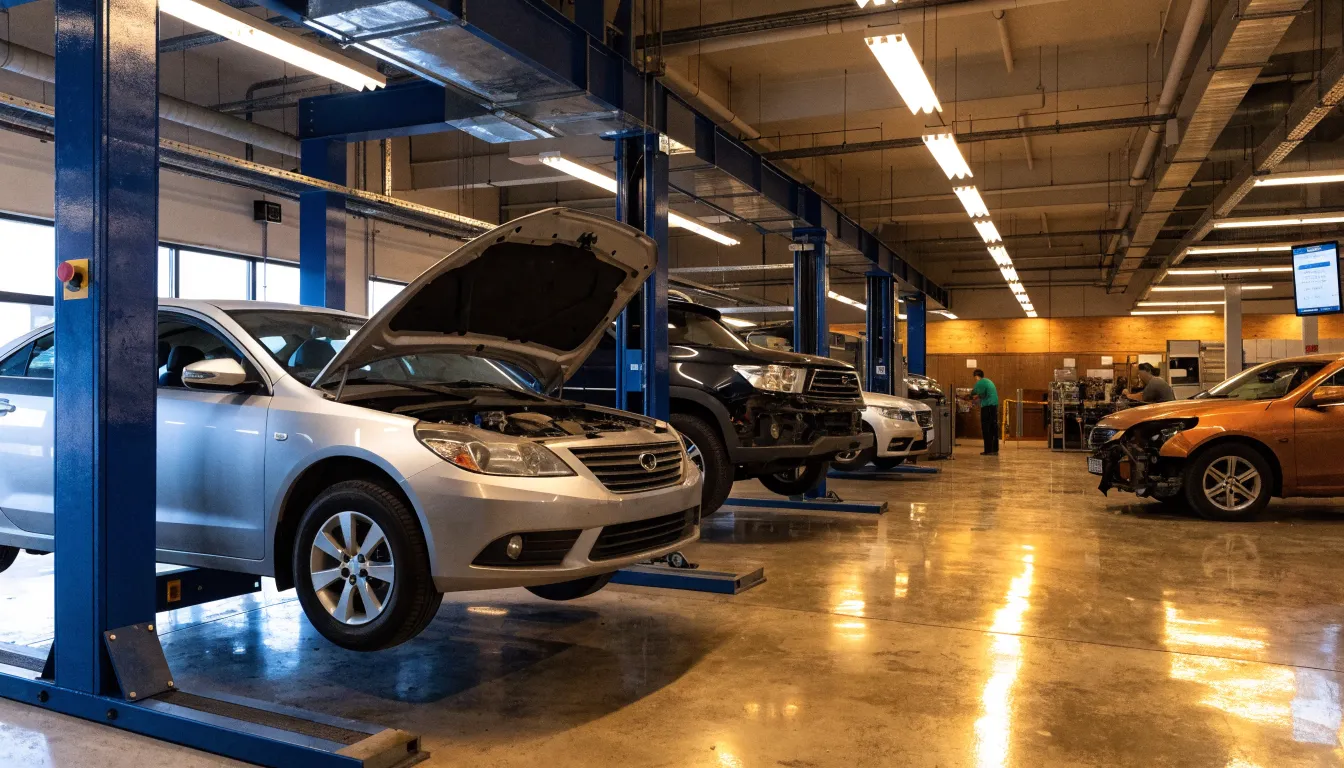
What does "certified collision center" mean?
The phrase "certified collision center" is not a single, universal standard. It's an umbrella term that can refer to several distinct types of credentials, each issued by a different organization with different requirements.
In broad terms, a certified collision center is an auto body shop that has met specific training, equipment, and process standards set by a certifying body. That certifying body might be an automaker (like Ford, Toyota, or BMW), an industry training organization (like I-CAR), or a professional credentialing group (like ASE). A single shop can hold multiple certifications simultaneously.
The key distinction consumers need to understand: certification doesn't automatically mean "best shop." It means the shop has met a defined set of standards, and those standards vary considerably depending on who issued the certification.
Three main types of certification
Most collision repair certifications fall into one of three categories:
-
OEM certification: Issued directly by a vehicle manufacturer. Requires specific tools, training, and repair procedures aligned with that brand's production standards. Examples: Tesla Approved Body Shop, BMW Certified Collision Repair Center, Toyota Collision Repair & Refinishing Program.
-
I-CAR Gold Class: Issued by the Inter-Industry Conference on Auto Collision Repair (I-CAR), the industry's primary training organization. Requires ongoing technician training across a defined curriculum, but is not brand-specific.
-
ASE certification: Issued by the National Institute for Automotive Service Excellence (ASE), which certifies individual technicians in specific repair categories (not entire shops). ASE-certified technicians can work at any shop.
Each type addresses different aspects of repair quality. OEM certification focuses on brand-specific procedures and equipment. I-CAR Gold Class focuses on technician training currency. ASE focuses on individual technical competency.
OEM certified body shops: what they are and what they require
OEM stands for Original Equipment Manufacturer, the company that built the vehicle. An OEM certified body shop has been approved directly by an automaker to repair that brand's vehicles using factory-specified procedures, tools, and parts.
What OEM certification requires
Certification requirements vary by manufacturer, but most OEM programs share a common set of standards:
- Brand-specific training: Technicians must complete training courses covering that manufacturer's specific repair procedures, which can differ significantly from general collision repair practices
- Specialized equipment: Many OEM programs require shops to own specific welding equipment, measuring systems, structural repair tools, or diagnostic technology that the manufacturer has approved
- Access to repair procedures: Certified shops receive access to the manufacturer's official repair documentation, the same procedures used during vehicle production
- Facility and process standards: Requirements often include defined shop layout, documentation practices, and quality control procedures
- Annual renewal: Most OEM certifications require annual or biennial renewal, including continued training and facility audits
The requirements become especially demanding for brands with advanced materials and technology. Tesla, for instance, requires specific spot-welding equipment, rivet tools, adhesive applicators, and the ability to handle high-voltage systems safely. Aluminum-intensive vehicles like the Ford F-150 or certain Audi models require MIG brazing equipment that standard steel-focused shops don't carry.
Which manufacturers have certification programs?
Most major automakers operate their own certified collision repair programs. The table below summarizes some of the most prominent:
| Manufacturer | Program Name | Notable Requirements |
|---|---|---|
| Tesla | Tesla Approved Body Shop | HV safety training, brand-specific welding/rivet tools, OEM parts only |
| BMW | BMW Certified Collision Repair Center | Aluminum repair capability, ADAS calibration equipment, factory repair data |
| Audi | Audi Certified Collision Repair | Aluminum-intensive training, specific measuring systems, Audi-approved parts |
| Porsche | Porsche Certified Collision Center | High-end finish standards, Porsche-specific structural procedures |
| Toyota | Toyota Collision Repair & Refinishing Program | Factory repair manual access, Toyota-approved paint processes |
| Hyundai | Hyundai Recognized Repairer | Hyundai training curriculum, ADAS calibration capability |
| Ford | Ford-Lincoln Recognized Quality Repair | Brand-specific procedures, aluminum repair (F-150) |
| General Motors | GM Collision Repair Network | GM-approved tools, training, OEM parts preference |
I-CAR Gold Class: the industry's training standard
While OEM certification is brand-specific, I-CAR Gold Class is industry-wide. I-CAR, the Inter-Industry Conference on Auto Collision Repair, is the primary training organization for the collision repair industry in North America. I-CAR's Gold Class program is the most widely recognized non-OEM certification in the field.
What I-CAR Gold Class requires
A shop earns I-CAR Gold Class status by meeting ongoing training requirements across its entire team. The program tracks training hours and courses completed by each role in the shop: estimators, structural technicians, non-structural technicians, painters, and refinish technicians.
Key requirements include:
- Annual training: Each role must complete a defined number of training hours every year
- Curriculum breadth: Training covers structural repair, aluminum repair, welding, ADAS (Advanced Driver Assistance Systems), estimating, and other core areas
- Full shop participation: Gold Class requires multiple roles to meet training standards; it's a shop-wide designation, not just a technician credential
- Renewal: Shops must maintain training currency to keep the designation. Falling behind results in loss of Gold Class status
I-CAR Gold Class doesn't require brand-specific training or equipment. A Gold Class shop can work on any brand of vehicle. The designation signals that the shop's technicians are keeping current with industry best practices and evolving repair technologies.
I-CAR Platinum individual credential
I-CAR also offers a higher individual designation called Platinum, which recognizes technicians who have completed the full training curriculum for their role. A shop with multiple Platinum-designated technicians typically demonstrates a deeper training culture than one with only the minimum Gold Class requirement.
ASE certification: individual technician credentials
ASE, the National Institute for Automotive Service Excellence, certifies individual technicians rather than entire shops. ASE credentials are earned by passing proctored exams in specific technical areas and require work experience to qualify.
Relevant ASE certifications for collision repair technicians include:
- B2: Non-Structural Analysis and Damage Repair
- B3: Structural Analysis and Damage Repair
- B4: Mechanical and Electrical Components
- B5: Damage Analysis, Estimating, and Salvage
- B6: Paint and Refinishing
- B7: Squeaks, Rattles, and Refinements (applied after repair)
A shop employing multiple ASE-certified technicians demonstrates a commitment to hiring credentialed workers. That said, ASE certification alone doesn't tell the whole story. A shop can employ certified technicians but still lack the specialized equipment needed for certain repairs.
Certified vs independent shops: a balanced comparison
The decision between a certified collision center and a non-certified independent shop depends on several factors: the vehicle, the type of damage, the insurance situation, and the specific certifications held by shops in the area.
When certified shops have a clear advantage
Certified shops offer the most significant advantages in these situations:
Late-model vehicles with advanced technology: Modern cars equipped with ADAS, which includes lane departure warning, adaptive cruise control, automatic emergency braking, and blind-spot monitoring, require precise sensor calibration after collision repair. Cameras, radar units, and ultrasonic sensors must be calibrated to manufacturer specifications. OEM certified shops typically have the required calibration equipment and procedures. According to the National Highway Traffic Safety Administration (NHTSA), improper ADAS calibration can affect safety system performance.
Aluminum-intensive vehicles: Vehicles like the Ford F-150, Audi A8, and Tesla Model S use aluminum extensively in their structure. Aluminum repair requires different equipment, techniques, and contamination controls than steel repair. Cross-contamination between steel and aluminum tools can create corrosion issues. OEM-certified shops with aluminum programs have the correct equipment and segregated work areas.
Warranty preservation: Some manufacturers' warranties include language about repair methods and parts. Using an OEM certified body shop that follows factory procedures and uses OEM parts provides the clearest documentation trail for warranty purposes.
Insurance total loss threshold concerns: If a vehicle's value is relatively high and the repair is complex, working with a certified shop that documents procedures meticulously reduces the chance of hidden damage appearing later that could affect the car's value.
When independent shops are a viable choice
Non-certified independent shops aren't inherently inferior. Many long-established independent shops employ highly experienced technicians, maintain excellent equipment, and produce repairs of outstanding quality. They may be a reasonable choice when:
- The vehicle is an older model without complex ADAS systems
- The damage is primarily cosmetic (panel dents, paint scratches, minor bumper damage) with no structural involvement
- The independent shop has verifiable quality reviews, a strong local reputation, and carries its own workmanship warranty
- The cost difference is significant and budget is a primary concern
The critical issue isn't certification per se but whether the shop has the capability to correctly repair the specific damage on the specific vehicle. A certified shop that rubber-stamps repairs without following procedures is less valuable than a meticulous uncertified independent shop.
Cost differences: certified vs independent
Certified shops often charge more than non-certified independent shops. Not always, but often. The reasons are structural:
- OEM certification programs require shops to invest in specialized tools, equipment, and ongoing training
- These costs are reflected in labor rates, which in OEM-certified shops commonly run $10 to $30 per hour higher than general market rates in the same geographic area
- OEM programs often encourage or require OEM parts usage, which typically costs 10% to 30% more than aftermarket alternatives
However, the higher cost isn't universal. Many I-CAR Gold Class shops charge competitive rates comparable to non-certified independents. And the cost difference may be offset by fewer comebacks, proper ADAS calibration, and repairs done to factory tolerances the first time.
Car owners navigating an insurance claim should note that many insurers have Direct Repair Programs (DRPs) that include both certified and non-certified shops. Being sent to a DRP shop is not the same as being sent to a certified shop, and car owners have the legal right to choose their own repair facility regardless of insurer recommendations.
Real-world scenarios: when certification made the difference
Scenario 1: The hidden camera alignment
Maria's 2023 Honda CR-V was rear-ended at low speed, mostly bumper damage with some trunk lid deformation. Her insurance company sent her to a DRP shop that wasn't Honda-certified. The shop repaired the bumper and trunk lid, but the rear-view camera, knocked slightly out of alignment, was never recalibrated. The repair looked fine. But the camera's parking assist lines were off by six inches, which Maria noticed on her first parallel parking attempt. A Honda-certified shop would have had the calibration procedure in their repair documentation and the equipment to verify alignment. The correction required a second shop visit and a supplement claim.
Scenario 2: The aluminum contamination problem
David's 2022 Ford F-150 took significant side damage in a collision. He chose an independent shop with a strong reputation for general collision work, but the shop wasn't Ford-certified and hadn't invested in dedicated aluminum repair equipment. Eighteen months after the repair, the repaired panels showed early signs of galvanic corrosion, caused by steel tool contamination on aluminum components during the repair process. The repair was otherwise visually correct. The issue would likely have been avoided at a Ford-Lincoln Recognized Quality Repair facility that maintains segregated aluminum tools per Ford's specifications.
Scenario 3: The out-of-warranty repair that held
Patricia's 2019 Subaru Outback, well outside its bumper-to-bumper warranty, needed significant front-end collision repair. A local independent shop, I-CAR Gold Class certified with ASE-certified technicians, completed the repair at a cost $400 less than the nearest Subaru-certified shop. The quality of work was excellent. The vehicle had no ADAS complications from the repair. For Patricia's vehicle, which predated some of the more complex ADAS configurations and had conventional steel construction, the independent shop's training credentials were sufficient, and the non-OEM-certified facility performed well.
How to verify a shop's certifications
Not all shops that claim to be certified actually are, and certifications can lapse if a shop fails to meet renewal requirements. Car owners can verify credentials through several channels:
Verifying OEM certification
Most manufacturers maintain searchable dealer and shop locators on their websites. These locators are typically updated regularly and reflect current certification status:
- Search the manufacturer's official website for "certified collision repair" or "certified body shop locator"
- Call the manufacturer's customer service line and ask for verified certified shops in a zip code
- Ask the shop to show their current certification documentation, which should include an issue date and expiration or renewal date
Verifying I-CAR Gold Class status
I-CAR maintains a public shop locator at i-car.com, which allows searches by zip code and shows which shops currently hold Gold Class status. The locator reflects real-time status. A shop that has let its training lapse will no longer appear as Gold Class.
Verifying ASE certification
ASE-certified shops and technicians can be verified through the ASE website. Technicians receive physical certificates and wallet cards; a shop should be able to show these on request.
Questions to ask any shop
Beyond checking databases, a direct conversation with the shop reveals a great deal. Useful questions include:
- "Are you certified by [vehicle manufacturer] for repairs on my specific model?"
- "What I-CAR training designations does your shop hold?"
- "Do you have the manufacturer's repair procedures for my vehicle, and are you following them on this repair?"
- "Will you be calibrating the ADAS sensors after the repair, and how will you verify they're within spec?"
- "What warranty do you offer on your work?"
A shop that answers these questions clearly and specifically is a more reliable choice than one that responds vaguely or deflects.
Insurance and certification: what car owners should know
Insurance companies play a significant role in shop selection, but they don't have the final say. Car owners in the United States have the legal right to choose their own repair facility, regardless of which shops an insurer recommends or prefers. The Insurance Information Institute (IIHS) notes that insurers may steer customers toward preferred shops, but steering is different from requirement.
Will insurance pay for a certified shop?
Most insurance companies will pay for repairs at a non-network certified shop, but the process may require more documentation and communication. Key points:
- If an OEM-certified shop charges more than a DRP shop for the same repair, the insurer may initially write the estimate at the lower rate
- Car owners can request a supplement if the certified shop's repair scope (including required calibrations, OEM parts, or specialized procedures) exceeds the initial estimate
- Some states have consumer protection laws that affect how insurers can restrict shop choice or parts specifications
- OEM parts requirements vary by state law; in some states, insurers must pay for OEM parts when requested under certain conditions
Car owners should document all communications with both the shop and insurer, including written repair plans and estimates. For collision repairs on newer vehicles with ADAS, explicitly ask whether the estimate includes all required sensor calibrations. This is a common area where initial estimates undercount the full scope of required work.
Collision center certification requirements: what shops must do to qualify
Understanding what shops must do to earn and maintain certification helps car owners evaluate whether a shop's credentials are meaningful. The requirements are more demanding than many car owners realize.
Typical OEM certification requirements (composite overview)
While each manufacturer's program differs, the following represent commonly required elements across major OEM programs:
Equipment:
- Manufacturer-approved frame/unibody measuring and repair systems
- Specific welding equipment (MIG, spot weld, MIG brazing where required)
- Vehicle-specific diagnostic scan tools
- ADAS calibration targets and equipment
- Aluminum-specific tools (segregated from steel tools) where applicable
- Paint mixing and application equipment meeting manufacturer standards
Training:
- Role-specific training for all technicians, including structural, non-structural, and refinish technicians
- Annual continuing education to maintain certification
- Management training on documentation and quality control processes
Facility:
- Minimum bay count and workspace requirements
- Proper ventilation and spray booth standards
- Documentation and parts storage protocols
Parts:
- Many OEM programs strongly encourage or require OEM parts for structural and safety-related repairs
- Some programs have approved alternative parts lists for cosmetic components
Audit process:
- Initial certification requires a facility inspection
- Renewal often involves re-audit or submission of training records
- Shops can lose certification for failure to maintain standards
OEM certification programs
OEM stands for Original Equipment Manufacturer, the company that built your vehicle. When automakers say a shop is "OEM certified" for their brand, it means that shop has met specific requirements set by that manufacturer to repair their vehicles correctly.
What OEM certification actually involves
Each automaker runs its own program with its own standards. Common requirements include manufacturer-approved measuring and welding equipment, model-specific training courses, access to OEM repair procedures (the exact instructions the automaker recommends for each model), and periodic audits by the manufacturer or a designated third party.
OEM certification is more restrictive and brand-specific than I-CAR Gold Class. A shop certified by Toyota isn't automatically certified by BMW. A shop may hold multiple OEM certifications, or specialize in just one brand.
OEM-certified shops commit to following OEM repair procedures, which means manufacturer-specified materials, tolerances, and sequences. That's different from a shop using aftermarket methods or parts without verifying whether they conform to OEM specs. For a closer look at how OEM and aftermarket approaches compare, see this guide to OEM vs. aftermarket parts.
Major manufacturer programs
The major automakers each run structured certification programs. Characteristics differ by brand:
| Manufacturer | Program Name | Key Focus Areas |
|---|---|---|
| Toyota / Lexus | Toyota Collision Repair & Refinishing Training | Aluminum and steel procedures, TSB compliance |
| Honda / Acura | Honda / Acura Collision Repair Network | Model-specific measuring, OEM parts requirement |
| BMW | BMW Certified Collision Repair Center | Mixed-material construction, ADAS recalibration |
| Tesla | Tesla Approved Body Shop | High-voltage safety, aluminum structure, software |
| Ford | Ford-Certified Collision Network | High-strength steel, F-Series aluminum body repair |
Tesla's program carries particular weight because Tesla vehicles require specific high-voltage safety protocols and OEM-only repair procedures that non-certified shops can't easily replicate. BMW and other premium European brands similarly use complex multi-material body construction that demands brand-specific equipment and training.
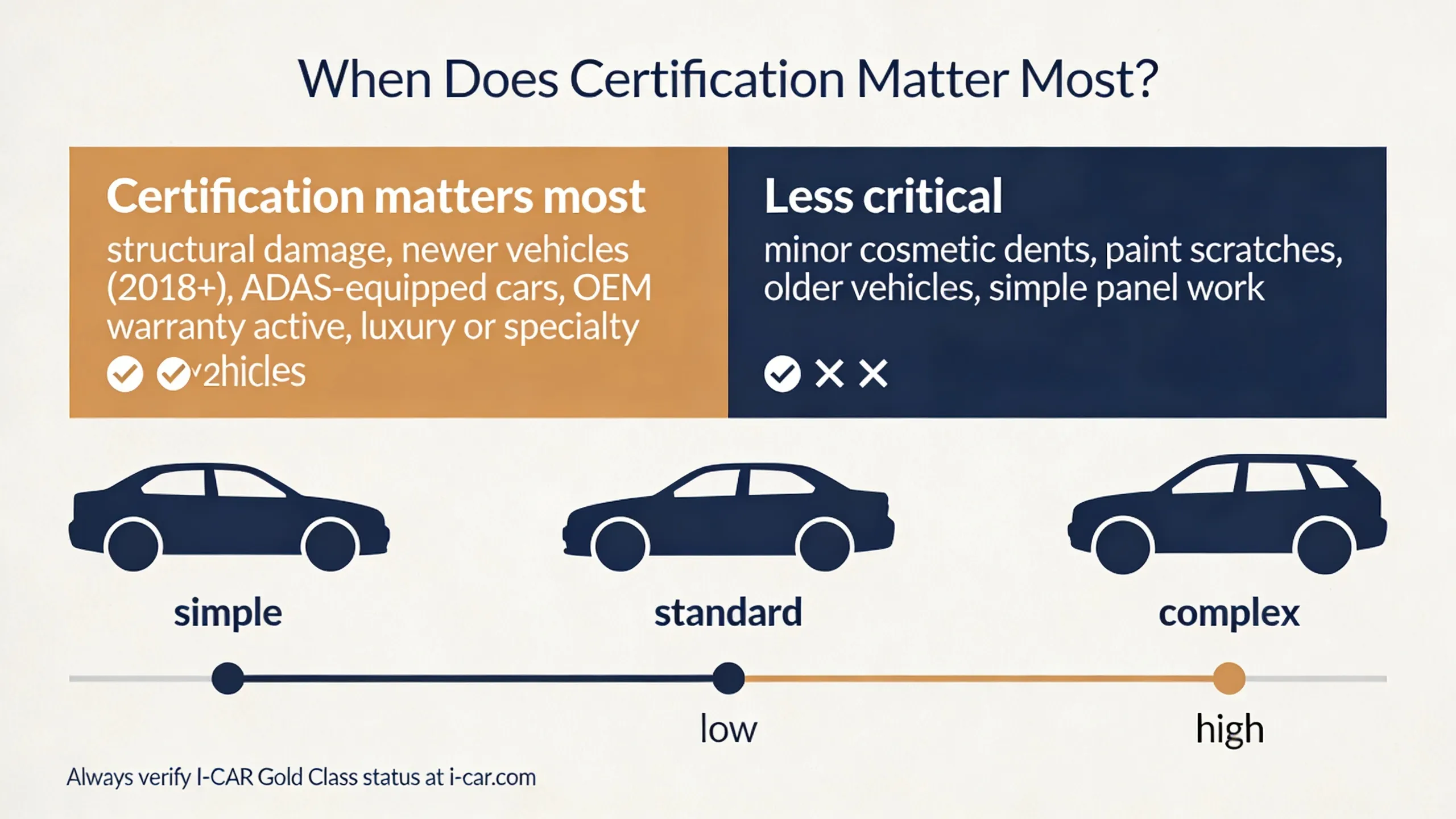
When OEM certification matters most
OEM certification matters most in four situations:
- Newer vehicles with complex construction: Vehicles built after roughly 2018 increasingly use mixed materials, structural adhesives, and sensors that require model-specific repair knowledge.
- Active OEM warranty: Repairs at non-certified shops may raise questions about manufacturer warranty compliance in some cases.
- ADAS-equipped vehicles: Sensor recalibration after collision repair requires both the correct equipment and the exact OEM procedure for each vehicle and sensor type.
- Luxury and specialty vehicles: Higher-complexity repairs where deviating from OEM procedure creates real risk of structural or safety failure.
For standard repairs on older or mainstream vehicles, OEM certification is helpful but less critical. The gap between certified and non-certified shop capability tends to narrow when the vehicle's construction is simpler and its repair procedures are widely understood.
DRP programs and certification
Direct Repair Programs. DRP, are insurance-company-operated networks of preferred auto body shops. When an insurer steers a claimant toward a specific shop, that shop is typically on its DRP list. Certification plays a key role in how these networks are built and maintained.
How insurance networks use certification
Most major insurers use I-CAR Gold Class status as a baseline DRP requirement. Shops without it often can't join the network at all. Some insurers layer additional requirements on top: OEM certification for specific vehicle makes, ASE staff credentials, or equipment audits conducted by the insurer.
The insurer's motive is partly quality-driven, partly financial. A certified shop is less likely to produce a repair that results in a supplement, a return visit, or a liability claim. That predictability has real value in high-volume claim handling.
From the car owner's perspective, DRP shops often offer streamlined claim handling: direct communication with the insurer, pre-negotiated labor rates, and warranty backing from both the insurer and the shop. The trade-off is that DRP shops operate within pricing constraints set by the insurer, which can affect which parts and repair methods they use.
Certified but not DRP: what that means for you
A certified shop that's not on a DRP list isn't necessarily a lesser shop. Many high-quality certified facilities, including many OEM-certified shops, deliberately stay outside DRP networks to maintain independence in repair decisions. They use OEM parts and procedures without pressure to substitute aftermarket components or cut repair time to meet insurer benchmarks.
You have the legal right to choose your own repair facility regardless of insurer preference. A certified shop that's not on the DRP list may charge slightly different rates, require more direct involvement in the claims process, or use repair methods that create supplement discussions with the insurer, but the repair quality and certification status are independent of DRP membership.
For a full walkthrough of the collision repair process from estimate to completion, see this complete collision repair guide.
Key takeaways
-
"Certified collision center" is not a single standard: it encompasses OEM manufacturer certification, I-CAR Gold Class training designation, and ASE individual technician credentials, each measuring different things.
-
OEM certification matters most for late-model vehicles with complex ADAS, aluminum-intensive construction, or brand-specific structural procedures. For a Tesla, BMW, or Audi, an OEM certified body shop significantly reduces the risk of improper repairs.
-
I-CAR Gold Class signals that a shop invests in ongoing technician training and stays current with evolving repair methods. It's a meaningful credential for any shop, regardless of the vehicle brand.
-
Independent shops can deliver quality repairs, particularly for older vehicles or cosmetic damage. The key is verifying the shop has the specific capabilities the repair requires, not just relying on brand name or certification status alone.
-
Cost differences are real but variable: OEM certified shops typically charge higher labor rates and recommend OEM parts, resulting in higher repair costs. However, improper repairs can create safety risks and secondary costs that exceed any initial savings.
-
Car owners have the right to choose their shop: insurance companies can recommend shops but can't legally require car owners to use a specific facility in most states.
-
Verify before you commit: manufacturer shop locators and I-CAR's Gold Class locator let car owners confirm a shop's current certification status before scheduling repairs.
Sources
- I-CAR — collision repair training and certification standards
- NHTSA Vehicle Safety — federal vehicle safety and crashworthiness standards
Frequently asked questions
What is the difference between an OEM certified body shop and an I-CAR Gold Class shop?
An OEM certified body shop has been approved by a specific vehicle manufacturer, Toyota, BMW, or Ford, and has met that manufacturer's requirements for tools, training, and repair procedures. It's brand-specific. An I-CAR Gold Class shop has met training standards set by the industry's primary training organization, covering a broad curriculum of collision repair topics. A Gold Class shop can work on any brand, while OEM certification applies to one manufacturer's vehicles. Many shops hold both types of credentials simultaneously.
Does my warranty require me to use an OEM certified body shop?
Most manufacturer warranties don't explicitly void coverage if repairs are performed at a non-certified shop, but warranty terms vary. Using an OEM certified body shop that follows factory repair procedures and uses OEM parts provides the clearest documentation trail if a warranty issue arises related to a repaired area. Car owners concerned about warranty implications should review their specific warranty documentation and contact the manufacturer's customer service directly for clarification.
Will my insurance cover the higher cost of a certified collision center?
Insurance coverage for certified shop pricing depends on the insurer, the state, and the specific repair. Most insurers will pay for repairs at a non-network certified shop, but they may start with an estimate based on prevailing local rates. If the certified shop identifies additional required procedures, such as ADAS calibrations or OEM-specified processes, these can typically be added through a supplement request. Car owners should document everything in writing and request itemized estimates that include all required calibration and documentation steps.
How do I find certified collision centers near me?
The most reliable methods are manufacturer shop locators (search the manufacturer's website for "certified collision repair locator"), the I-CAR Gold Class shop finder at i-car.com, and directories like AutoBodyShopNear.me which allow filtering for certified facilities. Always verify current certification status through the official source before scheduling. Certifications can lapse, and a shop's claim of being certified should be confirmed against an active database.
Are certified shops always better than non-certified independent shops?
Not necessarily. Certification indicates that a shop has met specific defined standards, but it doesn't guarantee the quality of every individual repair. A highly experienced independent shop with skilled technicians, quality equipment, and meticulous practices can outperform a certified shop that treats certification as a marketing badge rather than a commitment to process. The most important factors are the shop's specific capabilities relative to the vehicle's repair needs, particularly for ADAS-equipped vehicles and aluminum-intensive models, where specialized equipment is non-negotiable.
What is I-CAR Platinum, and how does it differ from I-CAR Gold Class?
I-CAR Gold Class is a shop-level designation indicating that the shop's team meets ongoing training requirements. I-CAR Platinum is an individual technician designation for someone who has completed the full training curriculum for their specific role: structural technician, non-structural technician, refinish technician, and so on. A shop with multiple Platinum-level technicians demonstrates a deeper training culture. Platinum is a more demanding credential than Gold Class and is relatively less common.
Does a certified shop have to use OEM parts?
Not always, but many OEM certification programs strongly encourage or require OEM parts for structural, safety-related, and visible cosmetic repairs. The extent of OEM parts requirements varies by manufacturer program and by repair type. For a non-structural repair like a bumper cover, some programs allow approved alternative parts. For structural components or safety systems, OEM parts are typically required to maintain certification compliance. Car owners who specifically want OEM parts should confirm the shop's parts sourcing policy and ensure the repair estimate reflects this preference.