You take a chipped windshield to two shops on the same afternoon. The first quotes a $90 repair. The second says the glass needs to go and quotes $480. Same chip, same car, two completely different answers — and now you do not know whether you are about to waste $400 or drive around on compromised glass.
Shops are not flipping coins. There is a real decision framework behind the repair-or-replace call, and once you know it, you can tell a sound recommendation from a lazy or self-serving one.
Sources
- NHTSA Windshield Safety Standards — federal windshield safety requirements
- Auto Glass Safety Council — auto glass repair and replacement standards
The Three Questions Every Shop Asks
When a technician leans over your windshield with a flashlight, they are answering three questions: How big is the damage? Where is it? And how deep does it go? Most of the industry works from a published guideline — the Repair of Laminated Automotive Glass Standard, or ROLAGS — which draws the lines that separate repairable damage from replacement territory. Individual shops adjust around the edges based on their equipment and their appetite for risk, but the core logic is consistent nationwide.
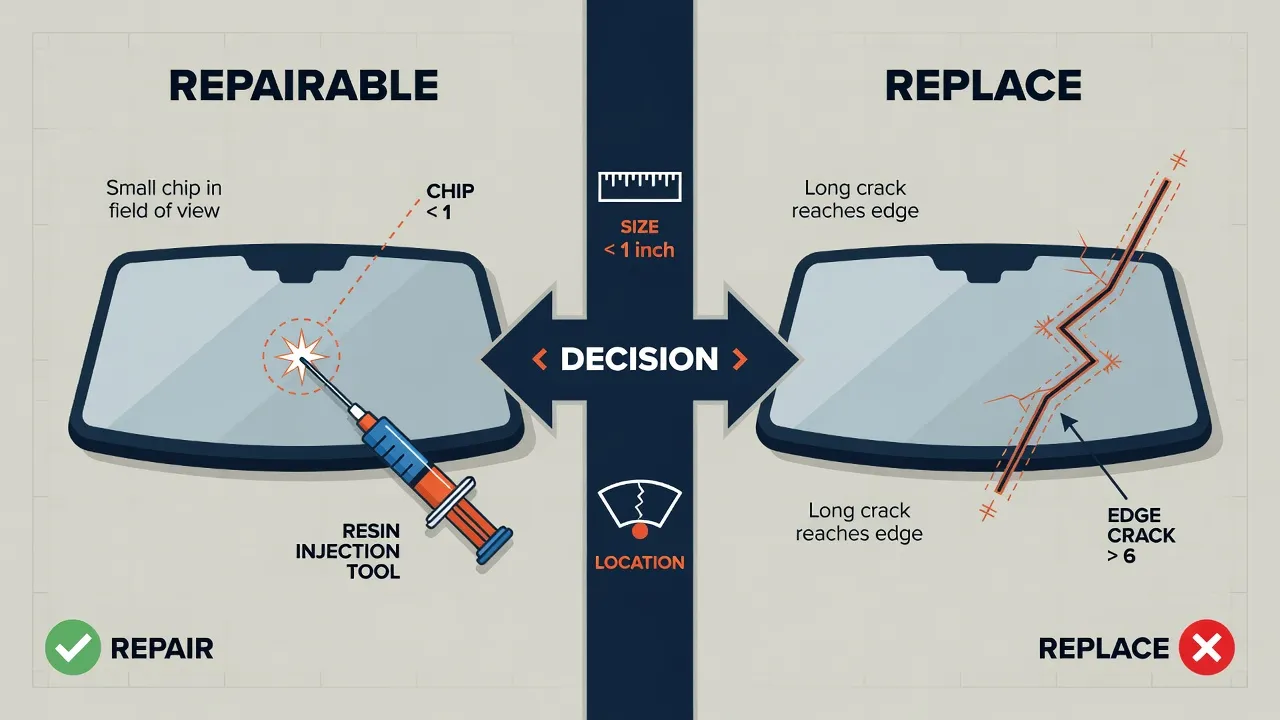
Size comes first: chips smaller than a quarter and cracks shorter than about three inches are standard repair candidates. Location comes second: damage near the edge of the glass or in the driver's direct line of sight pushes toward replacement even when it is small. Depth is the quiet third factor: a windshield is two layers of glass laminated around a plastic interlayer, and damage that penetrates past the outer layer cannot be repaired at all.
The Case for Repair
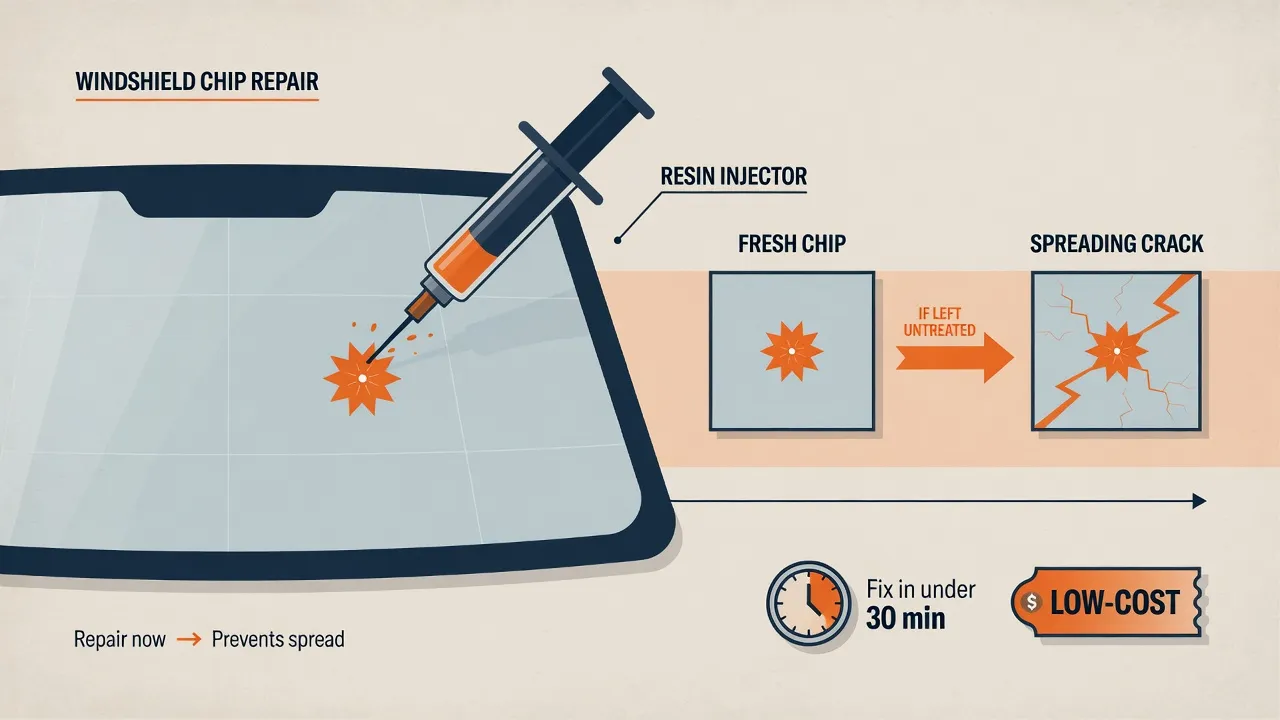
When damage qualifies, any honest auto glass shop would rather repair than replace, and not just because it is cheaper for you. A repair takes 20 to 30 minutes, costs $60 to $200, and — this is the part shops care about most — leaves the factory seal untouched. Your original windshield was bonded to the body at the factory under ideal conditions. Every replacement, however well done, reintroduces small risks: leaks, wind noise, and adhesive problems that a repair never creates.
Insurers agree, which tells you something. Most carriers waive the comprehensive deductible entirely for chip repair, making it free to you, because paying $75 now beats paying for a full replacement claim after the chip cracks out. When the shop, the insurer, and your wallet all point the same direction, repair is rarely the wrong call.
The Case for Replacement
Some damage disqualifies itself no matter how much everyone would prefer a repair:
- Edge cracks. Damage within about two inches of the windshield's perimeter sits in the bonding zone that ties the glass to the vehicle structure. It spreads fast and cannot be reliably stabilized.
- Line-of-sight damage. Repairs leave slight optical distortion, so shops will not inject resin directly in front of the driver's eyes. Small chip, wrong location, new glass.
- Long cracks. Past three inches the repair becomes a judgment call; past six inches, nearly every shop replaces.
- Deep damage. Anything that cracked the inner layer or punctured the plastic interlayer is beyond repair by definition.
- Contaminated or repeated damage. Old chips packed with dirt and moisture, three or more breaks, or a new chip on top of a previous repair all tip the math toward replacement.
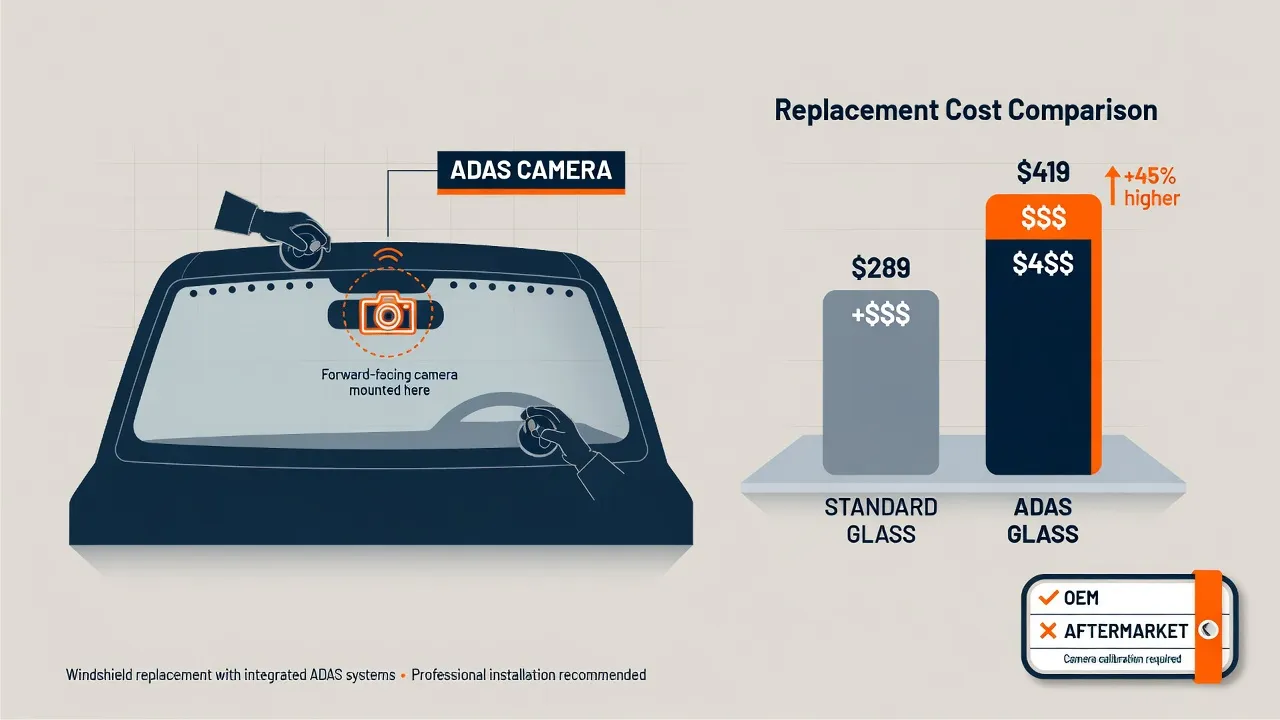
Replacement runs $250 to $600 for a standard windshield in 2026. If your vehicle has a forward camera for lane-keep assist or emergency braking, budget $600 to $1,600 or more, because the camera must be recalibrated to the new glass — a step no legitimate shop will skip.
The Gray Zone: Why Two Shops Disagree
Most disagreements between shops happen in a few predictable places. Line of sight is the biggest one: there is no universal definition of the critical vision area, so a chip eight inches up from the wiper rest might be repairable at one shop and a replacement at another. Long cracks are the second: some shops have long-crack equipment and technicians who trust it; others cap repairs at three inches, period. The third is liability posture — a shop that has eaten the cost of failed repairs tends to quote replacement earlier, and that caution is not necessarily dishonest.
Damage over the ADAS camera zone is another automatic split. Even a small chip in the area the camera looks through will push most shops to replace, since a repair scar there can distort what the camera sees.
Accident damage is its own category. If the windshield cracked in a crash rather than from a stray rock, shops replace rather than repair almost regardless of what the crack looks like, because impact loads stress the entire pane and the windshield is part of the structure a collision repair estimate has to restore. A resin injection has no answer for glass that has been flexed by a collision.
The Cost Math Behind the Call
Lay the numbers side by side and the decision framework makes financial sense from every angle. Repair: $60 to $200, often $0 after an insurance deductible waiver, 30 minutes, factory seal preserved. Standard replacement: $250 to $600, half a day including adhesive cure time. ADAS replacement: $600 to $1,600 or more with recalibration included, and 40 to 100 percent on top of the glass price if you opt for OEM instead of aftermarket.
That cost ladder explains both failure modes you need to watch for. A shop that pushes replacement on a clean, quarter-sized chip in the passenger-side glass is walking you up the ladder for no reason. A shop that agrees to repair a six-inch edge crack because you asked nicely is doing something worse — selling you a $150 fix that is going to fail and delay the replacement you needed anyway.
How to Judge the Recommendation You Get
You do not need to become a glass technician. You need to ask three questions and listen for specific answers. Ask why: a good shop will point to size, location, or depth, not wave vaguely at safety. Ask what happens if you repair anyway: an honest shop distinguishes between cannot repair and will not warranty it. Ask what the repair warranty covers: reputable shops guarantee repairs against spreading and credit the cost toward replacement if they fail.
If the answer is replacement and the price is significant, a second opinion costs you a phone call. Describe the damage precisely — size, distance from the edge, position relative to the driver — and most shops will give you a straight read over the phone. When two independent shops land on the same answer, you have your answer too. When they split, the difference is usually one of the gray-zone factors above, and now you know which question to ask about.
Frequently Asked Questions
Can a crack longer than six inches be repaired?
Realistically, no. A handful of specialists attempt longer crack repairs, but success rates fall as cracks grow, structural integrity is uncertain, and most shops and insurers treat six inches as the hard ceiling. Past that, replacement is the sound call.
Is it legal to drive with a cracked windshield?
It depends on your state. Most states prohibit cracks or chips that obstruct the driver's view, and states with vehicle safety inspections will fail a windshield with damage in the wiper sweep area. Even where enforcement is loose, a crack can spread suddenly in a temperature swing, so the legal question is rarely the one that should decide your timing.
Why will a shop refuse to repair a small chip in my line of sight?
Because every repair leaves minor optical distortion, and distortion directly in front of the driver's eyes is a safety and liability problem no matter how small the original chip was. This is one of the most common reasons a tiny chip still gets a replacement quote, and it is a legitimate one.
Does replacing a windshield weaken the car?
Not when it is done correctly. A proper installation with quality urethane restores the windshield's structural role, including its contribution to roof-crush strength and airbag support. The reason shops still prefer repair when possible is that the factory bond is a known quantity — preserving it removes any installation variables at all.
Will a repaired chip pass state inspection?
Usually, yes — a properly repaired chip outside the driver's critical viewing area passes inspection in most states. Damage or visible repair scars within the wiper sweep directly in front of the driver can still fail in stricter states, which is another reason shops decline repairs in that zone to begin with.