A small chip appears after a passing truck kicks up gravel. By morning, a crack has spread halfway across the glass. Most drivers have been there, and the first question is always the same: can you repair a cracked windshield, or does it need a full replacement?
The short answer: it depends. Repair is a cost-effective option for many cracks, but others have spread too far, sit in the wrong location, or penetrated too deep for a repair to hold. Understanding those differences helps car owners avoid overpaying for a replacement they don't need — or delaying one that's necessary for safety.
This guide covers what determines whether a crack can be fixed, how the repair process works, what each option costs, and when a windshield crack repair kit is worth considering.
What determines whether a crack can be repaired
Three factors govern whether a cracked windshield is repairable: crack size, crack location, and crack type. Auto glass technicians evaluate all three before recommending a fix or a replacement. Understanding these criteria helps car owners have an informed conversation before any work begins.
Crack size: the most important factor
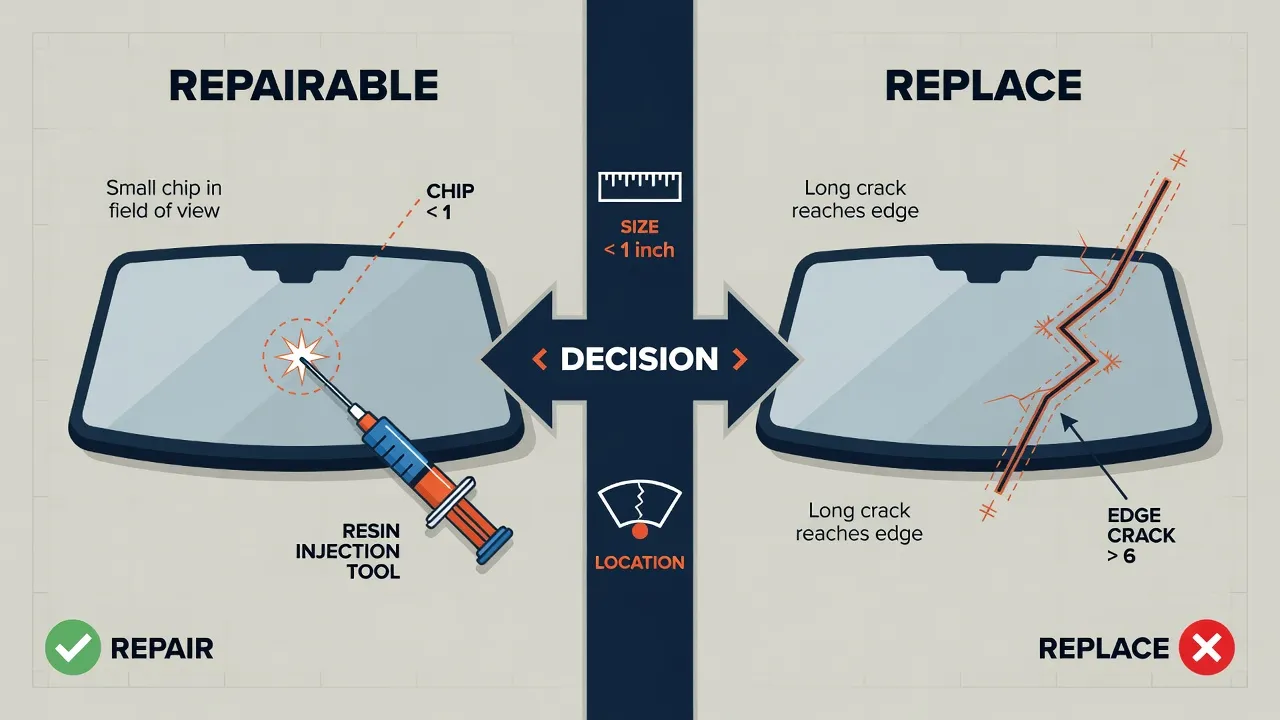
Most auto glass professionals follow a general rule: cracks shorter than 3 inches (roughly the length of a dollar bill's width) can often be repaired. Some advanced resin injection techniques can handle cracks up to 6 inches, though repair quality diminishes as length increases.
Chips — small circular or star-shaped impact points with no branching — are typically repairable if they're smaller than a quarter (about 1 inch in diameter). Larger chips that have already developed satellite cracks present more uncertainty.
| Damage Size | Typical Recommendation |
|---|---|
| Chip smaller than 1 inch | Repair usually possible |
| Crack 1–3 inches | Repair often possible |
| Crack 3–6 inches | Repair possible with advanced techniques; results vary |
| Crack longer than 6 inches | Replacement generally required |
| Chip larger than 1 inch with branching cracks | Replacement often required |
These are guidelines, not guarantees. A technician's in-person assessment accounts for factors that size alone doesn't capture.
Crack location: why placement matters
Even a small crack in the wrong place can make a windshield irreparable. Two locations in particular disqualify damage from repair:
Edges of the windshield. Cracks that reach within two inches of the glass border compromise the structural integrity of the windshield's seal with the vehicle frame. The windshield is a load-bearing component in modern vehicles — it helps maintain the roof's shape during a rollover. Edge cracks weaken that bond, making repair an inadequate fix.
Driver's line of sight. Repair resin fills and hardens the crack, but it rarely restores perfect optical clarity. Even a professionally repaired crack can leave minor distortion. If that distortion falls directly in the driver's forward sightline, most states consider the windshield non-compliant with safety standards. Replacement is the standard recommendation for cracks in that central zone.
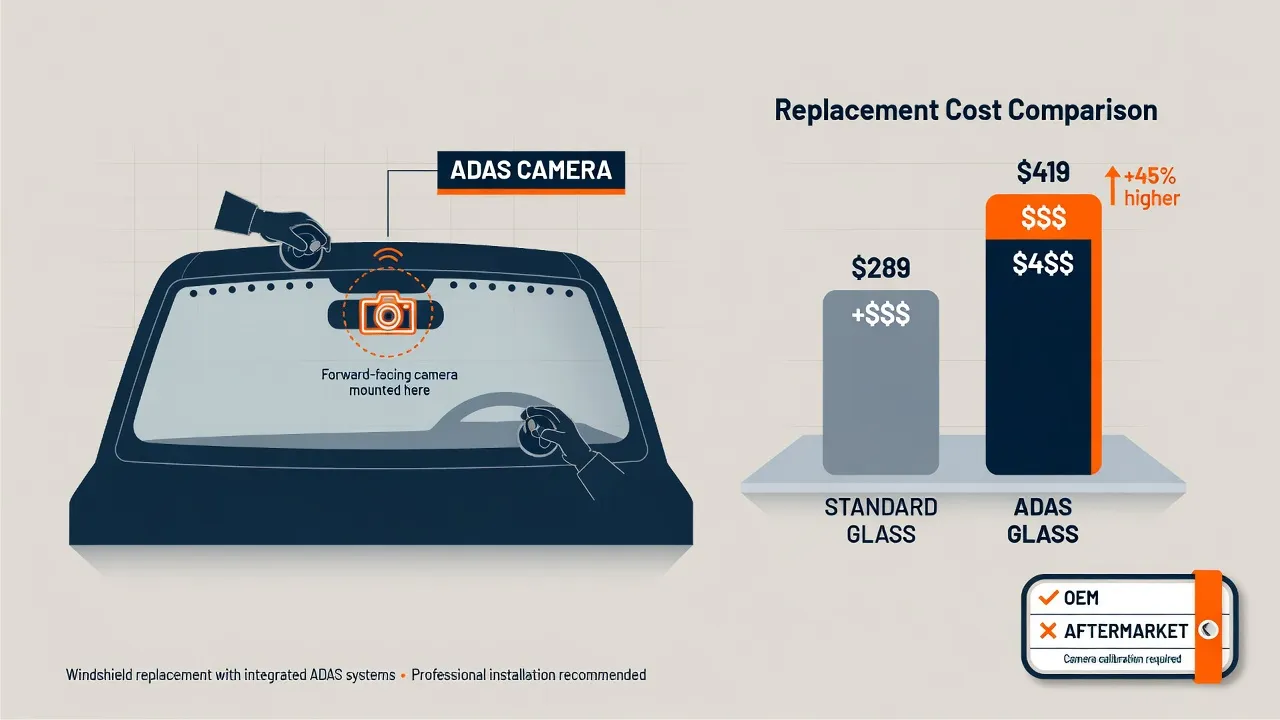
Behind Advanced Driver Assistance Systems (ADAS) sensors. Modern vehicles mount cameras and rain sensors to the windshield, typically behind the rearview mirror. Repair distortion in this zone can interfere with sensor accuracy. Replacement — with recalibration — is the standard recommendation when damage sits near these components.
Crack type: not all cracks behave the same
Different impact patterns produce different crack types, each with its own repair outlook.
The most common types:
- Bullseye crack: A circular impact mark with a center point. Generally the most repairable type.
- Star crack: A central impact point with short cracks radiating outward. Often repairable if contained.
- Half-moon crack: A semicircular shape similar to a bullseye. Typically repairable.
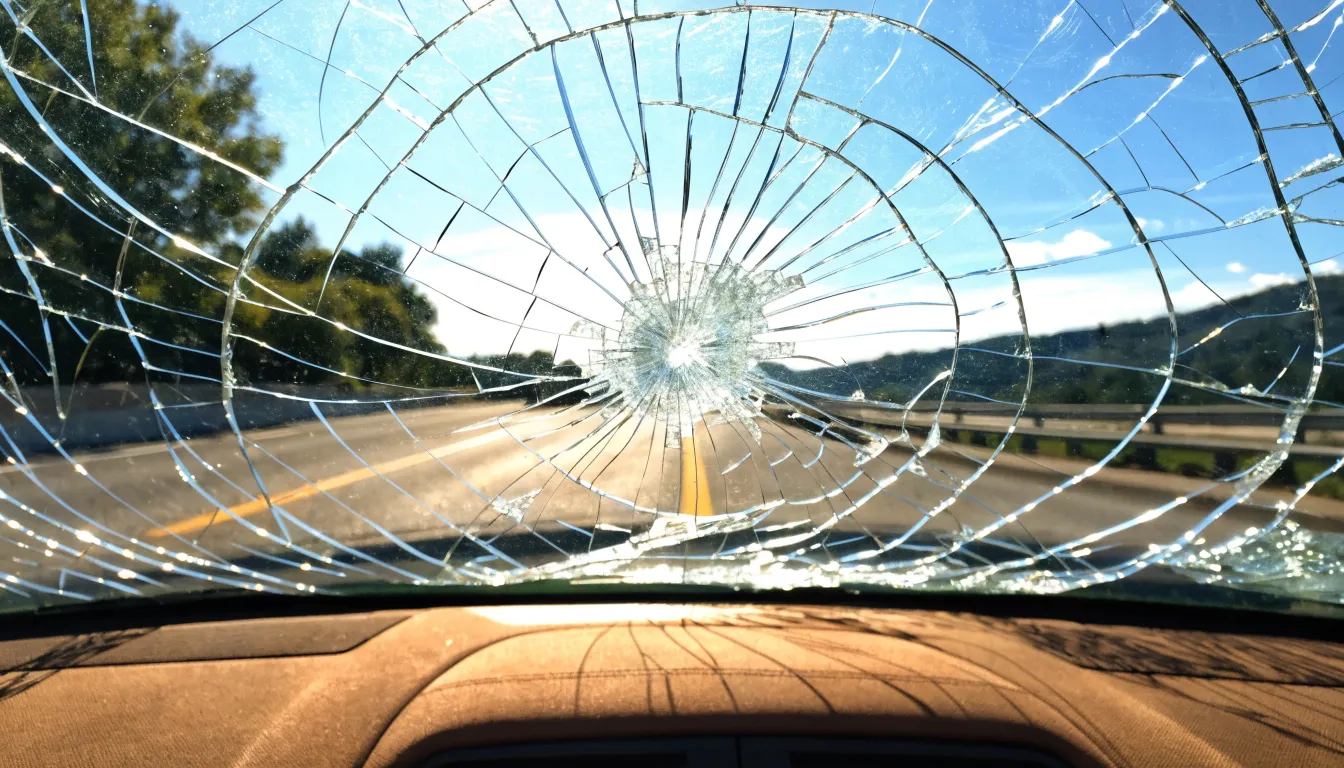
- Floater crack: A crack that begins in the middle of the glass rather than at an impact point. Often longer and less predictable; replacement is more common.
- Combination crack: Multiple crack types at one impact point. Harder to repair; depends on total damage spread.
- Long crack: A straight or curved crack usually caused by temperature stress. Most require replacement.
When you need windshield replacement instead of repair
Repair isn't always an option. Here are the situations that typically call for full replacement.
The crack is longer than 6 inches. Structural integrity is compromised at this length. Filling the crack with resin won't restore the glass's load-bearing capability.
Multiple cracks exist. Several separate cracks — particularly if they intersect — signal widespread stress across the glass. Repair resin handles isolated damage; it can't stabilize compound fractures.
The crack has reached both glass layers. Modern windshields use laminated safety glass: two layers of glass bonded around a plastic interlayer. Most small chips reach only the outer layer. When a crack penetrates through to the inner layer, replacement is required.
The crack is in the driver's line of sight. Repair resin rarely fully eliminates distortion. Residual distortion in the sightline zone creates a safety issue and may violate state vehicle codes.
ADAS sensors are near the damage. Cracks adjacent to windshield-mounted cameras or rain sensors typically require replacement and camera recalibration to restore factory safety system function.
Consider a late-model SUV that developed a temperature crack along the bottom of the windshield after a cold snap. The crack ran nearly edge to edge — over 14 inches — and fell within an inch of the glass border, in a zone that also affected the front-facing camera mount. Any one of those factors alone would have been borderline. Together, they made replacement the clear call.
How the windshield repair process works
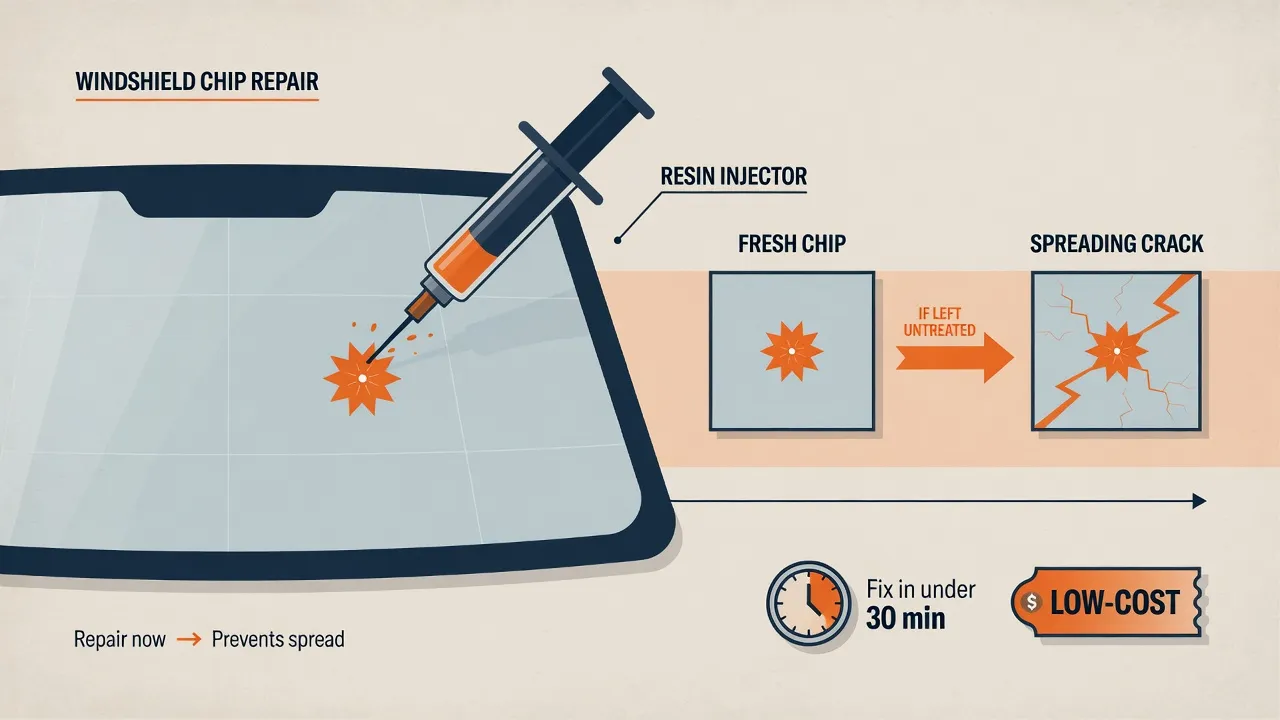
When a crack qualifies for repair, the process is relatively quick — most repairs take 30 to 60 minutes at a professional auto glass shop. Understanding the steps helps car owners know what to expect.
-
Cleaning the damage. Loose glass particles and debris are removed. Moisture or dirt inside the crack will prevent resin from bonding.
-
Applying a vacuum bridge. A specialized tool positioned over the damage removes air from the crack, creating negative pressure.
-
Injecting repair resin. A clear, UV-curable resin flows into the void under vacuum pressure, formulated to bond with glass and restore optical clarity.
-
Curing under UV light. A UV lamp hardens the resin in two to five minutes.
-
Polishing the surface. Excess resin is removed and the surface polished smooth.
A well-executed repair can prevent the crack from spreading and is nearly invisible. Repair rarely achieves perfect optical clarity — a faint trace often remains — but this is normal and doesn't affect safety when the damage is outside the driver's primary sightline.
Cracked windshield repair cost vs replacement cost
Cost is one of the most common reasons car owners look for ways to fix cracked windshield damage rather than replace the glass entirely. The difference between the two options is significant.
Repair cost
Professional windshield chip or crack repair typically costs between $50 and $150, depending on the shop, geographic location, and the complexity of the damage. A single chip at the low end, a multi-star crack pattern at the higher end.
Many insurance policies cover windshield repair at no cost to the policyholder — no deductible required — because the repair cost is far less than replacing the glass. Some states, including Florida and Kentucky, mandate that insurers cover windshield repair and replacement with no deductible if the driver carries comprehensive coverage.
Replacement cost
Full windshield replacement costs considerably more. Typical ranges:
| Vehicle Type | Replacement Cost Range |
|---|---|
| Standard sedan or compact car | $200–$400 |
| Midsize or full-size car | $300–$600 |
| SUV or truck | $350–$800 |
| Luxury or European vehicle | $500–$1,500+ |
| Vehicle with ADAS camera calibration | Add $150–$350 |
These figures reflect parts and labor as of 2026. Costs vary by region — high-cost metro markets typically run 20% to 40% above the national average. Vehicle make and model affect glass pricing significantly; some OEM windshields carry proprietary coatings or embedded display technology.
ADAS recalibration is required after replacement when cameras or sensors are mounted to the windshield. This step ensures lane-keeping assist, automatic emergency braking, and similar systems continue to work correctly. Skipping it on a vehicle that requires it is a safety risk.
For car owners with comprehensive coverage, insurance typically covers replacement subject to the deductible. If the deductible exceeds the replacement cost — common for older vehicles — paying out of pocket is often more practical.
Windshield crack repair kits: what DIY can and cannot do
For car owners considering a DIY approach, windshield crack repair kits are available at auto parts stores for roughly $10 to $30. These kits typically include a small amount of repair resin and a simple applicator. The question is whether they're worth using.
What repair kits do well
A DIY kit can stabilize a small, single bullseye chip — the kind caused by a rock strike — when it sits well away from the edges and outside the driver's sightline. Applied promptly, a kit can slow or prevent spreading and buy time before a professional visit.
Where repair kits fall short
- Limited resin volume. Most kits handle one small chip. Longer cracks need more material and better equipment.
- No vacuum injection. Professional tools use negative pressure to drive resin deep into the crack. Consumer kits rely on gravity and simple suction, often leaving air pockets.
- Inferior optical quality. Consumer resins leave more visible hazing than professional-grade formulations.
- Weak UV curing. Adhesive strips in kit packaging don't match the curing quality of a professional UV lamp.
A windshield crack repair kit is a reasonable emergency measure for a small chip — not a substitute for professional repair on anything longer than an inch or near critical locations.
A DIY kit may fill the visible surface of a crack without penetrating its full depth, leaving a weak point that expands under temperature swings. A two-inch crack stabilized with a kit overnight can become a five-inch crack by morning when temperatures drop, turning an $80 professional repair into a $400 replacement job.
How insurance covers windshield damage
Insurance coverage for windshield cracks depends on the type of policy and, in some cases, the state.
Comprehensive coverage is the relevant policy type. Windshields are damaged by flying debris, hail, vandalism, and temperature stress — none of which involve a collision. These fall under comprehensive coverage, not collision. Car owners who carry only liability insurance aren't covered for windshield damage.
Deductible considerations. Replacement claims are subject to the policy deductible. A $500 deductible on a $350 replacement means paying out of pocket is cheaper. Compare the repair or replacement cost to the deductible before filing.
Zero-deductible repair. Many insurers waive the deductible entirely for repairs — not replacements — because a low-cost repair prevents a larger replacement claim. Check with the insurer to confirm this option.
State mandates. Florida, Kentucky, and South Carolina are among the states that require insurers to cover windshield replacement with no deductible when the driver carries comprehensive coverage. Regulations vary; verify what applies in your state.
Insurance vs. out of pocket. For replacements over $500, a comprehensive claim often saves money. For a $100 repair, filing a claim may not be worth a potential premium adjustment. Most insurers don't raise rates for a single glass claim, but policy terms differ — worth confirming before filing.
Safety considerations: why a cracked windshield is not just cosmetic
Some car owners delay addressing windshield damage because the car drives fine and the crack seems minor. That reasoning underestimates the windshield's structural role.
Structural support. The windshield is bonded to the vehicle frame and helps maintain roof rigidity. In a rollover, an intact windshield can prevent roof collapse. A cracked windshield — especially with edge damage — provides less protection.
Airbag deployment. In many vehicles, the front passenger airbag inflates against the windshield before deploying toward the occupant. A compromised windshield may not withstand that force, affecting how the airbag performs.
Crack propagation. Cracks spread. Temperature swings, road vibration, and moisture all accelerate growth. A two-inch crack repairable for $75 can become a 12-inch crack requiring a $400 replacement in a matter of weeks.
Legal requirements. Most states prohibit driving with a crack that obstructs the driver's view. Enforcement varies, but fines apply and a failed roadside inspection can complicate an otherwise minor traffic stop.
How to find a qualified shop for windshield repair or replacement
Shop quality varies considerably. A few criteria help identify a reliable provider.
Technician certification. Look for shops whose technicians hold certification from the Auto Glass Safety Council (AGSC). AGSC-certified technicians follow the Auto Glass Replacement Safety Standard (AGRSS), the industry's primary technical benchmark.
OEM vs aftermarket glass. OEM glass matches the original factory windshield exactly. Aftermarket glass meets the same specifications at lower cost. Both can deliver quality results. For vehicles with embedded technology, heated glass, or heads-up displays, OEM is generally the safer choice.
Warranty on installation. Ask what the warranty covers and for how long. Reputable shops back both the glass and the seal, not just the material.
ADAS recalibration capability. Confirm the shop can handle static or dynamic camera recalibration in-house, or has a verified partner for this work. Skipping recalibration on a vehicle that requires it compromises lane-keeping, automatic emergency braking, and other safety systems.
Key takeaways
Can you repair a cracked windshield? Often yes, but the decision depends on three specific factors.
- Size: Cracks shorter than 3 inches are usually repairable. Cracks longer than 6 inches typically require replacement.
- Location: Edge cracks, driver's sightline cracks, and damage near ADAS sensors usually require replacement.
- Type: Bullseyes and small star cracks are more repairable than long floater cracks or combination damage.
Cost difference is significant. Professional repair runs $50 to $150. Replacement ranges from $200 to $800 or more, with ADAS recalibration adding $150 to $350 on top.
Insurance often covers repair at no cost. Many insurers waive the deductible for glass repair. Some states require zero-deductible coverage for both repair and replacement.
DIY kits have a narrow use case. They're reasonable for a single small chip as a stabilization measure, not a permanent fix for most cracks.
The windshield is a safety component. Delaying repair or replacement isn't just a cosmetic risk — it affects structural integrity, airbag function, and in some states, legal compliance.
Act quickly. A small crack that qualifies for a $75 repair today can spread to a 12-inch crack requiring a $400 replacement within a few weeks.
Sources
- NHTSA Windshield Safety Standards — federal windshield safety requirements
- Auto Glass Safety Council — auto glass repair and replacement standards
Frequently asked questions
Can you repair a cracked windshield if the crack is longer than 6 inches?
In most cases, no. Cracks beyond 6 inches have compromised enough glass structure that repair resin can't restore adequate strength or stop further spreading. Full replacement is the standard recommendation at this length, though some shops with advanced equipment attempt repairs up to 12 inches — results vary.
How much does cracked windshield repair cost compared to replacement?
Professional crack repair typically costs $50 to $150. Full replacement ranges from $200 to $800 for most vehicles, with luxury or technology-equipped vehicles reaching $1,500 or more. ADAS camera recalibration, when required, adds $150 to $350. Many insurers cover repairs with no deductible, making professional repair often free for the car owner.
Will a windshield crack repair kit work for a long crack?
Not reliably. Consumer kits lack the vacuum injection equipment and resin volume needed for cracks beyond an inch. They can temporarily stabilize a small chip to slow spreading, but shouldn't be used on long cracks, edge cracks, or damage in the driver's sightline.
Does insurance cover windshield replacement?
Comprehensive auto insurance typically covers windshield replacement subject to the deductible. Florida, Kentucky, and South Carolina are among the states requiring no-deductible coverage when comprehensive is in place. Repairs are often covered at no deductible even in other states, because insurers prefer the lower cost of repair over replacement. Verify the specific terms with your insurer before filing.
Is it safe to drive with a cracked windshield?
It depends on the crack's size and location. A small chip away from the edges and sightline is unlikely to cause immediate danger, though it should be addressed promptly. A crack that reaches an edge, spans the windshield, or sits in the driver's line of sight is a safety concern — it weakens the glass's structural role, may interfere with airbag deployment, and is illegal to drive with in most states. When in doubt, get a professional assessment.
How long does windshield crack repair take?
Most professional repairs take 30 to 60 minutes. Technicians typically advise waiting at least one hour before washing the vehicle or exposing it to rain. Full windshield replacement takes one to three hours, plus a similar wait period for the adhesive to cure to a safe drive-away strength.
Note: Windshield repair eligibility, insurance coverage rules, and state regulations vary. Consult a certified auto glass technician for an in-person assessment of specific damage, and contact your insurance provider directly for details on your comprehensive coverage terms. For state-specific driving laws regarding cracked windshields, refer to your state's motor vehicle code.
Last updated: May 2026