A windshield claim can raise your insurance, and whether it does depends on your insurer, your state, your claim history and how much the claim paid. Glass damage from a rock or storm is usually paid under comprehensive coverage rather than treated as an at-fault crash, but that doesn't guarantee a surcharge-free renewal, and only a few states flatly ban a surcharge for not-at-fault claims.
Key Takeaways
- Windshield damage from road debris, hail or vandalism is normally a comprehensive claim, not a collision claim, but that alone doesn't rule out a rate change.
- Progressive's own guidance says whether a glass claim raises rates "varies between car insurance companies," so ask before you file.
- Utah law bars premium increases for motor vehicle claims where you weren't at fault. Oklahoma's often-cited rule only covers liability and collision policies.
- A paid glass claim may appear on your LexisNexis C.L.U.E. report, which can hold up to seven years of reported auto claims.
- If the repair or replacement costs less than your deductible, or only a little more, paying cash may make more sense than filing.
Why a glass claim is different from a crash claim
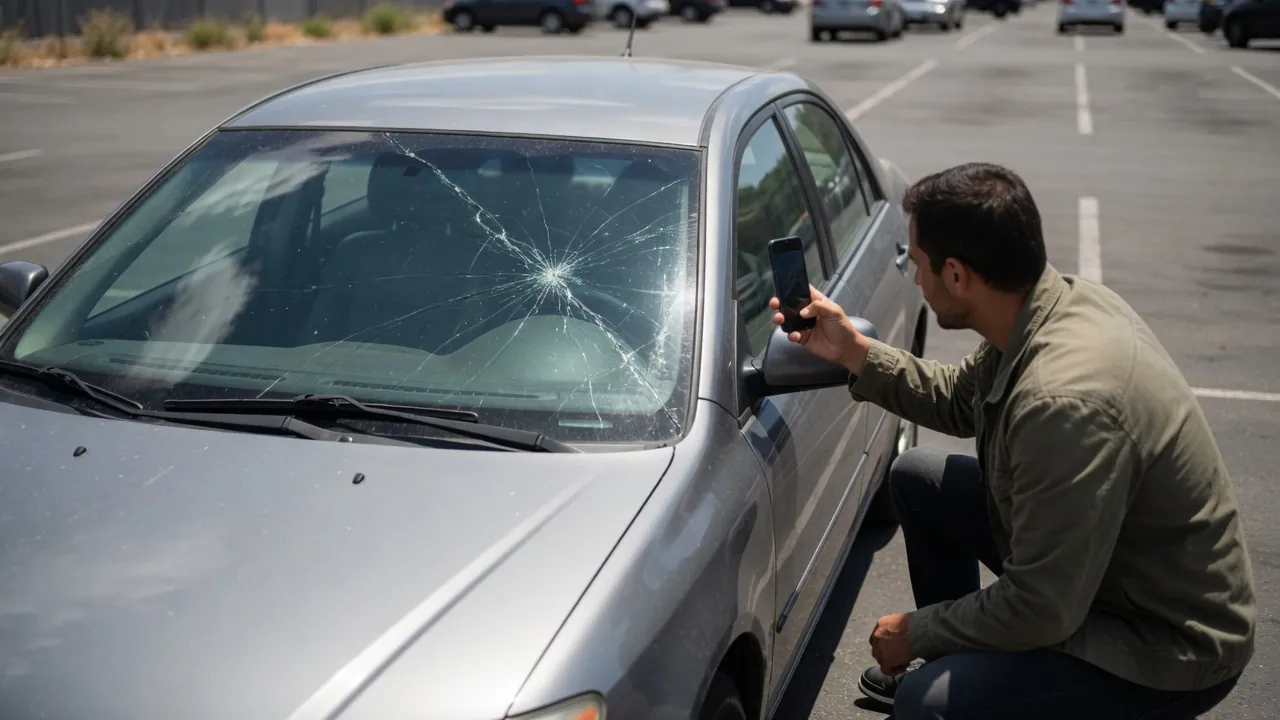
Your auto policy splits physical damage into two buckets. Collision pays when your car hits something or something hits it in traffic. Comprehensive pays for almost everything else: a rock kicked up on the highway, hail, a fallen branch, vandalism, theft. A cracked windshield from road debris almost always goes through comprehensive.
That matters because rate surcharges are mostly built around fault. Insurers raise prices after at-fault accidents because those drivers are statistically more likely to crash again. A pebble off a gravel truck says nothing about your driving.
There's one catch. If your windshield broke because you rear-ended someone, that glass is part of a collision claim, and whatever surcharge your insurer uses for an at-fault accident can apply. The coverage line, not the part of the car, decides how the claim is treated.
For the full picture of how each major carrier pays for glass, start with our guide to whether car insurance covers windshield replacement.
What Progressive and other insurers actually say
People search "will my insurance go up if I claim for a windshield Progressive" more than any other carrier, so here's what the company publishes. Progressive's glass page says a repairable crack under 6 inches can be fixed with no deductible, that replacements cost you up to your deductible, and that it offers a $0 glass deductible option for glass-only replacement claims in some states. On whether a glass claim raises your rate, it says only that this "varies between car insurance companies" and to talk to your insurer.
That's fair: rating plans are filed state by state, so one company can treat a glass claim differently in Ohio than in Utah. Our breakdown of Progressive auto glass coverage covers the deductible side in more detail, and the same advice applies if you're with another carrier, like those covered in our look at Liberty Mutual windshield coverage: call and ask how a comprehensive glass claim is rated in your state before you file.
How insurers use claim frequency
Insurers don't just ask "was it your fault?" They also look at how often you file. Two or three comprehensive claims in a short window can push you into a different risk tier at renewal, even if each one was a rock chip. Some carriers may also decline to renew a policy with a long claims list.
State rules hint at where the line sits. In Maryland, a 2025 legislative fiscal note explains that current law stops an insurer from canceling or refusing to renew a private passenger auto policy when two or fewer claims in the past three years were for losses where the insured wasn't at fault. That rule protects against nonrenewal, not price increases. A 2025 bill (HB 148) would have extended the protection to premiums, but the legislature's record shows no action past its January 2025 committee hearing.
Utah goes further: its law bars a premium increase because of a not-at-fault motor vehicle claim, which takes in typical rock, hail or vandalism glass losses. Local reporting on a driver's windshield claims noted that insurers there can still drop a customer who files too many claims.

State rules on surcharges for not-at-fault and glass claims
You'll see blog posts claiming that "California and Oklahoma ban rate hikes for glass claims." We checked the actual rules, and the picture is narrower than that.
| State | What the rule says | Does it cover a comprehensive glass claim? |
|---|---|---|
| Utah | Utah Code 31A-19a-212, "Premium increases prohibited for certain claims or inquiries," bars rate increases for motor vehicle claims where the insured or permissive driver wasn't at fault, including vandalism. | Yes. A rock or hail claim is a not-at-fault claim. |
| Oklahoma | 36 O.S. 941: insurers can't add points, cancel, refuse to renew, or raise the rate on a liability or collision policy because you were in a collision you didn't cause. | Not directly. The text names liability and collision, not comprehensive. |
| Florida | Fla. Stat. 626.9541(1)(o)3 limits surcharges on liability, PIP, medical payments and collision when you weren't substantially at fault. Separately, 627.7288 says the comprehensive deductible doesn't apply to windshield damage. | The surcharge rule doesn't list comprehensive, but you pay no deductible on the windshield. |
| California | Driving-record surcharges apply only to accidents where you're "principally at-fault," meaning at least 51% of the legal cause (10 CCR 2632.13). | A glass claim isn't an at-fault accident on your driving record. We didn't find a California rule that specifically addresses comprehensive glass claims. |
| Maryland | No nonrenewal based on claims history if two or fewer claims in three years were not-at-fault losses. | Protects your policy, not your price. |
If your state isn't listed, assume no specific ban and ask your agent. Your state insurance department takes complaints for free.
Your C.L.U.E. report records the claim either way
Even when your current insurer doesn't surcharge a glass claim, it may not disappear. A paid claim can show up on LexisNexis C.L.U.E. Auto, which the company describes as an exchange holding up to seven years of reported personal auto claims, with 99.6% of the auto industry contributing claims activity. The Connecticut Insurance Department lists what the report shows: your name, policy number, date of loss, type of loss, amount paid and vehicle details.
When you shop for a new policy, a prospective insurer may obtain that report for underwriting or rating. A string of glass claims can affect the quotes you get, even if your old carrier never raised your rate. Under the Fair Credit Reporting Act you can get your own report free once a year from LexisNexis online or by calling 1-866-312-8076, and you can dispute anything that's wrong.
Should you file a claim for a cracked windshield? A decision framework
The real question is whether the claim pays enough to be worth a C.L.U.E. entry.
- Is it a chip or a short crack? Repair is cheap. An Insurance Journal figure cited by Repairer Driven News put the average cost to fix a chip at $50 versus $400 for an average replacement claim. Many insurers, Progressive included, waive the deductible for repairs, so filing costs you nothing up front.
- Does it need full replacement? Get a cash price first. In 2023, Repairer Driven News reported Safelite quotes of about $350 for a 2010 Toyota Highlander or Honda CR-V, $880 for a 2022 CR-V, $950 for a 2022 Highlander and over $3,000 for a 2022 Tesla Model X. Our Safelite windshield replacement cost breakdown has more current ranges.
- Does your car have a windshield camera? If it has lane-keeping or automatic emergency braking, the camera has to be recalibrated. AAA's December 2023 study put that piece at $360 on the windshield scenario it tested. This is where cash prices climb fast and a claim starts to make sense.
- Compare the bill to your deductible. If the covered cost doesn't exceed your deductible, the policy pays nothing. If it does, the insurer may pay the covered remainder, subject to your policy. Say, hypothetically, the replacement is $450 and your deductible is $500: the claim pays nothing. Our explainer on deductibles vs out-of-pocket costs walks through the math.
- Count your recent claims. If you've already filed one or two comprehensive claims in the past three years, a small glass claim adds frequency for little payout. Paying cash keeps your record clean.
When paying cash makes sense
- The quote is below or just above your deductible.
- You've had other claims recently and are close to a renewal.
When filing makes sense
- It's a repairable chip and your insurer waives the deductible.
- You live in a state with no glass deductible, like Florida, or you carry a $0 glass option.
- The replacement plus ADAS calibration runs well past your deductible.
Either way, get a quote from a shop before you call your insurer. You can compare auto glass repair shops near you and ask for a cash price and an insurance price side by side.
Frequently Asked Questions
Will a windshield claim raise my insurance?
It can. The answer varies by insurer, state, claim history and how much the claim paid. A rock or hail claim is normally a comprehensive claim rather than an at-fault crash, but that doesn't guarantee a surcharge-free renewal, and several claims in a few years can raise your rate or affect future quotes.
Will my insurance go up if I claim for a windshield with Progressive?
Progressive doesn't promise either way. Its glass page says whether a claim raises rates varies between insurers and tells customers to ask. It also says a repairable crack under 6 inches can be fixed with no deductible.
Does windshield replacement increase insurance more than a repair?
It can. A replacement is a larger paid claim on your C.L.U.E. report than a $50-range chip repair, and insurers look at both how often you claim and how much they pay. Ask your insurer how it rates a single glass replacement before you file.
Which states ban rate increases for glass claims?
Utah's statute bars premium increases for claims where you weren't at fault, which covers typical glass damage. Oklahoma's law covers only liability and collision policies, and Florida's surcharge rule doesn't list comprehensive, though Florida waives the deductible on windshields.
How long does a windshield claim stay on my record?
LexisNexis C.L.U.E. Auto keeps up to seven years of claims history. How long your own insurer weighs it at renewal depends on its filed rating plan, so ask your agent.
Sources
- Progressive: Does car insurance cover windshield damage? (accessed Oct 2026)
- Utah Insurance Department: Auto Claims Information (cites Utah Code 31A-19a-212) (accessed Oct 2026)
- KJZZ: Utah law bans insurance companies from increasing premiums after windshield claims (accessed Oct 2026)
- Oklahoma Insurance Department: Auto Insurance FAQs (Section 941) (accessed Oct 2026)
- Florida Senate: Fla. Stat. 626.9541, Unfair methods of competition and unfair or deceptive acts (accessed Oct 2026)
- Florida Senate: Fla. Stat. 627.7288, Comprehensive coverage; deductible not to apply to motor vehicle glass (accessed Oct 2026)
- Cornell LII: Cal. Code Regs. tit. 10, 2632.13, Determination of principally at-fault accidents (accessed Oct 2026)
- Maryland Department of Legislative Services: HB 148 Fiscal and Policy Note (2025) (accessed Oct 2026)
- Maryland General Assembly: HB 148 (2025) bill status (accessed Oct 2026)
- LexisNexis Risk Solutions: C.L.U.E. Auto (accessed Oct 2026)
- LexisNexis Consumer Center: Request your FACT Act disclosure report (accessed Oct 2026)
- Connecticut Insurance Department: Get a C.L.U.E. to your claims history (accessed Oct 2026)
- Repairer Driven News: Industry weighs in on windshield replacement cost expectations (accessed Oct 2026)
- AAA Newsroom: Fixing advanced vehicle systems makes up over one third of repair costs following a crash (accessed Oct 2026)