
Deductible Vs Out Of Pocket: Deductible vs. Out of Pocket: When to Skip the Insurance Claim

Should you file a claim or pay out of pocket? The answer depends on your deductible, the damage amount, and whether it'll raise your premiums.

Insurance ClaimsMay 2, 20261 min read

Filing an insurance claim after auto body damage seems like the obvious choice. That is what insurance is for, after all. But the math tells a different story, one that insurance companies hope most car owners never calculate.

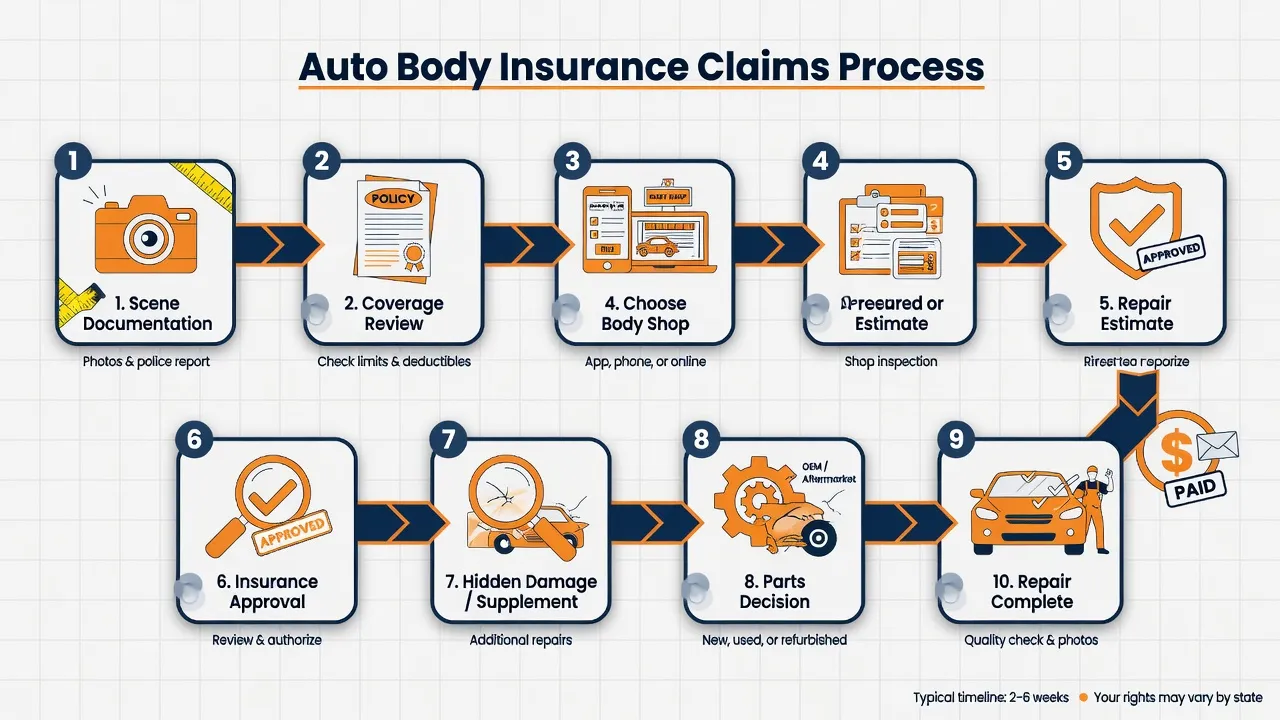
The decision between paying your deductible and filing a claim versus paying out of pocket for repairs is not as straightforward as it appears. Premium increases after claims can cost more over three to five years than the insurance payout itself. Understanding when to file and when to pay cash is one of the smartest financial decisions a car owner can make. For a broader overview of the claims process, see our complete guide to auto body insurance claims.

How car insurance deductibles work: deductible vs out of pocket

A deductible is the amount a car owner pays out of pocket before insurance coverage kicks in. When filing a claim for collision or complete damage, the insurance company subtracts the deductible from the total repair cost and pays the remainder.

Common deductible amounts are $250, $500, and $1,000. Most policies allow car owners to choose their deductible level. A higher deductible results in lower monthly premiums, while a lower deductible means paying more each month but less at claim time.

Here is how it works in practice: If bumper repair costs $1,500 and the deductible is $500, the insurance company pays $1,000 and the car owner pays $500. On the surface, that $1,000 payment from the insurer looks like a win. But this calculation ignores what happens to premiums after the claim.

The hidden cost: Premium increases after claims: deductible vs out of pocket

Insurance companies adjust premiums based on risk profile, and filing a claim signals increased risk. According to industry data, the average premium increase after an at-fault collision claim ranges from 20% to 58%, depending on the state and insurer.

These increases are not one-time adjustments. Rate hikes typically persist for three to five years after a claim. A car owner paying $150 per month in premiums who sees a 40% increase after a claim would pay an additional $60 per month, or $720 per year. Over three years, that adds up to $2,160 in extra premiums.

Complete claims, such as those for hail damage or vandalism, generally trigger smaller premium increases than collision claims. However, they are not consequence-free. Even a complete claim can result in a 10% to 20% rate increase with some insurers.

The premium impact varies significantly by state. New Jersey drivers face some of the highest increases, with rates jumping as much as 80% after an at-fault claim. Rhode Island sees more modest increases around 15%. This geographic variation makes it essential for car owners to understand their local market before deciding whether to file.

Your claims history follows you for seven years

Beyond immediate premium increases, every claim is recorded in the Complete Loss Underwriting Exchange (CLUE) database. Insurance companies access CLUE reports when setting rates for new and renewing customers. Claims remain on record for seven years.

This means a claim filed today affects insurance costs not just with the current insurer, but with any company the car owner might switch to over the next seven years. Multiple claims within a three-year period can even result in policy non-renewal, forcing the car owner into the more expensive high-risk insurance market.

The break-even calculation

The formula for deciding between filing a claim and paying out of pocket is straightforward:

If (Repair Cost - Deductible) is greater than (Estimated Annual Premium Increase x 3 years), file the claim.

If (Repair Cost - Deductible) is less than (Estimated Annual Premium Increase x 3 years), pay out of pocket.

Here are three scenarios that illustrate how this calculation works:

ScenarioRepair CostDeductibleInsurance PaysEst. Annual Premium Increase3-Year Premium CostBetter Choice
Minor dent repair$800$500$300$400$1,200Pay out of pocket
Bumper damage$2,000$500$1,500$400$1,200File the claim
Moderate fender damage$1,500$500$1,000$350$1,050Close to break-even

In the first scenario, filing a claim to receive $300 from the insurer results in $1,200 in extra premiums over three years. Paying the full $800 out of pocket saves $400 and keeps the driving record clean.

In the second scenario, the $1,500 insurance payout exceeds the $1,200 in premium increases, making the claim financially worthwhile.

The third scenario shows a near break-even situation. When the numbers are close, other factors tip the decision. Car owners with clean records and no recent claims may prefer to pay out of pocket to preserve that status. Those who already have a claim on record may find that an additional claim has less incremental impact.

When to file an insurance claim

Certain situations make filing a claim the clear choice, regardless of the break-even math:

When repair costs significantly exceed the deductible. If the repair costs $1,000 or more above the deductible, the insurance payout will likely outweigh premium increases.

When third-party liability is involved. Any damage to another person's vehicle or property should go through insurance. Paying third-party claims out of pocket exposes the car owner to legal and financial risk. Learn more about first-party versus third-party claims.

When injuries are involved. Any accident with injuries requires a claim, both for medical coverage and liability protection.

When the vehicle may be totaled. If damage is severe enough that the repair cost might exceed the vehicle's value, filing a claim initiates the total loss evaluation process. Car owners should not pay out of pocket for major damage only to discover later that the vehicle was a total loss.

When to pay out of pocket

Paying cash for repairs makes sense in these situations:

When damage is minor and close to the deductible. For damage costing less than $500 to $800 above the deductible, the long-term premium impact typically exceeds the insurance payout.

When a claim was filed recently. Car owners who have filed a claim within the past three years face compounded effects from additional claims. A second claim in a short period can result in steeper rate increases or non-renewal.

When protecting a clean record. A spotless claims history has tangible value. Some insurers offer claim-free discounts that disappear with the first claim. Keeping that record clean for minor repairs pays off over time.

When the repair can be delayed. For cosmetic damage that does not affect safety or vehicle function, delaying or declining repair entirely is an option. Not every dent requires immediate attention.

Key takeaways

The deductible versus out of pocket decision comes down to math that insurance companies do not volunteer. Before calling to file a claim, car owners should get a repair estimate, calculate the break-even point, and consider the seven-year impact on their insurance record.

For minor damage near the deductible amount, paying out of pocket almost always makes financial sense. For major repairs, total loss situations, or any incident involving injuries or third-party liability, filing a claim is the appropriate path.

Car owners seeking repair estimates before making this decision can find auto body shops in their area for cash-pay quotes that help inform the calculation.

External resources

Related Articles
Newsletter

Get repair tips in your inbox

No spam, no sales pitches. Just practical advice on collision repair, insurance claims, and car maintenance — twice a month.

Join 2,400+ car owners. Unsubscribe anytime.