You return to your car in a parking lot and find a crumpled bumper. Or a driver runs a red light and clips your rear quarter panel. In both cases, the next 30 minutes matter more than most people realize. Knowing what to do when someone hits your car, and doing it in the right order, directly affects whether you get a full, fair repair or spend months fighting with an insurance company over a settlement that doesn't cover the damage.
This guide walks through every step car owners should take after another vehicle strikes theirs, from the immediate moments at the scene through filing the claim and getting the car repaired. It covers both situations: accidents where the other driver is present and hit-and-run scenarios where they've left.
Step 1: Check for injuries and move to safety
The first priority after any collision is physical safety. Not documentation, not phone calls, and not confronting the other driver. Check yourself and any passengers for injuries before doing anything else.
If the accident occurred in active traffic and the vehicles are drivable, move them to a safe location, a parking lot shoulder or side street, before exchanging information. In most states, moving vehicles out of a traffic lane after a minor collision is legally required and doesn't affect fault determination.
If anyone is injured, call 911 immediately. Don't attempt to move an injured person unless they're in immediate danger from fire or oncoming traffic. Emergency responders will document the scene.
When to call 911 immediately:
- Anyone is injured, even if injuries seem minor
- Airbags deployed
- A vehicle is blocking traffic and can't be moved
- The other driver appears impaired
- The other driver attempts to leave
Step 2: Document everything at the scene
Thorough documentation at the scene is the single most valuable thing you can do after a collision. It protects against disputes over fault, damage extent, and repair costs later in the claims process.
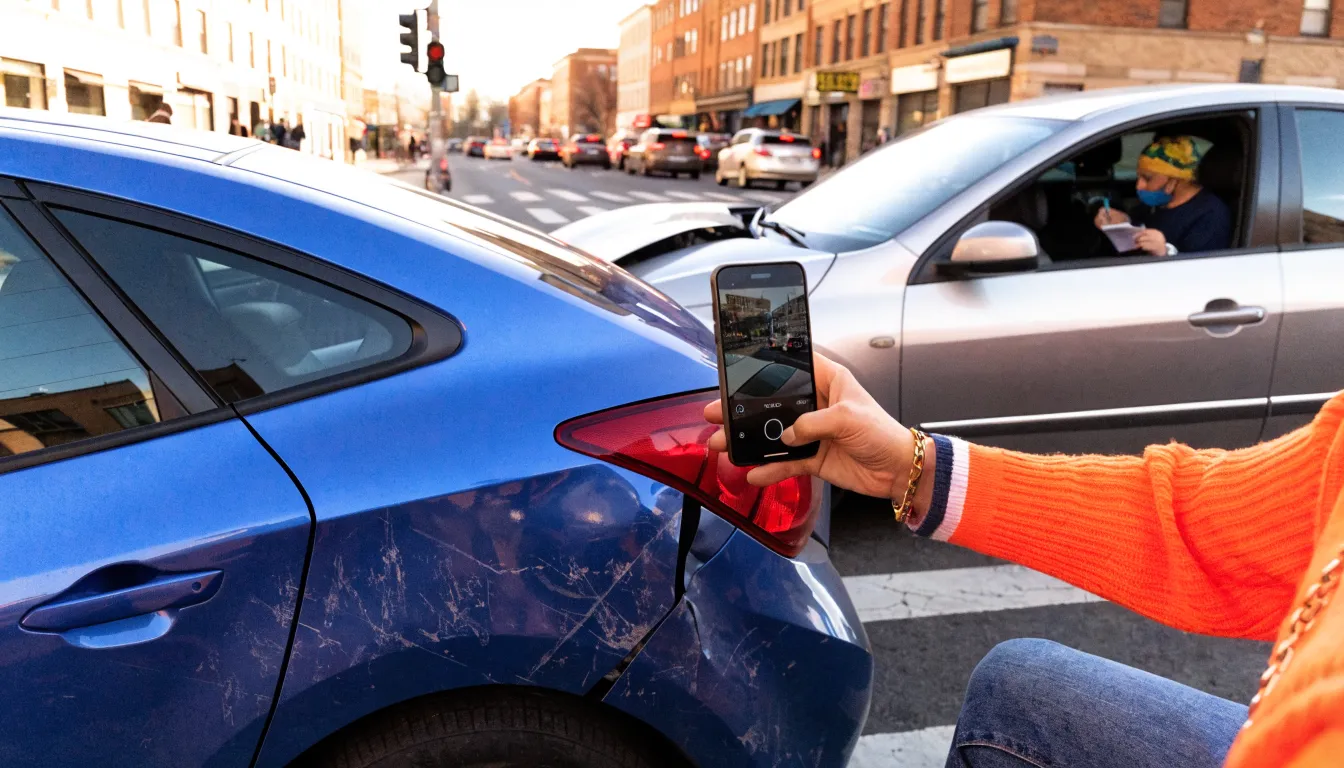
What to photograph
Use a smartphone to capture the following before anyone moves the vehicles (if safe to do so):
- Both vehicles from multiple angles, showing the damage and relative positions
- Close-up shots of all visible damage on both cars
- The license plates of all vehicles involved
- The street, intersection, or parking lot, including any traffic signals, stop signs, or lane markings
- Skid marks, debris, or other physical evidence on the road
- Any visible injuries (with consent where applicable)
- Weather and road conditions
- Timestamps on photos matter, most modern smartphones embed this automatically
What information to collect from the other driver
- Full legal name and contact information (phone, email)
- Driver's license number and state of issue
- Insurance company name and policy number
- Vehicle make, model, year, and VIN (usually on the dashboard near the windshield)
- License plate number and state
Don't share your Social Security number with the other driver. Your driver's license and insurance card are the only documents required at the scene.
Witness information
If bystanders witnessed the accident, collect their names and phone numbers. Witness accounts carry significant weight in disputed-fault situations, and insurance adjusters will often contact witnesses during the claims investigation.
Step 3: File a police report
Many car owners skip the police report after a minor collision, especially if the other driver seems cooperative. This is a costly mistake. A police report creates an official third-party record of the incident, which becomes critical if the other driver later disputes fault, provides false insurance information, or if injuries surface days after the accident.
When a police report is required by law
Most states require a police report when:
- Any person is injured
- Property damage exceeds a certain threshold (commonly $500 to $1,000, but this varies by state)
- A government vehicle or property is involved
- The other driver is uninsured or leaves the scene
Even when it's not legally required, filing a report is advisable after any collision involving another driver.
How to file a police report
If police respond to the scene, they'll generate the report automatically. Get the report number before leaving, you'll need it when filing the insurance claim.
If police don't respond (common for minor accidents in busy jurisdictions), you can file at the local police station, through the department's online portal, or in some states through the DMV. Most states allow 24 to 72 hours after the incident to file.
The National Highway Traffic Safety Administration (NHTSA) provides state-by-state information on accident reporting requirements.
Step 4: Notify your insurance company
Contact your insurance company to report the accident, even if the other driver was clearly at fault, and even if your plan is to file through the other driver's insurance. Most policies require prompt notification of any accident involving the insured vehicle.
Failing to notify your own insurer can jeopardize coverage if the claim later gets complicated, for example, if the other driver's insurance denies liability or if injuries develop.
What to tell your insurance company
- Date, time, and location of the accident
- A factual description of what happened (avoid speculation about fault)
- The other driver's information and insurance details
- The police report number if one was filed
- A description of the visible damage to your vehicle
Stick to facts. Insurance adjusters record these initial conversations. Avoid phrases like "I think" or anything that could be interpreted as admitting fault.
Choosing between first-party and third-party claims
If the other driver was at fault, you've two options:
- Third-party claim: Filing directly with the at-fault driver's insurance company. This avoids paying a deductible but puts you in the position of negotiating with an insurer that represents the other party's interests.
- First-party claim: Filing with your own insurer under collision coverage. Typically faster and more straightforward, but requires paying your deductible upfront (which can be recovered later if the other driver is found at fault).
Step 5: Get a repair estimate, and know your rights
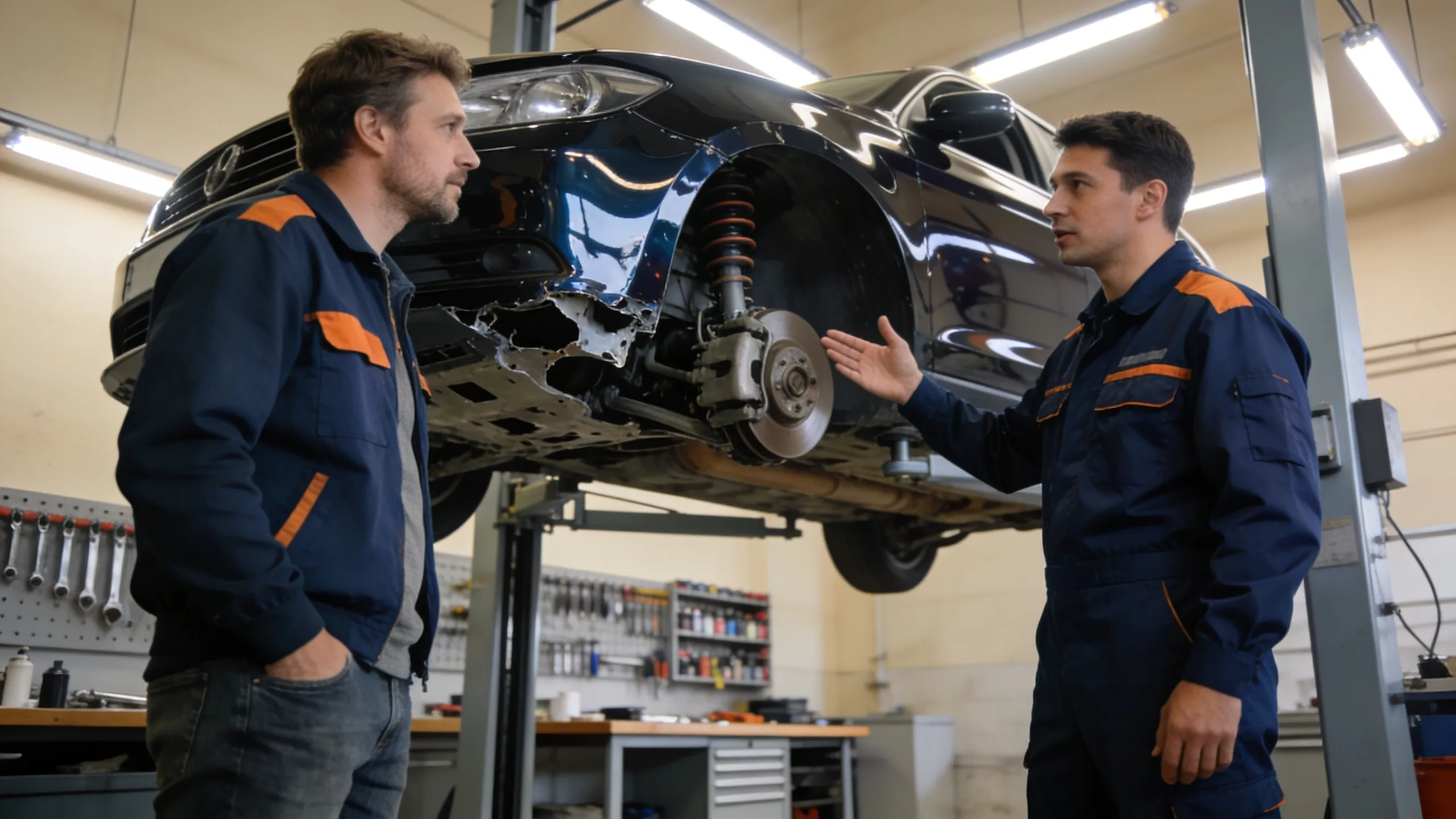
Once the claim is filed, the insurance company will arrange for a damage assessment. This may involve:
- An insurance adjuster visiting the vehicle
- A virtual inspection using photos submitted through the insurer's app
- Dropping the vehicle at a Direct Repair Program (DRP) shop affiliated with the insurer
Car owners have the legal right to choose their own repair facility, regardless of what the insurance company recommends. DRP shops aren't inherently lower quality, but you're never obligated to use them. Getting an independent estimate from a shop of your choosing gives you a useful benchmark.
For major collision damage, getting estimates from two or three shops is worth the time.
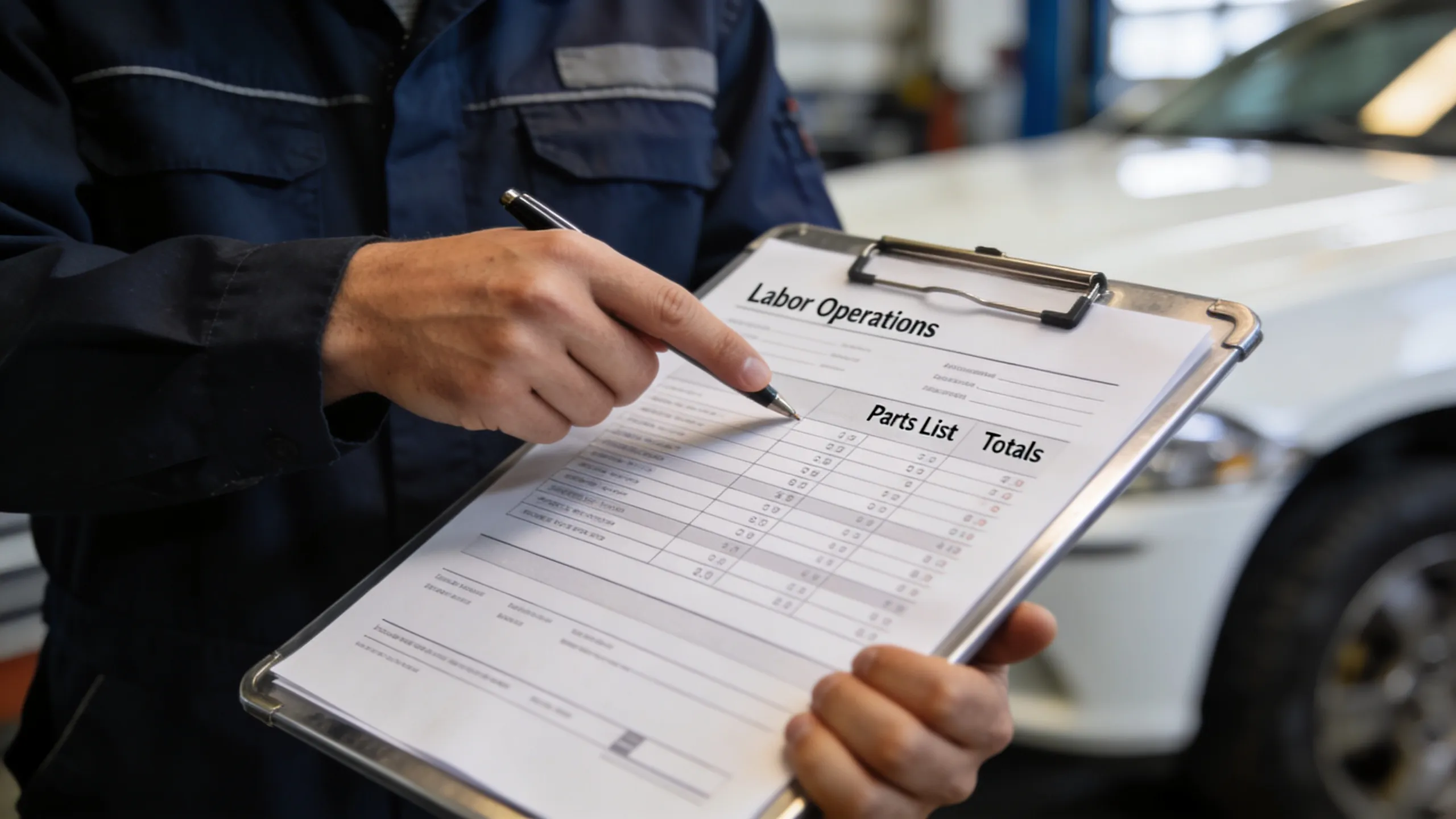
Understanding the estimate
A written repair estimate should itemize:
- Labor hours and hourly rate
- Parts costs (noting whether OEM, aftermarket, or used parts are specified)
- Paint and materials
- Sublet work (for example, if the shop sends the car elsewhere for alignment or glass replacement)
If the insurance estimate seems too low, you can dispute it.
Step 6: What to do in a hit-and-run situation
A hit-and-run, where the other driver leaves the scene without stopping, creates additional complications but doesn't leave you without options.
Immediate steps after a hit-and-run
- Don't chase the other driver. Attempting to follow creates safety risks and can complicate the legal situation.
- Note as much detail as possible about the vehicle: color, make, model, partial or full license plate, direction of travel.
- Check for witnesses and ask if anyone captured the incident on a dashcam or phone.
- Look for nearby security cameras, parking lots, gas stations, ATMs, and businesses often have footage that local police can request.
- Call the police and file a report immediately. Hit-and-run reports are taken more seriously than many car owners expect, and police do recover the responsible vehicle in a meaningful percentage of cases.
How to file an insurance claim after a hit-and-run
Most car owners file under their own uninsured motorist (UM) coverage or collision coverage:
- Uninsured motorist property damage (UMPD): Covers damage caused by an unidentified driver in states that require it. Rules vary significantly by state, some require physical contact, others don't.
- Collision coverage: Covers the damage regardless of fault or whether the other driver is identified. A deductible applies.
A police report is essential for hit-and-run claims. Most insurers won't process one without it.
Real scenarios: how these steps play out
Scenario 1: Parking lot damage with no note
Maria parked her 2022 Honda CR-V at a grocery store in Phoenix and returned to find a significant dent in her rear door, no note, no witnesses visible. She photographed the damage, noted the parking space and lot layout, and checked whether the lot had security cameras before leaving.
Maria reported the incident to police online and filed a claim under her collision coverage the same day. The repair came to $1,400. Her $500 deductible applied, but she avoided the weeks-long process of trying to locate an unidentified driver.
Scenario 2: Intersection collision with an at-fault driver
James was stopped at a red light in Chicago when a driver ran the signal and struck his driver-side door. Both drivers were uninjured. James photographed everything, collected the other driver's information, and confirmed police were filing a report.
He filed a third-party claim through the at-fault driver's insurer. Because James had thorough documentation, photos, a police report, and two witness names, the liability determination was straightforward. His vehicle went to a shop he selected, and he paid nothing out of pocket. The full repair cost of $3,800 was covered by the at-fault driver's liability insurance.
Scenario 3: Hit-and-run on a residential street
Diane discovered her parked 2019 Subaru Outback had been sideswiped overnight on a Seattle street. The damage ran along the entire driver's side. She filed a police report, checked with neighbors for doorbell camera footage, and found a partial plate number from a neighbor's Ring camera.
Seattle police identified the responsible driver within two weeks. Diane filed a third-party claim once the driver was confirmed. The repair cost $4,200, covered fully by the at-fault driver's insurance.
Filing the car insurance claim: what to expect
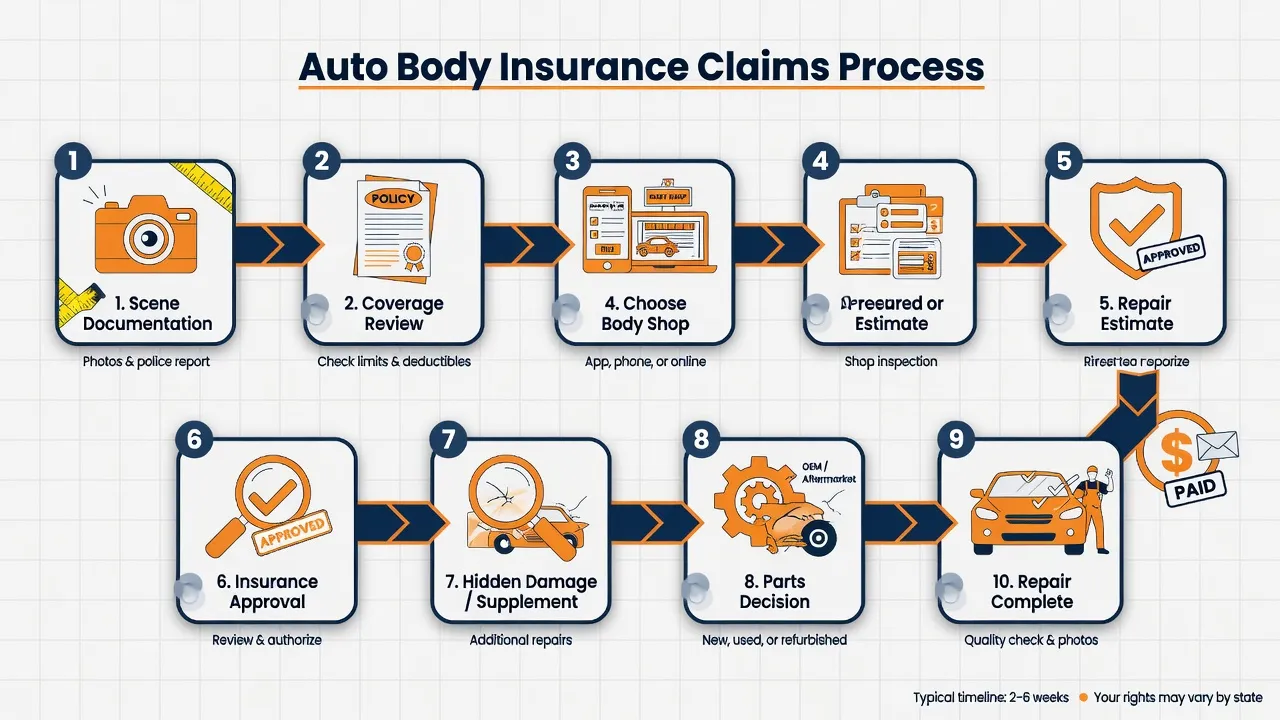
The claims process typically follows this sequence:
- Report the claim: Notify your insurer (or the at-fault driver's insurer) and get a claim number.
- Damage assessment: An insurance adjuster inspects the vehicle, either in person or virtually.
- Estimate review: The insurer issues a repair estimate. You can request a second estimate if the initial figure seems insufficient.
- Shop selection: Choose a repair facility. The insurer pays the shop directly in most cases, or reimburses you.
- Supplement process: If additional damage surfaces during repairs, the shop submits a supplement to the insurer. This is common in collision repairs.
- Repair and return: The shop completes repairs and notifies you when the vehicle is ready.
- Final inspection: Inspect the vehicle carefully before signing the release form.
The typical timeline from claim filing to vehicle return runs seven to 21 business days for most non-structural repairs, depending on parts availability and shop workload.
What to look for when choosing a repair shop
When evaluating shops, look for these factors before committing:
- Written estimate: Any reputable shop provides a detailed written estimate at no charge before work begins.
- Certifications: I-CAR Gold Class certification indicates rigorous ongoing training. ASE certifications for individual technicians are a strong indicator of technical competence.
- Warranty: Most reputable shops offer a written warranty on repairs, commonly lifetime for workmanship, with parts warranties varying by component.
- Insurance experience: Shops experienced in working with insurance claims can handle the supplement process and communicate directly with adjusters, which reduces your involvement.
- Customer reviews: Recent reviews on Google and the Better Business Bureau provide real insight into repair quality and customer experience.
Your Car Got Hit. Here's What to Do in the First 24 Hours
The first 24 hours after a car accident determine how smoothly your repair and insurance claim go. Here's exactly what to do, step by step.
The seconds after a crash feel strange. Your hands might be shaking. Your brain is juggling three conversations at once. That's completely normal — and also exactly why knowing what to do before it happens is so useful. What you do in the first 24 hours after a car accident shapes your insurance claim, your legal standing, and how fast you get back on the road.
At the Scene: The First 15 Minutes
- Check yourself and everyone in your car for injuries first — everything else waits
- If the cars are drivable, move to the shoulder or a nearby parking lot
- Turn on your hazard lights; set up flares or a reflective triangle if you have them
- Call 911 if anyone is hurt, the road is blocked, or there's serious damage
- Don't apologize or admit fault — even a casual "I'm so sorry" can be used against you later
Never leave the scene, even when the damage looks minor. Hit-and-run is a criminal offense in every state. Wait for the other driver, exchange information, and document the scene before you go anywhere.
What to Document After a Car Accident
Your phone is your best tool right now. Pull it out and start capturing everything while you're still at the scene:
- Wide shots and close-ups of all damage to both vehicles
- The full scene — road layout, traffic signs, intersections, skid marks
- The other driver's name, phone number, insurance company, and policy number
- Their license plate and driver's license number
- Photos of their insurance card and license — faster than writing it all down
- Names and phone numbers of any witnesses nearby
- Street names, mile markers, or nearby landmarks for the exact location
Shoot a slow video walkthrough of both cars before anyone moves them. Panning around the scene gives you spatial context that a handful of still photos can't fully capture — especially for showing the angle of impact.
Get Checked Out, Even If You Feel Fine
This one catches a lot of people off guard. Whiplash, soft tissue injuries, and even mild concussions can take hours — sometimes days — to show symptoms. If there's any chance you got knocked around, see a doctor within 24 hours of the accident.
Medical records from the day of the accident create a direct link between the crash and any injuries. If you wait two weeks, insurers and attorneys will argue the injury happened somewhere else entirely.
Your 24-Hour Checklist After a Car Accident
- Make sure everyone is safe; call for medical help if needed
- Photograph and video the full scene before leaving
- Exchange information with the other driver
- File a police report
- Call your insurance company to open a claim
- See a doctor if there's any chance of injury
- Do not post about the accident on social media — anything you write can surface in a claim dispute
- Start researching body shops — don't just take the first one your insurer suggests
- Save every receipt: towing, rental car, medical visits
- Write down your account of what happened while the details are still fresh
An accident is a stressful event with a business side. The more organized you are in those first 24 hours, the smoother everything that follows tends to go.
Related: filing an insurance claim
Related: collision repair estimate guide
Related: choose a collision repair shop
Related: find auto body shops near you
Sources
- National Highway Traffic Safety Administration (NHTSA) — vehicle safety recalls, crash data, and regulations
- Insurance Institute for Highway Safety (IIHS) — vehicle safety ratings and crash test results
- Insurance Information Institute — auto insurance claims statistics
- National Association of Insurance Commissioners — state insurance commissioner consumer resources
Frequently asked questions
What should I do if the other driver doesn't have insurance?
File a claim under your own uninsured motorist (UM) coverage if you carry it. UM coverage is required in many states and covers both bodily injury and property damage caused by uninsured drivers. If you don't have UM coverage, a personal injury attorney can advise on options for recovering damages directly from the uninsured driver, though this process is typically slower and less certain.
Does filing a claim raise my insurance rates even if I wasn't at fault?
It depends on the insurer and the state. Many states prohibit rate increases for not-at-fault accidents, but practices vary. Contact your insurer to understand your specific policy's terms before filing, particularly if the damage is minor and close to your deductible amount.
How long does a car insurance claim take to process?
Most property damage claims are processed within seven to 14 business days from the time all documentation is submitted. Complex cases involving disputed liability, significant structural damage, or total loss determinations can take 30 to 60 days. State regulations typically require insurers to acknowledge a claim within 10 business days and resolve it within 30 to 45 days, though timelines vary by state.
What if I discover more damage after I've already accepted a settlement?
If a settlement check has been cashed and a full release signed, reopening the claim is difficult. Don't sign a release until repairs are complete and inspected. If additional damage surfaces during repair, the shop can submit a supplement to the insurer before you receive a final settlement.
Can I get the car repaired at any shop I choose, or do I've to use the insurance company's recommended shop?
Car owners have the legal right to choose their own repair facility in all 50 states. Insurance companies may recommend DRP shops they work with regularly, but using one isn't required. The insurer must cover a reasonable repair cost at any licensed shop, even if it differs from their estimate.
What happens if the repair costs more than my car is worth?
If the estimated repair cost exceeds a percentage of the vehicle's actual cash value (ACV), typically 70% to 80%, though this varies by state and insurer, the insurer may declare the vehicle a total loss. In that case, you receive the ACV of the vehicle rather than repair costs. If you disagree with a total loss determination, you can dispute the ACV using comparable vehicle sales data.
Key takeaways
Understanding what to do when someone hits your car reduces stress, protects your rights, and leads to better repair outcomes. The steps that matter most:
- Document thoroughly at the scene: Photos, witness contacts, and the other driver's full information are essential.
- File a police report: Even for minor accidents, a report creates a third-party record that protects against disputed-fault situations.
- Notify your insurer promptly: Most policies require timely reporting, regardless of which driver was at fault.
- Know your rights: You choose your own repair facility and can dispute insurance estimates that seem inadequate.
- Don't sign releases prematurely: Wait until repairs are complete and inspected before accepting a final settlement.
Insurance disclaimers vary by state and carrier. The information in this guide is educational and general in nature. Consult your specific policy and, when appropriate, a licensed insurance professional or attorney for guidance on your individual situation.