How to Prepare for a Car Accident Before It Happens

Most drivers spend years on the road without ever thinking about what happens in the moments after a collision. Then, when an accident occurs, they find themselves standing roadside, hands shaking, unsure what to document, who to call, or where their insurance card even is.

insurance-claimsApr 28, 202611 min read
AS

Ambika Sharma

Brings 12 years of project management and technical operations experience to Auto BodyShop Near. Ambika oversees partnerships, city expansion, and listing quality across all states.

Most drivers spend years on the road without ever thinking about what happens in the moments after a collision. Then, when an accident occurs, they find themselves standing roadside, hands shaking, unsure what to document, who to call, or where their insurance card even is.

Knowing how to prepare for an accident before it happens is one of the most practical things a car owner can do. The preparation takes less than an hour. The payoff is a calmer, faster, and more effective response when it counts.

This guide covers the full car accident preparation checklist: the documents to keep in the glove box, the phone apps worth downloading, what to capture at the scene, how to pre-select a body shop, and whether a dashcam belongs in the budget.


Why accident preparation matters more than most drivers realize

Consider a scenario many body shop owners describe: a driver gets rear-ended at a stoplight. The other driver admits fault. The situation seems straightforward. But the driver at the front of that collision has no photos, doesn't write down the other driver's license plate, forgets to note whether the other vehicle had insurance, and leaves the scene before capturing the damage.

Three weeks later, the at-fault driver's insurance company disputes the extent of the damage. Without documentation from the scene, the claim becomes a negotiation instead of a clear-cut case. The repair takes longer, and the payout comes in lower than expected.

Preparation does not prevent accidents. It does, however, prevent the chaos that follows one from making a difficult situation worse. According to the National Highway Traffic Safety Administration (NHTSA), there are more than six million police-reported crashes in the United States each year. Any driver on the road regularly is statistically likely to be involved in at least one collision over a lifetime of driving.


Insurance preparation for an accident: know your coverage before you need it

The most important part of insurance preparation for an accident happens at home, not at the scene. Car owners who understand their coverage before a collision happens avoid the confusion that leads to bad decisions in the aftermath.

Document your policy details now

The first step is to locate the insurance declarations page, the summary sheet that outlines coverage types, limits, deductibles, and contact numbers. Most insurers provide this as a PDF through their online portal or mobile app.

Key details to record and keep accessible:

  • Policy number: The first thing a claims representative will ask for
  • Insurance company name and claims phone number: Different from the general customer service line
  • Coverage types: Whether the policy includes collision, comprehensive, uninsured motorist, and rental reimbursement
  • Deductible amounts: Knowing this number in advance avoids surprises when the estimate arrives
  • Agent contact information: Useful if the claims line has long hold times

Understand what each coverage type pays for

Collision coverage pays for damage to the policyholder's vehicle caused by a collision, regardless of who was at fault. Comprehensive coverage handles non-collision events, theft, hail, flooding, and falling objects. Uninsured and underinsured motorist coverage protects the driver when the other party has no insurance or insufficient coverage to pay for the damage.

Many drivers carry collision and comprehensive without understanding the distinction. Knowing which coverage applies to which type of accident eliminates confusion when filing.

Insurance processes vary by state and by carrier. Consult your specific policy for details on coverage limits, exclusions, and claims procedures.


The emergency glove box checklist: what to keep in the car

A well-organized glove box can reduce the post-accident scramble to almost nothing. The goal is to have everything needed to document and report the incident without relying on memory.

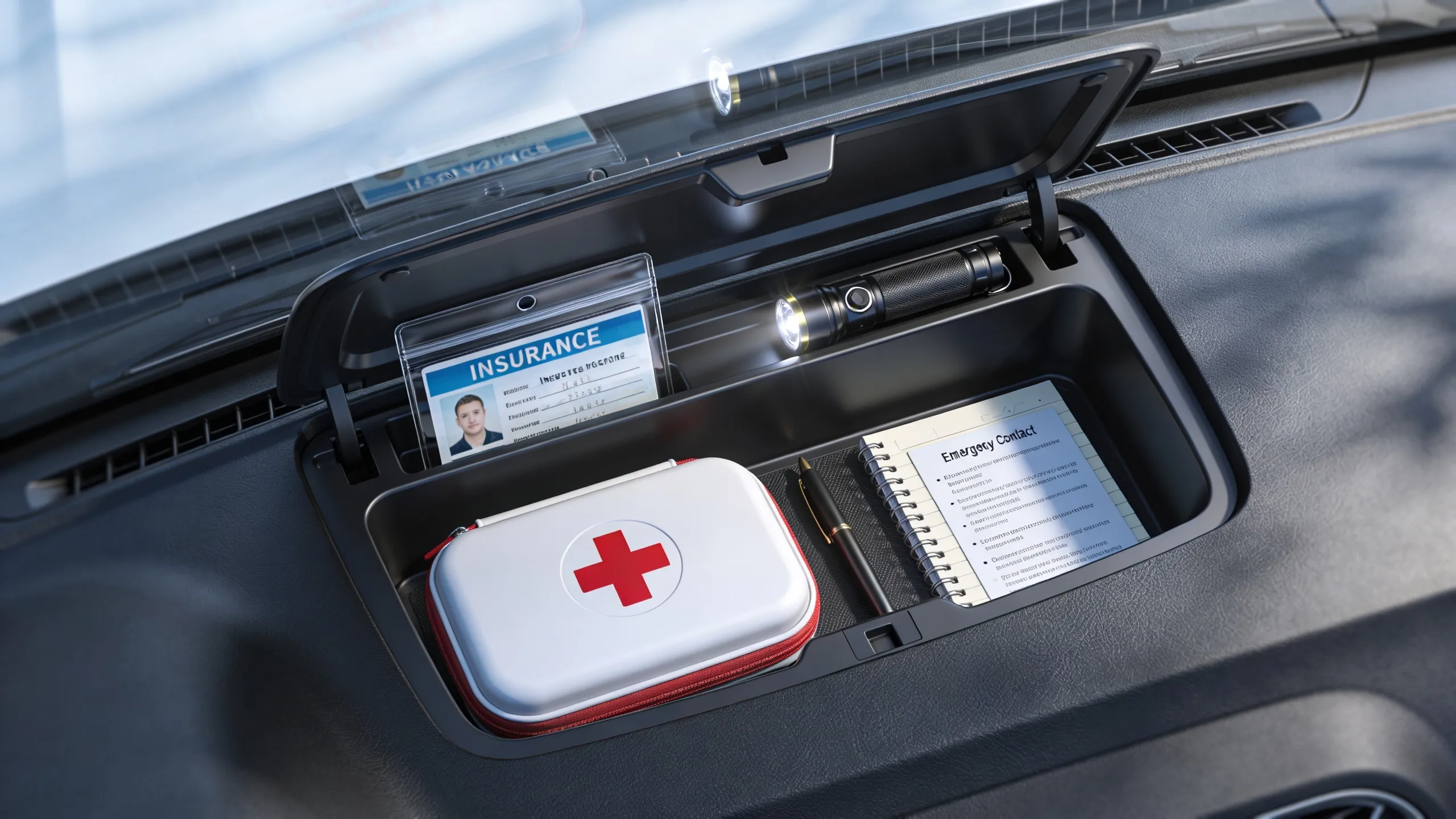
Documents to keep in the glove box

  • Insurance ID card: Most states require drivers to carry proof of insurance at all times. Keep a printed copy even if the insurer also provides a digital version, since phones can die or lock at the worst moments.
  • Vehicle registration: Needed to confirm ownership during a police report or insurance claim.
  • Driver's license copy: Storing a photocopy of the license provides backup in case the wallet is misplaced in the confusion after a collision.
  • Pen and notepad: Phones are useful, but a pen and paper are backup for capturing license plates, names, and phone numbers if the phone battery is low.
  • Blank accident information exchange form: Many insurers provide these. They list all the fields needed to document the other driver's information systematically.

Supplies to include in the emergency kit

Beyond documents, a compact kit stored in the trunk or under the seat covers the practical needs of a roadside situation:

  • Reflective triangles or road flares: Improve visibility for other drivers if the vehicle is stopped in a lane or on a shoulder
  • First aid kit: Covers minor injuries until medical help arrives
  • Phone charging cable and portable battery pack: Keeps the phone functional for documenting and calling
  • Flashlight: Useful if the collision happens at night or in a tunnel
  • Disposable camera (optional): An old-fashioned backup in case the phone fails

Phone apps and digital tools for accident documentation

Modern smartphones make on-scene documentation significantly more effective than it was even a decade ago. Several apps are specifically designed to guide drivers through the post-accident process.

Insurer apps

Most major insurance companies now offer dedicated mobile apps that include a built-in accident guide. These typically walk the user through each step: capturing photos of damage, entering the other driver's information, and filing a first notice of loss directly from the scene. Drivers should download their specific insurer's app before an accident, not after.

General accident documentation apps

Several third-party apps are designed for this purpose, regardless of insurance carrier. They prompt users to capture photos in the correct order, record GPS location automatically, generate a timestamped record of events, and store everything securely in the cloud. Search for "accident report" or "crash documentation" in the App Store or Google Play to find current options, as availability and features change regularly.

Additional tools worth using

  • Google Maps or Apple Maps: Screenshot or pin the exact location of the accident immediately after it happens
  • Phone camera video: A brief walkthrough video of the scene, vehicles, and surrounding conditions can capture context that individual photos miss
  • Voice memos: Recording a spoken account of what happened while memory is fresh creates a time-stamped record before details blur

What to document at the accident scene

Having the right tools is only half the equation. Knowing what to document ensures the information collected is actually useful during the claims process.

Information to collect from the other driver

  • Full legal name
  • Driver's license number and issuing state
  • Phone number
  • Insurance company name and policy number
  • Vehicle make, model, year, and color
  • License plate number and state

Scene documentation

  • Photographs of all vehicles from multiple angles, including wide shots that show the full scene and close-ups of every area of damage
  • Photos of the other driver's license, registration, and insurance card (with permission, where legally allowed)
  • Images of any visible skid marks, debris, or road hazards that contributed to the collision
  • Weather and road conditions, rain, ice, construction, or reduced visibility all become relevant in a claim
  • Traffic controls at the scene: stop signs, traffic lights, lane markings
  • Witness names and phone numbers, if any bystanders saw the collision

Notes to capture

Write down the time, date, and location as soon as the scene is safe. Note what each vehicle was doing immediately before impact. If law enforcement responds, record the officer's name and badge number and ask how to obtain a copy of the police report. The report number alone is often enough to request it later.

For a complete guide to the steps that follow, what to do when someone hits your car covers the post-accident process in detail.


Pre-selecting a body shop before an accident happens

One decision that drivers often make in a rushed and emotional state, choosing a repair facility, can actually be made in advance, when there is no pressure.

Why pre-selecting matters

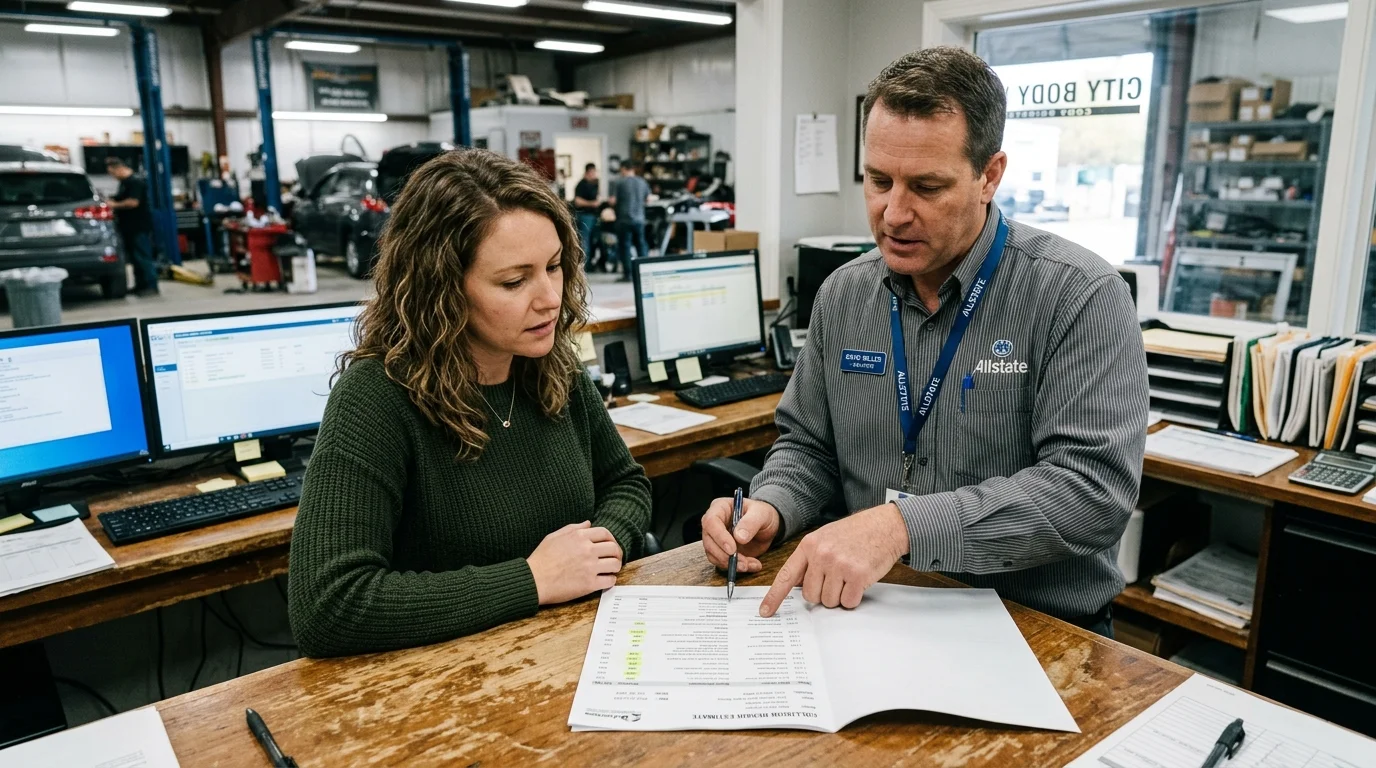
Insurance companies frequently steer policyholders toward their preferred network shops, known as Direct Repair Program (DRP) facilities. DRP shops have agreements with insurers that can include standardized pricing and cycle time requirements. This is not inherently bad, but it does mean the driver who has already chosen a preferred shop is less likely to be redirected without awareness.

Car owners have the legal right to choose their own repair facility in most states, regardless of what the insurance company suggests. Knowing the preferred shop before the accident removes one decision from a stressful situation.

What to look for when selecting a shop in advance

  • Certifications: Look for I-CAR (Inter-Industry Conference on Auto Collision Repair) Gold Class certification, which indicates technicians complete ongoing training in collision repair. OEM certifications from manufacturers like Toyota, Honda, or GM indicate the shop meets specific standards for those vehicles.
  • Reviews and reputation: Check Google, Yelp, and the Better Business Bureau for patterns, not just overall ratings.
  • Warranty policy: Reputable shops offer written lifetime warranties on their repair work.
  • Estimate process: Shops that provide transparent, itemized estimates are easier to work with during the claims process.

Save the shop's name, address, and phone number in the phone's contacts and on the paper accident form in the glove box. For collision repair needs, selecting a certified facility in advance gives car owners confidence going into a claim.

Finding options in advance is straightforward, auto body shops near you can be browsed and compared by location, certifications, and services before any accident occurs.


Dashcam considerations: is it worth it?

Dashcams have become increasingly common, and for good reason. A dashcam is a small camera that mounts to the windshield or rearview mirror and records continuously while the vehicle is in motion. Some models also include rear-facing cameras and parking mode, which records footage even when the vehicle is parked.

What a dashcam provides

Dashcam footage can resolve disputes about fault when driver accounts conflict. In cases where the other driver claims a different sequence of events, clear video evidence eliminates ambiguity. According to the Insurance Information Institute, staged accidents and insurance fraud cost the industry billions annually, dashcam footage is one of the most effective countermeasures available to individual drivers.

A dashcam also records driver behavior that leads to an accident, which works both ways. If the footage shows that the other driver ran a red light, it supports the claim. If it shows that the policyholder was also at fault in some way, that information will exist regardless.

Practical considerations

  • Price range: Entry-level dashcams start around $50 to $100. Models with rear cameras and parking mode range from $150 to $300 or more.
  • Storage: Most dashcams use a loop-recording system on a memory card, overwriting older footage automatically.
  • Insurance discounts: Some insurers offer discounts for drivers who use dashcams, though this varies by carrier.
  • Installation: Basic models are plug-and-play. Hardwired models that support parking mode typically require professional installation.

A dashcam is a one-time investment that pays for itself quickly if it helps resolve even a single disputed claim.


A mini-story: what preparation actually looks like in practice

Marcus had been driving for 19 years without a serious accident. When a driver ran a red light and struck the passenger side of his sedan, his first instinct was to check on the other driver. His second was to reach for the glove box.

Inside was a laminated card with his insurance company's claims number, his policy number, and a blank accident exchange form. His phone had his insurer's app installed. Within four minutes of pulling to the shoulder, he had photographed both vehicles from six angles, captured the other driver's license and insurance card on camera, and pinged the GPS location.

When the insurance adjuster called two days later, Marcus already had a preferred body shop selected from a search he had done months earlier. The claim was straightforward. The repair was completed within the expected timeline. The preparation he had done in a single afternoon made a meaningful difference in a situation that could have been significantly more chaotic.


Key takeaways

Preparing for an accident before it happens is a practical, low-effort step that every driver can take. The car accident preparation checklist comes down to five areas:

  1. Know your insurance coverage: Understand what collision, comprehensive, and uninsured motorist coverage pays for before filing a claim.
  2. Build the glove box kit: Keep insurance card, registration, a pen, a notepad, and a blank accident exchange form in an accessible location.
  3. Set up phone tools: Download the insurer's app and a documentation app. Know how to use them before needing them.
  4. Identify a preferred body shop: Research certified shops in the area now, while there is no pressure. Save the contact information.
  5. Consider a dashcam: Even a basic model provides a layer of protection that written documentation cannot.

For additional guidance on navigating the process after a collision occurs, the AutoBodyShopNear. com collision repair guide covers repair options, cost ranges, and what to expect from the body shop experience. Drivers who have already done the preparation work described here will be better positioned at every step.


Frequently asked questions

What documents should every driver keep in the car for an accident?
At a minimum, every driver should keep a current insurance ID card, vehicle registration, and a pen with a notepad. A blank accident information exchange form, listing all the fields needed to collect the other driver's details, is a practical addition. A photocopy of the driver's license serves as a backup if the wallet is misplaced at the scene.

What is the most important thing to do immediately after a car accident?
The first priority is ensuring everyone involved is safe and, if needed, calling 911. Once the scene is secure, begin documenting: photograph all vehicles from multiple angles, capture the other driver's license and insurance information, note the time, date, location, and conditions, and collect contact information from any witnesses.

Does having a dashcam lower car insurance rates?
Some insurance carriers offer discounts for drivers who use dashcams, but this varies significantly by insurer and state. The primary value of a dashcam is evidentiary, it provides objective footage that can resolve disputed claims. Drivers interested in a potential discount should contact their carrier directly to ask whether dashcam use affects their premium.

Can an insurance company require a driver to use a specific body shop?
Insurance companies can recommend or prefer certain body shops through their Direct Repair Program (DRP) networks, but in most states, drivers have the legal right to choose their own repair facility. The insurer is obligated to pay for a fair and complete repair regardless of which certified shop performs the work.

How much does a dashcam cost, and is it worth the investment?
Entry-level dashcams typically cost between $50 and $100 for a front-facing unit. Models with rear cameras and parking mode range from $150 to $300 or more. For drivers who want protection against disputed claims or insurance fraud scenarios, the upfront cost is generally modest relative to the potential benefit in a single incident.

What phone apps are useful for documenting a car accident?
Most major insurers offer their own mobile apps with built-in accident guides. Third-party accident documentation apps are also available and guide users through capturing photos, recording GPS location, and generating a timestamped report. Downloading the insurer's app and familiarizing with it before any accident occurs is the most practical step.


Insurance processes and consumer rights vary by state and insurance carrier. This guide is intended for general informational purposes. Consult your specific policy and a licensed professional for advice applicable to your situation.

Last updated: May 2026

Related Articles
Newsletter

Get repair tips in your inbox

No spam, no sales pitches. Just practical advice on collision repair, insurance claims, and car maintenance — twice a month.

Join 2,400+ car owners. Unsubscribe anytime.