The fastest way to spot a fake body shop review is to look for what's missing: specific repair details, named employees, and a realistic mix of praise and complaint. Fake reviews tend to be vague, uniformly glowing, and posted by accounts with little or no other review history. With Google blocking over 240 million fake or policy-violating reviews in 2024 alone and the FTC now enforcing civil penalties of up to $53,088 per violation under its Consumer Review Rule, the stakes for businesses that manipulate reviews have never been higher — but fake reviews still slip through, and it's on you to recognize them before choosing a shop.
Key Takeaways
- Fake reviews lack specifics — real customers mention the type of repair, how long it took, and who they worked with.
- A sudden burst of 5-star reviews over a few days or weeks is the single strongest signal of review manipulation.
- Google's February 2026 policy update explicitly targets "unusual volumes or patterns of review contributions" as grounds for removal.
- The FTC's Consumer Review Rule, effective October 2024, makes buying or incentivizing fake reviews a federal violation with penalties up to $53,088 per offense.
- A shop's response to negative reviews reveals more about quality than its star count — look for accountability, not defensiveness.
Why Fake Reviews Are an Auto Body Shop Problem
Auto body repair is one of the most review-sensitive industries. Most people choose a collision repair shop once every few years, often under stress after an accident. They don't have a regular shop the way they have a regular mechanic, so they lean heavily on Google reviews and star ratings to make a fast decision. That makes auto body shops a prime target for review manipulation.
The incentive is straightforward: a shop sitting at 4.8 stars pulls dramatically more clicks and phone calls from Google Maps than one at 4.2 stars. Some shops earn that rating honestly. Others take shortcuts — paying for reviews, asking employees to post under fake accounts, or using review-generation services that create entirely fabricated feedback. According to BrightLocal's 2024 Local Consumer Review Survey, businesses penalized by Google for fake review activity saw their map pack rankings drop by 67% within 30 days, and 82% lost "People Also Search" visibility. The short-term gain rarely survives a platform crackdown.
For consumers, the problem is practical: a fake 4.9-star rating can steer you toward a shop that delivers auto body repair that doesn't match the hype. Knowing what to look for protects your car and your wallet.
Six Red Flags That a Review Is Fake
No specific repair details
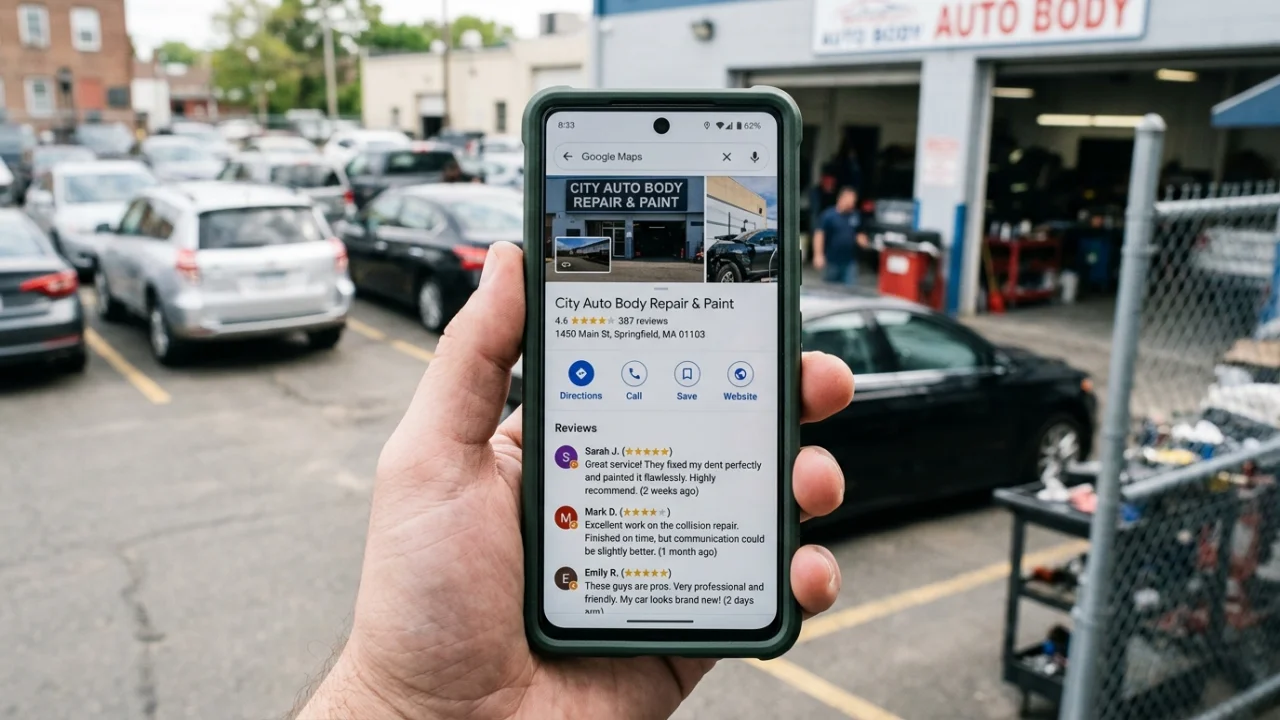
A real customer who had their bumper repaired or a fender repainted will usually mention it. Fake reviews stay vague: "Great service!" or "Highly recommend this place!" without naming what was actually done. When you see a cluster of reviews that could apply to any business in any industry, treat them with skepticism.
All 5 stars with no complaints
No shop is perfect. Even excellent body shops occasionally run behind schedule, miscommunicate about parts, or deliver work that needs a minor touch-up. A profile with dozens of 5-star reviews and zero mention of any friction is statistically unlikely and should make you scroll more carefully.
A sudden burst of reviews in a short window
This is the strongest signal. If a shop received two reviews per month for years and then suddenly got 15 in one week, something changed — and it probably wasn't a sudden surge of satisfied customers. Google's February 2026 policy update specifically targets "unusual volumes or patterns of review contributions indicative of efforts to manipulate a place's rating" (Google Business Profile Prohibited Content Policy, updated February 2026).
Reviewer accounts with one review or reviews in far-flung cities
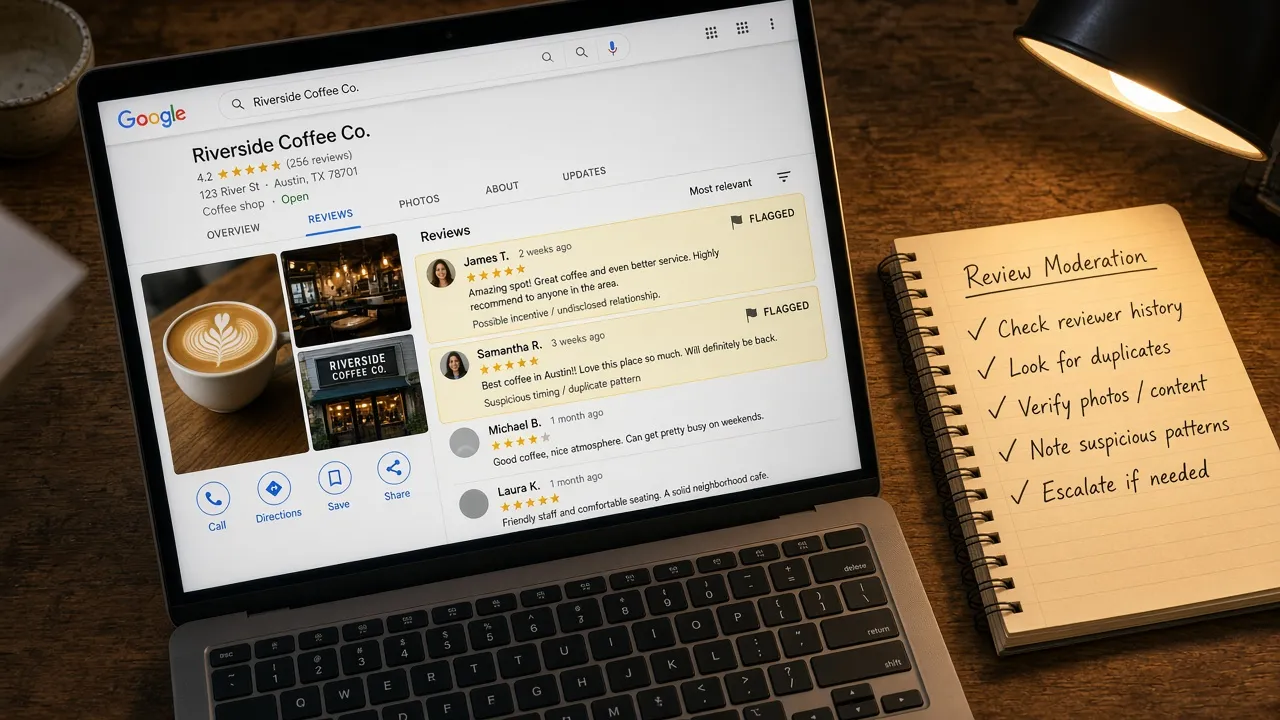
Click on the reviewer's profile. If they've posted a single review ever — yours — or if their other reviews are for businesses scattered across cities hundreds of miles apart, the account may be a paid reviewer or a bot. Geographic inconsistency is a well-known marker that review-detection algorithms track.
Suspiciously similar language across reviews
When multiple reviews use the same phrasing — "exceeded my expectations," "like-new condition," "would recommend to anyone" — in nearly identical sentence structures, they were likely written by the same person or generated by the same template. Real reviews have varied vocabulary, sentence length, and tone because real people write differently from one another.
Reviews that mention services the shop doesn't offer
If a body shop that only does collision repair has reviews praising its "amazing oil change" or "windshield tinting," those reviews were probably posted to the wrong listing or purchased from a bulk review service that didn't bother to customize. This one is easy to check against the shop's actual service list.
What Real Reviews Look Like
Genuine customer reviews share recognizable traits that are hard to fabricate at scale:
- They name what was fixed. "They repaired the rear quarter panel and blended the paint into the adjacent panels" tells you the reviewer was actually there.
- They mention timelines. "Took about 8 days, they called me twice with updates" reflects a real experience with a beginning and end.
- They name staff. "Mike at the front desk" or "the estimator, Sarah" — fabricated reviews almost never include employee names because the fake reviewer doesn't know them.
- They include a complaint alongside praise. "Paint match was perfect but the rental car coordination was a hassle" reads as authentic because it's balanced.
- They describe the insurance process. Body shop reviews often mention the insurer by name and whether the shop handled the claim smoothly. That level of process detail is almost never present in fake reviews.
When you're looking for a good cheap body shop, these details are more valuable than the star count. A 4.3-star shop with 50 detailed reviews from real customers is almost always a safer bet than a 4.9-star shop with 200 reviews that read like they were written by the same person.
How Google and the FTC Are Fighting Back
Google has steadily increased its automated detection. The platform blocked over 240 million reviews in 2024 that violated its policies, using machine learning models that analyze posting patterns, account age, geographic plausibility, and linguistic similarity. The February 2026 policy update added explicit language targeting coordinated review campaigns and reviews from individuals with no genuine customer experience.
On the enforcement side, the FTC finalized its Consumer Review and Testimonials Rule in August 2024, which took effect on October 21, 2024. The rule makes it a federal violation to buy or sell fake reviews, use undisclosed insider reviews, suppress negative feedback, or incentivize reviews expressing a particular sentiment (Federal Trade Commission, "Consumer Reviews and Testimonials Rule," August 2024). In December 2025, the FTC issued its first batch of warning letters to 10 companies, demanding corrective action within days and threatening civil penalties of up to $53,088 per violation.
For consumers, this means the ecosystem is slowly improving — but enforcement is reactive, not preventive. Fake reviews that are already posted may stay up for months before detection. Your own ability to read critically remains your best filter.
What to Do If You Suspect a Shop Has Fake Reviews
Start by reading the negative reviews. Shops can buy 5-star reviews, but they can't easily remove legitimate 1- and 2-star feedback (Google's removal process requires a policy violation, not just a business owner's preference). The negative reviews often contain the most useful information about a shop's actual weaknesses.
Next, check how the shop responds to criticism. A shop that addresses complaints directly — acknowledging the issue, explaining what happened, offering to make it right — demonstrates accountability. A shop that responds defensively, denies everything, or threatens the reviewer is telling you something about how they handle problems in the bay, not just online. To understand what star ratings tell you and don't tell you, context matters more than the number.
Cross-reference with other platforms. Check Yelp, the Better Business Bureau, and Facebook in addition to Google. A shop that has 4.9 stars on Google but 3.2 stars on Yelp may have invested in one platform but not others. Consistent ratings across platforms are a stronger trust signal.
Finally, ask for references directly. A shop with nothing to hide will give you the names of recent customers — or at minimum, point you to specific reviews from verified insurance jobs. If asking for a reference makes the front desk uncomfortable, that's information too.
Sources
- Federal Trade Commission — Auto Warranties — consumer rights regarding auto repair and warranties
- Insurance Information Institute — insurance guidance for consumers
Frequently Asked Questions
How common are fake reviews for auto body shops?
Industry estimates suggest that roughly 10 to 15% of all Google reviews across local businesses are fake or policy-violating, and auto body shops are among the most review-sensitive categories. Google blocked over 240 million reviews platform-wide in 2024 alone. Shops in competitive metro areas are more likely to engage in review manipulation because the margin between a 4.3-star and 4.8-star rating directly affects call volume from Google Maps.
Can I report a fake Google review?
Yes. On Google Maps, click the three-dot menu next to any review and select "Report review." Google will evaluate the report against its content policies. Reviews that contain no genuine customer experience, use fake accounts, or appear to be part of a coordinated campaign are eligible for removal. The process typically takes several days to a few weeks. You can also report patterns of suspicious reviews through the Google Business Profile support channel.
What happens to a business caught buying fake reviews?
Google may remove the fake reviews, suspend the business's Google Business Profile, or reduce the profile's visibility in search and maps results. Separately, the FTC's Consumer Review Rule — effective October 2024 — makes buying or incentivizing fake reviews a federal violation carrying civil penalties up to $53,088 per offense. The FTC issued its first enforcement warning letters in December 2025 and has signaled that penalties will escalate.
Are review-gating practices also considered fake?
Yes. Review gating is when a business surveys customers first and then only directs satisfied customers to leave a public review, while routing unhappy customers to a private feedback form. Google's policies explicitly prohibit this practice, and the FTC's rule also targets review suppression. A shop that selectively solicits only positive reviews is distorting its public profile even if each individual review is genuine.
Should I trust a body shop with a perfect 5.0-star rating?
Be cautious. A perfect 5.0-star rating with a large number of reviews is statistically unusual for any service business. Even the best auto body shops occasionally have customers who are mildly dissatisfied with wait times, communication, or minor cosmetic issues. A rating between 4.3 and 4.8 with a mix of detailed positive and constructive negative reviews is typically a healthier trust signal than a flawless score, especially when you can read how the shop responds to the occasional complaint.