Someone Hit My Car Door in a Parking Lot, Now What?

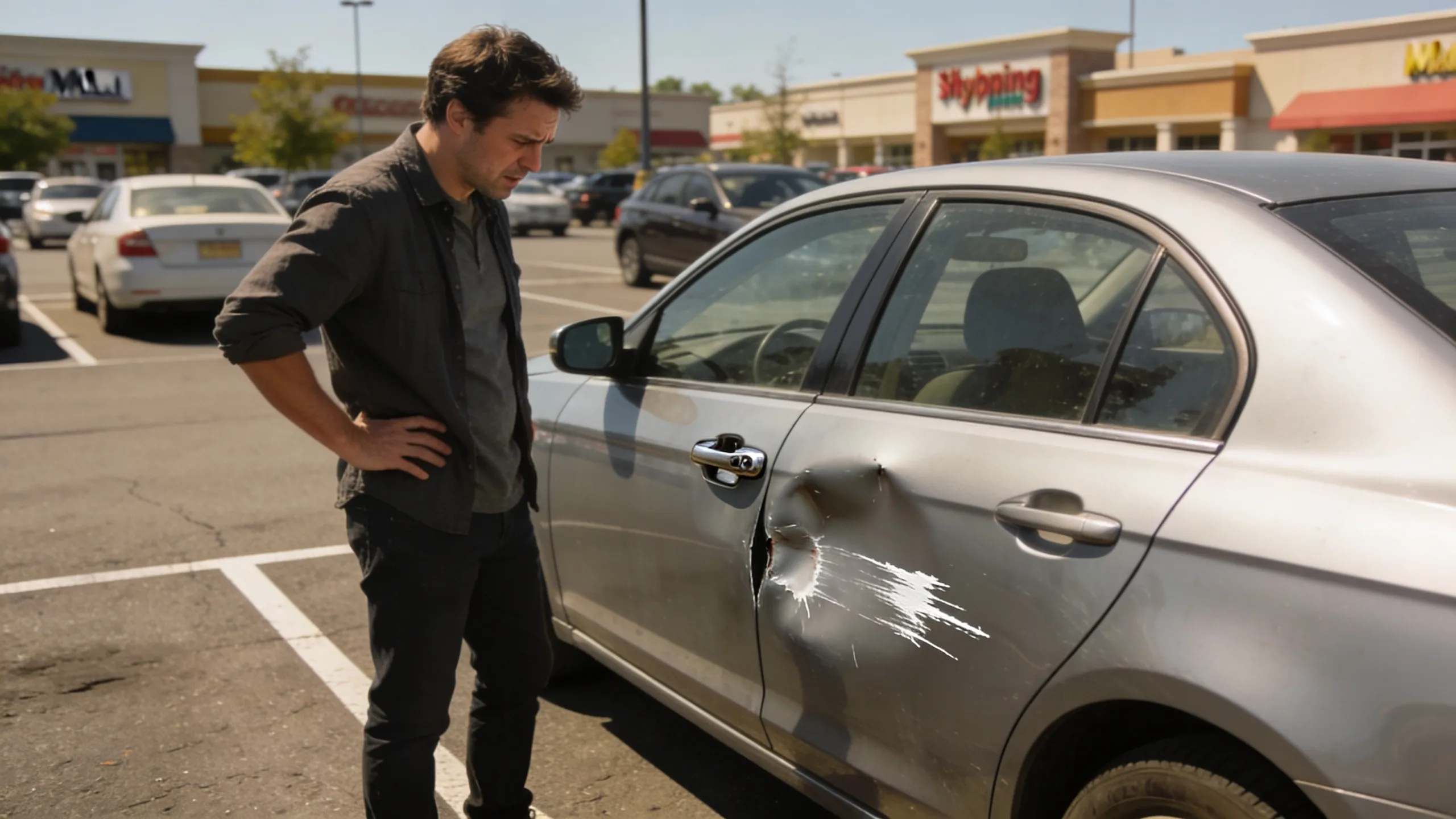
Returning to a parking lot to find a fresh dent in the driver's door, with no note, no contact information, and no witness in sight, is one of the most frustrating experiences a car owner faces. Someone hit your car door and left without taking responsibility, and now the repair bill is your prob...

insurance-claimsMar 25, 202613 min read
AS

Ambika Sharma

Brings 12 years of project management and technical operations experience to Auto BodyShop Near. Ambika oversees partnerships, city expansion, and listing quality across all states.

Returning to a parking lot to find a fresh dent in the driver's door, with no note, no contact information, and no witness in sight, is one of the most frustrating experiences a car owner faces. Someone hit your car door and left without taking responsibility, and now the repair bill is your problem.

This situation happens far more often than most drivers realize. The National Insurance Crime Bureau estimates that hit-and-run incidents account for roughly 11% of all crashes in the United States, with parking lot incidents making up a significant share. The good news: car owners who act quickly, document the damage properly, and understand their insurance options are in a much stronger position than those who simply drive home and hope for the best.

This guide covers everything from what to do in the first 30 minutes to how insurance claims work for this type of damage, what car door dent repair actually costs, and how to protect yourself from paying more than you should.


What to Do Immediately After Finding the Damage

The first 30 minutes after discovering parking lot car door damage are critical. Evidence disappears, witnesses leave, and memories fade. Acting methodically now can be the difference between a smooth insurance claim and a frustrating out-of-pocket expense.

Step 1: Stay at the Scene and Document Everything

Before moving the vehicle, document the damage thoroughly with photographs. Use a smartphone camera and capture:

  • Wide shots showing the car's position in the parking lot, including nearby spaces and surrounding vehicles
  • Close-up shots of the dent, scratch, or paint transfer from multiple angles
  • Any paint transfer on the damaged panel (this can indicate the color of the other vehicle)
  • The time and date stamp visible on the photos (most smartphones include this automatically in metadata)
  • Nearby landmarks, signage, or store fronts to establish the location clearly

Documentation quality matters when filing a claim. Insurance adjusters look for evidence that the damage occurred as described, and thorough photographs establish a clear record.

Step 2: Look for Security Cameras

Security cameras in parking lots are more common than many drivers realize. Retail stores, banks, restaurants, and parking garages often have cameras positioned to cover the parking area. Within the first few minutes, survey the area and note any cameras mounted on:

  • Building exteriors facing the parking lot
  • Light poles or overhead structures
  • ATMs or bank drive-throughs adjacent to the lot
  • Gas station canopies nearby

This matters because security camera footage of a parking lot hit and run is often only retained for 24 to 72 hours before being overwritten. Requesting footage quickly, within the same day if possible, is essential.

Step 3: Ask Nearby Businesses for Footage

Walk into the nearest store, restaurant, or business and speak with a manager. Explain that your vehicle was damaged in the parking lot and ask whether their security system captured the area around your parking space. Most businesses are willing to help when approached directly and promptly.

If the business agrees to pull footage, ask them to preserve it and confirm whether it can be shared with law enforcement or your insurance company. Some businesses require a formal records request or a police report before releasing footage.

Step 4: Look for Witnesses

Before leaving the lot, ask anyone nearby whether they saw the incident. This includes:

  • Store employees who may have been near doors or windows
  • Other customers loading groceries or merchandise nearby
  • Security guards or parking lot attendants

A single witness who can describe the other vehicle, color, make, model, or even partial license plate, significantly strengthens an insurance claim and any potential police report.

Step 5: File a Police Report

Many car owners skip this step, assuming a police report is only necessary for serious accidents. However, filing a report for a hit and run parking lot incident serves several important purposes:

  • It creates an official record of the event and the date it occurred
  • Insurance companies often require or strongly prefer a police report for uninsured motorist or collision claims
  • If the other driver is identified later (through camera footage or a witness), the report supports any legal or civil action

Most police departments allow non-emergency reports to be filed by phone, online, or in person. Keep the case or report number for your insurance claim.


Real Situations: How Car Owners Handled Parking Lot Damage

Understanding how others have navigated this situation, and what worked or didn't, helps set realistic expectations.

Marcus, 34, Chicago: Marcus returned to his SUV in a grocery store parking lot to find a deep door dent with white paint transfer. He immediately photographed everything, walked into the store, and asked the manager to pull footage from their exterior camera. The footage clearly showed a white sedan opening its door into his vehicle and driving away. With the partial plate number visible in the footage, local police identified the other driver within two days. Because a third party was identified, Marcus filed through the other driver's liability insurance and paid nothing out of pocket. Total repair cost for the car door dent: $740.

Priya, 28, Atlanta: Priya found a door ding on her leased sedan with no witnesses and no camera coverage in the smaller strip mall lot. She filed a police report the same afternoon, then contacted her insurance company the following morning. Her policy included collision coverage with a $500 deductible. The estimate from an auto body shop came in at $620, meaning she paid the $500 deductible and insurance covered the remaining $120. She chose not to file because the out-of-pocket difference was small, had the repair done at a local shop, and moved on. The lesson: knowing your deductible before deciding whether to file is always the right first step.

Derek, 51, Seattle: Derek discovered a long scrape running the full length of his rear passenger door after a weekend shopping trip. He had no information about the other vehicle. His insurer offered to process the claim under collision, but Derek decided to get two estimates first. One shop quoted $1,200 for conventional repair; another quoted $480 using paintless dent repair (PDR), a technique that removes dents without disturbing the paint surface. The scrape was shallow enough that PDR was a viable option. Derek paid out of pocket and avoided a potential premium increase. He now uses AutoBodyShopNear. me to search for certified shops whenever he needs repair estimates.


How Insurance Claims Work for Parking Lot Hit and Run Damage

Filing a claim for parking lot car door damage depends heavily on what information is available and what coverage the car owner carries.

If the Other Driver Is Identified

When the responsible party is known, through a note they left, a witness account, security camera footage, or police investigation, the claim goes through their liability insurance. The car owner files a third-party claim with the at-fault driver's insurer. If the other driver is uninsured, the car owner's own uninsured motorist property damage (UMPD) coverage may apply, depending on the state and policy.

If the Other Driver Is Unknown (True Hit and Run)

When no information about the other vehicle is available, the car owner has two main options:

Collision Coverage: Covers vehicle damage regardless of fault. The car owner pays their deductible, and the insurer covers the remaining repair cost. This is the most common path for hit and run parking lot damage when the other party is unknown.

Uninsured Motorist Property Damage (UMPD): Some states and policies allow UMPD to be used for hit-and-run damage, sometimes with a lower deductible than collision coverage. Requirements vary significantly by state, and some states require physical contact with an uninsured vehicle to trigger UMPD. Check the specific policy language or speak with an agent before assuming this coverage applies.

Should You File a Claim or Pay Out of Pocket?

This is one of the most common questions car owners face after parking lot car door damage. The decision depends on several factors:

Factor Consideration
Repair cost estimate Compare estimate to your deductible before filing
Deductible amount If damage is near or below deductible, out-of-pocket may be smarter
Claims history Multiple claims in a short period can affect future premiums
Vehicle value On older vehicles, cosmetic repairs may not be worth a claim
Lease or loan Lessors and lenders may require maintaining the vehicle's condition

A general rule: if the repair cost is less than 1.5 times the deductible, paying out of pocket often makes financial sense. However, this varies by insurance carrier and individual circumstances.

Important: Insurance processes vary by state and carrier. Consult your specific policy and speak with your agent or adjuster before making a filing decision.


Understanding Car Door Dent Repair Costs

Car door dent repair costs vary considerably based on the size and severity of the damage, whether paint is involved, and local labor rates.

Paintless Dent Repair (PDR)

Paintless Dent Repair, PDR for short, is a technique that uses specialized tools to push or pull dents back to their original shape without sanding, filling, or repainting the panel. PDR is effective when:

  • The paint is intact (no breaks, cracking, or chipping in the clear coat)
  • The dent is not too sharp or severe
  • The dent is accessible from behind the panel

PDR is typically faster and less expensive than conventional body repair. Cost ranges for door dent repair using PDR:

Dent Size Typical PDR Cost Timeline
Small (quarter-sized or less) $75 to $150 Same day or a few hours
Medium (golf ball to baseball sized) $150 to $350 Same day to one day
Large or multiple dents $350 to $600+ One to two days

Conventional Body Repair (With Paint)

When the paint has been scratched, chipped, or transferred from the other vehicle, conventional repair is usually necessary. This involves sanding, filling, priming, repainting, and blending the new paint into adjacent panels.

Damage Type Typical Repair Cost Timeline
Minor scratch + small dent $400 to $800 Two to four days
Door panel dent with paint damage $700 to $1,400 Three to five days
Full door panel repaint $900 to $1,800 Three to seven days

Costs vary based on geographic location, labor rates in major metro areas like Los Angeles, New York, and Chicago run 40 to 60% higher than rural markets. Vehicle type also matters: luxury vehicles and vehicles with specialty paint colors cost more to repair accurately.

For a free estimate from certified auto body shops in your area, browse auto body shops near you on AutoBodyShopNear. me.


How to Use Security Camera Footage in a Parking Lot Hit and Run

Security camera footage is among the most powerful tools available to car owners dealing with a hit and run parking lot incident. Here is a practical approach to requesting and using it.

Identify Camera Locations Quickly

Within the first hour of discovering the damage, identify all potential camera sources in the area. This includes cameras that may be pointed at your general location even if they were not primarily positioned to cover your exact parking space. A camera covering a store entrance may capture vehicles in the background.

Make a Formal Request to the Business

When approaching a business for footage, be specific:

  • Provide the date and approximate time window (extend the window by 30 minutes on each side of when you arrived and when you discovered the damage)
  • Describe the general area of the parking lot where your vehicle was parked
  • Ask whether the footage is still available and how long it is retained
  • Get the name and contact information of the person who spoke with you

If the business cannot or will not immediately share footage, ask whether they will preserve it pending a formal request from law enforcement.

Provide Footage to Police

If you obtain footage or are told it exists, provide this information to the police officer handling your report. In many jurisdictions, officers can formally request footage as part of a hit-and-run investigation more effectively than an individual car owner can.

Share with Your Insurance Company

If footage shows the other vehicle clearly enough to identify a make, model, color, or partial plate, share it with your insurance adjuster. Even partial identification can help the insurer subrograte, meaning they pursue the at-fault driver directly to recover claim costs, which protects the car owner from a claim affecting their rates.


Getting Repair Estimates After Parking Lot Car Door Damage

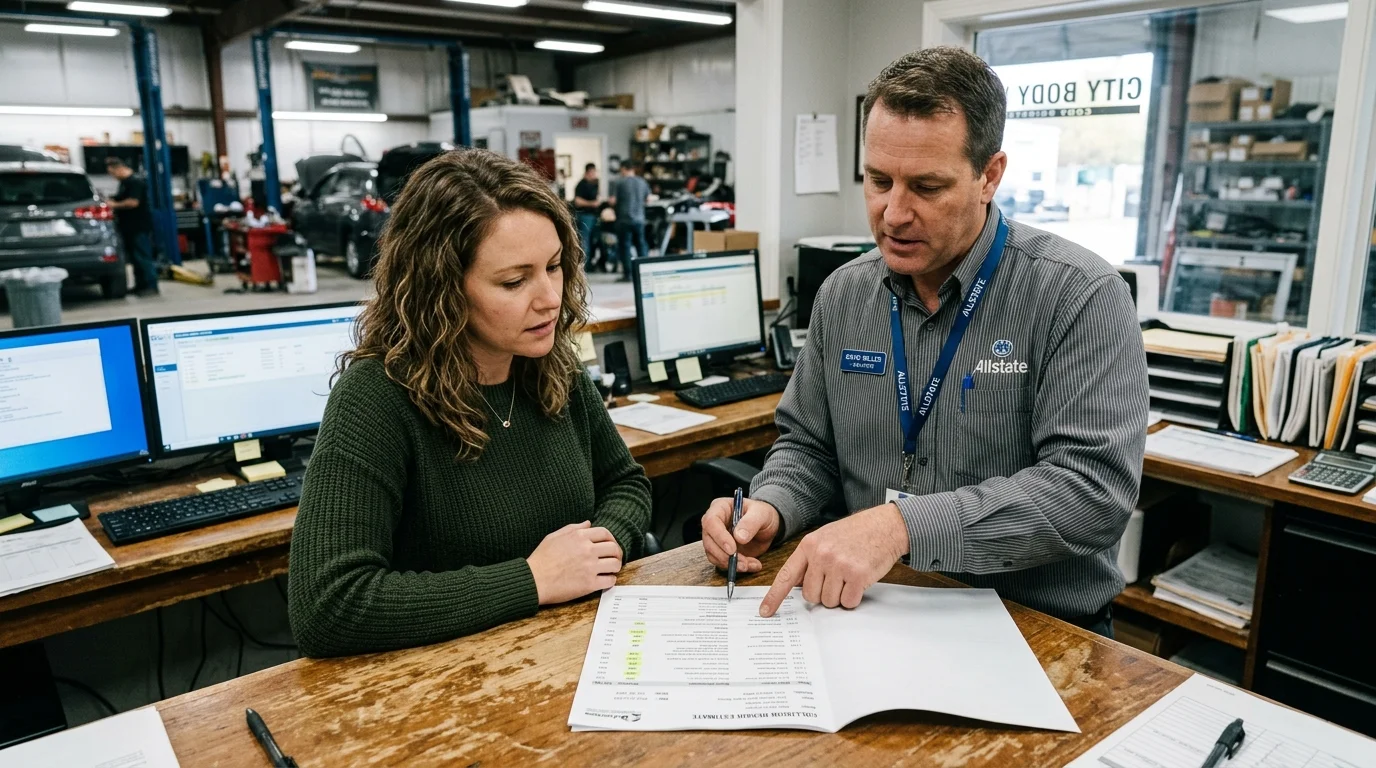
Before deciding how to proceed with repairs, car owners should obtain at least two estimates from reputable auto body shops. This serves multiple purposes: it establishes a fair market range for the repair, gives the insurer a basis for valuing the claim, and helps identify shops with appropriate certifications and capabilities for the specific repair.

What to Look for in an Estimate

A complete, professional estimate for car door dent repair should specify:

  • Labor hours for removal, repair, and reinstallation of any trim or components
  • Whether PDR or conventional repair is being proposed, and why
  • Paint materials, including the type of paint and clear coat to be used
  • Any blending costs for adjacent panels to ensure a seamless color match
  • Warranty terms for both parts and labor

Shops certified by OEM (Original Equipment Manufacturer) programs or carrying I-CAR (Inter-Industry Conference on Auto Collision Repair) certifications have demonstrated training standards that many insurers and car owners value for quality assurance.

Questions to Ask the Shop

  • Is the damage a candidate for paintless dent repair, or will conventional repair be necessary?
  • Will the paint match exactly, or will blending adjacent panels be required?
  • How long will the repair take, and is a loaner or rental available?
  • Does the shop work directly with my insurance company?
  • What warranty do you offer on parts and labor?

If the car door damage is severe enough to affect the window regulator, door hardware, or door alignment, those components should be included in the estimate. Incomplete estimates that omit related damage can lead to surprises during repair.

For filing a claim with documentation, visit AutoBodyShopNear. me to get a repair estimate before contacting your insurer, knowing the true cost helps make a smarter filing decision.


Frequently Asked Questions

Q: Someone hit my car door and left no note. Do I have to pay for the repair myself?

Not necessarily. If the other driver is identified through a witness, camera footage, or police investigation, their liability insurance should cover the repair. If the driver cannot be identified, your collision coverage (if you carry it) covers the damage minus your deductible. Without collision coverage and without identifying the other driver, the repair would typically be out of pocket.

Q: Should I file a police report for a parking lot door ding?

Yes, in most cases. Even a minor door dent from a hit and run parking lot incident benefits from a police report. It creates an official record for your insurance claim, and the report number is often required when filing under collision or uninsured motorist coverage. Many departments allow online or phone reporting for non-emergency incidents like this.

Q: Will my insurance rates go up if I file a claim for someone hitting my car door?

It depends on the carrier, the state, and your claims history. In many cases, a single not-at-fault claim (where you were parked and hit by another vehicle) has a limited impact on premiums. However, if the other driver cannot be identified, some insurers treat the claim similarly to an at-fault incident for rating purposes. Ask your agent specifically how a hit-and-run claim would affect your policy before filing.

Q: How long do parking lot security cameras keep footage?

Most retail and commercial parking lot cameras retain footage for 24 to 72 hours, though some systems retain footage for up to 30 days. The retention period varies by system and business. This is why requesting footage on the same day as the incident is critical, waiting even 48 hours may mean the footage has already been overwritten.

Q: Can paintless dent repair fix my car door dent?

PDR is an effective option when the paint surface is undamaged. If the other vehicle scratched or transferred paint when it hit your door, conventional repair with repainting is typically required. An auto body shop can assess the damage and tell you which method is appropriate during a free estimate.

Q: What if the repair cost is less than my deductible?

If the repair estimate is less than or close to your deductible, filing a claim may not be financially beneficial, you would pay the full repair cost as the deductible anyway, and the claim could affect future premiums. In this case, paying out of pocket and getting repair done at an auto body shop is often the smarter choice. Always get at least two estimates before deciding.


Key Takeaways

Discovering that someone hit your car door and left is frustrating, but acting quickly and systematically gives car owners the best chance of a fair outcome.

The most important immediate steps are thorough photo documentation, a search for security camera footage, and filing a police report. These three actions create the foundation for any insurance claim or future identification of the other driver.

On the insurance side, the decision to file should be based on the actual repair cost relative to the deductible, the claims history on the policy, and a clear understanding of what coverage applies. Collision coverage is the most common path for true hit-and-run situations where the other driver cannot be identified.

Car door dent repair costs range from $75 to $150 for minor PDR work to $1,800 or more for conventional repair with full panel painting, depending on damage severity and local labor rates. Getting multiple estimates from certified shops ensures the car owner has an accurate basis for comparison.

For help finding qualified auto body shops and getting repair estimates after parking lot car door damage, browse certified shops near you at AutoBodyShopNear. me. Understanding the full repair process, from collision repair options to paintless dent repair, helps car owners make informed decisions and avoid overpaying for work they need done.


Last updated: May 2026. Insurance processes and coverage vary by state and carrier. The information in this guide is for educational purposes. Consult your specific policy and a licensed insurance professional for advice specific to your situation.

Related Articles
Newsletter

Get repair tips in your inbox

No spam, no sales pitches. Just practical advice on collision repair, insurance claims, and car maintenance — twice a month.

Join 2,400+ car owners. Unsubscribe anytime.