Two repair methods dominate the dent repair market: paintless dent repair (PDR) and traditional body work. Same basic goal, restoring a vehicle's appearance after dents, dings, or impact damage, but completely different processes, price tags, and long-term outcomes.
PDR is a technique where a technician uses specialized metal rods and picks to massage a dent back into shape from behind the panel, without ever touching the paint surface. Traditional dent repair, also called conventional body work, involves sanding, body filler (sometimes called "bondo"), primer, paint, and clear coat. Both are legitimate professional methods. Each has a narrow set of conditions where it works best.
Choosing the wrong method for a given dent can mean paying more than necessary, or ending up with a repair that doesn't hold. This guide explains how each approach works, what each costs, when each produces the better outcome, and which situations make one or the other the only viable option.
PDR vs traditional repair at a glance
PDR costs $75–$500 per dent and preserves factory paint, making it the best choice for round dents with intact paint. Traditional body work costs $300–$1,500+ per panel and is required when paint is cracked, metal is creased or stretched, or body lines are involved. PDR is faster. Traditional repair handles a wider range of damage.
The comparison table below captures the core differences at a glance.
| Factor | Paintless dent repair (PDR) | Traditional body work |
|---|---|---|
| Average cost | $75–$500 per dent | $300–$1,500+ per panel |
| Typical timeline | 1–4 hours (often same day) | 2–5 business days |
| Paint preserved? | Yes, original factory paint intact | No, paint is removed and reapplied |
| Repair quality | Restores to factory shape when eligible | Good for severe damage; match may vary |
| Best for | Small-to-medium round dents, hail damage, door dings | Cracked paint, sharp creases, large deformations |
| Limitations | Paint must be intact; no sharp creases; metal cannot be stretched | Costlier, longer turnaround, potential color mismatch |
| Effect on resale value | Preserves original paint (positive for resale) | Paint blend may raise questions with buyers |
| Insurance coverage | Often covered under thorough claims | Covered under collision and full claims |
This table is a starting point. The right choice depends on the exact nature of the dent, which the sections below explain in detail.
How paintless dent repair (PDR) works
Paintless dent repair is a precision process. When done correctly on an eligible dent, it produces results that are indistinguishable from the original factory panel. The method has been refined since the 1980s and is now standard at professional body shops and specialty PDR providers.
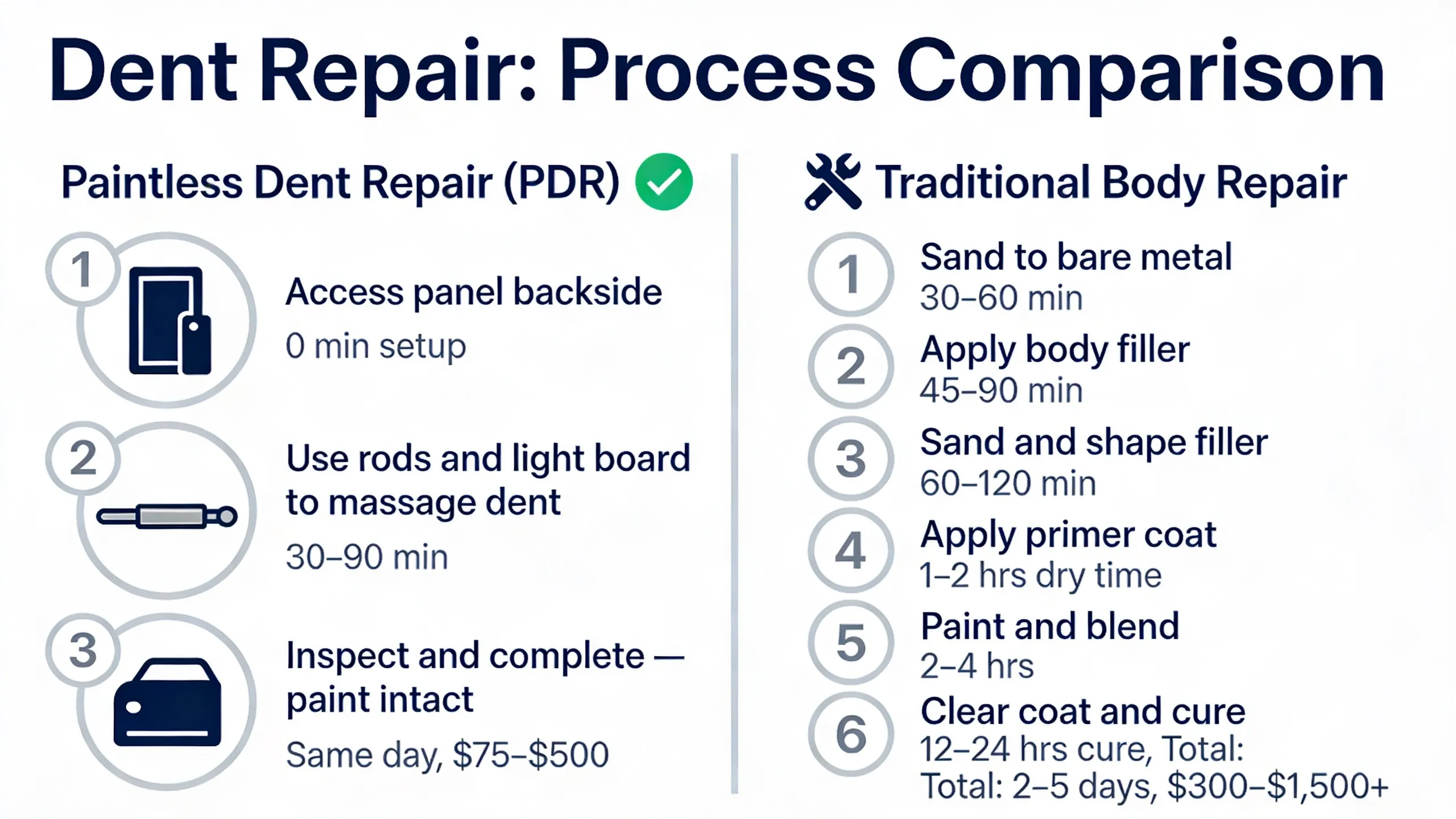
The process
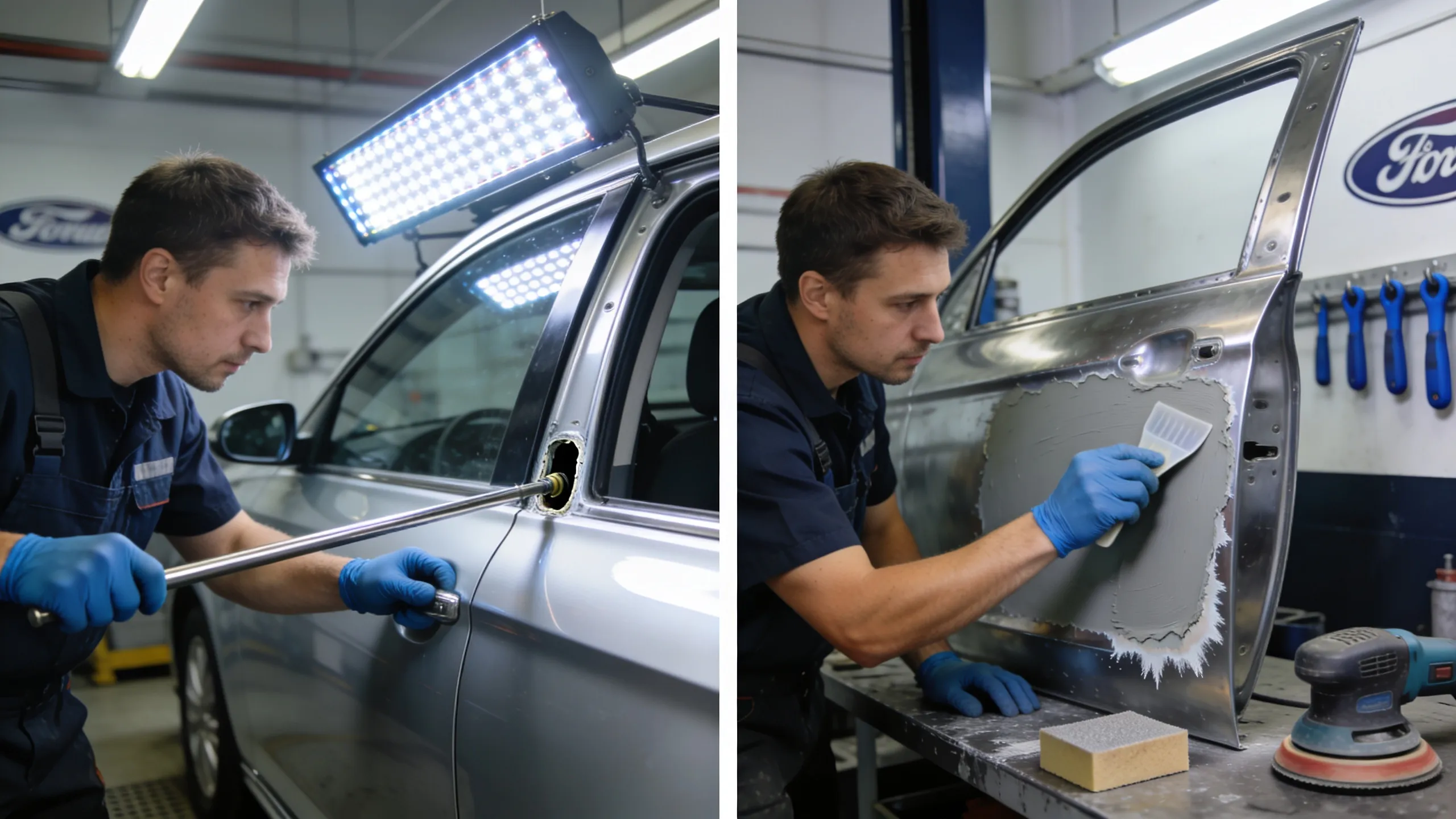
A PDR technician accesses the back side of the damaged panel, through a door jamb, interior trim gap, or small access point, and uses a series of metal rods and picks to apply controlled pressure to the low point of the dent. Rather than forcing the metal back, they work in small movements, gradually guiding the panel toward its original contour.
To monitor progress, technicians use a specialized light board or LED light bar positioned over the panel. The reflection reveals even tiny high and low spots invisible to the naked eye under normal lighting. That lighting setup is critical. It's how technicians know exactly where to apply pressure and when the repair is done.
The process requires significant skill and training. A qualified PDR technician may work a single dent for 30 minutes to two hours depending on size and location. Rushing risks cracking the paint or overworking the metal, and at that point, you're into traditional repair territory anyway.
Tools and techniques
PDR technicians use two main tool families:
- Metal rods and picks: Long, thin steel rods in various lengths and tip shapes that reach behind panels. Used for pushing dents outward from behind.
- Glue pulling tools: Suction-based tabs adhered to the outside of the panel and pulled with a slide hammer. Used when access from behind isn't possible, certain pillar sections or bonded panels, for example.
The I-CAR organization, which sets industry standards for collision repair training, certifies PDR-specific training programs. An I-CAR-trained technician has completed documented coursework in PDR procedures and materials science. For aftermarket part quality in cases where traditional repair follows PDR, NSF International certifies collision parts for fit and finish against OEM benchmarks.
What makes a dent PDR-eligible
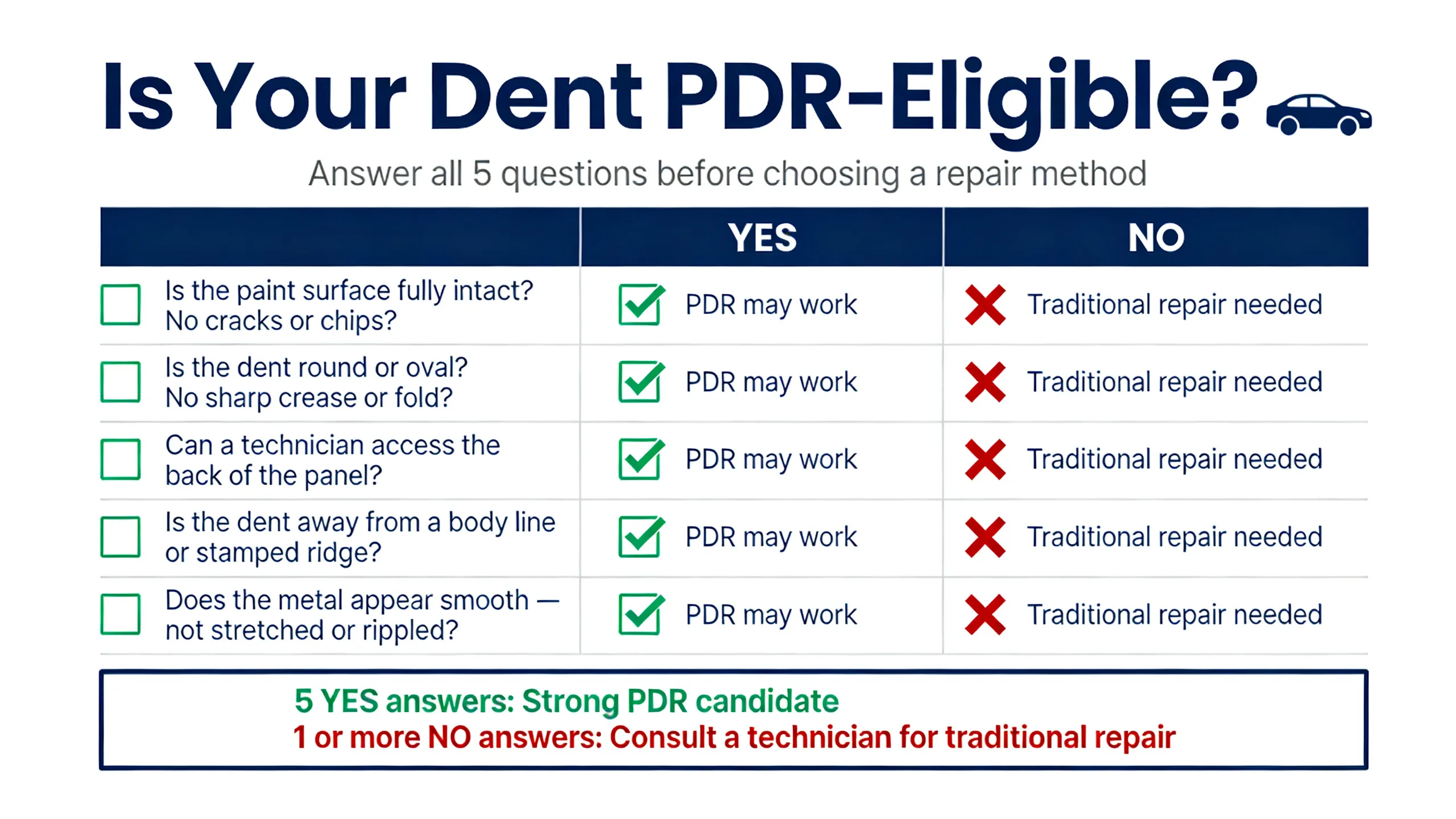
Not all dents qualify for paintless dent repair. A dent is typically PDR-eligible when:
- The paint surface is fully intact, no cracks, chips, or flaking
- The dent is round or oval, not a sharp angular crease
- The metal hasn't been stretched past its elastic limit
- The damage doesn't fall directly on a body line (the stamped ridge running along a vehicle's profile)
- The technician can physically access the back of the panel
Fail any one of these criteria and traditional body work is the more appropriate method. A good technician will tell you this upfront after a quick look at the dent, no commitment required.
How traditional dent repair works
Traditional dent repair involves a multi-step process that modifies the metal surface and fully replaces the paint on the affected area. More invasive than PDR, but it handles a wider range of damage types, including cases where paint is already compromised, metal is stretched, or the dent is too severe for PDR.
Body filler and sanding
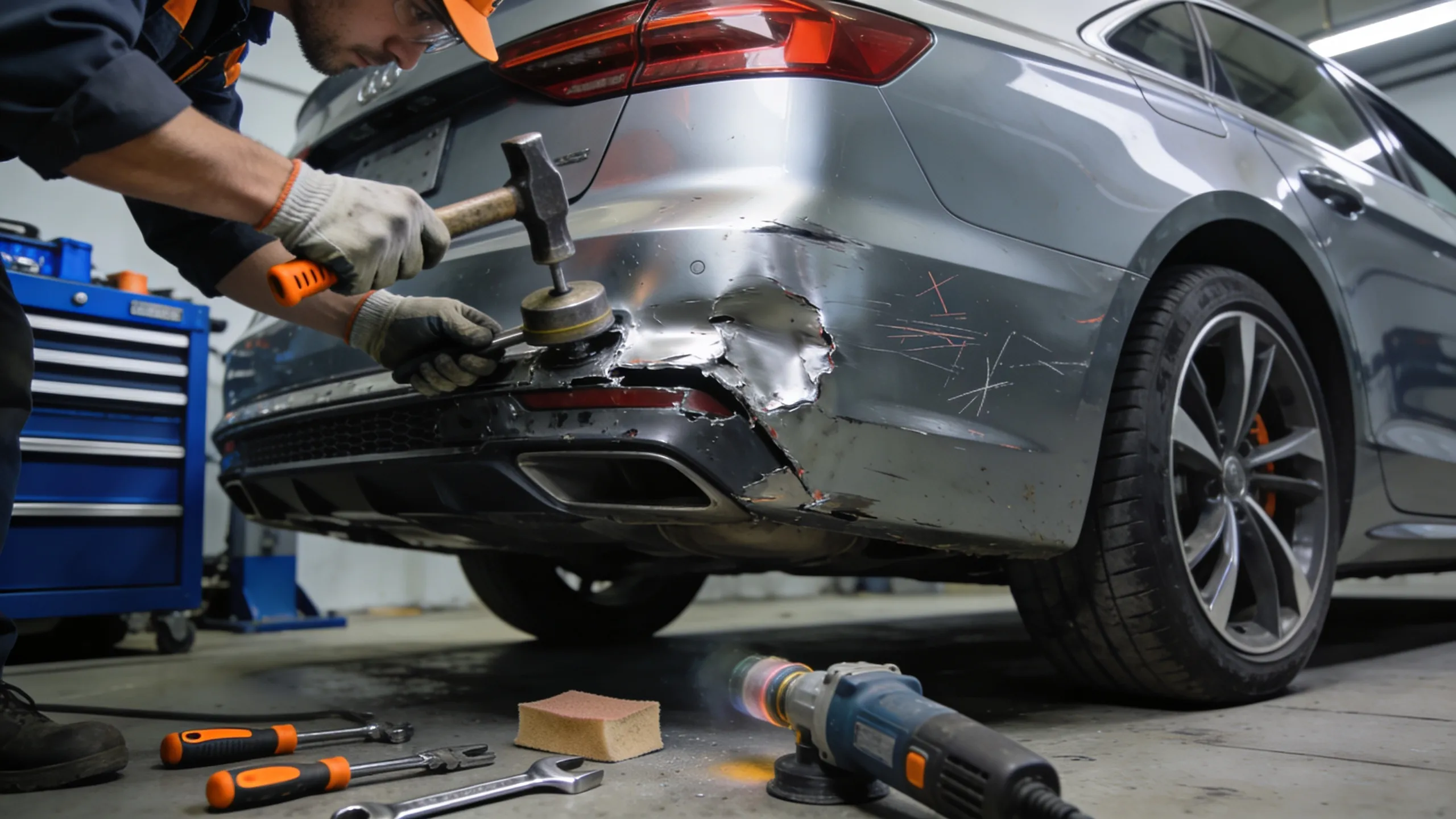
After a technician roughly reshapes the damaged area using a hammer and dolly (a smooth steel backing block), the panel surface is sanded down to bare metal. A polyester body filler (commonly known by the brand name "Bondo," though many products exist) is mixed and applied to fill in remaining low spots and imperfections.
Body filler cures quickly and sands smoothly. Technicians shape it with a block sander to match the panel's contour, working through progressively finer grits until the surface is smooth to the touch.
Panel replacement
For severe damage, where the metal is torn, badly creased, or structurally compromised, the damaged panel may be replaced entirely rather than repaired. Panel replacement is common after significant collisions and is covered under most collision insurance policies. A replacement panel is welded or bonded in place, then prepared for paint the same way a repaired panel would be.
Primer, paint, and clear coat
Once the surface is smooth, a primer coat is applied to seal the bare metal and create a foundation for paint adhesion. The area is then color-matched using the vehicle's paint code (typically found on a sticker inside the door jamb) and painted.
Most modern vehicles use a three-stage paint system: base coat (color layer), mid-coat (for metallic or pearl finishes), and clear coat (the transparent protective layer over the color). Skilled technicians often "blend" the new paint into adjacent panels, fading the new color gradually into the existing paint so the repair area matches naturally under different lighting. Even so, a perfect color match isn't always guaranteed, particularly on older vehicles where the original paint has faded.
For a full overview of paint work in body repair, see the auto painting services page.
Cost comparison: PDR vs traditional dent repair
Cost is often the deciding factor for car owners evaluating dent repair methods. PDR is significantly less expensive in most cases. But that cost advantage only applies when the dent is eligible.
PDR cost ranges by dent size ($75–$500)
PDR pricing is typically based on dent size and count, with common benchmarks as of 2026:
| Dent size | Typical PDR cost |
|---|---|
| Small ding (under 1 inch) | $75–$125 |
| Medium dent (1–3 inches) | $125–$250 |
| Large dent (3–6 inches) | $250–$400 |
| Multiple small dents (hail, parking lots) | $400–$900+ depending on count |
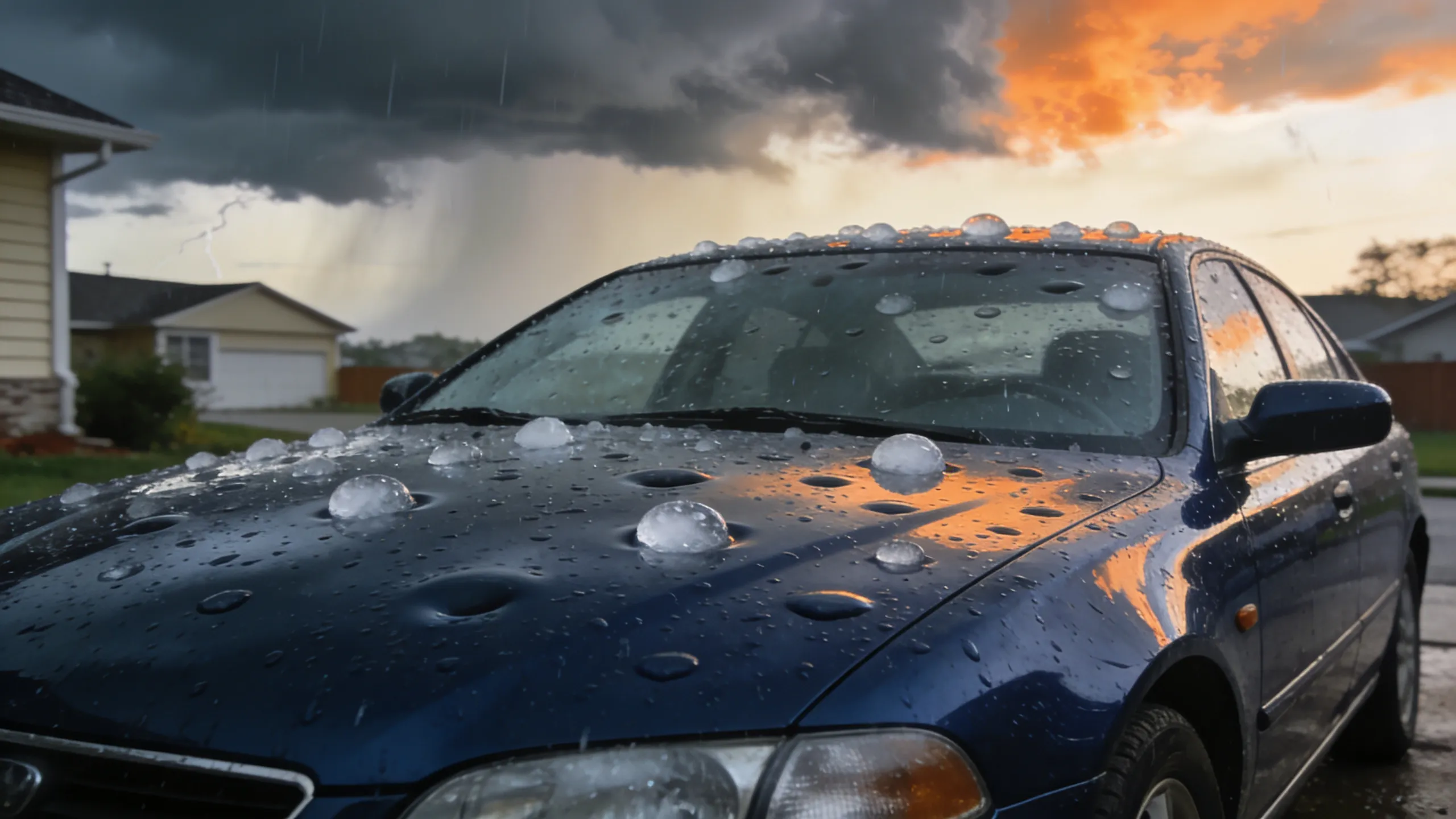
Hail damage is a special case: a vehicle with 40 or 50 small hail dents may still be repaired entirely by PDR for $800 to $2,500, far less than traditional repair would cost for the same panel count. See the complete breakdown in this hail damage repair cost guide. Car owners in hail-prone states like Texas can browse auto body shops in Texas for PDR-certified providers familiar with storm damage claims.
Traditional repair cost ranges ($300–$1,500+)
Traditional dent repair involves more labor, more materials, and more time, reflected in the higher price range:
| Damage type | Typical traditional repair cost |
|---|---|
| Small dent with cracked paint | $300–$600 |
| Medium panel repair with blend | $500–$900 |
| Full panel repaint | $700–$1,200 |
| Severe damage requiring panel replacement | $1,000–$2,500+ |
These ranges reflect national averages. Labor rates vary significantly by region, costs in major metropolitan areas typically run 30% to 50% higher than in smaller markets. For bumper-specific damage costs, see this guide on bumper repair cost.
Why the gap is so large
The cost difference between PDR and traditional repair comes down to three factors:
Labor time: PDR can resolve a medium dent in 1 to 2 hours. Traditional repair for the same panel may take 8 to 16 labor hours, sanding, filling, priming, painting, and blending.
Materials: PDR requires almost no consumable materials beyond the technician's tools and skill. Traditional repair involves body filler, primer, paint, clear coat, sandpaper, and masking materials, all with their own costs.
Equipment: PDR technicians need a light board and a tool set. Traditional paint work requires a dedicated spray booth, baking oven, and mixing equipment, major capital investments that factor into the shop's labor rates.
Quality and longevity
Cost isn't the only consideration. The quality and durability of the repair matters for both the vehicle's appearance and its long-term value.
Why PDR often produces better results
When a dent is PDR-eligible, the repair often outperforms traditional body work, for one simple reason: the original factory paint is preserved.
Factory paint is baked onto the vehicle during manufacturing at temperatures and durations that are difficult to replicate in a body shop spray booth. It also represents decades of refinement in adhesion, durability, and UV resistance. When PDR restores the panel without disturbing the paint, the vehicle retains that original finish in full.
Traditional paint work introduces variables: color match accuracy, paint thickness consistency, curing conditions, blend transitions. Minor color or texture discrepancies can develop over time, especially under direct sunlight or on darker paint colors. Not always visible, but not always invisible either.
When traditional repair is the better outcome
Traditional body work is the better choice, and sometimes the only viable option, when damage is beyond PDR's capabilities. In those cases, traditional repair delivers a professional result that PDR simply can't.
A well-executed traditional repair, performed by an experienced technician using quality materials in a climate-controlled booth, should produce a finish that holds up for years. The key variables are the shop's skill level, material quality, and whether the color blend is properly executed. Those three things account for most of the difference between a great result and a mediocre one.
When evaluating shops for traditional repair, look for facilities with OEM certifications and documented training programs. The collision repair service page outlines what to look for in collision-capable shops.
Resale value impact
Original factory paint is a meaningful factor in used vehicle valuation. When a buyer or dealer uses a paint thickness gauge, a common practice during used car inspections, readings above factory spec on specific panels indicate past body work. That can reduce the vehicle's value and flag it as having undisclosed prior damage.
PDR preserves original paint thickness across the repaired panel. A vehicle repaired by PDR will often pass a paint thickness inspection with no sign of prior repair. Traditional body work will show higher readings on the repaired areas. No way around that.
For vehicle resale, this distinction matters. A vehicle with factory-original paint on all panels commands higher confidence from buyers than one with documented body work on multiple panels.
When paintless dent repair won't work: traditional body work is required
Understanding the limits of paintless dent removal is as important as understanding its advantages. Attempting PDR on an ineligible dent risks cracking the paint, overworking the metal, or producing a result that requires traditional repair anyway, at additional cost and delay.
Cracked or chipped paint
PDR relies entirely on the paint surface being intact. If the paint has cracked, chipped, or flaked at the dent point, even a small area, the repair can't proceed without addressing the paint. Any further movement of the metal at that location will cause the existing crack to expand. Traditional repair is required to remove the compromised paint, refinish the metal, and repaint the area.
Sharp creased dents
A crease is a sharp fold in the metal, not a smooth round depression. Creases occur when direct impact forces the metal to fold rather than deform uniformly. The metallurgy is fundamentally different from a round dent: the metal fibers along the crease line have been stressed in a way that PDR tools can't fully address. Traditional repair (hammer and dolly work to reduce the crease, followed by body filler, sanding, and paint) is the standard approach here.
Body line damage
Body lines are the raised ridges stamped into a vehicle's panels to give them visual character and structural rigidity. When a dent distorts a body line, restoring the original geometry requires precise contouring that's difficult to achieve with PDR tools. Any visible deviation will be obvious under raking light. Traditional repair, with the ability to use body filler to precisely reform the contour, handles this better.
Stretched metal
When metal is struck hard enough, it can stretch beyond its elastic limit, deforming permanently rather than springing back. Stretched metal has excess material that can't simply be pushed back into position; doing so creates a high spot or ripple. Addressing stretched metal typically requires heat shrinking techniques in combination with traditional repair methods. PDR isn't effective on stretched panels.
Inaccessible locations
PDR requires physical access to the back side of the damaged panel. Most doors, fenders, and hoods have access points, but certain roof sections, structural pillars, and reinforced bumper sections either lack accessible backside space or have backing structures that block tool placement. When the back of the panel can't be reached, glue-pull PDR (working from the outside only) is sometimes possible, but its effectiveness depends on dent characteristics and the technician's skill level.
How to find a qualified PDR technician
The quality of a PDR repair depends almost entirely on the technician's skill and training. PDR is a hands-on craft with a high learning curve, the difference between an experienced practitioner and a novice is visible in the finished result.
What to look for
When evaluating a PDR technician or shop:
- I-CAR training credentials: I-CAR offers PDR-specific training programs. An I-CAR Gold Class shop has met ongoing training requirements across multiple repair categories.
- Dedicated PDR lighting: A professional setup requires a reflective light board or fluorescent light bar to reveal panel imperfections during repair. Shops performing PDR without this equipment are essentially working blind.
- Portfolio or before/after examples: Reputable PDR technicians can show examples of completed repairs, especially on challenging dents or hail damage work.
- Warranty on repairs: Professional PDR technicians stand behind their work. Ask whether the shop offers a warranty on PDR repairs and what it covers.
- Specialization in hail damage: Shops that focus exclusively on PDR for hail damage claims have high-volume repetitive PDR work, a strong signal of real experience.
Use the paintless dent repair shop directory to find PDR-capable shops in your area.
Questions to ask
Before authorizing PDR work, ask these questions:
- Is my specific dent PDR-eligible, and why or why not?
- What happens if the paint cracks during the repair, what's the process and who covers the cost?
- How long have your technicians been performing PDR?
- Does this repair carry a warranty, and what are the terms?
- Given the metal condition and location, is PDR or traditional repair the better fit here?
A qualified technician should answer all of these directly and explain the reasoning. Vague or defensive answers are a red flag.
Key takeaways
Paintless dent repair vs traditional body work isn't a question with a universal answer. It depends entirely on the specific damage.
Choose PDR when:
- The paint surface is fully intact
- The dent is round or oval with no sharp crease
- The damaged area is not on or near a body line
- The metal has not been stretched
- A technician can access the backside of the panel
Choose traditional body work when:
- The paint has cracked, chipped, or flaked at the dent
- The dent involves a crease or fold in the metal
- The damage affects a body line
- The metal appears stretched or has excess material
- Panel access makes PDR tools impractical
On cost: PDR typically ranges from $75 to $500 per dent. Traditional repair for the same area typically runs $300 to $1,500 or more. The gap reflects labor time, materials, and equipment, not quality. Both methods produce professional results when applied to the right damage type.
On quality: PDR preserves the original factory paint, which carries long-term advantages for resale value and paint durability. Traditional repair introduces more variables but handles damage that PDR can't.
On finding help: When in doubt about which method applies to a specific dent, get a professional assessment from a qualified technician before committing to anything. Shops with real PDR experience can typically assess a dent's eligibility within a few minutes. No charge, no obligation in most cases.
To find PDR-capable and full-service collision shops near you, browse auto body shops in your area or explore the collision repair directory.
Frequently asked questions
Is paintless dent repair better than traditional?
Paintless dent repair produces superior results, preserved factory paint, no color mismatch risk, on eligible dents. However, PDR cannot address cracked paint, sharp creases, stretched metal, or body line damage. For those situations, traditional repair is the correct method. The best approach depends entirely on the specific damage type and condition.
How much cheaper is PDR than traditional dent repair?
PDR typically costs 50–80% less than traditional repair for comparable damage. A medium dent via PDR costs $150–$250; traditional repair of the same panel, paint removal, body filler, sanding, primer, repaint, runs $500–$900. The gap reflects labor hours and materials, not a difference in repair quality.
Can PDR fix large dents?
PDR can address dents up to six inches in diameter when the paint is intact, the metal is not creased, and back-panel access is available. Hail damage across an entire roof or hood is routinely handled with PDR. Size alone does not disqualify a dent; paint and metal condition are the deciding factors.
Does PDR work on all types of dents?
No. PDR works on round or oval dents with intact paint, no body line involvement, and accessible backside access. It does not work on dents with cracked or chipped paint, sharp creases, stretched metal, or body lines running through the damaged area. A qualified technician can assess any specific dent in minutes and determine whether PDR is viable.
How long does PDR take compared to traditional repair?
PDR typically takes one to four hours per dent and is often completed same-day. Traditional dent repair, sanding, filling, priming, painting, and curing, spans two to five business days per panel. For hail damage across multiple panels, PDR finishes in one to three days; traditional repair of the same panels can take a week or more.