Bumper repair cost is one of the first questions after a fender bender or parking lot scrape, and the answer depends on more than just the size of the dent. Bumper material, damage location, paint complexity, and whether sensors are embedded behind the cover all affect the final number.
In 2026, minor bumper repairs typically run $100 to $800. Full replacement, parts, labor, and paint included, runs $500 to $2,000 or more. That's a wide range. The right call between repair and replacement isn't always obvious. This guide breaks down the cost factors, explains the repair-vs-replace decision, and covers what insurance typically covers.
For broader context on collision repair costs and process, see this collision repair guide.
Bumper Repair Costs at a Glance
Bumper repair cost in 2026 ranges from $100 for a minor surface scuff to $2,000 or more for full structural replacement on a sensor-equipped vehicle. Repair typically runs $100 to $800; replacement runs $500 to $2,000 or more including parts, labor, paint, and sensor recalibration where needed.
The table below shows 2026 national average ranges by damage type. These reflect parts, labor, and paint at typical shop labor rates.
| Damage Type | Repair Cost | Replacement Cost |
|---|---|---|
| Minor scuff or scratch | $100–$300 | N/A (repair is standard) |
| Small dent (no cracking) | $200–$450 | N/A (PDR may apply) |
| Crack or fracture | $300–$800 | $500–$1,200 |
| Deep gouge or large dent | $400–$800 | $600–$1,500 |
| Full structural damage | Not repairable | $800–$2,000+ |
Costs vary by vehicle make, model, bumper material, and local labor rates. Urban markets like New York City and Los Angeles typically run 30 to 50 percent above these figures. Rural markets usually run below them.
Dealership body shops tend to charge more per hour. Independent certified shops often offer competitive pricing with equivalent quality when properly equipped. Getting two or three written estimates for the same scope is the most reliable way to benchmark fair pricing.
For a full breakdown of bumper repair services and what the process looks like, that service page covers the workflow in detail.
Bumper Repair vs Replacement: How to Decide
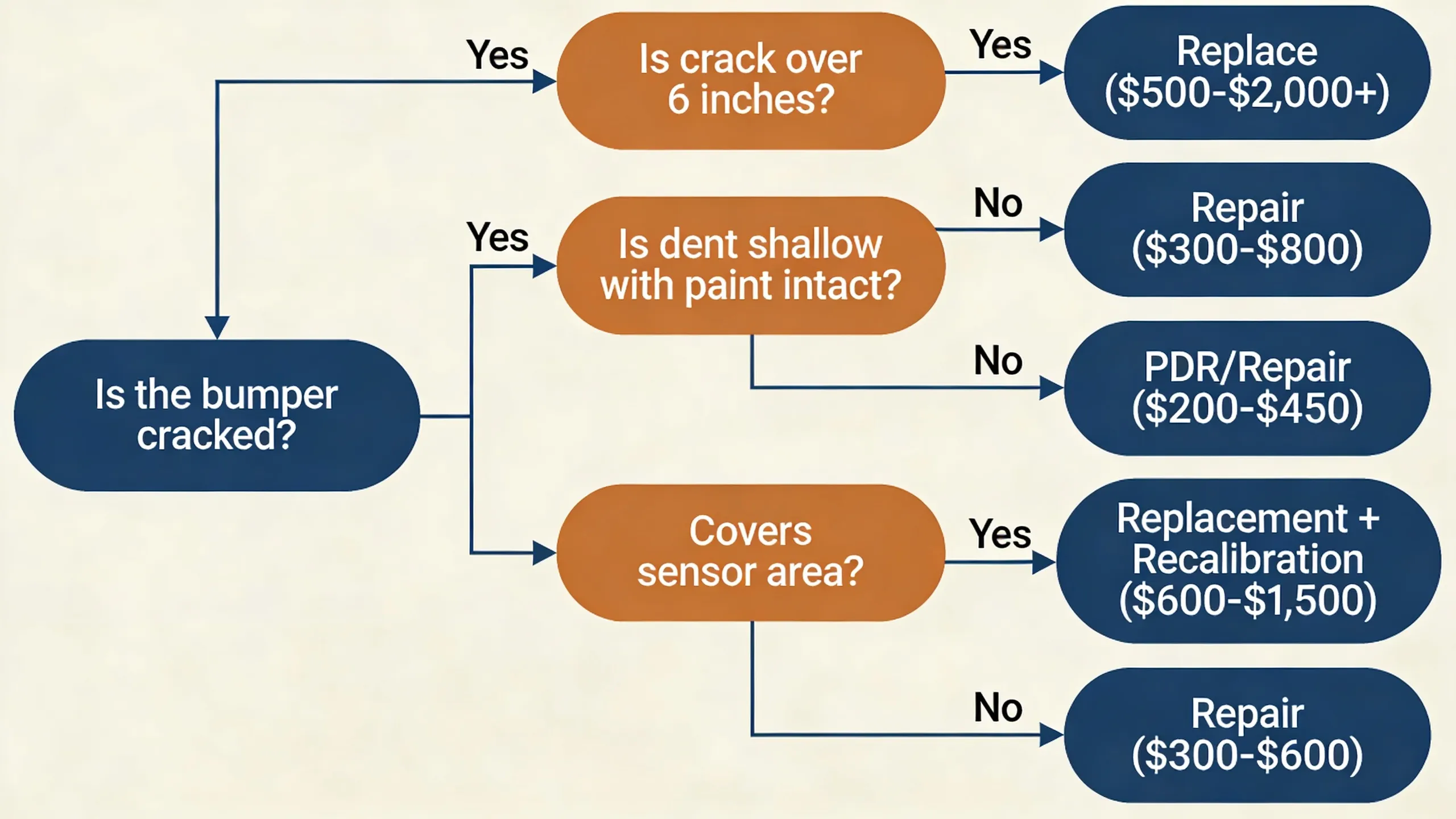
The core decision comes down to three things: damage severity, bumper material condition, and repair cost relative to replacement cost. Get this right and you avoid paying for an unnecessary replacement, or approving a repair that won't hold.
When Repair Makes Sense
Repair makes sense when the bumper cover is structurally intact and the surface damage is contained. The right situations for repair:
- Scuffs and shallow scratches that haven't broken through the bumper material
- Small dents that haven't cracked or fractured the plastic, these can sometimes be addressed with paintless dent repair (PDR), skipping painting altogether
- Cracks under 6 inches in areas that don't affect mounting points or sensor brackets
- Minor color mismatches where blending into adjacent panels is straightforward
PDR is a technique where technicians push dents out from behind the panel without repainting. Works best on shallow dents where the paint surface is unbroken. See paintless dent repair to understand whether your damage type qualifies.
When a Full Replacement Is Needed
Replacement is necessary when the bumper cover can't be restored to a structurally sound condition. Common situations that call for it:
- Deep cracks or fractures through mounting tabs or sensor housings
- Large impact zones that have deformed the reinforcement bar or absorber behind the cover
- Multiple overlapping damage areas where repairing each section would cost more than a new cover
- Significant paint fade or oxidation on an older vehicle where a patch will visibly stand out
- Sensor bracket damage affecting the mounting position of radar or camera systems
One important note: when the bumper reinforcement bar (the rigid structural component behind the cover) is bent or cracked, replacement of both the bar and the cover is almost always required. That's a safety issue, not just cosmetic.
The 50% Rule
A common industry benchmark: if the estimated bumper repair cost exceeds 50 percent of replacement cost, replacement is usually the better investment.
Example: replacement bumper cover costs $600 installed. A repair quote comes in at $400. Repair is reasonable. If that repair quote creeps up to $500–$550 and still leaves visible imperfections, replacement at $600–$650 often makes more financial and aesthetic sense.
This is a starting point, not a hard formula. Paint matching complexity, vehicle age, and insurance coverage can all shift the calculus. But it's a useful frame when you're comparing estimates from two different shops.
What Affects Bumper Repair Cost?
Several variables feed into the final bumper repair cost. The main ones: bumper material, damage severity, paint complexity, parts selection (OEM vs. aftermarket), and whether embedded sensors require recalibration. Knowing what each factor contributes helps you evaluate whether a quote is reasonable.
Bumper Material
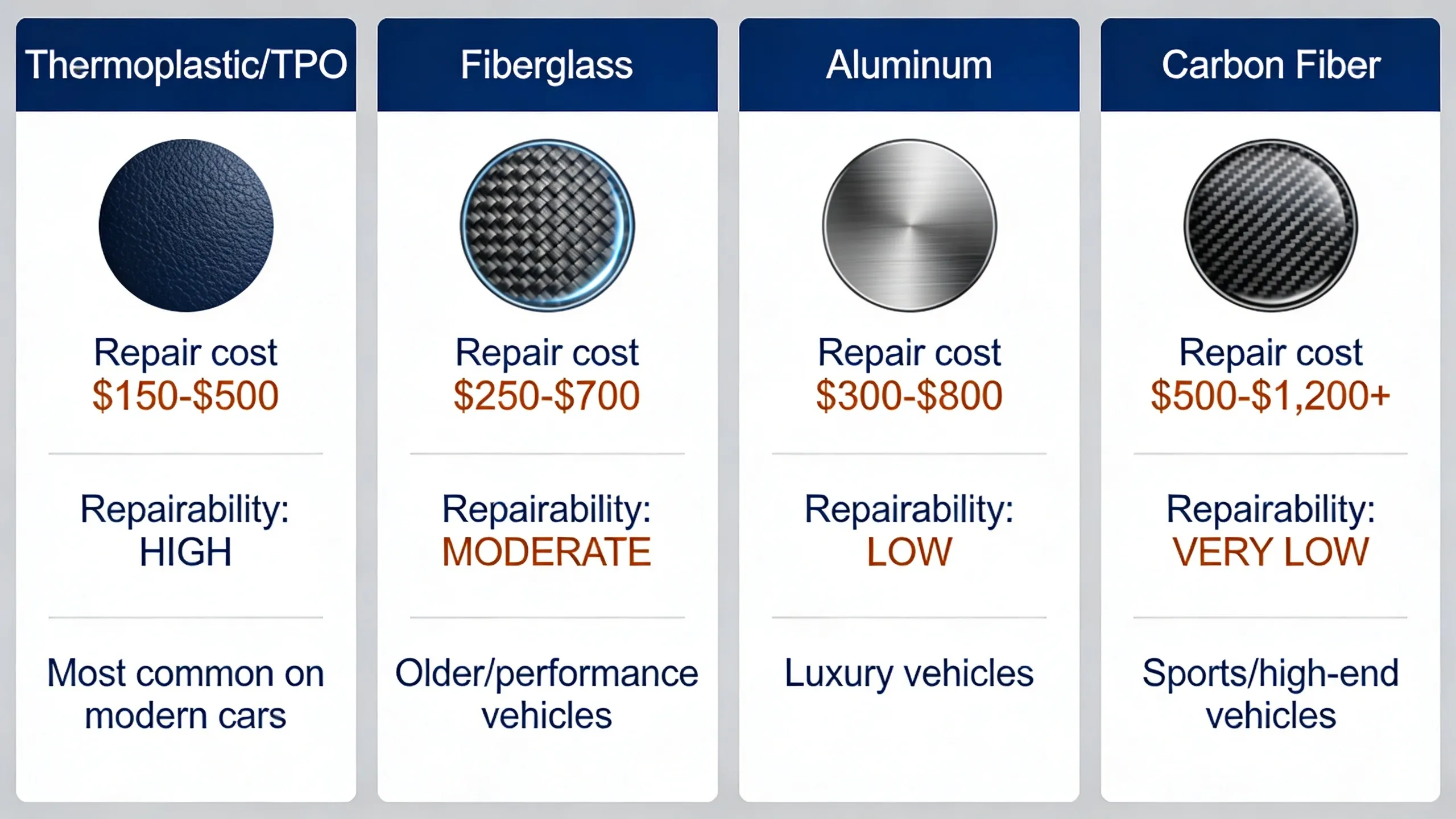
Bumper covers are made from several materials, each with different repair properties and cost profiles.
| Material | Repairability | Typical Repair Cost | Common On |
|---|---|---|---|
| Thermoplastic (TPO/PP) | High | $150–$500 | Most modern passenger cars and trucks |
| Fiberglass | Moderate | $250–$700 | Older vehicles, performance cars |
| Aluminum | Low | $300–$800 | Premium/luxury vehicles |
| Carbon fiber | Very low | $500–$1,200+ | Sports cars, high-end vehicles |
Thermoplastic bumpers (TPO/PP) are the most common type on modern cars and SUVs. They flex slightly on impact, which absorbs minor damage without cracking, and they're the most straightforward to repair with heat, adhesive fillers, and paint.
Fiberglass and aluminum are less forgiving. Fiberglass cracks more readily; repairs require more preparation. Aluminum dents don't bounce back like plastic, and the metal can work-harden after impact, which complicates reshaping.
Carbon fiber is the most labor-intensive material to repair, often the most expensive, and frequently not worth attempting. A crack in a carbon fiber bumper usually means replacement.
Damage Severity and Location
Where the damage sits on the bumper matters as much as how deep it is. Corner damage, where the bumper wraps around to the wheel arch, is harder to blend and typically requires more extensive paint work than a center impact. Damage near mounting brackets adds labor because technicians have to reattach or reinforce structural points.
Depth matters too. A shallow crease in the center of a rear bumper may respond to PDR or a simple fill-and-paint approach. A deep gouge that has removed material needs a different preparation sequence and more time blending into adjacent panels.
OEM vs Aftermarket Bumper Covers
When replacement is needed, parts cost varies significantly based on whether OEM or aftermarket covers are used.
- OEM parts come from the vehicle's original maker, built to exact fit and finish specifications. They typically cost 20 to 40 percent more than aftermarket alternatives but guarantee precise panel alignment and paint-code matching.
- Aftermarket parts are made by third-party manufacturers. Quality varies widely. High-quality aftermarket covers from reputable suppliers fit and paint well. Lower-quality options may need fitment adjustments, which add labor cost and can show in the final result.
Both can produce solid repairs. OEM offers guaranteed fit. Aftermarket offers lower cost. The right choice depends on the vehicle's age, your priorities, and whether the repair is going through insurance.
Some states require insurers to cover OEM parts on newer vehicles. Check your state's rules and review your policy language before accepting an estimate that specifies aftermarket.
Paint and Color Matching
Paint is often the largest labor cost component in bumper repair or replacement. Solid single-stage colors are the least expensive to match. Metallic, pearl, and tri-coat finishes need more layers and blending time, which adds cost.
Blending is where technicians feather new paint into surrounding panels to achieve an invisible repair. A bumper-only repaint may still look slightly off from panels that have weathered for several years. Blending the adjacent quarter panel or fender improves the match but adds to the total estimate.
This is one of the main reasons two shops can quote different prices for what looks like the same job. Ask each shop directly: does the estimate include blending adjacent panels, or bumper-only painting?
For more on what auto painting services involve and how paint jobs are priced, that service page provides a full breakdown.
Sensors and ADAS Components
Modern bumpers frequently house radar sensors, parking sensors, and camera systems. These ADAS components must be addressed during bumper repair or replacement. They add cost, but they're not optional.
When a bumper cover gets replaced, radar sensors mounted behind it often need to be recalibrated to their original aim specification. Front radar systems powering automatic emergency braking and adaptive cruise control typically cost $250 to $450 to recalibrate. Parking sensor arrays may require bench testing and reinstallation time on top of that.
Skipping recalibration after bumper work can cause ADAS features to operate incorrectly or fail entirely, sometimes without triggering any warning light. OEM repair procedures require calibration after any repair that disturbs sensor position. It's not discretionary.
Before accepting any bumper repair estimate, ask the shop which sensors are present and what calibration steps are included. An estimate that omits sensor recalibration looks cheaper upfront and costs more in the end.
Front Bumper vs Rear Bumper Repair
Front and rear bumper repair patterns differ in cost and in damage type. Front bumpers typically cost more to repair or replace due to greater sensor integration and larger surface area on many vehicles. Understanding the differences helps you set accurate expectations before getting estimates.
Cost Differences
Front bumper repair tends to run higher than rear for a few consistent reasons:
- Front bumpers on newer vehicles are more complex, integrating radar sensors for automatic braking and adaptive cruise, active grille shutters, tow hook covers, and camera housings
- Front covers are physically larger on many trucks and SUVs
- Front bumper replacement typically requires recalibration of radar and camera systems, adding $250 to $500 to the estimate
| Bumper | Repair Range | Replacement Range | Sensor Calibration (if equipped) |
|---|---|---|---|
| Front | $200–$800 | $600–$2,000+ | $250–$500 |
| Rear | $100–$600 | $500–$1,500 | $150–$400 |
These are national averages for 2026. Luxury vehicles, trucks, and vehicles with advanced sensor packages will run higher.
Common Damage Patterns
Front bumper damage most often results from:
- Low-speed forward collisions in traffic
- Parking lot impacts (shopping carts, bollards, other vehicles)
- Wildlife impacts (deer strikes frequently damage front fascias)
- Severe weather debris
Rear bumper damage most often results from:
- Being rear-ended at low speed
- Backing into fixed objects (poles, curbs, garage walls)
- Tow hitch impacts
Rear bumper damage from being rear-ended typically goes through the at-fault driver's liability insurance, not your own policy. Front bumper damage from a collision where you were at fault goes through your collision coverage. Which coverage applies affects your deductible and out-of-pocket cost.
For a broader overview of the full repair process, this collision repair service page covers workflow from estimate to delivery.
Insurance Coverage for Bumper Damage
Whether insurance covers bumper repair depends on the type of coverage you have, how the damage happened, and whether the repair cost clears your deductible.
When to File a Claim vs Pay Out of Pocket
Filing a claim makes sense when:
- The repair or replacement cost is significantly higher than the deductible
- Another driver caused the damage and their liability insurance applies
- Full coverage applies (weather event, theft, vandalism, animal strike)
Paying out of pocket makes sense when:
- The damage cost is close to or below the deductible amount
- The car owner was at fault and wants to avoid a potential rate increase
- The repair is minor (scuff, small scratch) and clearly cosmetic
General benchmark: if the repair cost is within $300 of your deductible, paying out of pocket usually makes more financial sense over a three-year horizon when potential rate impact is factored in. If the damage is $500 or more above the deductible, filing typically delivers clear financial benefit.
Deductible Considerations
Standard collision deductibles in 2026 typically range from $250 to $1,000. A $600 rear bumper repair against a $500 deductible leaves only $100 of insurer payment, rarely worth the administrative time or potential rate impact.
A $1,500 front bumper replacement against that same $500 deductible means $1,000 of insurer coverage. That's generally worth filing.
Also check whether your policy includes accident forgiveness. Some policies prevent the first at-fault claim from affecting your rate, which significantly changes the math.
Important: Insurance processes vary by state and carrier. Review your specific policy. You have the legal right to choose your own repair shop regardless of what the insurance company recommends.
DIY Bumper Repair: What Car Owners Can Handle
Some minor bumper damage can be addressed without professional repair. Knowing what's realistic helps you decide whether to attempt it or bring it to a shop.
Scuff and Scratch Touch-Up
Light scuffs that haven't penetrated through to the base coat can sometimes be buffed out with a plastic-safe polishing compound. Deeper scratches that have broken through to the plastic require primer, paint, and clear coat, color matching becomes difficult without professional tools.
Scratch repair pens and touch-up paint are widely available and work reasonably well on very small chips. Results vary by skill level and color complexity. Solid colors are more forgiving than pearl or metallic finishes.
For professional scratch repair, see scratch repair to understand what shops offer at different damage depths.
Minor Dent Removal
Small dents without cracking or paint damage are the strongest candidates for DIY. Common methods include heat-and-cool techniques using a hair dryer and compressed air, or suction-based dent pullers from auto parts stores.
These work best on thermoplastic bumpers with shallow, centrally-located dents. They rarely match the clean results of professional PDR, but for dents in low-visibility spots, they can reduce the visual impact without spending $200 to $400 at a shop.
When to Leave It to the Professionals
Bring bumper damage to a professional shop when:
- The cover is cracked, fractured, or has lost material
- Sensors, camera lenses, or radar housings are in the damage zone
- The damage affects mounting tabs or attachment points
- Color matching matters (resale, lease return, newer vehicle)
- Structural components behind the cover may be compromised
DIY repairs on cracked bumpers or sensor areas can look acceptable at first and fail during temperature cycling or a secondary impact. Shops following I-CAR repair standards use adhesive systems and welding techniques designed for bumper cover substrates, not available at the hardware store.
Key Takeaways
Bumper repair cost in 2026 ranges from $100 for minor scuffs to $2,000 or more for full structural replacement on sensor-equipped vehicles. The final number depends on material, damage severity, paint complexity, and sensor recalibration requirements.
Quick reference for common scenarios:
- Minor scuffs, surface scratches: $100 to $300 (repair only; no replacement needed)
- Small dents without cracking: $200 to $450 (PDR may qualify)
- Cracks or moderate damage: $300 to $800 to repair; $500 to $1,200 to replace
- Front bumper with sensors: Add $250 to $500 for radar/camera recalibration
- Full structural damage: $800 to $2,000+ for replacement
Use the 50% rule as a starting benchmark: if repair exceeds 50 percent of replacement cost, replacement is usually the better investment. For any damage near sensors, ask specifically what calibration is included, an incomplete estimate isn't a cheaper estimate, it's a deferred cost.
On insurance: file when the repair cost is significantly above the deductible. Pay out of pocket for minor damage where the claim benefit doesn't outweigh the potential rate impact.
For more context on the full repair process, see this collision repair cost guide and browse auto body shops near you to compare estimates from qualified shops in your area.
Frequently Asked Questions
How much does it cost to repair a bumper?
Bumper repair typically costs between $100 and $800, depending on damage severity, bumper material, and local labor rates. Minor scuffs and scratches on the low end; cracks and larger dents on the higher end. Full bumper replacement ranges from $500 to $2,000 or more when parts, labor, paint, and sensor recalibration are included.
Is it cheaper to repair or replace a bumper?
For minor to moderate damage, repair is almost always cheaper than replacement. For severe structural damage or when the bumper cover is extensively cracked, replacement often costs less than attempting a complex repair that may not hold. Use the 50% rule: if repair cost exceeds 50% of replacement cost, replacement is generally the better value.
Can a cracked bumper be repaired?
Yes, in many cases. Small to medium cracks that don't affect mounting tabs or sensor housings can be repaired using plastic welding or two-part adhesive systems. Cracks larger than about six inches, cracks through structural mounting points, or cracks affecting sensor brackets typically require replacement rather than repair.
Does insurance cover bumper repair?
It depends on coverage type and how the damage occurred. Collision coverage typically applies when the car owner was at fault. Liability coverage on the other driver's policy applies when they were at fault. Thorough coverage applies for weather, animal strikes, and vandalism. Whether it's worth filing depends on the deductible amount relative to the repair cost.
How long does bumper repair take?
Most bumper repairs take one to three business days at a professional shop. Simple scuff repairs may be completed same-day. Full bumper replacement with paint work and sensor recalibration typically takes two to four business days. Timelines can extend if parts need to be ordered, especially for OEM components on less common vehicles.
Can a car be driven with a damaged bumper?
For cosmetic damage only, light scuffs where the cover is still fully attached, driving is generally safe for short periods. However, a cracked or partially detached bumper reduces low-speed impact protection and can shed road debris. If sensors are in the damage zone, ADAS features may not function correctly. Professional assessment is advisable for anything beyond surface scuffs.
For industry repair standards and procedures, see I-CAR's collision repair guidelines. For bumper safety performance data by vehicle, see IIHS bumper test ratings. For OEM-specific repair procedures, consult the OEM Collision Repair Technology Summit resources.