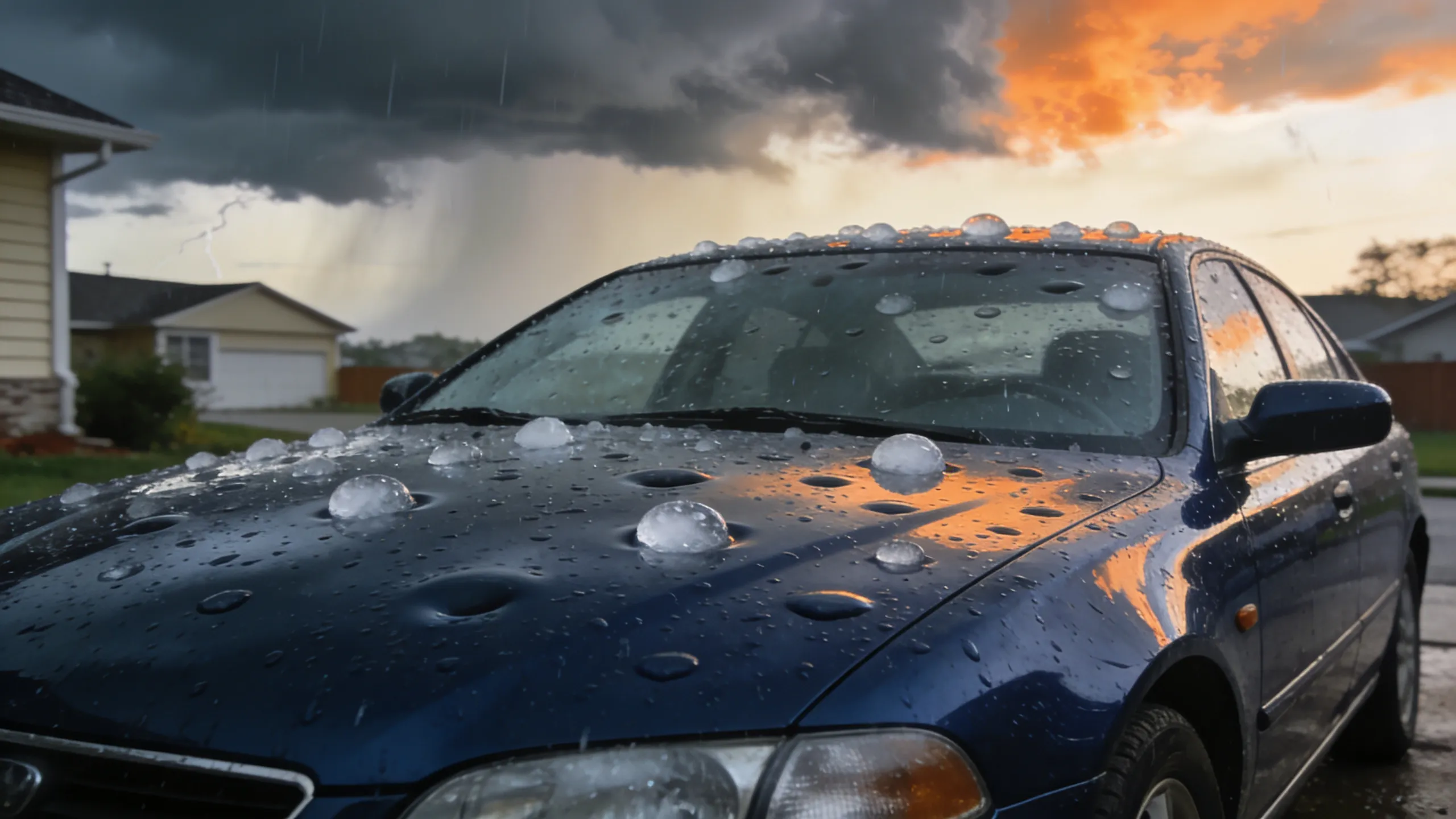
A spring storm drops golf ball-sized hail for ten minutes. The next morning, a car owner walks outside to find a hood and roof covered in dozens of small, round dents. Hail damage repair cost ranges from $500 to $8,000 or more, and the path forward, from choosing a repair method to filing an insurance claim, is less clear than the damage itself.
Hail damage car repair is one of the most common insurance claims filed in the United States each year. NOAA's National Centers for Environmental Information tracks billion-dollar weather disasters, and hail-related events consistently rank among the costliest. Understanding hail damage repair cost, how the insurance claim process works, and how to avoid the predatory "storm chaser" shops that follow every major storm can save car owners hundreds or thousands of dollars.
This guide covers all of it, from severity classifications and pricing to filing a full claim and protecting against fraud.
Hail damage repair costs at a glance
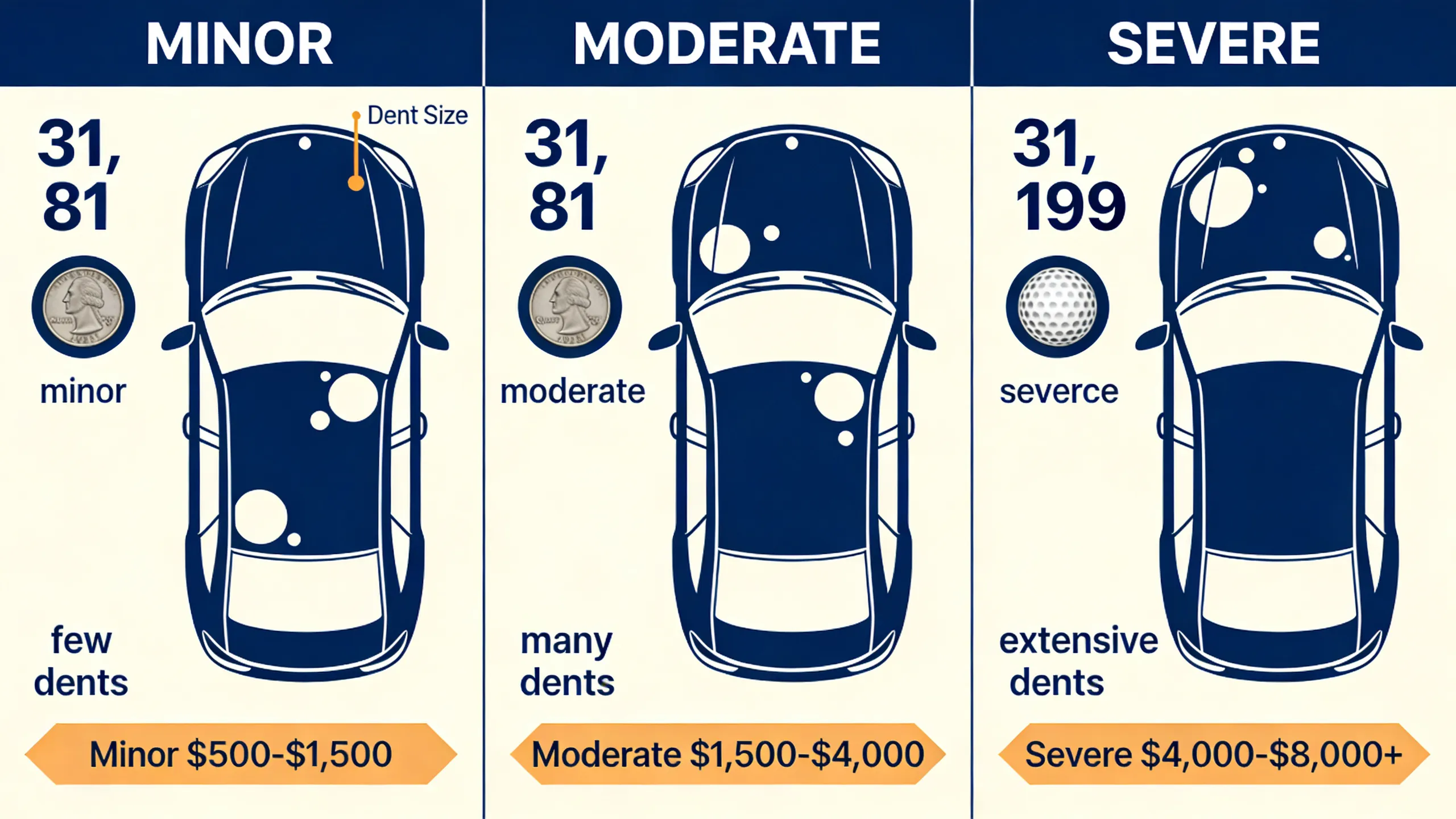
Hail damage repair cost varies widely based on how many dents are present, how large they are, which panels are affected, and whether paint, glass, or trim is also damaged. The table below provides a practical starting framework.
| Severity Level | Description | Estimated Repair Cost |
|---|---|---|
| Minor | Few dents, small diameter (under 1 inch), no paint damage | $500–$1,500 |
| Moderate | Many dents across multiple panels, some larger dents | $1,500–$4,000 |
| Severe | Extensive denting, large dents, cracked or broken glass | $4,000–$8,000+ |
| Total loss threshold | Repair cost exceeds 70-80% of actual cash value | Insurance may total the vehicle |
These ranges reflect national averages as of 2026. Actual hail dent repair cost can fall outside these bands depending on vehicle type, local labor rates, and how much glass or trim damage accompanies the dents. Luxury vehicles and trucks with large flat surfaces, hoods, cab roofs, cargo beds, tend to land toward the higher end of each range.
For a deeper look at hail damage repair options and how shops approach storm-related work, the service overview provides additional context.
Understanding hail damage repair severity levels
Before any estimate can be trusted, it helps to understand how body shops and insurance adjusters classify hail damage. The same storm can produce very different results on two cars parked side by side.
Dent count and size classification
Hail dents are typically measured by diameter. Industry estimating tools classify dents in categories: under half an inch, half to one inch, one to two inches, and above two inches. A vehicle with 80 quarter-sized dents on the hood alone will cost more to repair than a vehicle with 15 dime-sized dents spread across three panels.
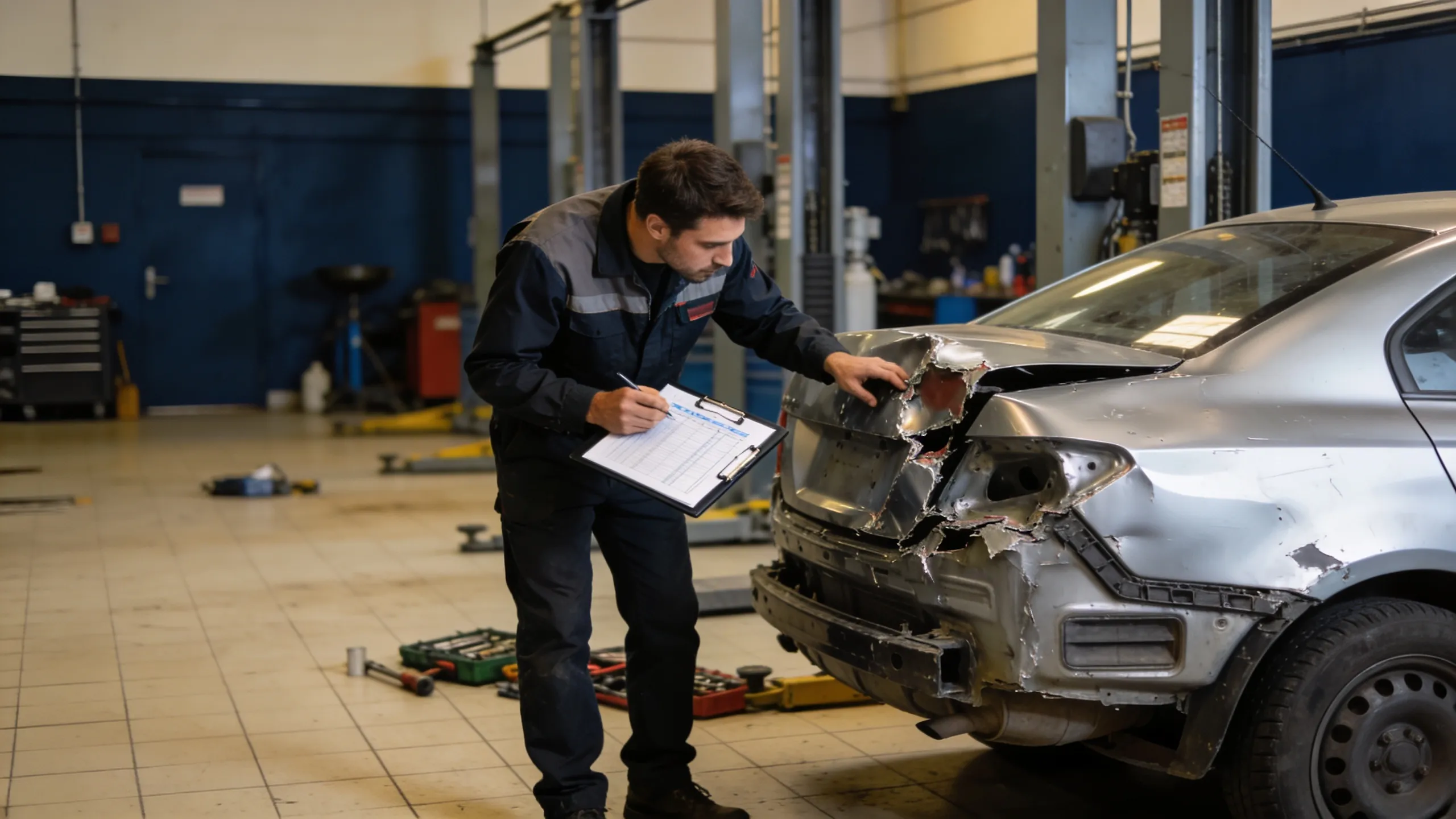
Estimators count dents panel by panel. The count influences whether paintless dent repair (PDR), the preferred method for most hail jobs, is practical, and how many labor hours the job will require. A thorough count is the foundation of an accurate estimate.
Panel location and accessibility
Not all panels are equally accessible. Hood, roof, and trunk lid dents are generally the easiest for PDR technicians to reach. Door panels, fenders, and quarter panels add complexity depending on whether access holes or door panels need to be removed. The roof of an SUV or truck with a panoramic sunroof requires different techniques than a sedan roof. Each factor adds or subtracts from the total hail damage repair cost.
Paint damage vs. dent-only
PDR works best when the paint is intact. If hail impact has cracked or chipped the clear coat or paint film, a different repair approach is needed. Clear coat is the transparent protective layer on top of the color coat that gives paint its gloss and shields it from UV and moisture. When the clear coat cracks, the damaged spot can eventually rust or peel.
Cracked paint means the dented area needs conventional bodywork: filler, primer, color coat, and clear coat. This adds both materials and time, pushing hail dent repair cost significantly higher than PDR alone.
Glass and trim damage
Severe hailstorms crack windshields, side windows, rear glass, sunroof panels, and plastic trim pieces like mirror caps and grille surrounds. Each broken piece adds cost beyond the dent repair estimate. A cracked windshield alone can cost $300 to $600 on a standard vehicle and $700 to $1,200 or more on a vehicle equipped with a front-facing camera that requires recalibration after glass replacement. Sunroof glass and rear hatch glass can add $400 to $900 depending on vehicle and complexity.
Paintless dent repair (PDR) for hail damage
Paintless dent repair (PDR) is the repair method of choice for the overwhelming majority of hail damage jobs. Understanding why helps car owners evaluate estimates and ask informed questions.
Why PDR is the preferred method
PDR preserves the original factory paint, which maintains the vehicle's appearance and resale value. It's significantly faster than conventional bodywork, a full hail job that would take a week in a traditional body shop can often be completed in two to four days with PDR. It also costs less because there are no paint materials, and it eliminates the need to blend surrounding panels. Insurance companies favor PDR for the same reasons: lower cost, faster turnaround, and no paint quality disputes.
For more on what sets PDR apart from traditional repair, see this paintless dent repair service overview.
How PDR works on hail dents
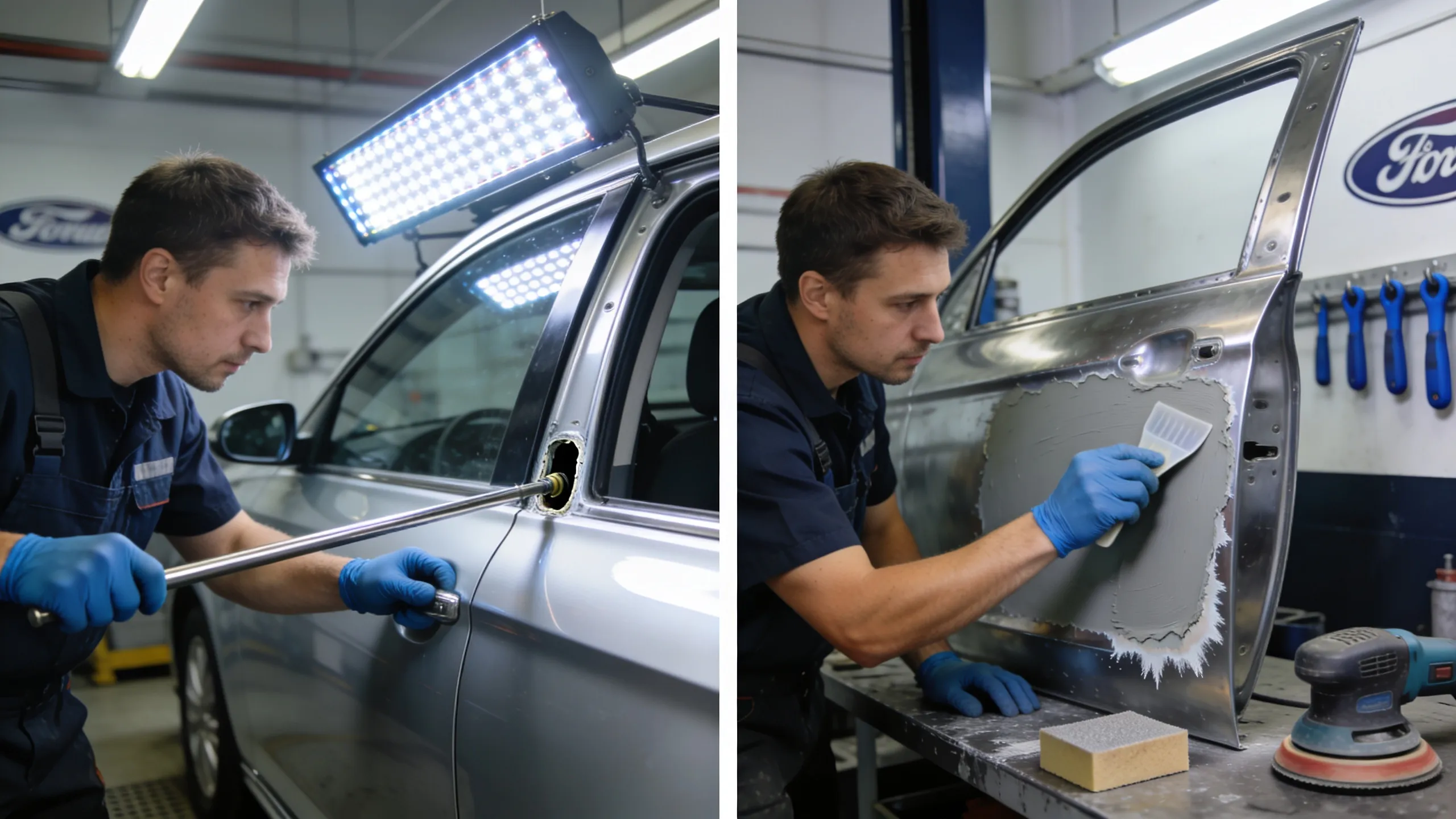
PDR technicians use specialized metal rods and ramps to access the backside of a dented panel and apply controlled pressure from behind. They work the dent out gradually, in small increments, until the panel surface returns to its original shape. On the exterior side, a light board or LED reflector tool lets the technician see the surface geometry clearly and detect even small high spots or low spots.
Skilled PDR work is nearly invisible. Correctly repaired hail dents leave no trace.
When PDR won't work (cracked paint, sharp dents, body lines)
PDR has limits. Paint that's cracked, chipped, or heavily stress-fractured can't be massaged back into shape, conventional repair is required. Very sharp, angular dents are also poor candidates because the metal has been stretched beyond what PDR rods can gradually push back. Dents located directly on a body line, the sharp ridge pressed into a panel for styling, are difficult to repair cleanly with PDR because the geometry is harder to duplicate.
In these cases, a hybrid approach may be used: PDR on accessible dents, conventional repair on the problem areas.
PDR vs. traditional repair cost comparison
| Repair Method | Typical Cost (per panel) | Paint Preserved? | Timeline | Best For |
|---|---|---|---|---|
| Paintless dent repair (PDR) | $75–$150 per dent / $500–$2,500 per panel | Yes | 1–4 days | Round dents, intact paint |
| Conventional body repair | $300–$800+ per panel | No (repaints) | 3–7 days | Cracked paint, sharp dents, body lines |
| Hybrid (PDR + conventional) | $600–$2,500+ per panel | Partial | 4–8 days | Mixed damage types |
These figures reflect repair cost per panel in 2026. A vehicle with 8 to 12 affected panels in a severe hailstorm will multiply these numbers accordingly. For a detailed side-by-side breakdown of both methods, the paintless dent repair vs. traditional repair guide covers each trade-off in depth.
Insurance claims for hail damage repair cost
Hail damage falls under comprehensive coverage, not collision coverage. This distinction matters and affects both the claim process and potential rate impact.
Comprehensive coverage (not collision)
Comprehensive coverage pays for vehicle damage caused by events outside the driver's control: storms, floods, fire, theft, and falling objects. Hail is a covered peril under virtually every comprehensive policy. Collision coverage, by contrast, pays for damage from a crash, hitting another vehicle or a fixed object. Car owners who carry only liability and collision insurance, with no comprehensive, have no coverage for hail damage at all. Reviewing the policy declarations page before hail season is a smart annual habit, particularly in hail-prone regions.
Filing a hail damage insurance claim step by step
Filing a hail damage insurance claim is straightforward when approached methodically. Here's the process in sequence:
- Document the damage thoroughly. Before moving the vehicle, photograph every dented panel in natural daylight. Capture wide shots showing the whole vehicle and close-ups showing individual dents, cracked paint, and any broken glass. Video walkarounds help capture depth and context that photos alone may miss.
- Report the claim promptly. Contact the insurance company or use the mobile app to open a claim. Most insurers have 24-hour claim reporting lines. Prompt reporting speeds up scheduling and reduces the risk of disputes about pre-existing damage.
- Receive the adjuster's estimate. An insurance adjuster, either an in-person field adjuster or a virtual adjuster using photos, will inspect and write an initial estimate. This is a starting point, not a ceiling. Adjusters often undercount dents on the first pass, particularly on complex areas like the roof or hood.
- Choose a repair shop. Car owners have the legal right to choose their own repair facility. The insurer may suggest shops on its Direct Repair Program (DRP), but those suggestions aren't requirements. Choosing a qualified shop, one with proven PDR experience, protects repair quality.
- Allow the shop to write a supplement. Reputable shops will compare their estimate to the insurer's and request a supplement for any items the adjuster missed. This is standard practice and typically approved. See the collision repair guide for context on how the supplement process works.
- Pay the deductible. The car owner's portion is the deductible specified in the policy. If the estimate is $3,000 and the deductible is $500, the insurer pays $2,500.
Understanding each step reduces the anxiety of an unfamiliar process. For a broader look at how insurance interacts with all types of body damage, the collision repair cost guide is a useful reference.
Will a hail damage claim raise my rates?
This is one of the most frequently asked questions about the hail damage insurance claim process. The answer depends on the insurance carrier and the state.
Comprehensive claims, including hail, are generally treated differently from collision claims. Because hail damage isn't the driver's fault, many carriers don't surcharge rates for a single comprehensive claim. But this isn't universal. Some insurers do factor comprehensive claim frequency into renewal pricing, particularly for car owners with multiple claims in a short window. State regulations also vary: some states limit how much insurers can raise rates after weather-related claims.
The safest approach is to call the insurer before filing and ask directly: "Will filing a comprehensive claim for hail damage affect my renewal rate?" Most agents will give a clear answer. Document the response.
Total loss for hail damage
When hail damage repair cost exceeds a threshold percentage of the vehicle's actual cash value (ACV), typically 70% to 80%, though this varies by state and insurer, the insurance company may declare the vehicle a total loss. This outcome surprises many car owners who assumed their car was "just dented."
A 2018 sedan with an ACV of $12,000 and a repair estimate of $9,500 may cross the total loss threshold even if the vehicle is fully drivable. In a total loss, the insurer pays out the ACV minus the deductible. Car owners who believe the ACV is understated have the right to dispute it using comparable vehicle listings and market data.
Storm chaser shops: red flags to watch
Every major hailstorm is followed by a surge of out-of-state body shops setting up temporary operations in affected communities. These "storm chaser" operations prey on car owners who are overwhelmed and unfamiliar with the repair process.
What are storm chasers?
Storm chaser body shops are operations, sometimes legitimate, sometimes not, that follow storm damage events across the country, set up temporary shops or tents, and aggressively recruit customers with promises of quick repairs, insurance deductible waivers, and special deals. Some do perform acceptable work. Many don't, and the risks are significant: shoddy repairs, abandoned vehicles mid-repair when the operation moves to the next storm, and fraudulent billing practices that can implicate the car owner in insurance fraud.
The National Insurance Crime Bureau (NICB) has documented storm chaser fraud extensively and maintains consumer resources for identifying suspicious operations.
Warning signs
These signals warrant caution with any shop that approaches a car owner after a storm:
- Unsolicited contact at home, in a parking lot, or door-to-door. Reputable shops don't solicit storm victims this way.
- Deductible waiver offers. Waiving a deductible is insurance fraud in most states. Any shop offering this arrangement is creating legal risk for the car owner.
- Requests to sign over insurance rights. An Assignment of Benefits (AOB) agreement gives the shop control over the insurance claim. Car owners should never sign one without consulting an attorney.
- No local address or established business history. A temporary tent, a P.O. box, or a recently registered LLC with no reviews are warning signs.
- Pressure for an immediate decision. Legitimate shops allow time for research. Pressure tactics suggest the shop knows it won't survive scrutiny.
- Unusually low or unusually high estimates. Both extremes can signal problems: a very low estimate may hide costs added later; an inflated estimate may be designed to maximize insurance payouts.
How to protect yourself
Before authorizing any hail repairs, take these protective steps:
- Research the shop's business history and look for reviews predating the storm.
- Verify the shop holds a physical address and is licensed in the state.
- Get at least two estimates from established local shops before deciding.
- Read any paperwork completely before signing, never sign in a parking lot.
- Confirm that the chosen shop will communicate directly with the insurer, not ask you to act as a financial intermediary.
Finding established, vetted shops is straightforward with a directory search. Auto body shops in Texas and auto body shops in Colorado, two of the most hail-impacted states, are good starting points for car owners in those regions.
Hail season: when and where it hits hardest
Hail damage is not distributed evenly across the United States. Some regions absorb the majority of storm activity year after year.
Hail belt states
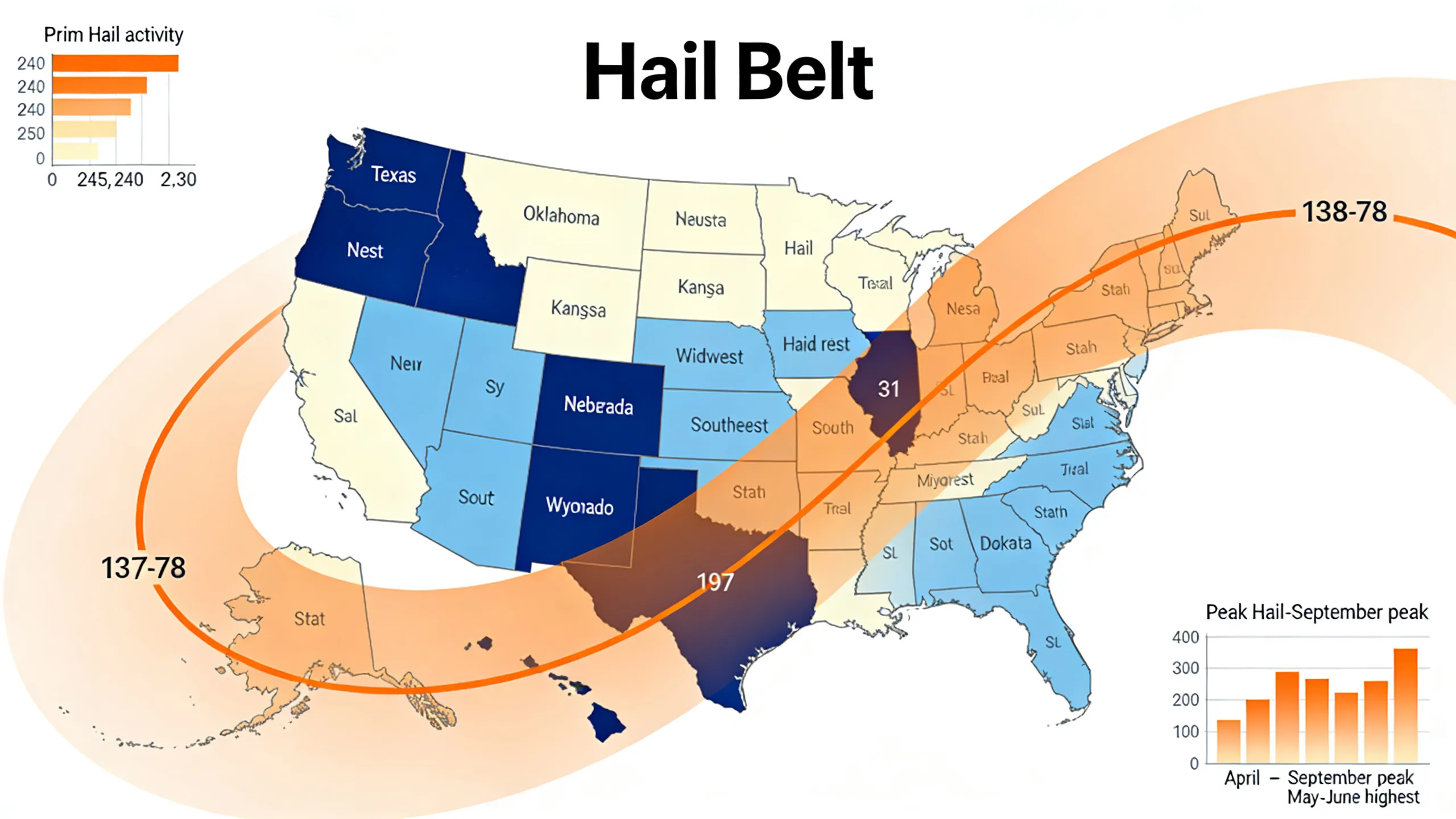
The central United States is known as the "Hail Belt", a corridor stretching from Texas and Oklahoma through Kansas, Nebraska, Colorado, Wyoming, and into the Dakotas. This region sees the highest frequency of large hail events, driven by warm, moist air from the Gulf of Mexico colliding with cold fronts from the Rockies.
Colorado and Wyoming see some of the nation's highest per-storm hail damage averages because storms in those states frequently produce large, dense hailstones. Denver consistently ranks among the top U.S. cities for hail insurance claims. Texas; particularly the Dallas-Fort Worth, San Antonio, and Austin metro areas, also absorbs massive hail events almost every spring.
States outside the Hail Belt aren't immune. Large hail events also strike the Midwest, Mid-Atlantic, and Southeast with enough regularity to make comprehensive coverage valuable in those regions too.
NOAA's Storm Events Database tracks hail events by state, county, and hailstone size, and is a reliable resource for car owners assessing their area's hail risk.
Seasonal timing
Hail season in the United States peaks from April through September, with the highest concentration of damaging hail events occurring in May and June. The Great Plains tend to see their heaviest activity in late spring, while the Southeast may see significant events in both spring and early fall. Winter hail is possible in some coastal and transition-zone climates, though it's far less common and typically smaller in diameter.
Prevention tips
No product fully prevents hail damage on an unprotected vehicle. A few practical steps reduce risk, though:
- Use a garage or covered parking whenever possible during storm season.
- Purchase a padded hail-protection car cover if regular covered parking is unavailable. These covers are designed to absorb impact and can reduce denting significantly during moderate hail events.
- Monitor weather alerts using NOAA's Wireless Emergency Alerts or apps like Weather Underground, and move the vehicle before severe weather arrives when possible.
- Review your comprehensive coverage annually before hail season, and make sure the deductible is set at a level that makes filing worthwhile for moderate damage events.
Understanding Your Deductible
The deductible is the out-of-pocket amount you pay before comprehensive coverage kicks in. Common deductibles: $250, $500, $1,000, and $1,500.
When the Deductible Matters
If repair costs are less than or only slightly above your deductible, filing a claim may not be worth it. A $1,200 estimate with a $1,000 deductible means the insurer pays only $200. Filing for that small amount can affect your claim history and potentially push future premiums up. Some owners just pay out of pocket.
When damage is moderate to severe—estimates of $2,500 or more—filing a claim is usually the right financial call.
One Deductible Per Occurrence
If a storm damaged multiple vehicles on the same policy, each vehicle typically carries its own separate deductible. Confirm with your insurer.
First, Document the Damage
Before you call anyone, photograph the car. Shoot every panel in shade or on an overcast moment, because direct sun hides shallow dents. Get close-ups of anything with cracked paint, broken glass, or damaged trim, and note the date and time of the storm. Hail claims spike after big storms, adjusters move fast, and your photos are the backstop if the first estimate misses panels. Don't sign anything with a repair shop yet either; more on that below.
Filing the Claim Without Losing Money
Report the claim promptly. After a major storm, insurers deploy catastrophe teams and set up drive-through inspection sites, and both estimate appointments and repair slots fill fast. Treat the adjuster's first estimate as a starting point, not a final number: hail estimates almost always grow once panels come off and hidden damage shows up, and the shop handles that through a supplement to the insurer.
You also choose who does the work. Your insurer can recommend its direct-repair shops, and those are often fine, but in every state the choice of body shop is legally yours. Pick one with real hail and PDR experience, and ask directly how they handle supplements and what warranty they put in writing.
Should You Even Fix It?
If the car is paid off, most insurers will cut you a check for the estimate minus your deductible and let you decide what to do with it. Pocketing the money and driving the dimpled car is a legitimate option. Just know the trade-offs: unrepaired hail damage gets documented and deducted at trade-in, a future claim involving the same panels gets complicated by the prior-damage record, and any spot where hail chipped the paint will rust if left bare. If you keep the cash, at least touch up every paint break.
Traditional Body Work for Severe Hail
When hail damage is too severe for PDR—cracked paint, sharp creases, damage right on a body line—traditional body repair is the answer. This means filling, sanding, and repainting affected panels.
- Cost: $4,000–8,000+ for a full car with severe damage
- Time: 1–3 weeks depending on extent of damage and shop schedule
- Panels may need body filler, primer, and a complete repaint
- Color matching adds complexity, especially on older or faded paint
- Adjacent panels often need blending for a consistent result
After a major hailstorm, shops book out fast—especially PDR specialists. If your damage qualifies for PDR, call shops immediately. PDR techs fill up within days of a big storm.
Can You Just Live With It?
Honestly? Yes. Hail damage is cosmetic. Your car drives exactly the same with or without dents. If the damage is minor and resale value isn't a priority right now, there's no mechanical reason to fix it.
That said, unrepaired hail damage reduces resale value by roughly the cost of the repair. And in some states, if you take an insurance payout and don't put it toward repairs, a subsequent hail claim gets complicated. The pre-existing damage becomes a point of dispute.
Key takeaways
Hail damage repair cost ranges from $500 to $1,500 for minor events, $1,500 to $4,000 for moderate damage, and $4,000 to $8,000 or more for severe storms involving extensive denting, cracked paint, and broken glass. Total loss is possible when repair costs approach or exceed 70-80% of the vehicle's actual cash value.
Paintless dent repair (PDR) is the right choice for most hail damage scenarios. It preserves factory paint, cuts repair time, and costs less than conventional bodywork. PDR isn't suitable when paint has cracked, when dents are sharp or angular, or when damage falls directly on a body line.
Hail damage falls under comprehensive coverage, not collision. Most insurers don't surcharge rates for a single comprehensive claim, but car owners should verify this with their carrier before filing. The claims process is methodical and manageable when approached step by step.
Storm chaser shops pose real risks. Any shop that solicits business aggressively after a storm, offers to waive a deductible, or requests control of the insurance claim deserves serious scrutiny. Established local shops with verifiable history are the safer choice.
Car owners in the Hail Belt. Texas, Colorado, Kansas, Oklahoma, Nebraska, and surrounding states, should carry comprehensive coverage and review it before each spring storm season. For those outside the Hail Belt, the same advice applies: hail can happen almost anywhere.
For next steps: find hail-damage-experienced auto body shops in your area, compare at least two estimates before authorizing repairs, and keep all documentation, photos, estimates, and final invoices, for the life of the vehicle.
Frequently asked questions
How much does hail damage repair cost?
Hail damage repair cost typically ranges from $500 to $1,500 for minor damage, $1,500 to $4,000 for moderate damage, and $4,000 to $8,000 or more for severe storms with extensive denting, cracked paint, or broken glass. The final cost depends on dent count, panel count, hail size, and whether PDR is suitable for the damage type.
Does insurance cover hail damage?
Yes, hail damage is covered under comprehensive auto insurance, not collision coverage. Drivers who carry only liability and collision policies have no coverage for hail. Comprehensive coverage is required, and the car owner pays the deductible specified in the policy before the insurer covers the remaining repair cost.
Will a hail damage insurance claim raise my rates?
For most insurers, a single comprehensive claim for hail damage doesn't raise rates because the damage isn't the driver's fault. Policies and states vary, though. Some carriers factor comprehensive claim frequency into renewals. Ask your insurer directly before filing whether the claim will affect your renewal premium.
How long does hail damage repair take?
Minor to moderate hail damage repaired with PDR typically takes one to four business days. Severe damage involving cracked paint, many panels, or broken glass can extend the timeline to one to two weeks. After a major regional storm, shops are often backed up, which can add days to the wait.
Can all hail dents be fixed with PDR?
No. PDR works best on round, shallow dents with intact paint. It's not suitable when paint is cracked, dents are sharp or angular, or damage falls on a body line. Conventional repair, filler, primer, and repaint, is required in those cases. Many shops use a hybrid approach: PDR where possible, conventional repair for the rest.
How do I avoid storm chaser body shops?
Research any shop's business history before authorizing repairs. Warning signs include unsolicited solicitation, offers to waive the deductible (insurance fraud), requests to sign over insurance rights, no verifiable local address, high-pressure tactics, and no reviewable track record predating the storm. Getting two estimates from established local shops before deciding is the single most effective protection against storm chaser fraud.