Frame damage doesn't automatically total a car. Most of it can be pulled back to factory spec on a frame bench, and your insurer totals the car only when the full repair estimate, not the frame alone, gets close to what the car is worth. So when the estimate comes back after a rear-end collision and says "frame damage," don't assume the car is finished. Whether it gets totaled comes down to a simple math problem your insurer runs.
Key Takeaways
- On most modern cars there's no separate frame. "Frame damage" means the unibody's load-bearing rails, pillars, or floor are out of spec.
- Shops pull structures back on a frame bench while measuring against factory dimensions, typically to within about 3 mm.
- Kinked parts, many high-strength steels, and most structural aluminum get replaced, not straightened, per I-CAR and carmaker guidance.
- Cars get totaled when the whole repair estimate approaches the car's value, often 70 to 80 percent of actual cash value, with some states setting the line by law.
- A properly repaired structure is safe. Ask for the before-and-after measurement printout.
What Frame Damage Actually Means on a Modern Car
Start by clearing up a myth. Most modern cars, crossovers, and small SUVs use unibody construction, so unless you drive a truck or a traditional body-on-frame SUV, your vehicle doesn't have a frame in the old-fashioned sense. What it has determines how it gets repaired.
Unibody: most cars, crossovers, and minivans
On a unibody vehicle, the body shell itself is the structure. The rails, pillars, rocker panels, and floor pan all carry load, and they are engineered with crumple zones designed to fold in a controlled way and absorb crash energy. Frame damage on a unibody means any of those structural sections bent, crushed, or shifted out of specification, even if the car still drives.
Body-on-frame: pickups and traditional SUVs
Trucks like the F-150 and Silverado, and SUVs like the Tahoe and 4Runner, still bolt a separate body onto a steel ladder frame. Frame damage here means the ladder itself bent or twisted. These frames are simpler and often more forgiving to straighten than unibody structures, but a badly kinked rail can still end the vehicle.
What doesn't count as frame damage
Not every bent part under the skin is "frame." A pushed-in radiator support, a bent bumper reinforcement, or a crushed bracket in the front crumple zone is structural, but those parts are designed to absorb a hit and are usually bolted or welded on as replaceable pieces. True frame damage involves the main rails, aprons, pillars, rockers, floor, or crossmembers that form the car's core. That's the difference between a bolt-on replacement and a bench job, so ask the estimator which parts the "frame" line actually refers to.
The Four Kinds of Frame Damage
Shops classify structural damage into four patterns, and the type tells you a lot about how hard the fix will be:
- Sway is sideways deflection, usually from a corner hit. The tell is a car that drives slightly crooked, with the rear not tracking behind the front.
- Sag is a section drooping below spec, often revealed by uneven gaps between body panels.
- Mash is shortening from a front or rear impact, where the rails crumple and the structure loses length. It's a common pattern after front and rear collisions and often shows up as wrinkles in the inner fenders or rails.
- Twist is one corner sitting higher than the others, common after a rollover or a hit at an angle. It's the hardest to spot by eye and the hardest to correct.
How severe is it? A practical scale
Estimators don't use a standard severity rating, but the damage you're told about usually falls into one of these bands:
| Severity | What's damaged | Typical outcome |
|---|---|---|
| Minor | Crush-zone parts (radiator support, bumper reinforcement, rail tips); main rails within spec or close | Replace bolt-on parts, light pull if needed; rarely a total-loss question on its own |
| Moderate | Main rail or apron bent but not kinked, measurements out in one area | Bench pull and possibly sectioning per the carmaker's procedure |
| Severe | Rails kinked, torn, or out of spec in several places; damage in more than one plane (mash plus twist) | Section replacement and long bench time; total loss on lower-value cars |
| Catastrophic | Pillars, roof rails, or floor buckled; passenger compartment deformed | Usually totaled |
How Shops Straighten a Frame
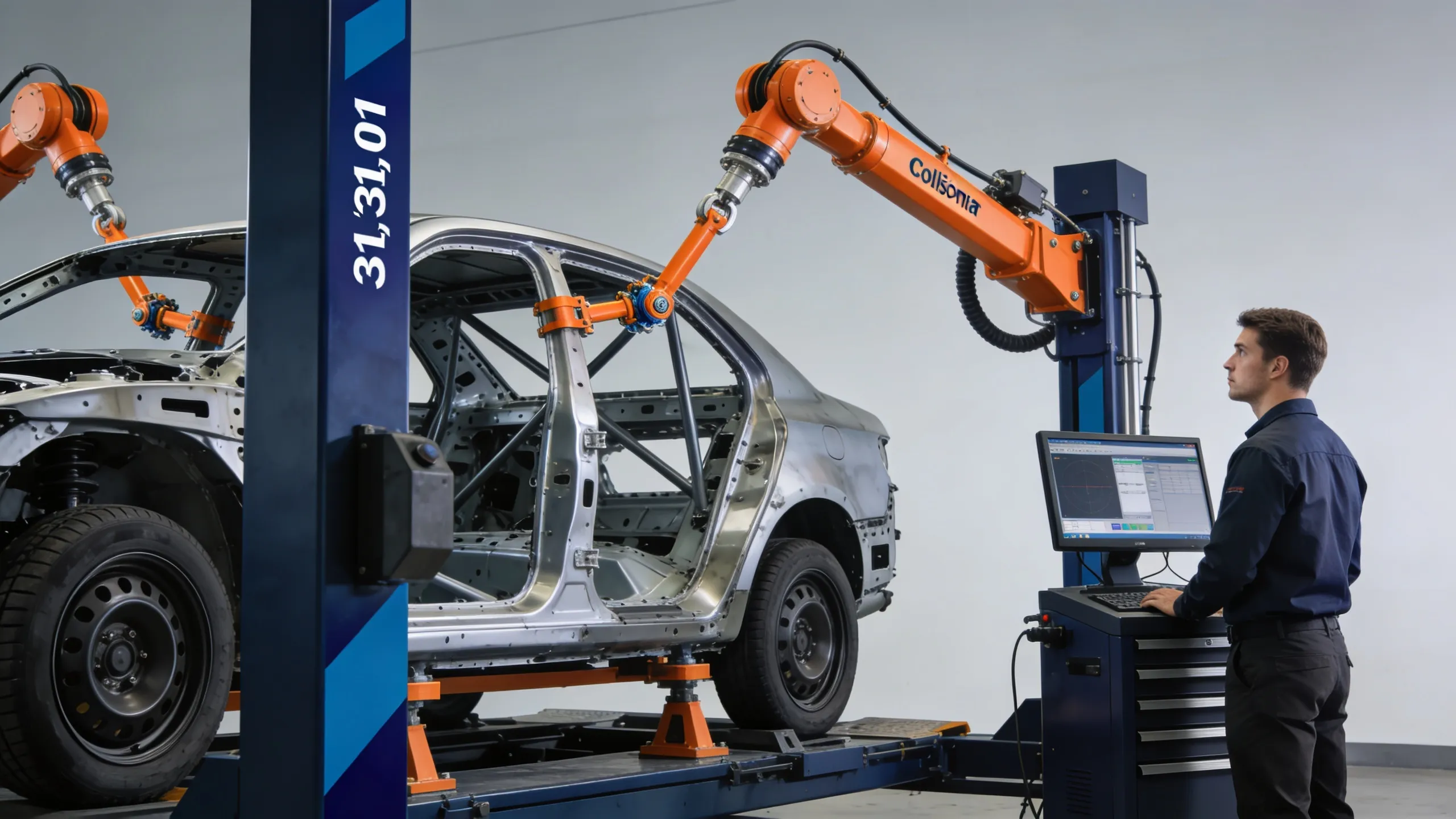
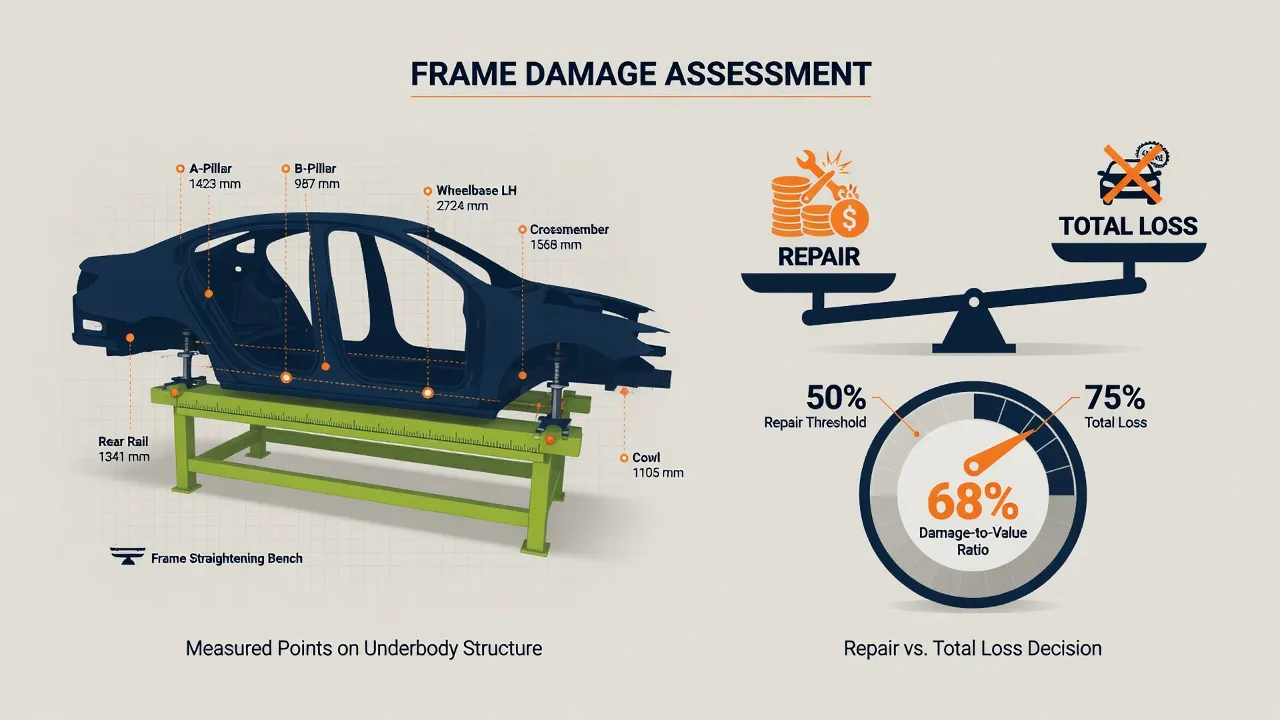
Structural repair happens on a frame machine, a heavy steel bench that anchors the vehicle while hydraulic towers pull on the damaged sections with chains. What makes modern work trustworthy is the measuring: computerized systems using lasers or electronic probes compare dozens of reference points on your vehicle against the manufacturer's factory data, live, while the pull happens. The technician isn't eyeballing anything. I-CAR notes that a typical tolerance is about 3 mm, and the structure is pulled until every point sits inside it.
Caliber Collision, one of the largest US repair chains, puts frame straightening at roughly $600 to $10,000. A single light pull on one rail sits near the bottom of that range. Multiple pulls in different directions, or cutting out and replacing a crushed rail section, push toward the top. That figure covers the structural work only. Body panels, paint, suspension parts, and sensor recalibration are separate line items, and that split drives the total-loss math below. For a line-by-line look at structural repair pricing, see our frame damage repair cost guide; this page is about the repair-or-total decision. When you're ready for a structural estimate, start with frame repair shops near you.
When Straightening Is Off the Table
Some damage can't be pulled back, no matter how good the shop is:
- Kinked metal. I-CAR's long-standing rule is that kinked parts must be replaced while bent parts may be repairable, and the carmaker's instructions override that rule whenever they're stricter.
- High-strength steel. Modern unibodies use ultra-high-strength and boron steels in critical sections. I-CAR says not to straighten parts above 600 MPa without specific OEM documentation, and that above 800 MPa the repair is usually replacement at factory seams. GM's position is that heat isn't recommended on these steels. If a shop says it can heat-straighten boron steel, find a different shop: the part may look right but won't perform the same in a crash.
- Tears and cracks in structural rails. Torn metal has lost its integrity. Sectioning and replacement is the only sound fix.
- Aluminum structures. I-CAR warns that cold-straightening aluminum often cracks it, and most carmakers call for replacing deformed aluminum structural parts (Ford is one of the few that allows some realignment). Aluminum work also requires dedicated equipment; Ford, for example, requires a dedicated aluminum MIG welder for F-150 structural repairs, which narrows your options and raises the price.
- Damage in multiple planes. A car with mash and twist together needs far more bench time, and labor hours can climb toward the value of the vehicle.
Notice that none of these automatically total the car. They raise the repair cost, and it's the cost, not the damage itself, that totals cars.
The Total-Loss Math That Actually Decides It
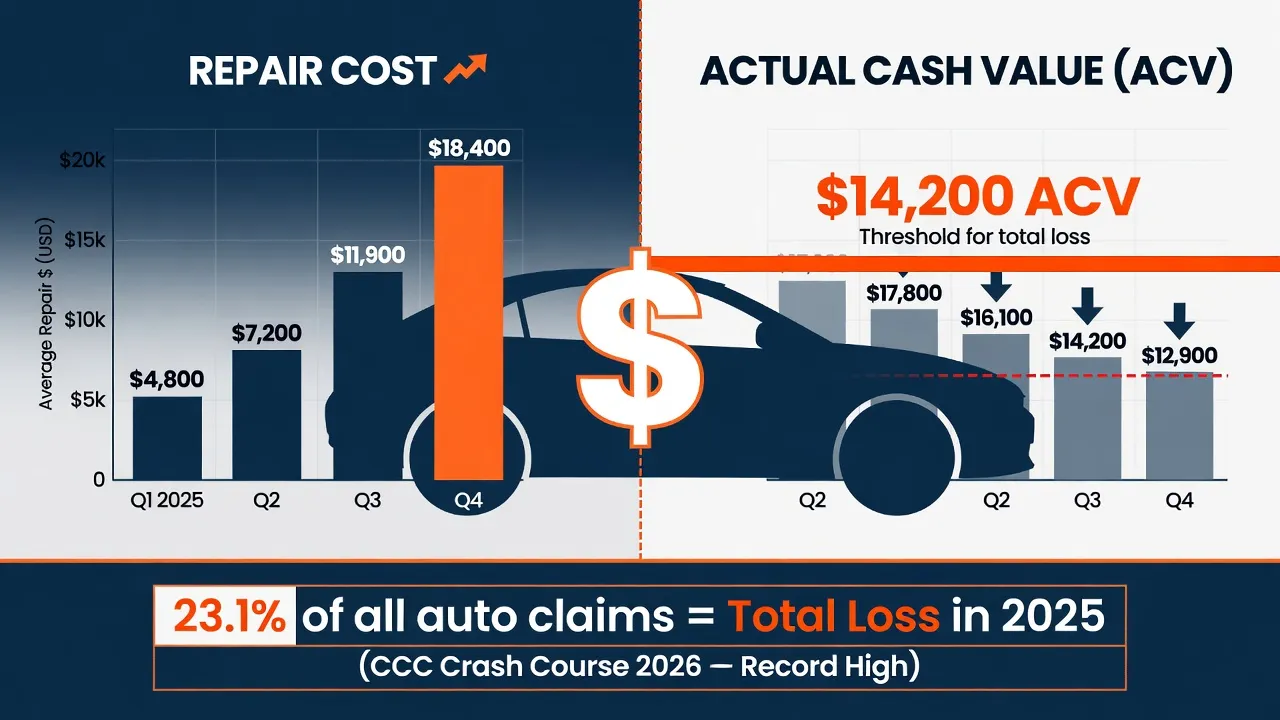
Insurers don't total cars because frame damage sounds scary. They total them when the repair estimate crosses a threshold, often 70 to 80 percent of the vehicle's actual cash value, according to CarInsurance.com's state-by-state table. Some states write the line into their salvage-title laws: Florida at 80 percent, Iowa at 70 percent (raised from 50 percent in 2021), and Texas when repairs exceed the full actual cash value. Many others use a total loss formula, where the car is totaled when repair cost plus salvage value exceeds its value.
Here's how it plays out. Say your car is worth $12,000 and your insurer totals at 75 percent, so the ceiling is $9,000. The frame pull is $3,500, which sounds survivable. Then add a rear body panel, a quarter panel repair, paint, a new bumper assembly with parking sensors, and a blind-spot radar recalibration, and the estimate lands at $9,400. Totaled. Not because the car was unrepairable, but because it failed the math.
The exact same damage on a $35,000 vehicle gets repaired without a second thought. This is why frame damage totals older cars so reliably: their value is low next to the repair bill, and labor rates are the same whether the car is worth $8,000 or $80,000. It's also part of why total losses keep climbing; CCC reports total loss frequency hit a record 23.1 percent of claims in 2025.
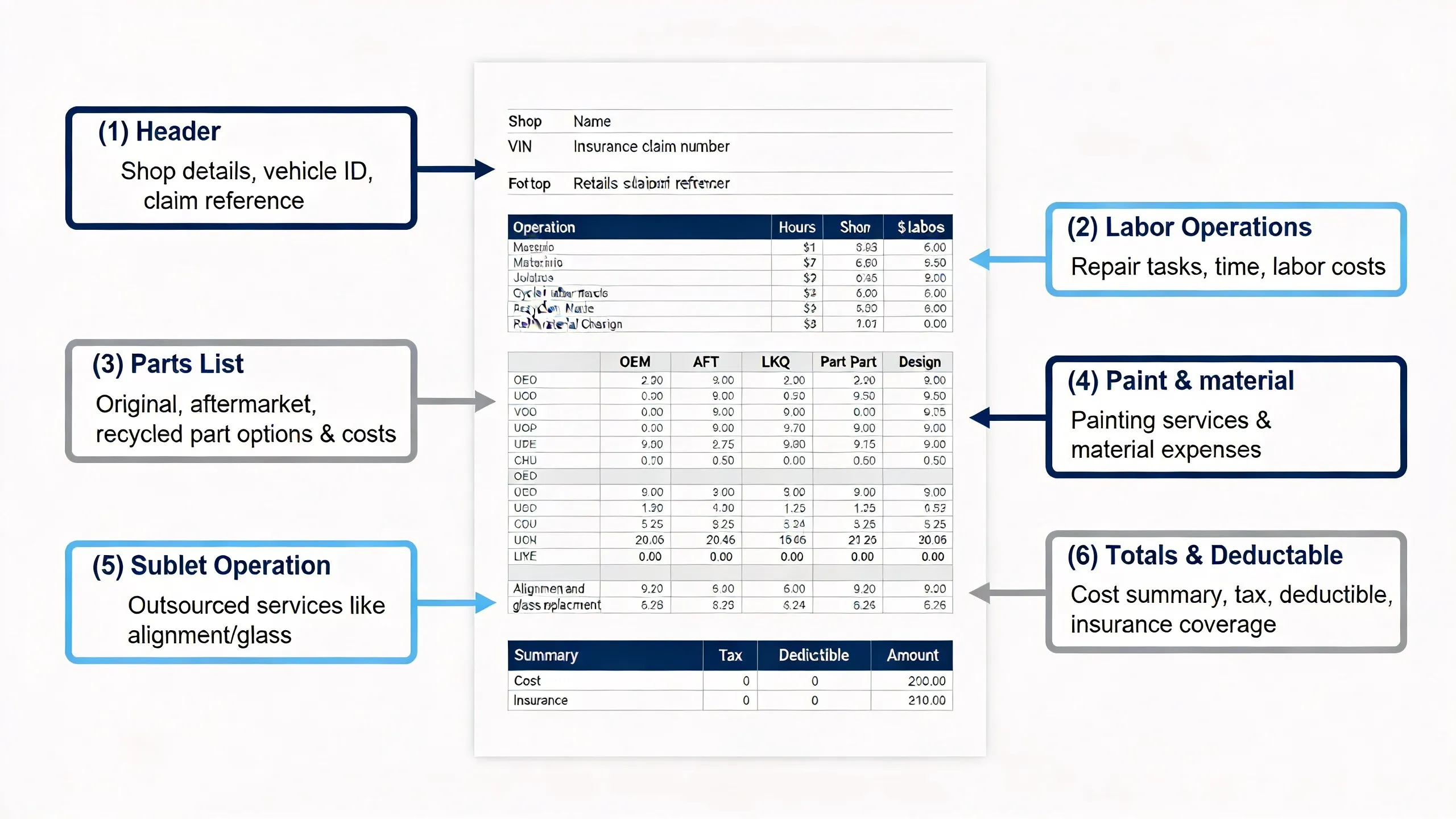
Insurers also hedge. In CCC's 2019 data, more than half of repairable estimates (55.6 percent) picked up a supplement after teardown, and the average supplement equaled 18.1 percent of the repair cost. A car sitting just under the threshold is often totaled preemptively rather than risk that supplement. If you want to see how those line items stack up on paper, our guide to reading a collision repair estimate walks through each section.
If You Disagree With the Verdict
You have more room to push back than most people use:
- Get an independent estimate. Take the car to a well-reviewed collision repair shop for its own assessment. Shops sometimes find a repair path the insurer's estimate missed, such as straightening a section the first estimate priced as a replacement.
- Challenge the valuation. The actual cash value drives everything. If comparable listings for your trim, mileage, and condition show a higher market price, submitting them can raise the ACV enough to move the threshold above the repair cost.
- Keep the car. Most states let you retain a totaled vehicle. The insurer pays you the ACV minus salvage value, the title becomes salvage, and you can repair it yourself. Just understand the consequences: the car needs a rebuilt-title inspection to drive legally, some insurers will only write liability coverage on it, and resale value drops sharply.
Our guide to your rights when insurance totals your car covers the valuation dispute and appraisal clause in more detail.
Is a Straightened Frame Safe?
Done to spec, yes. When a shop follows the manufacturer's repair procedures and the final measurements sit within factory tolerance, the crumple zones and suspension mounting points perform the way they were engineered to. The danger is bad repair: heat abuse on high-strength steel, or a clamp-and-yank job with no measuring system behind it.
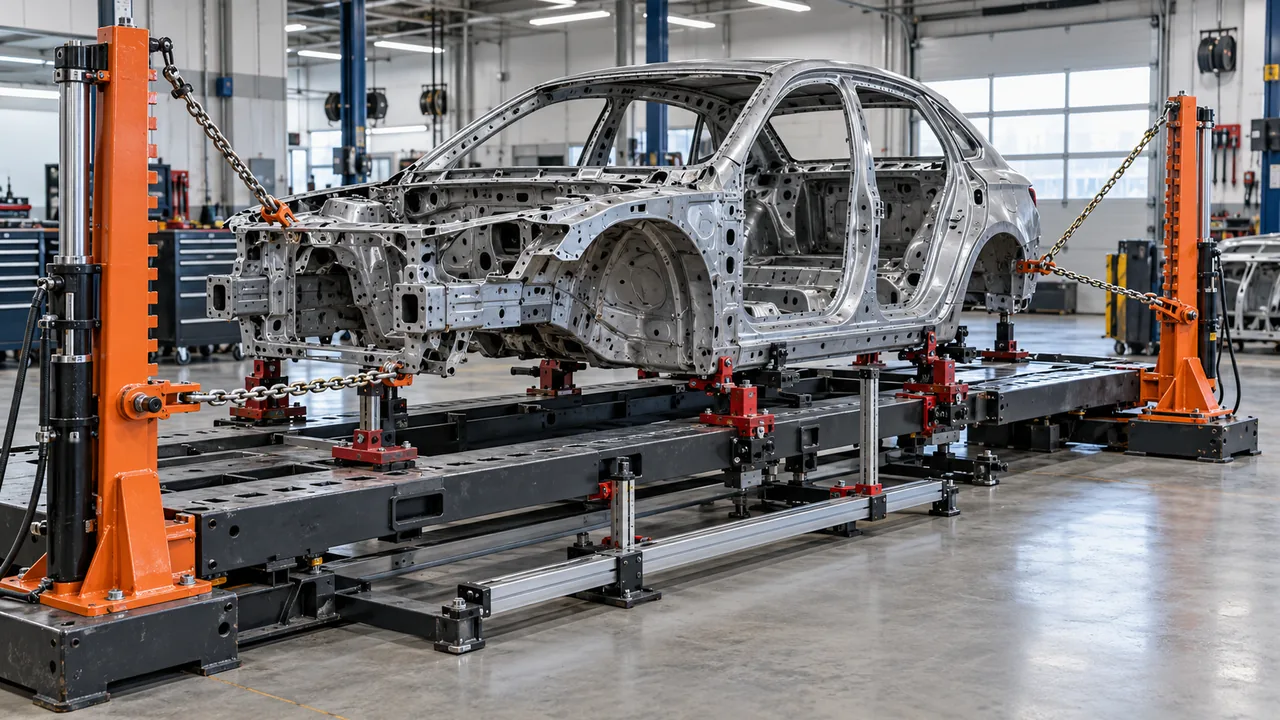
A safe structural repair comes down to four things you can ask about:
- Measurements. Every reference point back within the carmaker's tolerance, with a printed before-and-after report. Any shop with a computerized bench can produce one in seconds, and a shop that can't is telling you something.
- Materials. Replacement sections that match the original steel or aluminum grade, sourced to the carmaker's procedure.
- Joining methods. The welding or bonding method the carmaker specifies for that metal. Different steels and aluminum need different welders and settings, which is one reason certified collision centers exist.
- Alignment. A four-wheel alignment after the structural work, confirming the suspension mounting points are where they should be.
After the repair, watch the evidence. The alignment should hold, tires should wear evenly, panel gaps should be uniform, and doors should close without effort. A persistent pull or one tire scrubbing its inner edge means the structure isn't where it should be, and you should take it back.
Frequently Asked Questions
Can a car with frame damage be repaired?
Usually, yes. Bent unibody and ladder-frame sections can be pulled back to factory specification on a frame machine, and sections that can't be straightened, like kinked high-strength steel, can be cut out and replaced. A car gets totaled only when the combined repair cost approaches its value, not because frame damage is inherently unfixable.
How much does frame straightening cost?
Caliber Collision puts it at roughly $600 to $10,000 depending on severity. A single light pull on one rail sits at the low end; multiple pulls or a replaced rail section sits toward the top. Body panels, paint, suspension parts, and sensor recalibration are billed on top of that, which is why total estimates run much higher. For a full price breakdown, see our frame damage repair cost guide.
At what point does frame damage total a car?
When the full repair estimate reaches roughly 70 to 80 percent of the vehicle's actual cash value, depending on your state and insurer. Some states set the line by law, like Florida at 80 percent and Iowa at 70 percent. A $4,000 structural repair can total an $8,000 car and barely register on a $40,000 one. The ratio decides it, not the damage.
Is it safe to drive a car with frame damage?
No, not until the structure has been measured and repaired. Damage that looks mild can misalign suspension mounting points, change how the body manages crash energy, and compromise crumple zones in a second collision. Have the vehicle measured on a bench before putting it back in service.
Does repaired frame damage hurt resale value?
Yes. A structural damage entry on a vehicle history report lowers resale value even after a proper repair, and the drop depends on severity, repair documentation, and the vehicle. If the other driver was at fault, you may recover part of that loss through a diminished value claim against their insurer, which is worth pursuing on newer vehicles.
Sources
- I-CAR Repairability Technical Support: Kink vs. Bend
- I-CAR Repairability Technical Support: Boron steel repair
- I-CAR RTS: GM position on heat and high-strength steel
- I-CAR RTS: Cold straightening
- I-CAR RTS: Ford F-150 aluminum repair requirements
- I-CAR RTS: Measuring tolerances
- FenderBender: Understanding aluminum structural repairs
- Caliber Collision: Car frame straightening guide
- CarInsurance.com: Total loss thresholds by state
- Florida Statutes 319.30
- Iowa Legislature: SF 230 (2021)
- Texas Transportation Code 501.091
- CCC Crash Course 2026: record total loss frequency
- Repairer Driven News: CCC Crash Course 2020 supplement data