Franchise body shops and corporate-owned body shops look similar from the outside, but the ownership structure behind each model directly affects repair quality, pricing, accountability, and your experience as a customer. In a franchise model — used by CARSTAR, Fix Auto USA, and Maaco — a local business owner operates under a national brand, pays royalties, and follows brand standards while retaining day-to-day control. In a corporate model — used by Caliber Collision, Crash Champions, and Gerber Collision — a single parent company owns every location outright, sets all operational decisions from headquarters, and employs staff directly. Understanding this distinction helps you ask better questions and choose a shop that fits your priorities.
Key Takeaways
- Franchise body shops (CARSTAR, Fix Auto, Maaco) are independently owned by local operators who license a national brand, pay 2.5%–8% in royalties, and follow brand quality standards.
- Corporate chains (Caliber, Crash Champions, Gerber) own every location outright, employ all staff directly, and control operations from a central headquarters.
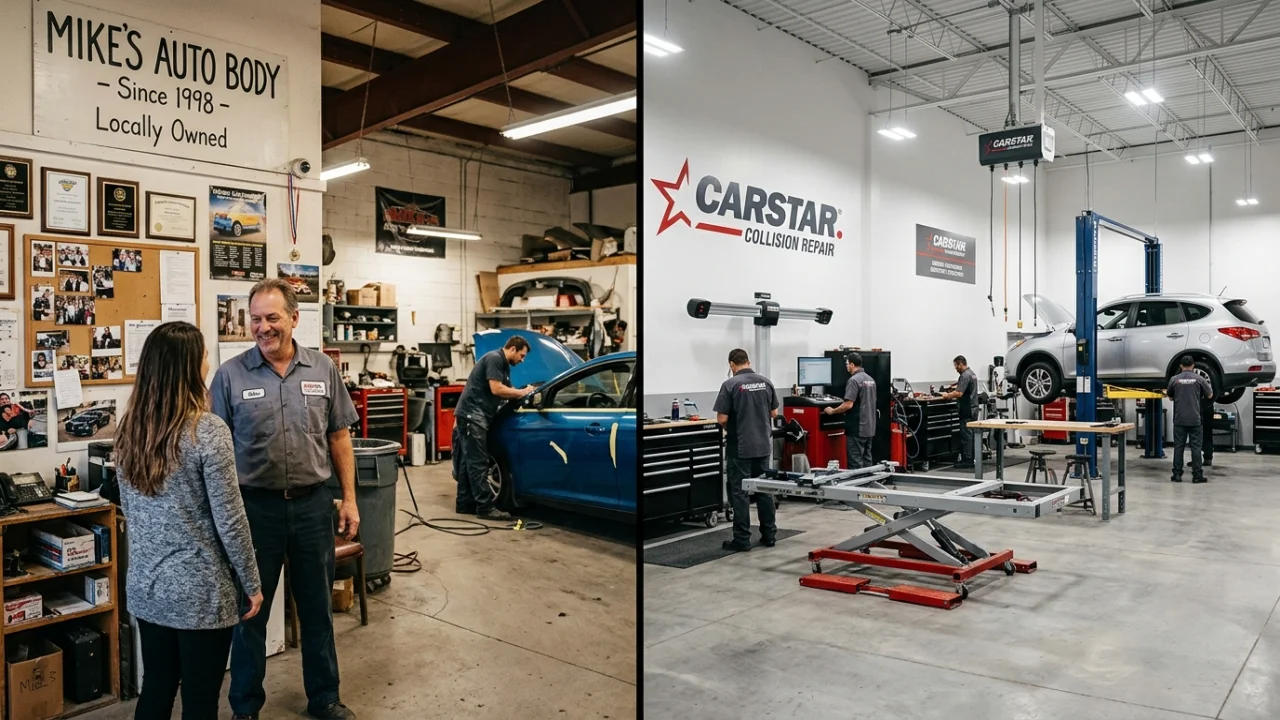
- Franchise shops tend to offer more local accountability and personalized service; corporate shops deliver more uniform processes and standardized warranties.
- Insurance DRP (Direct Repair Program) relationships exist in both models, but corporate chains often negotiate national DRP contracts that cover every location automatically.
- Neither model is inherently better — the individual shop's certifications, technician experience, and equipment matter more than ownership structure alone.
How Franchise Body Shops Work
A franchise body shop is an independently owned business that licenses the right to operate under a national brand name. The franchisee — typically an experienced collision repair operator — pays an initial franchise fee and ongoing royalties in exchange for brand recognition, insurance relationships, training programs, and operational support.
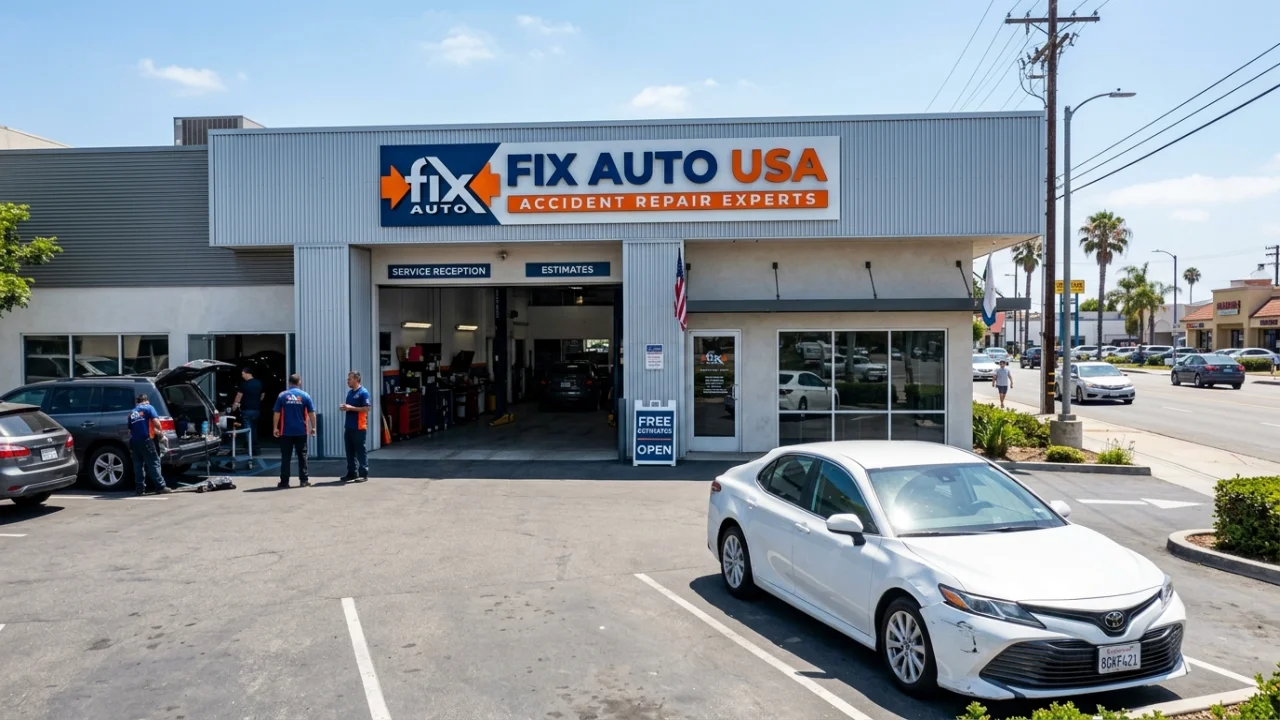
The three largest franchise collision repair networks in the United States are CARSTAR (700+ locations across 35 states, owned by Driven Brands), Fix Auto USA (approximately 220 locations, concentrated heavily in California), and Maaco (roughly 400 locations nationwide). Each operates on a similar principle: the local owner runs the shop, hires technicians, and manages customer relationships, while the franchisor provides the brand, national insurance partnerships, and a quality assurance framework.
What franchise owners actually pay
Franchise economics vary significantly across brands. CARSTAR charges a 2.5% combined royalty covering royalties, insurance, and marketing, with additional fees for CCC software and training programs. The total initial investment for a CARSTAR franchise ranges from $298,000 to $804,000. Maaco charges an 8% ongoing royalty with a $40,000–$47,000 franchise fee and total startup costs between $250,000 and $1,016,000. These costs come directly out of the shop's revenue, which affects how the business is managed day to day.
The upside of local ownership
Because franchise shops are owner-operated, the person making decisions about your repair often has a personal financial stake in customer satisfaction. If a repair goes wrong, the franchisee's reputation and livelihood are directly affected — there's no corporate layer to absorb the complaint. Many CARSTAR and Fix Auto franchisees are veteran body shop operators who converted existing independent shops to gain the brand's insurance relationships and national warranty program. For a detailed look at how one franchise network performs, see our Fix Auto USA review.
How Corporate-Owned Chains Work
Corporate body shop chains operate under a fundamentally different structure. A single parent company — typically backed by private equity — owns every location, employs all staff, and makes operational decisions from a central headquarters. The shop manager is an employee, not an owner.
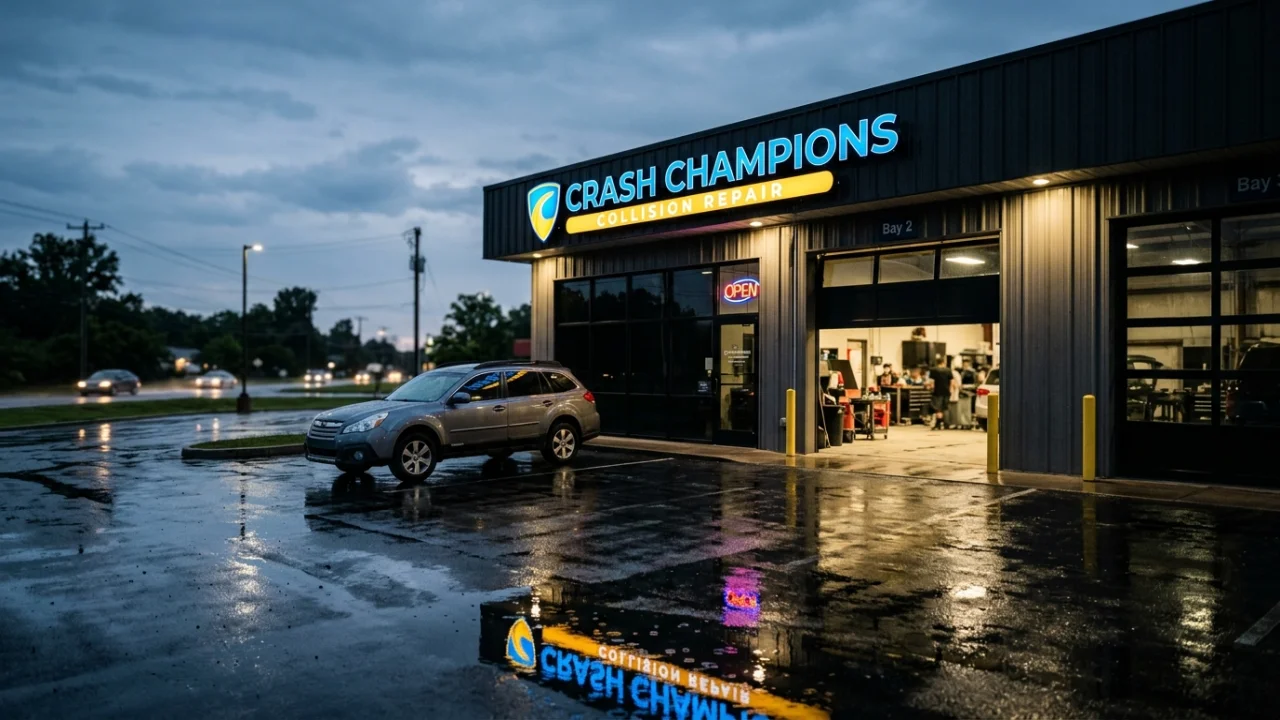
The three largest corporate collision repair chains are Caliber Collision (the largest chain by location count with over 1,800 shops), Gerber Collision & Glass (approximately 1,300 locations, owned by the publicly traded Boyd Group), and Crash Champions (650+ locations, backed by Clearlake Capital). Together with Classic Collision, these corporate chains operate roughly 4,019 locations and control approximately 31.7% of industry revenue as of mid-2026.
The scale advantage
Corporate ownership enables standardization that franchise models struggle to match. Caliber Collision and Gerber can deploy identical repair processes, equipment standards, and training curricula across every location because they control the entire operation. Parts purchasing at scale reduces costs. Technology investments — like centralized estimating platforms and real-time repair tracking — get rolled out system-wide rather than adopted shop by shop. For consumers, this often means a more predictable experience from one location to the next.
The financial pressure trade-off
The corporate model also carries risks. Private equity-backed chains are often leveraged with significant debt from acquisitions — Crash Champions, for example, carries a debt-to-EBITDA ratio of roughly 9x following its 2022 merger with Service King, and Moody's downgraded its credit rating to Caa1 in August 2025. Read more about Crash Champions' debt challenges and how that affects consumers. When financial pressure is high, corporate chains may cut costs in ways that affect repair quality: reducing training budgets, substituting lower-grade parts, or understaffing locations to protect margins.
Head-to-Head: Where Each Model Wins
Quality control
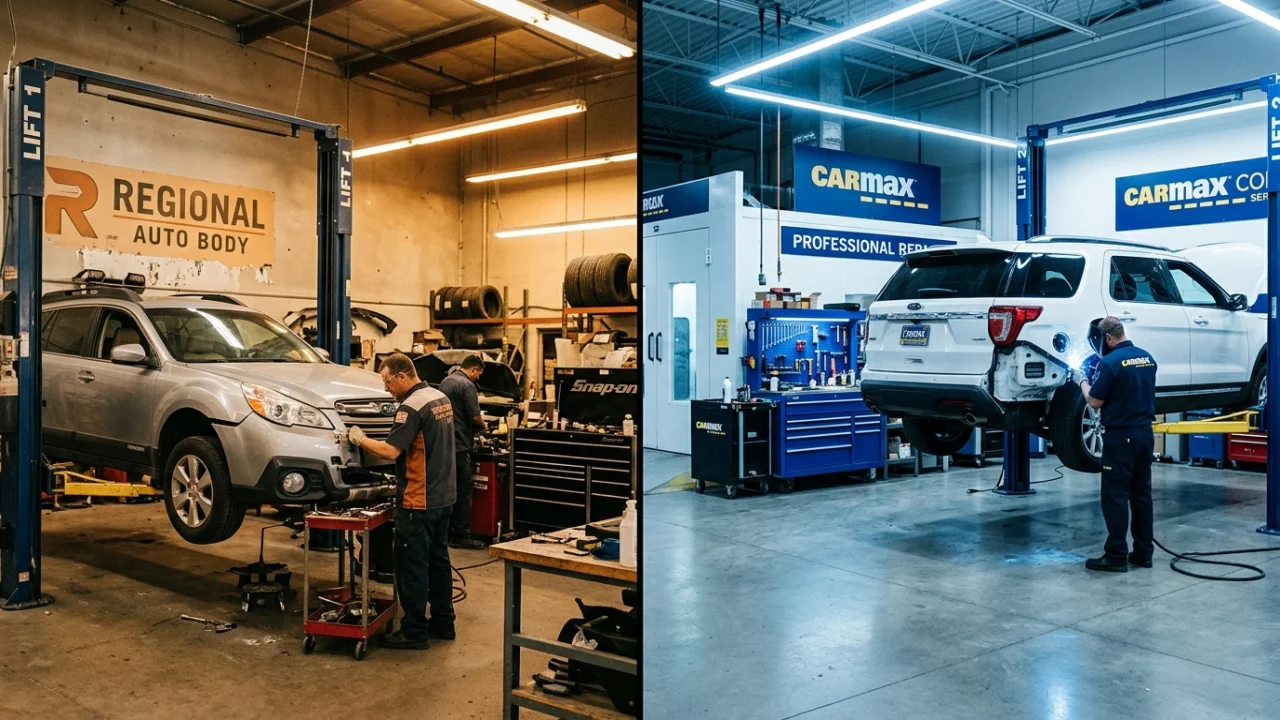
Corporate chains enforce quality through centralized audits, standardized repair procedures, and company-wide training mandates. Franchise networks set minimum standards but rely on franchisees to implement them — the result is higher variance. A great CARSTAR franchise may outperform a Caliber location, but a struggling franchise has less corporate oversight pulling it back to baseline. Both models pursue I-CAR Gold Class and OEM certifications, but corporate chains are more likely to mandate them across all locations.
Pricing and estimates
Franchise owners set their own labor rates within brand guidelines, which can mean competitive local pricing — especially in markets where the owner has deep relationships with parts suppliers. Corporate chains negotiate national parts contracts and insurance reimbursement rates centrally, which standardizes pricing but may leave less room for the kind of flexibility a local owner can offer on a case-by-case basis.
Warranty and accountability
Both models offer national warranties, but the mechanism differs. A corporate chain's warranty is backed by the parent company directly — if your Caliber location closes, the warranty transfers automatically to any other Caliber. A franchise warranty depends on the franchisee and the franchisor's willingness to enforce it across independently owned locations. CARSTAR's national warranty, for example, is honored network-wide, but the experience of claiming it at a different franchisee's shop can vary. See our Classic Collision vs Caliber comparison for a closer look at how warranty programs differ between chains.
Insurance DRP access
Insurance companies' Direct Repair Programs (DRPs) are critical for body shop volume. Corporate chains negotiate national DRP agreements that automatically include every location — when State Farm or GEICO adds Caliber to their DRP, all 1,800+ Caliber shops qualify. Franchise networks negotiate at two levels: the franchisor secures national framework agreements, and individual franchisees may have additional local DRP relationships. This dual approach can be an advantage in some markets, but it also means DRP coverage across a franchise network is less uniform. Learn more about how DRP body shop programs work.
Decision-making speed
When something goes wrong mid-repair — a hidden damage supplement, a parts delay, a customer complaint — franchise owners can make decisions on the spot. They don't need regional manager approval to authorize additional work or offer a concession. Corporate locations route decisions through management hierarchies, which can add hours or days to resolution times. For straightforward repairs, this difference is invisible. For complex or problem repairs, it can matter significantly.
Which Matters More: The Brand or the Shop?
The most important insight about both models is that they produce wide ranges of quality. A CARSTAR franchise run by a 25-year collision repair veteran with OEM certifications and I-CAR Gold Class will likely outperform a corporate chain location that's understaffed and relying on aftermarket parts. The reverse is equally true.
When choosing between a franchise and a corporate shop for your collision repair, focus on the individual location rather than the brand on the sign. Check for I-CAR Gold Class certification, OEM certifications for your vehicle's make, technician training documentation, and the specific warranty terms in writing. Ask whether the shop does auto body repair on your vehicle type regularly and whether they sublet any of the work — particularly ADAS calibration, which is increasingly common after collision repairs.
Read reviews for the specific location, not the chain overall. A 4.8-star CARSTAR in one city tells you nothing about a 3.2-star CARSTAR across town. The same applies to every Caliber, Gerber, and Crash Champions location. Ownership structure sets the framework, but the people inside the shop determine whether your car gets fixed right.
Sources
- I-CAR (Inter-Industry Conference on Auto Collision Repair) — collision repair industry training standards
- NHTSA Vehicle Safety — federal vehicle safety and crashworthiness standards
Frequently Asked Questions
Is CARSTAR a franchise or a corporate chain?
CARSTAR is a franchise network. Each CARSTAR location is independently owned and operated by a local franchisee who licenses the CARSTAR brand from Driven Brands. The franchisee pays royalties (approximately 2.5% combined for royalties, insurance, and marketing) and follows brand standards, but retains day-to-day control over hiring, pricing, and customer relationships. CARSTAR operates more than 700 locations across 35 U.S. states as of 2026.
Is Gerber Collision a franchise?
No. Gerber Collision & Glass is a corporate-owned chain. Every Gerber location is owned and operated by its parent company, the publicly traded Boyd Group Services (TSX: BYD). Boyd Group directly employs all staff and manages operations centrally. Gerber operates approximately 1,300 locations across the United States, making it the second-largest corporate collision chain behind Caliber Collision.
Do franchise body shops cost more than corporate chains?
Not necessarily. Franchise owners set labor rates locally and may offer competitive pricing based on their market, parts supplier relationships, and overhead structure. Corporate chains negotiate national parts contracts that can reduce material costs but apply standardized labor rates across all locations. In practice, repair costs at both types vary more by location, vehicle type, and repair complexity than by ownership model. Always get estimates from at least two shops regardless of their structure.
Are franchise body shop warranties as good as corporate chain warranties?
Both franchise networks and corporate chains offer national warranties, but they work differently. Corporate chains like Caliber Collision back warranties directly through the parent company, so any location in the network can service a warranty claim seamlessly. Franchise networks like CARSTAR offer network-wide warranties, but because each shop is independently owned, the claims process between locations can vary. Get the warranty terms in writing before authorizing repairs, regardless of the shop type.
Should I choose a franchise or corporate body shop for my repair?
Focus on the individual shop rather than the ownership model. Check for I-CAR Gold Class certification, OEM certifications for your vehicle's make, and read reviews for that specific location — not the chain overall. Ask about warranty terms, parts sourcing (OEM vs. aftermarket), and whether they sublet any repair work. A well-run franchise and a well-run corporate location can both deliver excellent repairs. The technicians, equipment, and management at the specific shop matter more than whether the owner is a franchisee or a corporate entity.