You backed into a concrete pillar in a parking garage at four miles per hour. Now the corner of your rear bumper is scuffed, slightly dented, and cracked along one edge. Before you brace for a four-figure bill, here is the part most drivers never hear: the majority of plastic bumper damage can be repaired for $150 to $800, and a good repair is invisible once the paint cures.
Shops replace a lot of bumpers that could have been fixed. Sometimes replacement genuinely makes sense, but often it is just the faster path for the shop. Knowing what repair actually costs, and which damage is truly repairable, puts you in a position to ask for the cheaper option when it exists.
Sources
- CCC Intelligent Solutions — collision repair cost benchmarks and industry data
- Insurance Information Institute — auto insurance and repair cost statistics
Why Plastic Bumpers Can Be Repaired at All
Almost every bumper on the road today is a flexible plastic cover, usually thermoplastic polyolefin or polypropylene, sitting over a foam or metal impact absorber. That plastic is engineered to flex, which is why a low-speed hit that would have crumpled a chrome bumper in 1985 often leaves nothing but scratches now.
Because the material is thermoplastic, it can be reshaped with heat, welded with plastic filler rod, sanded, and repainted. A technician can warm a dented section until the plastic relaxes back toward its molded shape, then handle remaining damage with adhesive or a plastic welder. Done properly, the repaired area is as strong as the surrounding material.
What Plastic Bumper Repair Costs in 2026
Prices vary by region and by shop, but these ranges hold across most of the US. Independent body shops usually land near the bottom of each range; dealership body shops and luxury-brand certified shops land near the top.
Scuffs and scrapes: $150 to $450
Surface scuffs that have not cracked the plastic are the cheapest fix. The shop sands the area, fills minor gouges, primes, and repaints the affected section. If the scuff only removed clear coat, some shops can buff it out for less than $150. This is also the job where mobile technicians who come to your driveway are most competitive, often quoting $150 to $300 for a single corner.
Dents without cracks: $200 to $600
A pushed-in section that has not torn the plastic can often be reshaped with heat from behind. If the paint survived, you might pay only a couple hundred dollars. If the paint cracked as the plastic flexed, add refinishing and you are closer to $500 or $600.
Cracks and punctures with repaint: $350 to $800
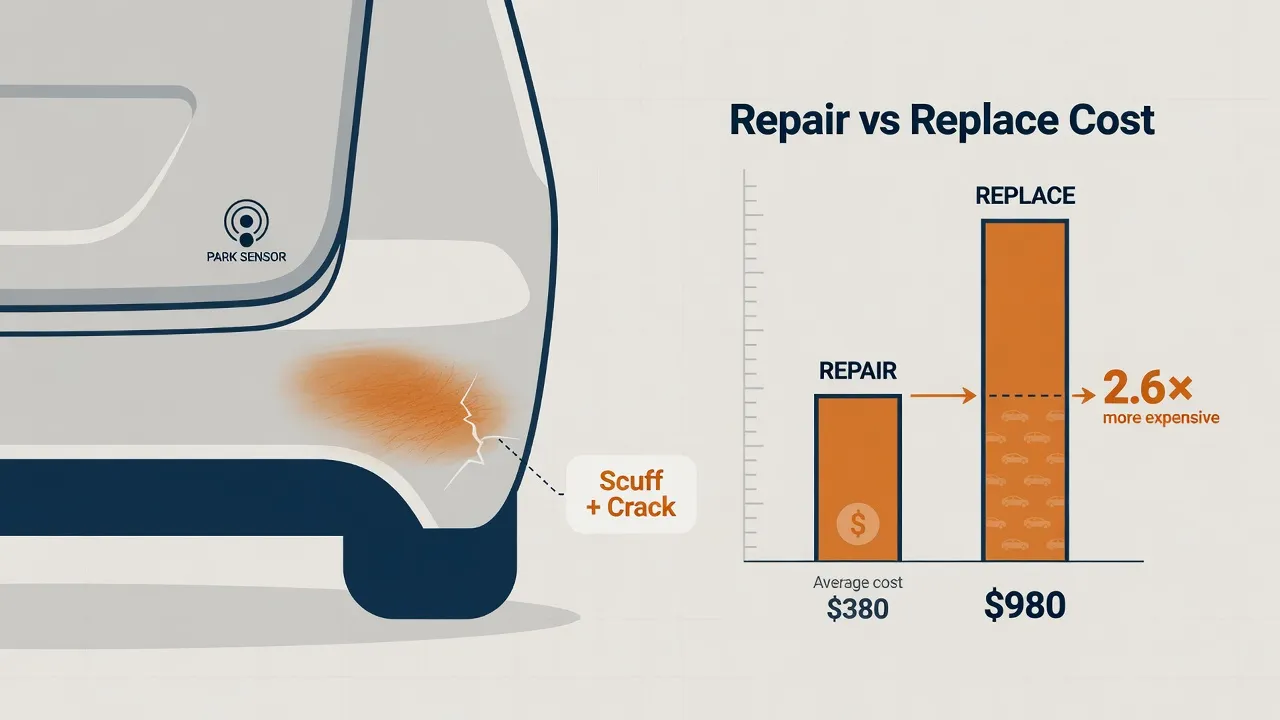
A crack needs structural repair, not just cosmetics. The technician grinds a groove along the crack, welds or bonds it with reinforcement mesh on the back side, refinishes the front, and blends the paint. Expect $350 to $800 depending on the length of the crack and how much of the bumper needs paint. Multiple cracks push you toward the top of that range fast, and at some point replacement becomes the smarter buy.
Full bumper cover replacement: $500 to $1,500, more with sensors
When repair is not viable, a new cover runs $500 to $1,500 installed and painted on most mainstream vehicles. That number climbs quickly on newer cars. Parking sensors, blind-spot radar, and park-assist cameras live in or behind modern bumpers, and each sensor that needs transferring or replacing adds parts cost plus a calibration charge. On a vehicle loaded with driver-assist features, a bumper replacement can pass $2,000 once recalibration is included, which is exactly why a $400 repair is worth asking about first.
If you are collecting quotes, get at least two. Estimates for bumper repair on the same damage routinely differ by several hundred dollars between shops, mostly because one shop quoted a repair and the other quoted a replacement.
What Actually Drives the Price
Two bumpers with similar-looking damage can produce very different bills. These are the variables that matter:
- Paint blending. Refinishing is usually half or more of the bill. If the damage sits near the edge of the bumper, the painter may need to blend color into adjacent panels for a seamless match, which adds labor.
- Color. Tri-coat pearls and some metallics take more material and more skill to match, adding $100 to $200 over a standard color.
- Location of the damage. Damage near sensor openings, fog lights, or mounting edges takes longer to repair correctly.
- Vehicle brand. Luxury and European makes carry higher labor rates and pricier paint codes.
- Where you live. Labor rates in major metros run 20 to 40 percent above rural rates for identical work.
When Repair Works and When It Does Not
Repair is usually the right call when the damage is cosmetic or limited to one area:
- Scuffs, scrapes, and paint transfer from another car
- A single crack shorter than a few inches, away from the edges
- Dents where the plastic flexed but did not tear
- Small punctures from a trailer hitch, post, or tow hook
Replacement becomes the better answer when:
- The mounting tabs are broken. The tabs that clip the cover to the fenders and rails snap easily in a hit. Some shops can weld tabs back on, but multiple broken tabs usually mean the cover will never sit flush again.
- There are multiple long cracks. Each crack adds welding and refinishing time. Past two or three, repair labor exceeds the cost of a new cover.
- The damage crosses a sensor mount. Radar and ultrasonic sensors need factory-spec plastic thickness around them. Filler and welds in those zones can distort readings, and most shops will refuse to repair there.
- The structure behind the cover is crushed. The cover is cosmetic; the foam absorber and reinforcement bar behind it are what protect you. Crushed structure must be replaced, and a hit that hard also warrants a check for hidden damage further in.
Should You Even Fix It? A Quick Decision Framework
Run the math before you run to a shop. If your insurance deductible is $500 and the repair quote is $450, filing a claim gains you nothing and may cost you at renewal. Most bumper repairs land below or near typical deductibles, which is why the majority get paid out of pocket.
Then consider your situation. Leased vehicle going back within a year? Fix it, because lease-end inspectors charge more for damage than a repair costs. Twelve-year-old commuter with 160,000 miles? A $200 scuff repair may be justifiable, an $800 crack repair probably is not. Planning to sell soon? A repaired bumper photographs far better than a damaged one and recovers more than it costs on most vehicles under ten years old.
DIY Kits vs. Professional Repair
Plastic repair kits run $20 to $100 and work reasonably well for the structural half of the job. Bonding a crack from behind is genuinely achievable in a driveway. The paint is where DIY fails: spray-can color rarely matches factory paint that has aged in the sun, and the mismatch is obvious from ten feet away. A common middle path is to do the structural fix yourself and pay a local paint shop to refinish the area, which can cut the total bill to $200 or $300. If the damage is on a newer vehicle you plan to keep, skip the experiment and have a professional handle the whole job.
Frequently Asked Questions
How much does it cost to fix a scratched plastic bumper?
Light scratches and scuffs run $150 to $450 at a body shop, depending on how much repainting is needed. Clear-coat-only scratches can sometimes be buffed out for under $150, and mobile repair services often quote $150 to $300 for a single scuffed corner.
Is it cheaper to repair or replace a plastic bumper?
Repair is almost always cheaper when the damage qualifies. A crack repair with repaint costs $350 to $800, while a replacement cover runs $500 to $1,500 installed, and more if sensors need transferring and recalibrating. Replacement only wins when the damage is extensive, tabs are broken, or the repair quote approaches the replacement price.
Can a cracked bumper be repaired instead of replaced?
Yes, in most cases. Technicians weld or bond the crack with reinforcement on the back side, then refinish the face. Single cracks away from edges and sensor mounts repair well. Multiple long cracks, or cracks through mounting points, usually justify replacement.
Does insurance cover bumper repair?
Collision coverage does if you caused the damage, and the other driver's liability coverage does if they hit you. But since many bumper repairs cost less than a typical $500 deductible, paying out of pocket is often the smarter move for self-inflicted damage. Get a repair quote before deciding whether to file.
How long does plastic bumper repair take?
A scuff repair is often same-day. Crack repairs with repaint typically take one to two days because the paint and clear coat need cure time. A full replacement with sensor recalibration can take two to three days, longer if the cover has to be ordered and pre-painted.