Clear coat repair runs roughly $400 to $1,200 per panel, or $3,000 to $5,000 for a full vehicle, because the only real fix is sanding the panel down and respraying it. It spreads because once UV cracks the top layer, sunlight and moisture keep attacking every newly exposed edge.
Clear coat failure is the most misunderstood paint problem there is, because it looks minor for months and then suddenly is not. Understanding why it spreads is the difference between a $150 fix and an $800 one, and sometimes between saving a panel and repainting half the car.
What Clear Coat Actually Does
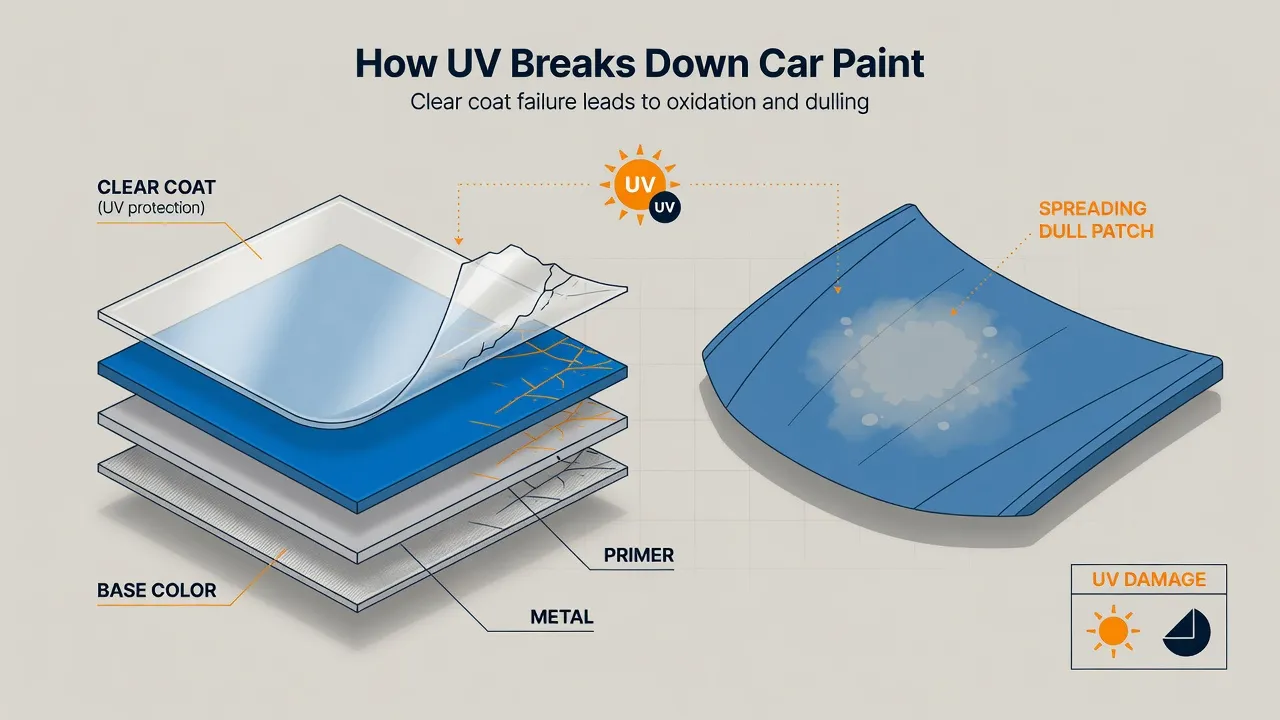
Modern car paint is layered: primer bonds to the metal, base coat carries the color, and clear coat sits on top as a transparent shell roughly as thick as a sheet of paper. The clear coat provides nearly all of the gloss and nearly all of the protection. It blocks UV light, seals out moisture and chemicals, and takes the daily abuse from washing, weather, and road grime so the color layer underneath never has to.
That layering explains a rule that surprises people: the color coat under the clear is not designed to be exposed. Base coat is porous and dull on its own. The moment clear coat fails, the color layer beneath it starts degrading immediately, which is exactly why the damage grows.
Why Clear Coat Damage Never Stays Put
Three mechanisms make clear coat problems expand rather than sit still. First, UV. Sunlight breaks down the exposed edge of the failure and the unprotected base coat inside it, chalking the color and weakening the surrounding clear. Second, edge lifting. Once clear coat delaminates at one spot, the boundary is no longer bonded, so water, heat cycles, and car washes work under the edge and peel it back a little more each month. Third, the base coat itself deteriorates once exposed, so even the area that already failed keeps getting worse, going from dull to chalky to worn through.
This is why horizontal panels fail first and fastest. Hoods, roofs, and trunk lids take direct sun for hours a day. It is also why a quarter-sized peel in spring becomes a dinner plate by summer. If you catch clear coat damage while it is still just scratches or haze, a good paint shop can often save the panel for a few hundred dollars. Once it peels, that option is gone.
The Four Kinds of Clear Coat Damage
Scratches and swirl marks
Fine lines from automatic washes, dry wiping, and everyday contact. These live entirely within the clear coat and are fully repairable by polishing. Run a fingernail across the mark: if it does not catch, it is this category.
Oxidation and haze
The clear coat surface degrades from UV exposure and turns cloudy or milky instead of glossy. Early oxidation polishes out because only the top of the layer is affected. Advanced oxidation, where the paint looks chalky white, often means the clear coat is too thin or too far gone to correct.
Etching
Bird droppings, tree sap, and bug remains are acidic, and heat bakes them into the clear coat, leaving a dulled outline or a visible crater even after the mess is cleaned off. Shallow etching polishes out. Deep etching that has eaten through the clear requires repainting, which is why cleaning droppings off within a day or two matters more than any other single habit.
Peeling and delamination
The clear coat loses adhesion and flakes off in patches, showing dull base coat underneath. This is the terminal category. No polish, wax, or spray product reattaches clear coat that has let go. The panel must be sanded down and refinished.
What Clear Coat Repair Costs in 2026
The price depends entirely on which of those four categories you are in:
- Polishing out scratches or light haze: $75 to $300. A shop machine-polishes the affected area, sometimes after light wet sanding. The damage is removed, not hidden.
- One-step paint correction: $150 to $400. A full-vehicle polish that handles widespread swirls and early oxidation across the whole car.
- Multi-stage paint correction: $500 to $1,500. For heavily swirled or moderately oxidized paint that still has healthy clear coat thickness. Worth it only if the clear coat is intact, which a shop can verify with a paint thickness gauge.
- Repainting one peeling panel: $300 to $1,000. Once clear coat peels, the panel gets sanded, refinished in base coat, and re-cleared. A hood or roof sits at the upper half of that range because of size.
- Hood and roof together: $800 to $2,000. The most common real-world clear coat job, since both panels bake in the sun and usually fail around the same time.
- Widespread failure: $1,500 to $5,000 and up. When multiple panels are peeling, a full repaint becomes more economical than chasing panels one at a time.
One pricing note that catches people off guard: a shop cannot respray only clear coat over your existing color. Sanding the failed clear disturbs the base coat, and new clear will not bond reliably over aged, UV-damaged base anyway. A proper repair always includes new color, which is why there is no cheap professional fix for peeling. Any body shop quoting a few hundred dollars to just re-clear a peeling panel is describing a repair that will fail again quickly.
Why the Spray-Can Fix Fails
Aerosol clear coat from the parts store is tempting at $15, and it consistently fails for the same reasons. Rattle-can clear is a different chemistry than the two-part urethane shops spray, so it stays softer and yellows. It cannot be applied over the crumbling edge of old clear without that edge continuing to lift underneath it. And it goes on without proper surface prep, so it typically starts flaking at the borders within months. If the car is worth almost nothing and appearance barely matters, a spray can buys time. On any car you care about, it adds a layer the shop later has to strip off, which adds labor to the eventual real repair.
How to Stop Damage From Spreading
If you have caught the problem early, or just refinished a panel and do not want a repeat, protection is cheap compared to paint:
- Wax or apply a paint sealant two to four times a year. It is a sacrificial UV and chemical barrier over the clear coat.
- Consider a professional ceramic coating at $500 to $2,000 if you keep cars long term. It lasts years instead of months.
- Park in shade or a garage when you can. Sun exposure is the primary driver of clear coat failure, and cars in Arizona, Texas, and Florida fail years earlier than the same models in Minnesota.
- Remove bird droppings and sap within a day, especially in summer.
- Skip automatic washes with brushes, which install the fine scratches that thin the clear coat over time.
If the peeling has already started, none of this reverses it, but keeping the car waxed and out of the sun does slow the spread while you budget for the repaint.
Sources
- CCC Intelligent Solutions — collision repair cost benchmarks and industry data
- Insurance Information Institute — auto insurance and repair cost statistics
Frequently Asked Questions
Can clear coat damage be fixed without repainting?
Yes, if the damage is limited to scratches, light haze, or shallow etching within the clear coat. Polishing at $75 to $300 removes it entirely. Once the clear coat is peeling or worn through and the base coat is exposed, repainting is the only repair that lasts, at $300 to $1,000 per panel.
How fast does peeling clear coat spread?
Fast enough to change your repair bill within a season. A small peel commonly doubles in size over a few sunny months, since UV and moisture keep working the exposed edge. A car parked outside in a hot, sunny climate can go from one bad spot to a visibly failing hood in a single summer.
Why is my clear coat failing when I never damaged the car?
Age and sun are usually the whole story. UV exposure slowly breaks down the resin in clear coat until it loses adhesion, typically after 10 to 15 years outdoors, sooner in southern states. Some vehicles from certain factories and eras are also known for thin factory clear that fails early no matter how the car was treated.
Is it worth repainting a hood with peeling clear coat on an older car?
Do the math against the car's value and your plans. A $500 to $900 hood respray on a car you will keep for years is usually worthwhile, both for appearance and because exposed base coat eventually lets moisture reach primer and metal. On a car worth $3,000 that you plan to sell soon, most owners skip it and price the car accordingly.
Does insurance cover clear coat failure?
Not when it is age and sun related, which insurers classify as wear and tear. Comprehensive coverage applies to sudden external events like vandalism, chemical spills, or hail, not gradual deterioration. If a specific incident like an industrial fallout event damaged the clear coat, document it immediately, because that can be claimable.