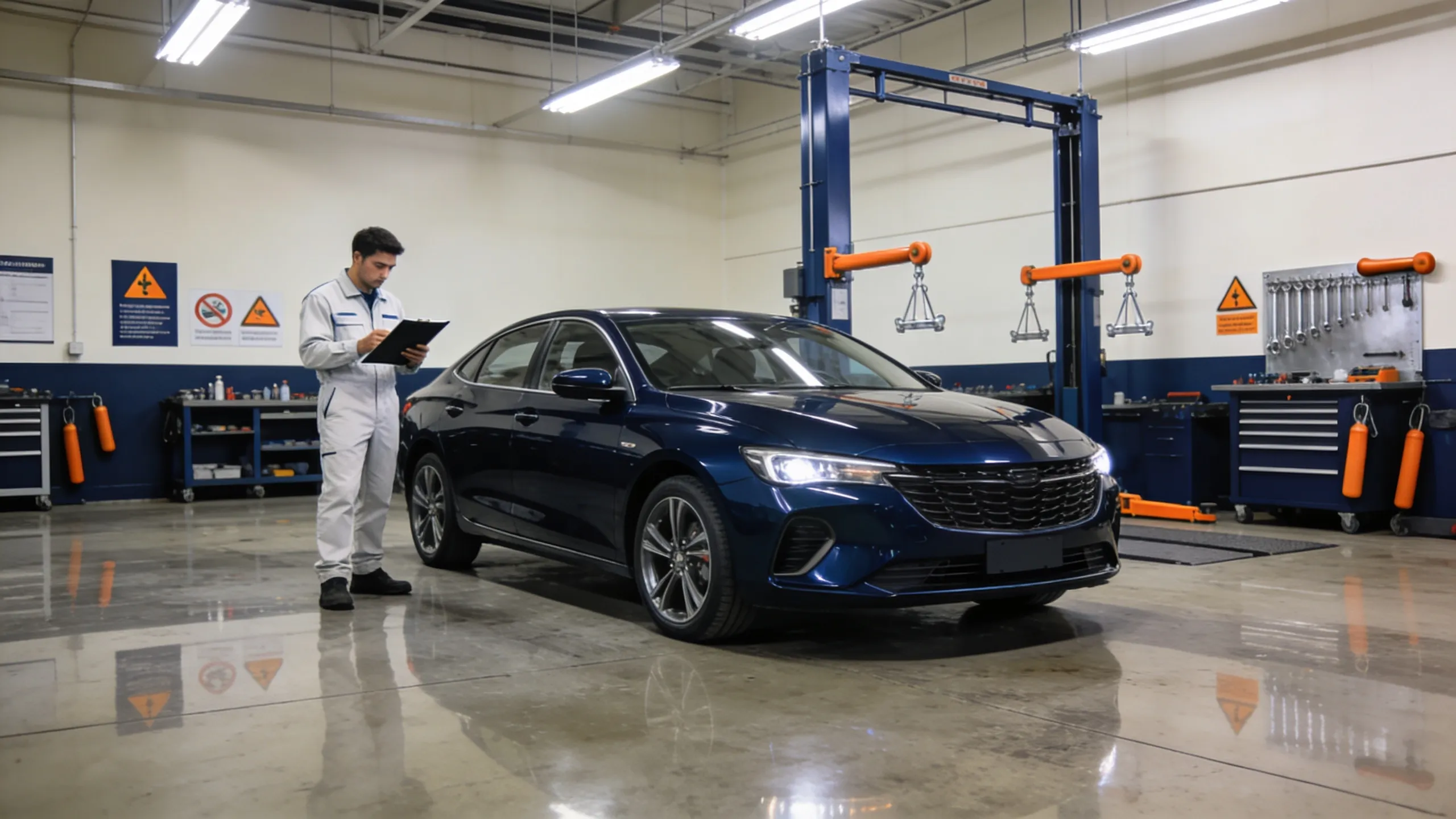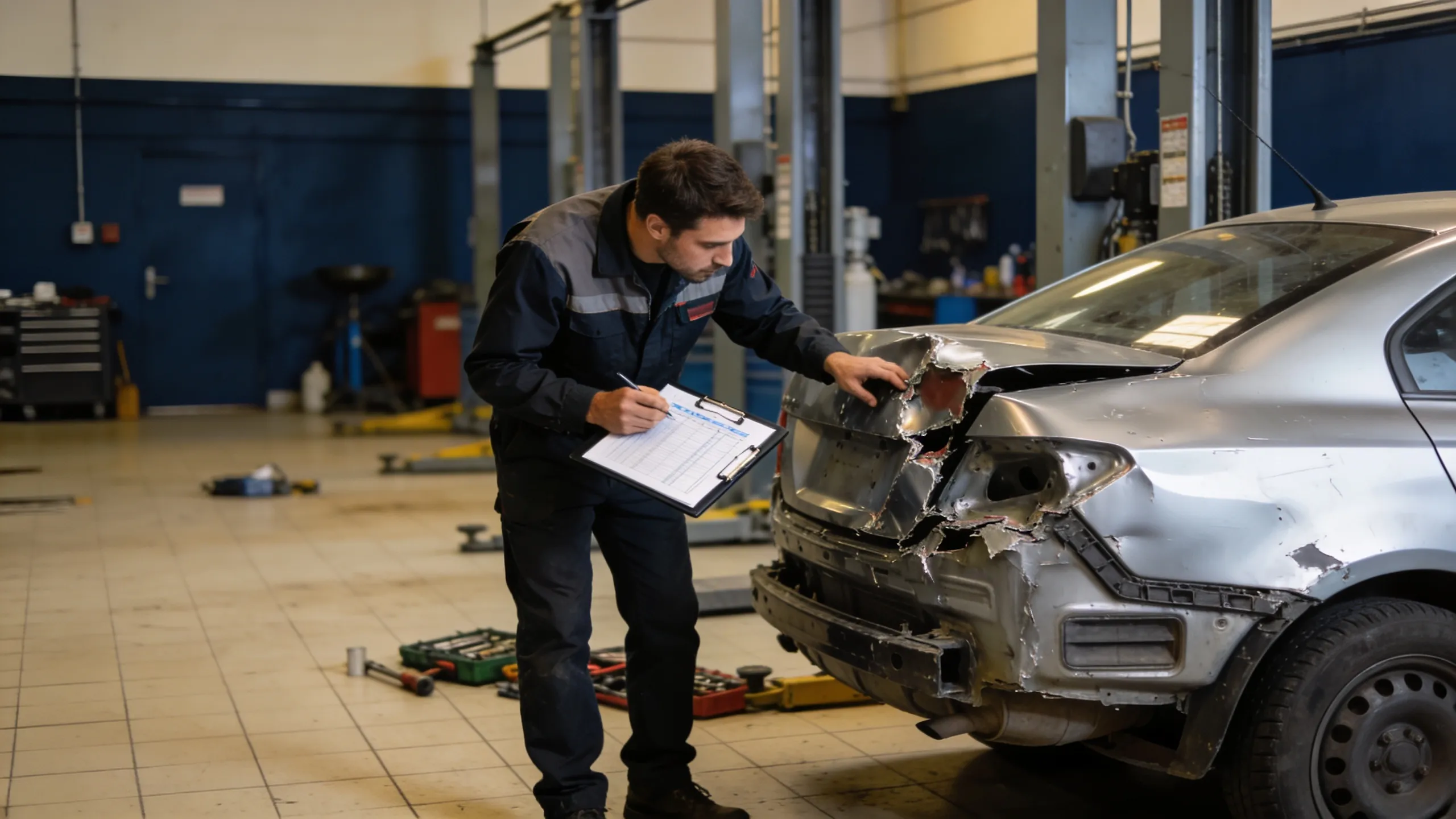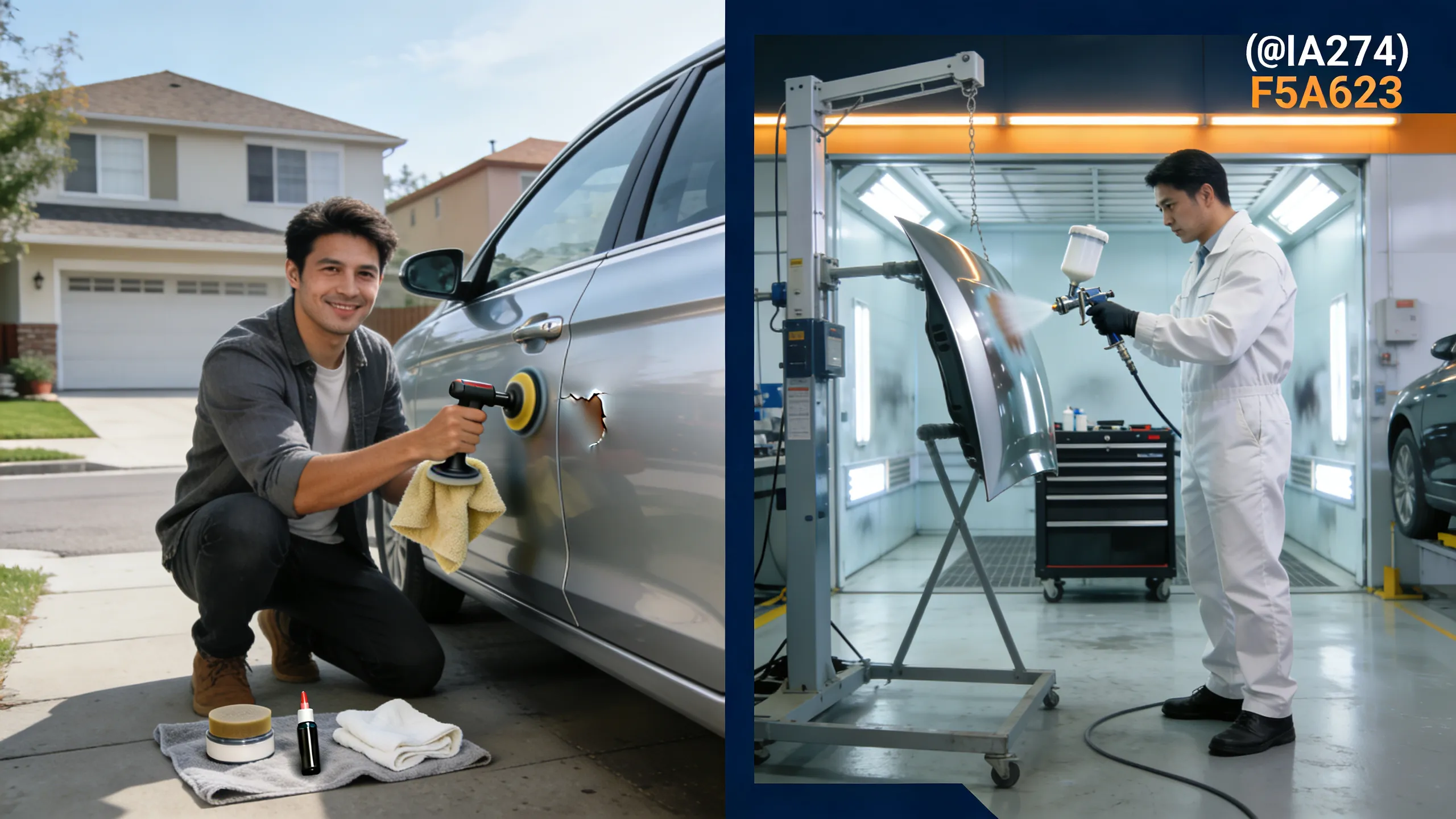
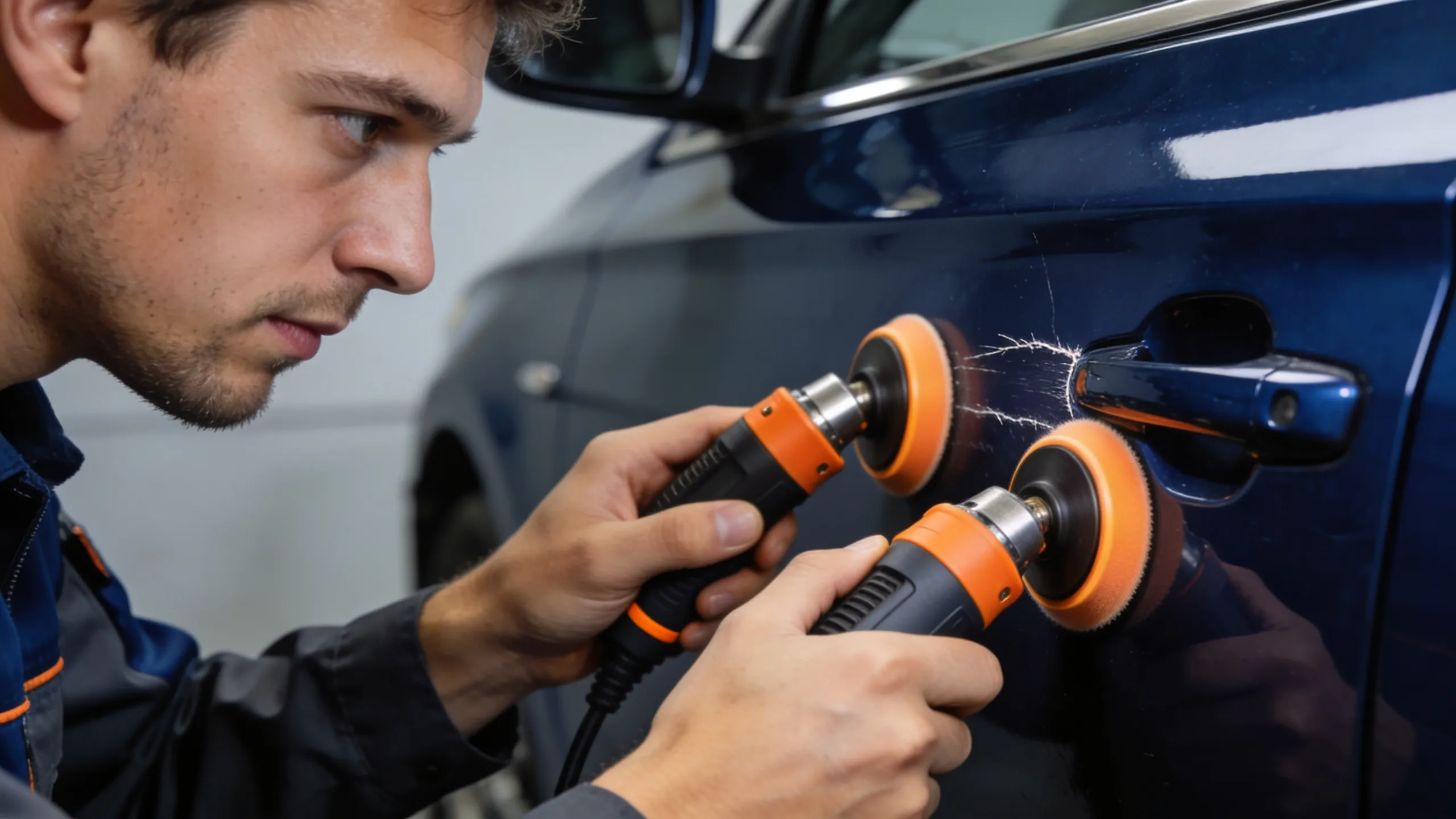
Car scratch repair cost ranges from $150 for a minor surface scuff to $2,500 or more for deep damage that reaches bare metal. That wide range confuses a lot of car owners who assume all scratches are basically the same.
They're not. The difference between a $150 fix and a $1,200 repair often comes down to a single paint layer.
Knowing scratch depth before you call a shop helps you budget accurately, decide whether DIY makes sense, and avoid paying for repairs your car doesn't actually need. This guide covers all four severity levels, what professional repair costs at each one, how DIY products stack up, and when filing insurance is worth the hassle.
For a broader look at cosmetic and structural damage options, see the collision repair guide.
Key Takeaways
- Clear coat scratches ($150 to $300) can often be polished out professionally or treated with a $15 to $60 DIY kit.
- Base coat and deeper scratches ($300 to $2,500+) need professional paint work. The fingernail test tells you which category you're in: if your nail catches, it's beyond DIY.
- Key scratches from vandalism typically cost $500 to $1,200 per panel and may be covered under comprehensive insurance with no impact on premiums.
- Vehicle type matters: luxury and exotic cars cost 50 to 100% more for the same scratch repair due to paint complexity and labor rates.
Car scratch repair costs at a glance
Car scratch repair cost runs $150 to $2,500+ depending on how deep the scratch goes. Clear coat damage costs $150 to $300 professionally. Base coat scratches run $300 to $600. Primer-level damage costs $500 to $800. Bare metal starts at $800 and can exceed $2,500 per panel.
The table below summarizes typical auto scratch repair costs by damage depth. These figures reflect 2026 national averages from body shop estimates collected across multiple markets. Your number will vary based on local labor rates, vehicle type, and how many scratches you're dealing with.
| Scratch Depth | What Is Affected | Typical Repair Cost | Repair Method |
|---|---|---|---|
| Level 1: Clear coat only | Top protective layer | $150 to $300 | Wet sanding + machine polish |
| Level 2: Base coat | Color/pigment layer | $300 to $600 | Touch-up paint + blending |
| Level 3: Primer | Primer layer beneath color | $500 to $800 | Sand, re-prime, repaint panel |
| Level 4: Down to metal | Bare metal exposed | $800 to $2,500+ | Full panel prep, prime, paint, clear |
These figures cover professional repair. DIY products for Level 1 damage cost $15 to $60. For deeper scratches, DIY results vary and professional repair is usually the better investment.
Understanding scratch depth: the 4 levels
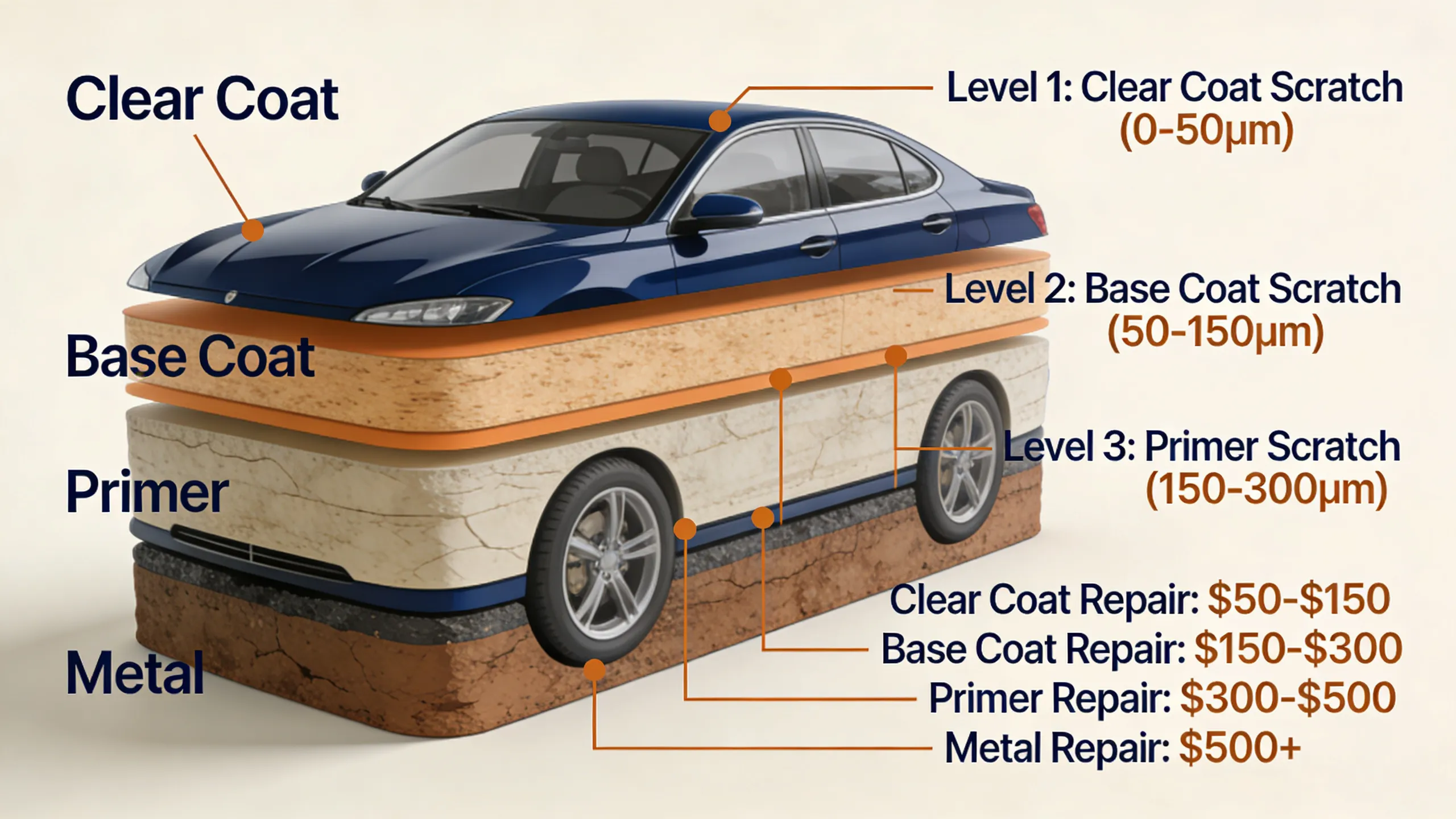
Car paint isn't a single layer. It's a system of four distinct layers built on top of bare metal, and each one serves a specific function. The depth of a scratch determines which layers are affected, and that's what drives the repair cost.
Level 1: Clear coat scratches (surface only)
The clear coat is the outermost layer. No color; its job is purely protective against UV rays, oxidation, and minor abrasion. Most light scratches from car washes, shopping carts, or a key that barely made contact stay within this layer.
The fingernail test: Run your fingernail across the scratch at a 90-degree angle. If it glides over without catching, the damage is in the clear coat only. If the nail catches in a groove, it's gone deeper.
Clear coat scratches often look worse than they are. In direct sunlight they show up as white or silver lines. A technician looking at the same scratch under shop lighting can usually confirm the color layer underneath is still intact.
Repair involves wet sanding to smooth the surface, then machine polishing to restore gloss. Cost: $150 to $300 per scratch area, depending on size and local labor rates.
Level 2: Base coat scratches (through color)
The base coat is the pigmented layer, what actually gives the car its color. A scratch that reaches it has cut through the clear coat and into (or through) the color pigment itself. These typically show as white, silver, or gray lines where the color has been removed.
No bare metal yet, but you can't polish these out. Touch-up paint, blending, and refinishing are required. For longer or more prominent scratches, a full panel respray may be the only way to get a clean color match.
Cost: $300 to $600, depending on affected area size, paint type (metallics and pearls cost more to match and blend), and whether adjacent panels need to be included.
Level 3: Primer scratches (to primer layer)
Primer is a gray or white undercoat applied directly to metal before the base coat. It creates adhesion and provides the first line of corrosion resistance. A scratch at this level has cut through both the clear coat and the base coat entirely.
You'll see it as a dull gray or white patch, with no color left in the damaged area. Left unrepaired, moisture reaches the boundary between primer and metal, and rust starts from there. This happens particularly fast in cold climates where road salt is a factor.
Repair means sanding back to primer, applying fresh primer, repainting, and blending. Panel-level work. Cost: $500 to $800 per panel.
Level 4: Deep scratches (down to metal)
The most serious category. Bare metal exposed, rust is now an immediate concern.
Even in dry climates, bare metal starts oxidizing within days. In humid or salt-belt regions (think the Northeast or Midwest in winter), visible rust can appear within hours of exposure. This one is time-sensitive.
Deep scratches usually come from vandalism (key scratches), significant contact damage, or road debris impacts. Repair involves sanding to metal, rust-preventive primer, repainting, and clear coating. If the metal itself is gouged or bent, body work has to come first.
Cost: $800 to $2,500+ per panel. Full doors and quarter panels push toward the upper end.
For damage that involves both scratches and structural concerns, collision repair services address the full scope of repair.
Cost by scratch location and scenario
The same scratch depth costs different amounts depending on where it is and what caused it. These are the scenarios body shops see most often, with cost ranges based on professional repair estimates.
| Scenario | Typical Depth | Cost Range | Best Fix | Insurance? |
|---|---|---|---|---|
| Door scratch (parking lot) | Clear coat to base coat | $150 to $500 | Polish or touch-up paint | Collision (if another driver) |
| Bumper scratch/scrape | Clear coat to primer | $150 to $600 | Polish, touch-up, or respray | Collision |
| Key scratch (vandalism) | Primer to bare metal | $500 to $1,200/panel | Panel respray | Comprehensive |
| Shopping cart ding | Clear coat | $100 to $250 | Machine polish | Rarely worth claiming |
| Branch/bush scratch | Clear coat to base coat | $100 to $600 | Polish or panel work | Comprehensive |
| Curb rash (bumper/wheel) | Primer to metal | $150 to $500 | Sand, prime, repaint | Usually out-of-pocket |
Door scratches and bumper scrapes together account for the majority of scratch repair work at body shops. For bumpers with both scratches and dents, paintless dent repair can address both in a single visit when the paint is still intact over the dented area.
Key scratches deserve special attention
Key scratches are some of the most damaging cosmetic incidents short of a collision. A key dragged deliberately across a panel usually reaches primer or bare metal, and it typically runs the full length, which means repair almost always involves a complete panel respray.
Cost: $500 to $1,200 per panel. Multiple panels are common, often totaling $1,000 to $3,000+. Key scratches usually qualify as vandalism, which means they may be covered under comprehensive auto insurance. See the insurance section below.
Branch and bush scratches
Contact with tree branches, bushes, hedges, and road debris produces scratches that vary widely in depth. Fine branches often create multiple thin clear coat scratches that can be polished out. Thicker branches or sharp wood edges can cut into the base coat or primer.
Cost: $100 to $300 for light scratches; $300 to $600 for deeper or more widespread damage.
Accident-related paint damage
Scratches from minor collisions (scraping a wall, clipping a curb, or low-speed contact) often combine paint damage with denting, and may involve bumpers, corners, or entire panels. These scenarios typically require professional assessment to determine whether paint repair alone is sufficient or whether underlying panel damage must be addressed first.
Cost: $200 to $1,500+ depending on the extent of damage. For collision-related repairs, see the full collision repair cost guide for detailed pricing across damage categories.
Professional scratch repair methods
Shops use several techniques for scratches. The right one depends on depth, size, and where on the car it sits.
Wet sanding and buffing
Wet sanding uses fine-grit sandpaper with water lubrication to level out surface imperfections. Machine polishing then restores the gloss. Works well for Level 1 clear coat damage and some shallow Level 2 scratches. No paint is removed; the existing clear coat is leveled to blend the scratch into the surrounding surface.
Typically takes one to three hours per panel. Cost: $100 to $250 per area.
Touch-up paint
For scratches through the base coat or into primer, technicians apply color-matched paint layer by layer: cleaning the scratch, priming if needed, base coat in thin passes, then clear coat over the top. On small, isolated scratches, this can produce acceptable results.
Larger or more visible areas are harder. Color matching gets tricky on metallic, pearl, or tri-coat finishes. What looks fine under indoor lighting can stand out in direct sunlight. Cost: $150 to $400 depending on size and color complexity.
Panel respray
When a scratch covers a significant portion of a panel, or when the color match has to be exact, shops respray the whole panel. That means removing adjacent trim and glass if needed, masking, priming, painting, and clear coating. Blending (gradually fading fresh paint into the existing finish on adjacent panels) is usually part of the job.
It's the most reliable way to get an invisible result on deeper scratches. Cost: $400 to $1,200 per panel. Larger panels and premium vehicles push higher.
For vehicles requiring full panel color matching, auto painting services cover the full range of refinishing options.
Full panel replacement
When a scratch is combined with significant dent damage, corrosion, or structural deformation, replacement may be more cost-effective than repair. New or recycled OEM (Original Equipment Manufacturer) panels can be installed and painted to match. This is more common for doors and fenders than for structural components.
Cost: $800 to $2,500 or more depending on the panel, vehicle make and model, and whether OEM or aftermarket parts are used.
DIY scratch repair: what actually works
DIY scratch products are everywhere and marketed confidently. Their actual effectiveness depends almost entirely on scratch depth.
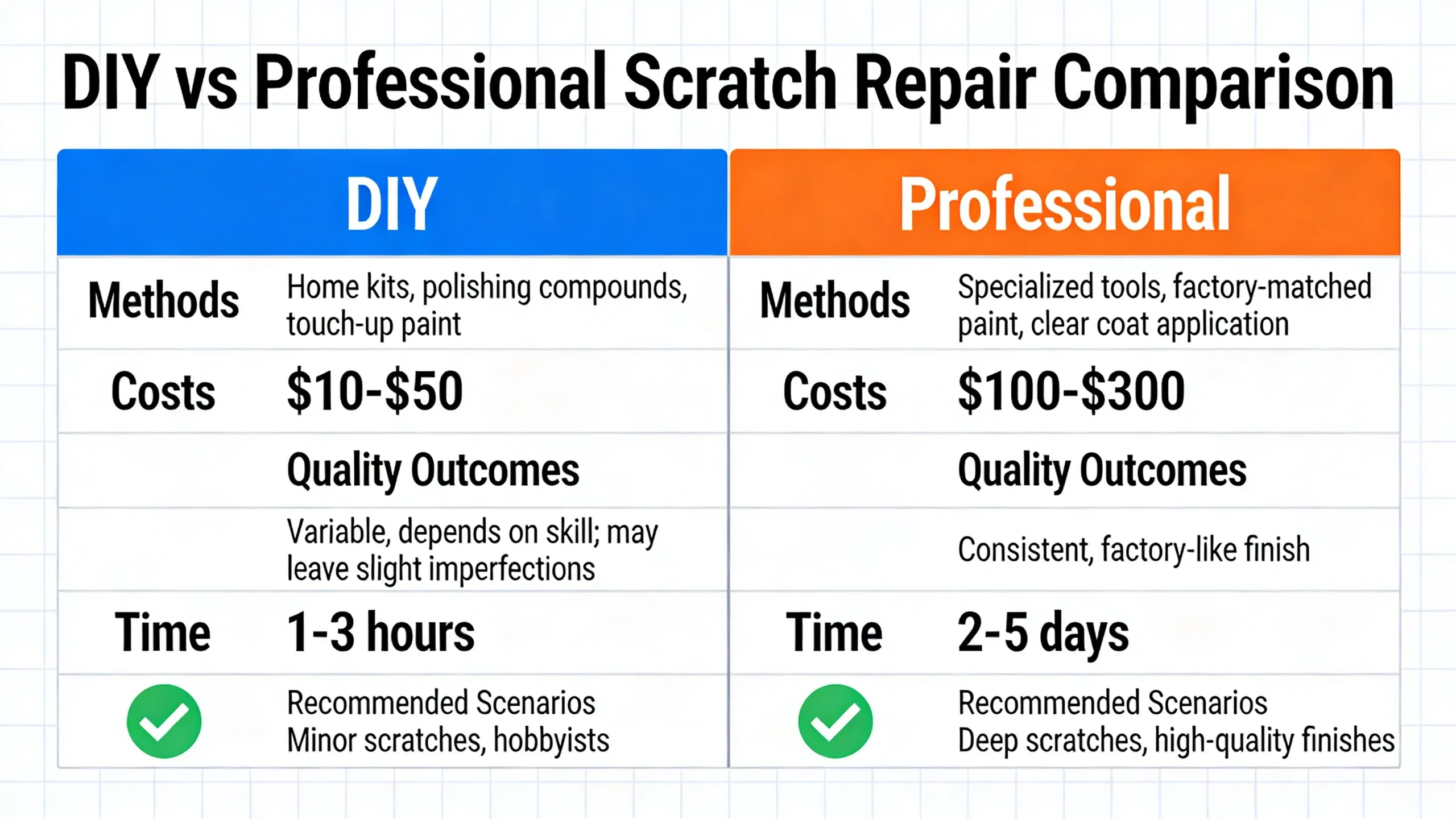
DIY vs. professional repair: cost and quality comparison
| Method | Cost | Best For | Result Quality | Time |
|---|---|---|---|---|
| DIY scratch remover kit | $15 to $50 | Clear coat scratches under 3 inches | Good on clear coat; ineffective on deeper | 30 to 60 min |
| DIY touch-up paint pen | $10 to $30 | Small deep scratches on low-value cars | Visible up close, passable at distance | 1 to 2 hours |
| Professional machine polish | $100 to $250 | Clear coat damage, light base coat | Near-invisible on clear coat scratches | 1 to 3 hours |
| Professional touch-up paint | $150 to $400 | Base coat scratches, small areas | Good color match on solid colors | 2 to 4 hours |
| Professional panel respray | $400 to $1,200 | Primer/metal damage, large areas | Invisible when done well | 1 to 2 days |
Scratch repair kits: do they work?
Most over-the-counter kits are designed for Level 1 clear coat damage only. Typically: an abrasive compound, a polishing compound, and an applicator pad. Used correctly on genuine clear coat scratches, they can reduce or eliminate the appearance.
The problem is depth. If the scratch has reached the base coat or deeper, polish can't restore what's gone. Polishing a scratch that's into the color layer may smooth the edges and make it temporarily less visible, but the missing paint is still missing. Cost: $15 to $60 per kit.
Touch-up paint pens
Touch-up pens deposit color-matched paint directly into a scratch using a small brush or pen tip. Most effective on small, isolated deep scratches, say, a short key scratch that's hit primer. On longer or wider damage, getting a smooth, blended result by hand is genuinely hard.
Common problems: overfilling (leaving a raised bead of paint), color mismatch (factory codes shift with age and UV exposure), and surface gloss that doesn't match the surrounding panel. Results almost always look better indoors than they do in direct sunlight.
Your factory paint code is usually on a sticker inside the driver's door jamb. Cost: $10 to $30 per pen.
When to DIY and when to skip it
DIY makes sense when:
- The scratch is clear coat only (nail test doesn't catch)
- The affected area is small, under 2 to 3 inches
- The vehicle has lower market value and "good enough" is acceptable
- You're fine reducing visibility rather than eliminating the scratch entirely
Skip DIY when:
- The scratch has reached base coat, primer, or metal
- It's in a prominent spot (center of a door, hood, bumper face)
- The car has a metallic, pearl, or tri-coat finish, since these are hard to match even for professionals
- Rust has already started in the scratch
- The car is relatively new or worth enough to protect
For deeper scratches in visible areas, professional scratch repair services produce results that DIY can't replicate.
What affects scratch repair costs?
Even scratches that look similar in photos can land at very different price points. Here's what actually moves the number.
Number and length of scratches
One two-inch scratch costs far less than five scratches running the length of a door. Shops price based on total area to address, and once damage covers enough of a panel, a full respray is often cheaper and cleaner than patching multiple isolated spots.
Where on the car it is
Flat panels (hoods, roofs, doors) are generally easier and cheaper to repair than curved areas, bumpers, or spots near trim and glass that need masking or partial removal. Access difficulty and masking time both affect labor cost directly.
Bumper scratches are the most common scenario. Cost typically runs $150 to $450 depending on depth. For bumpers with both scratches and dents, paintless dent repair can address both in a single visit when the paint is still intact over the dented area.
Color type
Solid colors (white, black, red) are straightforward to match. Metallic, pearl, and tri-coat finishes are not. Metallic paints have aluminum flakes that must orient correctly during application. Pearl finishes use mica particles that refract light differently based on viewing angle. Both require more skill, more material passes, and more time to blend cleanly.
Color-matched repairs on silver, champagne, or color-shifting finishes typically run $100 to $200 more than equivalent work on solid colors.
Vehicle type and class
Repair costs scale with vehicle class. The same Level 2 scratch that costs $250 on a Honda Civic can cost $500 or more on a BMW 5 Series. Several factors drive the difference:
- Economy vehicles (Honda, Toyota, Hyundai): Baseline pricing. Standard paint systems, widely available color codes, competitive shop rates.
- Mid-range vehicles (Ford, Chevrolet, Subaru): 10 to 20% above baseline. Slightly more complex paint, some tri-coat options.
- Luxury vehicles (BMW, Mercedes, Audi, Lexus): 50 to 80% above baseline. Multi-stage paint systems, higher labor rates at certified shops, OEM repair procedures that take longer.
- Exotic vehicles (Porsche, Ferrari, Lamborghini): 100%+ above baseline. Specialized paint, limited technician availability, and OEM parts requirements can push a single-panel scratch repair past $2,000.
- Trucks and SUVs: Larger panels mean more material and more labor time for the same depth of damage. Expect 15 to 30% more than a sedan of the same class.
Labor rates in your area
Labor rates for auto body work vary 40 to 60% between lower-cost markets and major metros. A repair quoted at $200 in a mid-sized city could run $300 to $350 in Los Angeles or New York. Same work, same materials, different labor market.
To compare local rates, find shops in your area and request itemized quotes that break out labor and materials separately.
Insurance coverage for car scratch repair
Whether insurance covers scratch repair depends on what caused it, what coverage you have, and whether the repair cost actually exceeds your deductible.
Coverage type by cause
| Cause of Scratch | Coverage Type | Deductible Applies? | Premium Impact |
|---|---|---|---|
| Vandalism (key scratch) | Comprehensive | Yes ($250 to $1,000 typical) | Usually minimal |
| Parking lot hit (other driver at fault) | Their liability | No (their insurance pays) | None |
| You scraped a pole/wall | Collision | Yes | May increase |
| Tree branch fell on car | Comprehensive | Yes | Usually minimal |
| Road debris damage | Comprehensive | Yes | Usually minimal |
| Shopping cart ding | Collision (if you file) | Yes | Rarely worth filing |
When filing a claim makes sense
Filing an insurance claim for scratch repair is worth considering when:
- The repair cost significantly exceeds the deductible
- The damage was caused by vandalism, a third party, or a covered peril
- Multiple panels are damaged, bringing total repair cost well above $1,000
Filing may not make sense when:
- The repair cost is close to or less than the deductible
- The scratch is minor and paying out of pocket avoids a potential premium increase
- The damage was caused by your own actions and collision coverage applies, since this may affect future premiums
Comprehensive claims (vandalism, weather) generally have less impact on future premiums than collision claims, though this varies by insurer and state.
Important: Insurance processes and deductible amounts vary by policy and state. Consult your specific policy and insurance provider for details before filing.
For a full breakdown of how auto body repair relates to the collision claim process, including when to repair without insurance, see the related guide.
Frequently asked questions
How much does it cost to fix a scratch on a car?
Car scratch repair cost ranges from $150 to $2,500 or more depending on scratch depth. Clear coat scratches cost $150 to $300 professionally. Base coat scratches run $300 to $600. Primer-level damage costs $500 to $800. Scratches down to bare metal can cost $800 to $2,500 per panel.
How much does it cost to fix a scratch on a car door?
Door scratch repair costs $150 to $500 for most damage. Light clear coat scratches from parking lot contact cost $150 to $250 to polish out. Deeper door scratches that reach the base coat or primer run $300 to $500, and a full door panel respray for severe damage costs $400 to $900.
How much does it cost to fix a scratch on a car bumper?
Bumper scratch repair costs $150 to $600. Minor scuffs and clear coat scratches cost $150 to $250. Deeper bumper scratches that expose primer run $250 to $450. A full bumper respray for extensive damage costs $350 to $600, depending on whether the bumper cover needs to be removed.
How much does it cost to fix a key scratch on a car?
Key scratch repair costs $500 to $1,200 per panel. Key scratches from vandalism typically cut through to primer or bare metal and run the full length of a panel, so repair almost always requires a complete panel respray. Multi-panel key scratches can cost $1,000 to $3,000+ total.
Can car scratches be buffed out?
Only clear coat scratches, ones that haven't broken through to the color layer, can be buffed out. Machine polishing levels the clear coat surface around the scratch. If the scratch has reached the base coat or deeper, buffing will not restore the missing paint. The nail test helps determine whether buffing is a viable option.
Do scratch repair kits actually work?
Scratch repair kits work on genuine clear coat damage where the color layer beneath is still intact. Abrasive compounds in the kit reduce or eliminate visibility on those scratches. They don't work on scratches that have broken through to the base coat or deeper. If the scratch shows gray primer or bare metal, professional repair is needed.
Does insurance cover scratch repair?
Insurance may cover scratch repair depending on the cause and coverage type. Vandalism falls under comprehensive coverage; collision-related scratches fall under collision coverage. Whether filing makes sense depends on the deductible and potential premium impact. Minor scratches close to the deductible are usually handled out of pocket.
Is it worth fixing a scratch on a car?
It depends on scratch depth, car value, and whether you plan to sell. Clear coat scratches on older cars can be left alone or treated with a $15 to $30 DIY kit. Deeper scratches that expose primer or metal should be fixed to prevent rust, especially in humid climates. On cars worth $10,000+, fixing visible scratches protects resale value.
Is scratch repair cheaper than repainting?
Yes, scratch repair on a single panel costs $150 to $1,200 depending on depth. A full car repaint costs $1,000 to $3,500+ for quality work. Scratch repair targets only the damaged area, while repainting covers the entire vehicle. Repair is almost always more cost-effective unless scratches cover multiple panels extensively.
How do I know if a scratch needs professional repair?
Run a fingernail across the scratch at a 90-degree angle. If the nail glides over without catching, the damage is limited to clear coat and may respond to DIY polishing. If the nail catches in a groove, the scratch is deeper and professional repair is recommended. Any scratch showing gray primer or bare metal needs professional attention to prevent rust.
How long does scratch repair take?
Clear coat polishing and touch-up work typically takes one to three hours and is often completed same-day. Panel resprays require masking, painting, and color matching, usually taking one to two business days. Repairs involving multiple panels can take two to four business days. Some shops offer express service for minor clear coat damage.
Sources and methodology
- I-CAR, Industry training and refinishing procedure standards for auto body paint repair
- PPG Automotive Refinish, Paint system composition, color matching, and application guidance
- Consumer Reports, Independent product testing and evaluation for DIY automotive repair products
- RepairPal, Fair repair cost estimates based on reported shop pricing across U.S. markets
- Kelley Blue Book, Vehicle valuation and repair cost guidance
Cost ranges in this guide reflect 2026 estimates verified against WRC Collision, Ecostify, CCC Intelligent Solutions Crash Course 2026, and Autobody News national labor rate data (June 2026: $86/hr body, $85/hr refinish). Individual quotes will vary based on location, vehicle make, paint type, and shop specialization.