A BMW owner in Denver brought her M5 to a well-regarded local shop after a rear-end collision. The shop did solid work, the car looked fine when she picked it up. But six months later, she discovered the rear camera system was slightly out of alignment, the trunk sensors were giving false readings, and the structural repair had used non-OEM parts that voided part of her warranty. The shop was skilled at general collision work. It just wasn't equipped for a modern BMW.
That scenario plays out regularly across the country. BMW vehicles — particularly newer models — use advanced materials, complex electronics, and precision structural designs that require specialized repair equipment and certified training. The difference between a BMW certified collision center and a general auto body shop isn't just a plaque on the wall. It reflects a specific set of tools, processes, and technician qualifications that BMW requires before authorizing a shop.
This guide explains what BMW's certification program requires, why it exists, what BMW owners can expect to pay at a certified shop, and how to verify certification before authorizing any repairs.
What is a BMW certified collision center?
A BMW certified collision center is an auto body shop that has met a specific set of standards set by BMW of North America. Certification means the shop has invested in BMW-approved equipment, trained its technicians through BMW's designated programs, and passed an audit verifying those investments are in place.
BMW's program — called the BMW Collision Repair Network — is separate from I-CAR (Inter-Industry Conference on Auto Collision Repair) Gold Class certification, though many certified shops hold both. To earn BMW approval, a shop must meet requirements that go well beyond what most general collision centers have on hand.
Not every shop that claims to "specialize in European vehicles" is BMW-certified. The certification is a formal designation with documentation. Car owners can — and should — verify it before authorizing any repairs.
BMW collision repair center requirements: what shops must have
BMW's requirements for collision center certification cover four main areas: equipment, training, parts sourcing, and facility standards. Understanding these requirements helps car owners evaluate whether a shop is genuinely equipped to repair modern BMW vehicles.
Aluminum and CFRP repair capability
Modern BMW vehicles use a mix of high-strength steel, aluminum, and Carbon Fiber Reinforced Polymer (CFRP) — a lightweight, extremely rigid composite material found in the frames and body panels of many BMW 5 Series, 7 Series, and M models.
Repairing CFRP requires entirely different tools and techniques than steel or aluminum work. Damaged carbon fiber can't be pulled, hammered, or straightened the way metal can. It must be replaced. And the replacement process involves specific bonding agents, curing equipment, and surface preparation steps. Shops that lack this equipment will substitute conventional repairs that may look identical but don't restore original structural integrity.
Aluminum repair also requires dedicated, separate tools. Aluminum and steel can't share the same welding equipment because cross-contamination causes corrosion. BMW-certified shops maintain dedicated aluminum MIG (Metal Inert Gas) welding stations isolated from their steel work areas.
Structural measurement and straightening systems
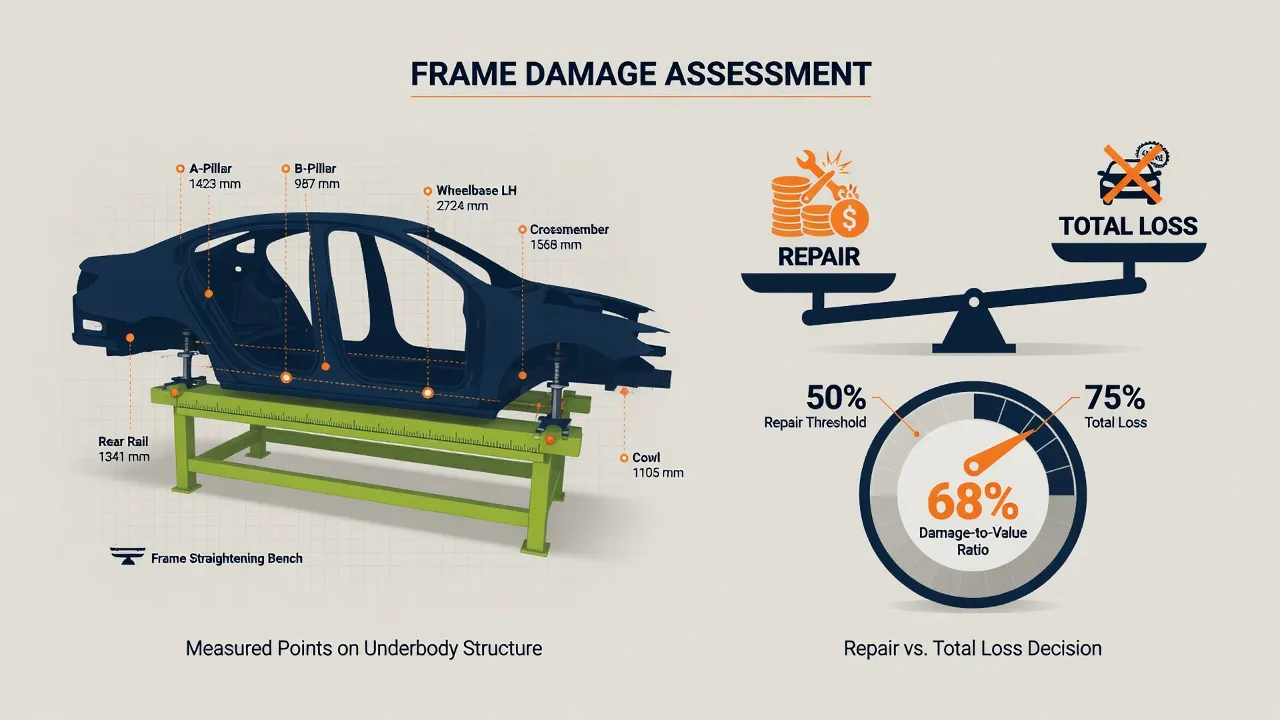
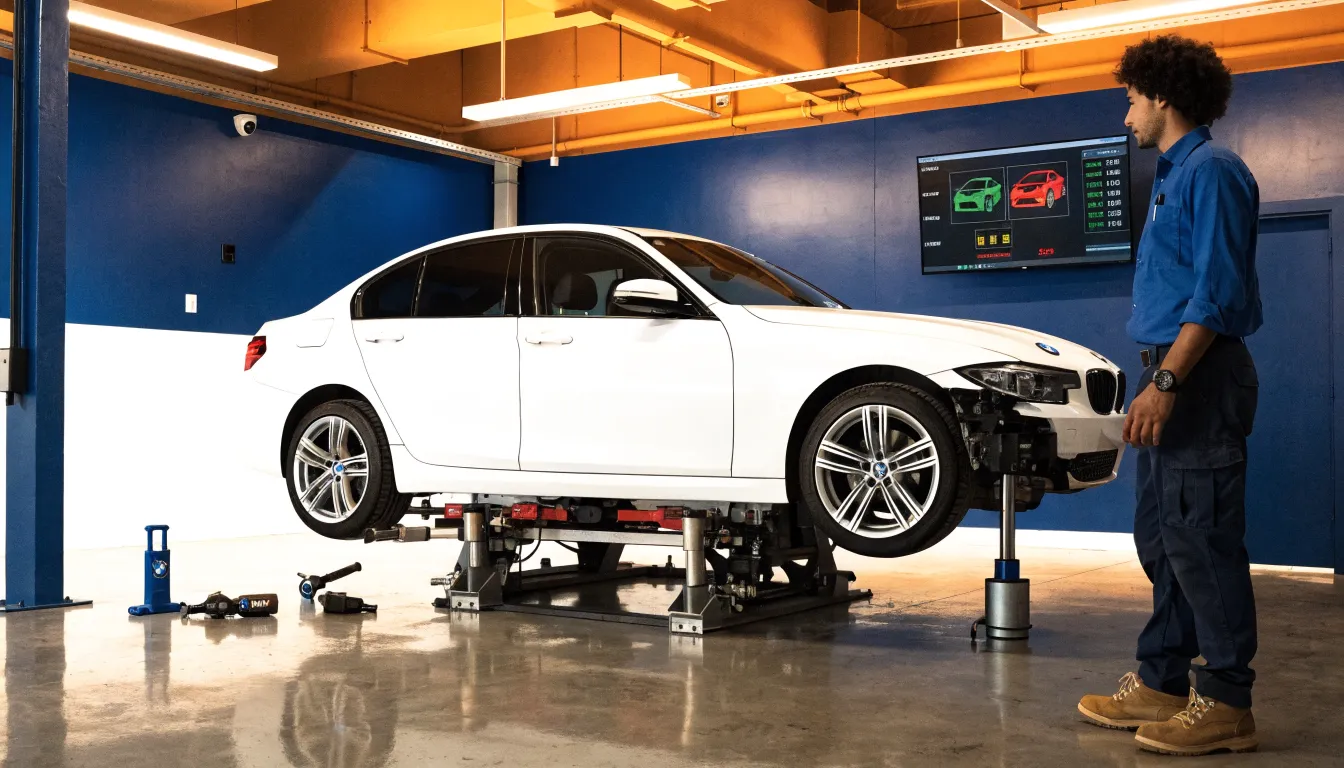
BMW requires certified shops to use computerized measuring systems capable of verifying structural alignment to within fractions of a millimeter. After any significant collision, the shop must measure dozens of reference points across the vehicle's frame — called a unibody on most modern cars — to confirm everything is within BMW's published tolerances.
Conventional frame straightening equipment exists in most body shops, but BMW's vehicles require systems that can pull and measure with precision that meets manufacturer specifications. The shop must document these measurements and confirm alignment before proceeding with panel repair or reassembly.
Advanced Driver Assistance Systems (ADAS) recalibration
This is one of the most important — and most frequently skipped — steps in modern BMW collision repair. ADAS refers to the suite of electronic safety systems built into most recent BMW vehicles: lane departure warning, automatic emergency braking, blind spot monitoring, adaptive cruise control, and front and rear camera systems.
These systems depend on sensors and cameras mounted at very specific positions and angles. After any significant collision — or even after bumper, hood, or windshield replacement — these sensors must be recalibrated to BMW's exact specifications. Recalibration requires a large, flat calibration space and BMW-approved diagnostic equipment.
A shop that skips ADAS recalibration after collision repair may return a car that looks perfect but has safety systems operating outside their designed parameters. In some cases, the driver wouldn't know until the system either failed to engage when needed or triggered a false warning that caused an accident.
BMW-certified shops are required to have ADAS recalibration capability on-site or through a documented dealer partnership.
BMW OEM parts and paint systems
Certified shops must use BMW OEM parts for structural components and safety-related assemblies. OEM means the part is manufactured to the same specifications as the original and is sourced through BMW's authorized parts network. Non-OEM or aftermarket parts may fit, but they're not required to meet BMW's exact tolerances for structural integrity, fit, or sensor compatibility.
BMW also requires certified shops to use approved paint systems and clear coat products that match BMW's finish formulas. BMW's paint codes are precise, and the multi-layer application process — including primer, base coat, and clear coat — must follow BMW's published repair procedures to achieve a color-accurate, durable result.
Why BMW collision repair requires specialized equipment
The reason BMW vehicles require specialized collision repair comes down to how they're built. A car designed and manufactured with high-strength steel, aluminum panels, and carbon fiber components can't be repaired using the same methods and tools used on a conventional steel-bodied vehicle.
Material science and structural integrity
BMW engineers specify each material in the vehicle's body for a specific purpose: weight savings, rigidity, or crash energy management. When a non-certified shop repairs a BMW using substitute materials or conventional techniques, the vehicle may look correct but no longer behaves as designed in a subsequent crash. A high-strength steel rocker panel that's heated and reshaped rather than replaced loses the tensile strength built in at the factory, which can change crash energy paths and affect occupant safety.
The Insurance Institute for Highway Safety (IIHS) has documented that improper collision repairs can affect crash performance in ways invisible to visual inspection. BMW's certification requirements exist, in part, to ensure structural repairs restore the vehicle's original crash performance.
Warranty implications
BMW's new vehicle and Certified Pre-Owned warranties can be affected by repairs that use non-OEM parts or fail to follow BMW's published procedures. The Magnuson-Moss Warranty Act prevents BMW from voiding an entire warranty over aftermarket parts, but BMW can deny claims on components directly affected by non-compliant repairs. For owners with vehicles under warranty, using a BMW certified body shop creates documentation that repairs met manufacturer standards — documentation that matters if a later warranty claim involves the repaired area.
BMW certified collision repair: what it costs
Repairs at a BMW certified collision center typically cost 15 to 30 percent more than the same repair at a general collision shop, according to industry estimates. Several factors drive that premium.
Equipment and overhead
The diagnostic equipment, welding systems, ADAS calibration tools, and structural measurement systems required for BMW certification represent significant capital investment — often $200,000 to $500,000 or more in specialized equipment. Certified shops spread those costs across labor rates, which typically run higher than general shops.
BMW OEM parts
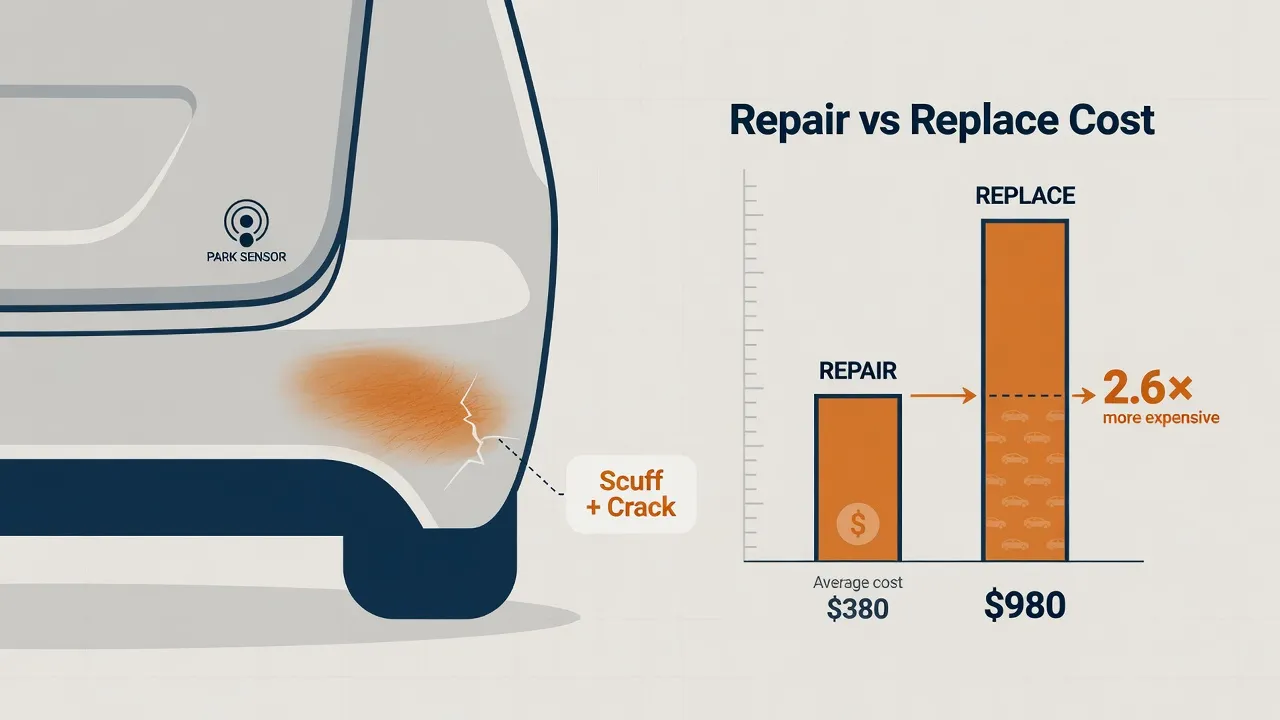
BMW OEM parts consistently cost more than aftermarket alternatives. A front bumper cover for a BMW 5 Series, for example, may cost $800 to $1,400 through BMW's parts network, versus $300 to $600 for an aftermarket equivalent. For structural components, BMW requires OEM; for cosmetic parts, some flexibility may exist depending on the repair situation.
Labor rates
Certified shops in metropolitan markets typically charge $120 to $180 per labor hour, compared to $80 to $120 at general shops in the same market. Rural markets will see lower rates on both ends. The technicians working on BMW vehicles at certified shops have completed specific training hours that command higher compensation.
Typical repair cost ranges at BMW certified shops
| Repair type | Estimated cost range |
|---|---|
| Front bumper replacement (M-trim) | $3,500–$6,500 |
| Hood replacement (aluminum) | $4,000–$8,000 |
| Rear quarter panel repair | $3,000–$7,000 |
| ADAS recalibration (standalone) | $300–$700 |
| Full front-end structural repair | $8,000–$18,000+ |
These ranges reflect 2026 estimates and will vary significantly based on the specific BMW model, damage extent, and local labor rates. Vehicles with CFRP components — common on newer M-series and 7 Series models — will sit at the higher end of these ranges.
Insurance and BMW certified repair
One of the most common questions BMW owners have after a collision is whether their insurance company will cover the cost difference between a certified and non-certified shop. The short answer: it depends on the policy and the insurance company.
Direct Repair Programs (DRPs)
Many insurance companies maintain networks of preferred shops — called Direct Repair Programs (DRP) — that agree to negotiated labor rates and parts protocols. BMW certified shops are frequently not on these lists because their pricing doesn't conform to the rates the insurer negotiates. Car owners have the legal right to choose their own repair facility, regardless of which shops the insurer recommends. This right exists in every U.S. state.
OEM parts and insurance
Some policies include OEM parts endorsements that require the insurer to pay for manufacturer-original parts. Without that endorsement, the insurer may default to aftermarket pricing. BMW owners with vehicles under warranty should review their policy for OEM parts provisions or add that coverage before a claim occurs. If an insurer approves non-OEM parts on a warranty-eligible vehicle, the car owner should document that decision in writing.
How to verify a BMW certified collision center
Not every shop that advertises BMW expertise is part of BMW's Collision Repair Network. Verifying certification before authorizing work protects against paying premium prices for non-certified work.
Step 1: Use BMW's official locator
BMW of North America maintains an online locator tool on bmw.com that allows car owners to search for certified collision repair facilities by ZIP code. This is the most reliable verification method. The list reflects current certification status — certification requires renewal, so a shop certified two years ago may not still be active.
Step 2: Ask for documentation at the shop
A genuinely certified shop should be able to show its current BMW certification documents, along with the year of certification and any specialty designations (such as aluminum repair or CFRP certification). Some shops hold partial certification — certified for steel and aluminum but not CFRP, for example. Understanding exactly what the certification covers helps set accurate expectations.
Step 3: Look for I-CAR Gold Class designation
I-CAR Gold Class — while not the same as BMW certification — indicates that the shop meets the collision industry's baseline training standards. Most BMW-certified shops hold both. A shop with neither credential warrants closer examination before entrusting it with a BMW.
According to I-CAR's training standards, Gold Class shops must maintain ongoing training across all technician roles — welding, structural repair, non-structural repair, and refinishing — with annual recertification requirements.
Step 4: Ask specific questions
When calling or visiting a shop, these questions quickly separate genuine BMW-certified shops from those simply marketing BMW experience:
- "What specific BMW training have your technicians completed?"
- "Do you have dedicated aluminum welding equipment separate from your steel tools?"
- "Do you perform ADAS recalibration in-house, or do you send the vehicle to the dealer?"
- "Do you use BMW OEM parts for structural repairs?"
- "Can you show me your current BMW certification documents?"
A certified shop will answer these questions directly and specifically. Vague answers about "experience with European vehicles" suggest the shop may not hold the formal certification.
How BMW certified repair affects resale value
Maintaining BMW-approved repair documentation has a measurable impact on resale and trade-in value. CarFax, AutoCheck, and similar vehicle history services record accident reports. Dealers and private buyers review these reports when evaluating a used BMW.
What those reports don't always capture — but what a BMW dealer evaluating a trade-in will look for — is documentation of how the collision was repaired. A certified pre-owned BMW with repair records from a BMW certified collision center holds its value better than one with repairs from an uncertified shop, because the dealer can verify the repair met manufacturer standards.
For BMW owners who plan to sell or trade in within a few years of a collision, the cost premium at a certified shop is often offset by the resale value protection. A $1,000 to $2,000 premium on a repair can translate to a meaningful difference in trade-in offer from a BMW dealer reviewing the vehicle's history.
Real stories: the difference certification makes
Marcus, Houston, TX: Marcus brought his 2023 BMW X5 to a certified shop after a side-impact collision that deployed the curtain airbags. The shop replaced the airbag modules, performed a full structural measurement, recalibrated the blind spot and lane-keeping systems, and provided BMW-formatted repair documentation. When he traded the X5 14 months later, the BMW dealership noted the certified repair records and offered a trade-in value $1,800 higher than the initial estimate before reviewing the paperwork.
Jennifer, Chicago, IL: Jennifer's 330i was rear-ended in a parking garage. Her insurer directed her to a preferred DRP shop. The repair was completed in three days. Two weeks later, her parking sensors were triggering constant false alerts. A BMW dealer diagnosed the problem: the rear sensors hadn't been recalibrated after bumper replacement. She paid $480 out of pocket for the recalibration — a cost her insurer disputed. The original shop wasn't BMW-certified.
David, Los Angeles, CA: David's BMW M4 had a CFRP roof panel and front subframe. After a front-end collision, two shops said the CFRP could be repaired. A BMW certified shop determined those components required full replacement and provided documentation explaining why — the bonding integrity of the existing carbon fiber couldn't be verified post-impact. The certified repair cost $4,200 more than the competing quote. David's insurer initially refused the difference. After he provided BMW's published repair procedures, supplied by the certified shop, the insurer approved the OEM repair.
Sources
- I-CAR — collision repair training and certification standards
FAQ: BMW certified collision center
What is a BMW certified collision center?
A BMW certified collision center is an auto body shop that has completed BMW of North America's Collision Repair Network certification process. This requires specific equipment investments, technician training in BMW repair procedures, BMW OEM parts sourcing, and passing a facility audit. Certification isn't permanent — shops must renew periodically to maintain active status.
How do I find a BMW certified body shop near me?
The most reliable method is searching BMW's official shop locator on bmw.com, which lists currently certified shops by location. AutoBodyShopNear.com's auto body shop directory also includes certification information for listed shops and allows filtering by vehicle specialty. When calling shops, ask to see current BMW certification documents before authorizing repairs.
Will my insurance cover repairs at a BMW certified collision center?
Insurance companies are required to pay for necessary repairs to return a vehicle to pre-accident condition. If a BMW certified shop is the appropriate facility for the vehicle and damage type, the insurer generally must cover it — though labor rate disputes are common. Car owners always have the right to choose their own repair facility. Adding an OEM parts endorsement to an auto policy before a claim helps ensure OEM parts costs are covered.
Does using a non-certified shop void my BMW warranty?
Under the Magnuson-Moss Warranty Act, an insurer or shop can't void an entire warranty simply by using non-OEM parts. But BMW can deny warranty claims on specific components that were directly affected by a non-compliant repair or non-OEM parts. For vehicles still under the new car warranty or BMW's Certified Pre-Owned warranty, using a BMW approved collision repair shop and documenting the repair provides the strongest protection.
What is ADAS recalibration and why does it matter after a BMW collision?
ADAS (Advanced Driver Assistance Systems) refers to electronic safety features in modern BMW vehicles — automatic emergency braking, lane departure warning, adaptive cruise control, and more. These systems rely on precisely positioned sensors and cameras. After any significant collision — or after bumper, hood, or windshield replacement — sensors must be recalibrated to BMW's factory specifications. A shop that skips this step may return a car that looks fine but has safety systems operating outside their designed parameters. BMW certified shops are required to have ADAS recalibration capability on-site.
How much more does a BMW certified shop charge compared to a general body shop?
BMW certified shops typically charge 15 to 30 percent more than general collision shops on comparable repairs, reflecting higher labor rates, OEM parts costs, and the overhead of maintaining certified equipment. The specific difference depends on the repair type, vehicle model, and local market. For structural repairs or vehicles with CFRP components, the gap can be larger.
Key takeaways
Understanding the BMW certified collision center program comes down to several core points:
-
Certification is specific and verifiable. BMW's Collision Repair Network has documented requirements — equipment, training, parts, and processes. Car owners can verify current certification through BMW's official locator before authorizing any work.
-
Modern BMW vehicles require specialized repair capability. Aluminum structures, CFRP panels, and ADAS electronics can't be properly restored without the right equipment and training. A shop that lacks these tools may produce repairs that look correct but fall short of BMW's structural and safety standards.
-
ADAS recalibration isn't optional. After any significant collision — or after replacing bumpers, hoods, or windshields — the vehicle's safety systems must be recalibrated to factory specifications. This step is often skipped by non-certified shops and can affect the vehicle's safety performance.
-
OEM parts protect the warranty. BMW OEM parts for structural and safety-related components ensure the repair meets manufacturer specifications. Non-OEM structural parts may save money upfront but can create warranty complications.
-
Car owners have the right to choose their facility. Insurance companies can't require use of a specific shop. If the vehicle warrants certified repair, owners can insist on it and document the insurer's response.
-
Certified repair documentation protects resale value. BMW dealers look for manufacturer-compliant repair records when evaluating trade-ins. Documentation from a BMW approved collision repair shop supports stronger resale values.