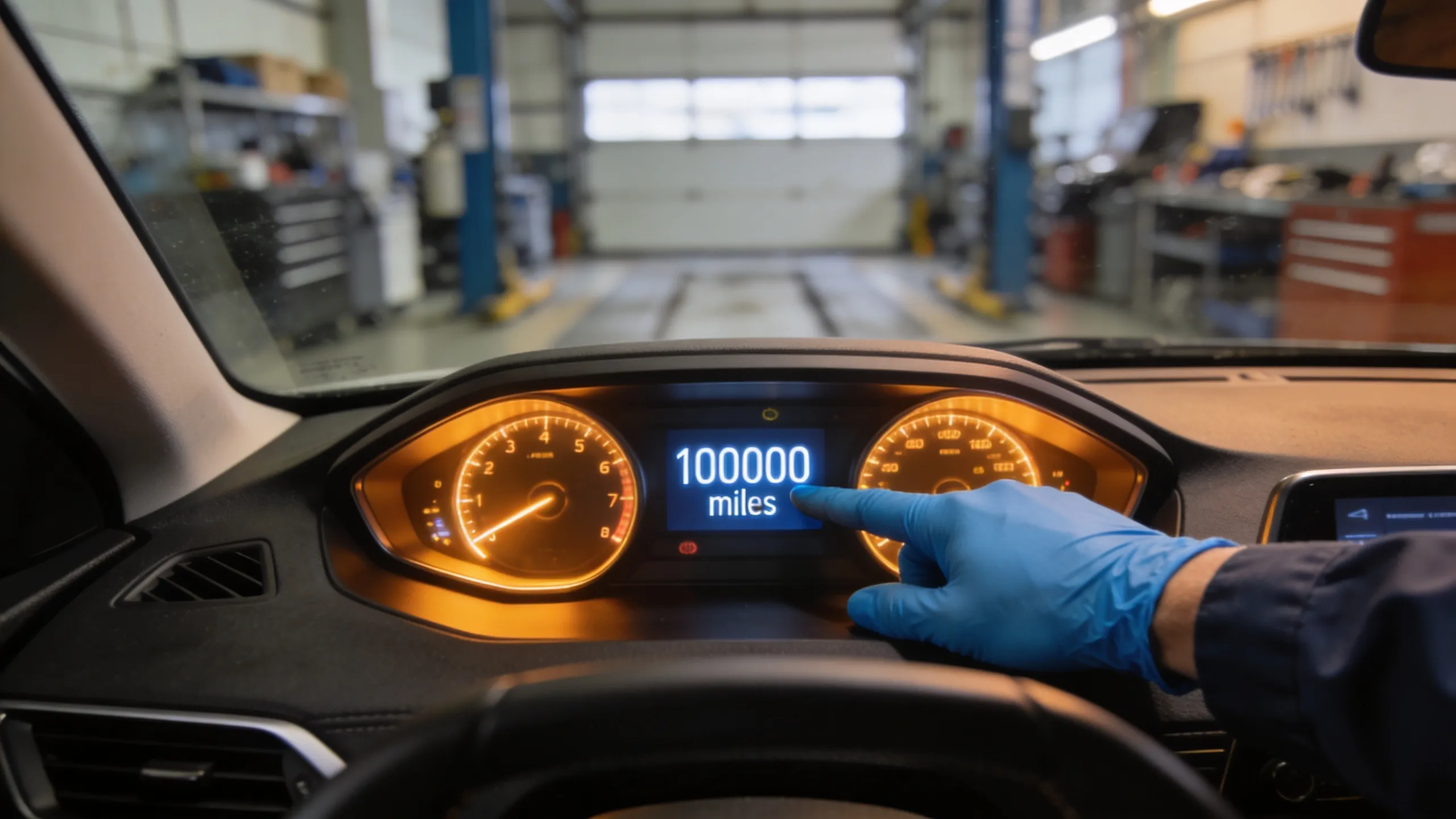
Reaching 100,000 miles is a milestone most car owners either celebrate or dread. Some treat it as proof the vehicle is reliable. Others worry it signals the start of expensive problems.
The reality sits somewhere in the middle. A car at 100k miles is not automatically headed for the scrapyard, but it does reach a threshold where several key components require attention, regardless of how well the vehicle has been maintained. Skipping 100k mile maintenance at this stage is one of the most common reasons cars develop serious, preventable failures.
This guide covers the complete 100000 mile service checklist: what to inspect, what to replace, what services cost in 2026, and how to prioritize if budget is tight. Understanding these services helps car owners make informed decisions, and avoid the far higher costs that come from deferred maintenance.
Finding a qualified mechanic to handle high mileage car maintenance is an important first step. Find auto body and mechanical shops near you to compare local options and get estimates.
Why 100k mile maintenance is a turning point
Most manufacturers design service schedules around 30,000-mile or 60,000-mile intervals. By 100,000 miles, vehicles have passed through multiple of those cycles. Components that were replaced or serviced at 60k or 75k are now approaching end-of-life again. Others, like timing belts, coolant, and spark plugs, are at or past their designed service limits for the first time.
According to data from the Car Care Council, deferred maintenance is one of the leading causes of vehicle breakdowns. At high mileage, the cost of ignoring service items compounds quickly. A $150 coolant flush ignored becomes a $1,500 head gasket repair. A $300 timing belt replacement deferred becomes a $3,000 to $5,000 engine rebuild.
The goal of 100k mile maintenance is not just keeping the car running, it's protecting the investment already made in the vehicle, and avoiding the disproportionate repair costs that follow component failures.
Complete 100000 mile service checklist
The services below represent the core items in a thorough high mileage car maintenance plan. Not every item applies to every vehicle, consult the owner's manual and a trusted mechanic for model-specific guidance. Cost estimates are national averages as of 2026 and vary by geographic location, vehicle make, and shop labor rates.
Powertrain and engine services
Timing belt or timing chain inspection
This is the most critical item on any 100k mile maintenance list. The timing belt synchronizes the engine's crankshaft and camshaft rotation. If it breaks while the engine is running, the result is catastrophic engine damage in interference engines, valves and pistons collide, and the repair cost typically exceeds the vehicle's value.
Most manufacturers recommend timing belt replacement between 60,000 and 100,000 miles. If the vehicle is approaching 100k and the timing belt has never been replaced, it should be treated as urgent.
Timing chains are more durable and typically do not have a set replacement interval, but they should be inspected for wear and tension.
| Service | Estimated Cost | Priority |
|---|---|---|
| Timing belt replacement | $400–$900 | Critical if due |
| Timing chain inspection | $100–$200 (labor) | High |
| Water pump replacement (often done with timing belt) | $150–$350 (parts) | Recommended with belt |
Spark plug replacement
Standard copper spark plugs require replacement every 30,000 miles. Iridium or platinum plugs extend to 60,000–100,000 miles. At 100k, even long-life plugs should be replaced. Worn plugs cause misfires, poor fuel economy, and rough idle.
- Estimated cost: $100 to $300 for most vehicles; $200 to $500 for V8 engines or vehicles with difficult plug access
Engine air filter
A clogged air filter restricts airflow to the engine, reducing performance and fuel efficiency. Replacement is simple and inexpensive.
- Estimated cost: $20 to $60 for parts; $15 to $30 for labor if not self-serviced
Fuel system service
High mileage engines benefit from fuel injector cleaning and fuel filter replacement. Carbon buildup on injectors reduces spray pattern efficiency, leading to rough starts and reduced fuel economy. Fuel filter replacement prevents debris from reaching the injectors.
- Injector cleaning: $100 to $200
- Fuel filter replacement: $50 to $150
Fluid services
Fluids degrade over time regardless of mileage. At 100,000 miles, most primary fluids should be flushed and replaced if not recently serviced.
Engine coolant (antifreeze) flush
Coolant prevents the engine from overheating and protects against freezing. Over time, it becomes acidic and loses its protective properties. Most manufacturers recommend a full coolant flush every 30,000 to 50,000 miles or every five years.
- Estimated cost: $100 to $200
Transmission fluid change
Automatic transmission fluid degrades with heat and use. Old fluid loses its lubricating properties, accelerating wear on internal components. For vehicles with automatic transmissions, a fluid change at 100k is strongly recommended. Manual transmissions also require gear oil changes, check the owner's manual for the specific interval.
- Automatic transmission fluid: $100 to $250
- Manual transmission gear oil: $75 to $150
Brake fluid flush
Brake fluid is hygroscopic, it absorbs moisture from the air over time. Moisture lowers the fluid's boiling point, which can cause brake fade under heavy use. Most manufacturers recommend replacement every two to three years or 30,000 to 45,000 miles.
- Estimated cost: $80 to $150
Power steering fluid (if applicable)
Vehicles with hydraulic power steering systems require power steering fluid. Electric power steering systems do not. If the vehicle has a hydraulic system, flush and replace fluid if it has not been done recently.
- Estimated cost: $75 to $130
Differential and transfer case fluid (AWD/4WD vehicles)
All-wheel drive and four-wheel drive vehicles have additional fluid-filled components that require service at 100k. Neglecting these fluids leads to bearing wear and eventual component failure.
- Estimated cost: $80 to $200 per differential
Brake system
Brake pad and rotor inspection
Brake pads typically last 30,000 to 70,000 miles depending on driving style and vehicle weight. At 100k, brake pads may be on their second or third set. Rotors may be worn thin or warped. A full brake inspection should be included in any 100k mile maintenance service.
Replacement costs depend heavily on vehicle type:
| Component | Economy Vehicle | Mid-Size SUV | Full-Size Truck |
|---|---|---|---|
| Brake pads (front axle) | $100–$200 | $150–$300 | $200–$400 |
| Rotors (front pair) | $150–$300 | $200–$400 | $250–$500 |
| Full brake job (all four corners) | $400–$700 | $600–$1,000 | $800–$1,400 |
Brake caliper inspection
Calipers should be inspected for leaks, sticking, and uneven wear. A sticking caliper causes uneven pad wear and can overheat the brake system.
- Caliper replacement (if needed): $100 to $300 per caliper plus labor
Suspension, steering, and chassis
Shock absorbers and struts
Shocks and struts are often overlooked in maintenance schedules. Most manufacturers suggest inspection every 50,000 miles and replacement between 75,000 and 100,000 miles, depending on driving conditions. Worn shocks increase stopping distance, reduce tire contact with the road, and cause uneven tire wear.
- Replacement (pair): $250 to $600 for economy vehicles; $400 to $1,000 for trucks and SUVs
Control arm bushings and ball joints
Bushings are rubber or polyurethane components that cushion the suspension and reduce noise. At 100k miles, they often show cracking and deterioration. Ball joints connect the steering knuckle to the control arm; worn ball joints are a safety risk.
- Bushing replacement: $200 to $500 per arm
- Ball joint replacement: $200 to $400 per joint
Wheel bearings
Wheel bearings typically last 75,000 to 100,000 miles. A failing wheel bearing produces a humming or grinding sound that changes with vehicle speed. Neglecting a wheel bearing can lead to wheel separation, a serious safety failure.
- Replacement: $250 to $500 per wheel
Power steering system (mechanical inspection)
At 100k miles, the power steering rack and tie rod ends should be inspected for play and leaks. Tie rod ends are steering components that connect the steering rack to the wheels; worn tie rods cause steering looseness and uneven tire wear.
- Tie rod end replacement: $100 to $250 per end
Belts, hoses, and seals
Serpentine belt
The serpentine belt drives engine accessories, the alternator, air conditioning compressor, and power steering pump. Most belts last 60,000 to 100,000 miles. At 100k, replacement is inexpensive insurance against a roadside breakdown.
- Estimated cost: $75 to $200 including labor
Coolant and vacuum hoses
Hoses degrade from heat cycles over time. Cracks, soft spots, and swelling are signs of imminent failure. A burst coolant hose can overheat the engine within minutes.
- Hose inspection is included in most tune-up services; replacement costs $30 to $80 per hose
Engine seals and gaskets
At 100k miles, valve cover gaskets, oil pan gaskets, and camshaft seals may begin seeping. Minor seeping is common and manageable; active leaks should be addressed to prevent engine oil starvation.
- Valve cover gasket: $100 to $300 depending on engine complexity
Tires and wheels
Tire inspection and replacement
Tires wear at different rates depending on vehicle alignment, driving habits, and inflation maintenance. At 100k miles, tires may be on their second or third set. Tread depth below 2/32 inch is legally unsafe in most states; 4/32 inch is recommended for wet traction.
- New tire cost: $100 to $200 per tire for economy models; $150 to $350 per tire for performance or truck tires
Wheel alignment
Alignment shifts over time due to road impacts and suspension wear. Misalignment causes rapid, uneven tire wear and can indicate worn suspension components. Alignment check is recommended any time suspension work is performed.
- Estimated cost: $75 to $150 for a four-wheel alignment
Tire rotation and balance
If not recently done, tires should be rotated and balanced. This extends tire life and eliminates vibration.
- Estimated cost: $20 to $60
What does 100k mile service cost?
The total cost of a complete 100000 mile service checklist varies significantly depending on which services are needed, vehicle type, and local labor rates. Below is a realistic range:
| Service Category | Estimated Cost Range |
|---|---|
| Tune-up (plugs, filters, fluids) | $300–$600 |
| Timing belt + water pump | $500–$1,200 |
| Brake system (pads, rotors, fluid) | $400–$1,000 |
| Suspension components (shocks, bushings) | $500–$1,500 |
| Tires + alignment | $400–$1,200 |
| Full comprehensive service | $1,500–$4,000 |
Most car owners don't need every item done simultaneously. A trusted mechanic can perform an inspection and prioritize services based on actual component condition, spreading costs across multiple visits.
For an accurate estimate specific to the vehicle, get a service estimate from a local shop to compare pricing.
Real owner experiences: What happens when 100k maintenance gets skipped
Marcus T., 2014 Honda Accord, Atlanta, Georgia
Marcus drove his Accord past 110,000 miles without replacing the timing belt. He'd seen the recommendation in his owner's manual but assumed the car was running well enough to wait another year. The belt snapped on I-285 during morning rush hour. The resulting engine damage, bent valves, two cracked pistons, cost $4,200 to repair. The timing belt replacement would have cost approximately $550. "I knew it was due," Marcus said. "I kept putting it off because everything seemed fine."
Sarah K., 2016 Toyota RAV4, Denver, Colorado
Sarah's RAV4 started making a low hum at highway speeds around 97,000 miles. She researched the sound and suspected a wheel bearing but delayed repair for several months. By 104,000 miles, the bearing had deteriorated to the point where the wheel had noticeable play, a technician told her she was "lucky it held together this long." The repair cost $440. Had she addressed it at the first sign, the cost would have been similar, but the safety risk would have been avoided.
James R., 2012 Ford F-150, Houston, Texas
James was meticulous about oil changes but had never serviced his automatic transmission fluid. At 101,000 miles, his F-150 began slipping between gears. A transmission flush and fluid replacement at that stage cost $185 and resolved the issue. His mechanic told him the fluid was "completely burnt" and that continued operation would have led to internal damage requiring a rebuild costing $2,800 to $4,500. A $185 service every 30,000 miles had been the right call, just one he'd skipped for 100,000 miles.
Prioritizing 100k mile service when budget is limited
Not every car owner can afford $2,000 to $4,000 in services at once. Prioritizing by safety and failure consequence is the practical approach.
Tier 1, Address immediately (safety and catastrophic failure risk)
- Timing belt (if due and never replaced)
- Brake system (pads, rotors, fluid) if worn
- Wheel bearings if showing symptoms
- Tires if below safe tread depth
Tier 2, Schedule within 30-60 days
- Coolant flush
- Transmission fluid change
- Spark plug replacement
- Serpentine belt replacement
Tier 3, Inspect and plan within 90 days
- Suspension components (shocks, struts, bushings)
- Power steering service
- Fuel system service
- Differential and transfer case fluid (AWD/4WD)
A qualified mechanic can perform a multi-point inspection to identify which Tier 1 and Tier 2 items are genuinely needed versus which can wait. The inspection itself typically costs $50 to $150 and is money well spent before committing to a full service plan.
How to find a shop for high mileage car maintenance
Not every shop is equally equipped for comprehensive 100k mile maintenance. Look for:
- ASE-certified technicians: Automotive Service Excellence (ASE) certification indicates technicians have passed standardized industry exams
- Experience with the vehicle's make: Shops that specialize in or frequently service the same make and model tend to be more efficient and accurate
- Written estimates: Any reputable shop provides a written estimate before beginning work
- Warranty on parts and labor: Most quality shops offer 12-month or 12,000-mile warranties on parts and labor
For vehicles with existing cosmetic or collision damage alongside mechanical maintenance needs, browse auto body shops near you to find shops that handle both mechanical and body work, reducing the number of service appointments needed.
The Automotive Service Association (ASA) also maintains resources for finding qualified repair facilities in most metro areas.
100k mile maintenance FAQ
Q: Is it worth maintaining a car after 100,000 miles?
In most cases, yes. The cost of maintaining a high mileage vehicle is nearly always lower than the cost of replacing it. If the vehicle has a clean maintenance history and no structural damage, 100k to 200k miles is a realistic lifespan for most modern vehicles with proper care.
Q: What is the most important service at 100k miles?
Timing belt replacement is the most consequential deferred item for vehicles that use a rubber timing belt (rather than a timing chain). Skipping it risks catastrophic engine damage. After that, brake system inspection and fluid services rank highest by safety and failure impact.
Q: Does 100k mile service have to be done all at once?
No. A mechanic can perform a diagnostic inspection to identify priority items, and services can be spread across multiple visits based on urgency. Tier 1 safety items, brakes, timing belt, failing wheel bearings, should not wait. Fluid services and minor component replacements can be scheduled over 30 to 90 days.
Q: How do I know if my car has a timing belt or timing chain?
Check the owner's manual under the maintenance schedule section. Timing belts will have a specified replacement interval (typically 60k to 100k miles). Timing chains generally do not have a replacement interval listed. Most modern vehicles (post-2010) use timing chains; older and many Japanese-market vehicles commonly use belts.
Q: Will insurance cover 100k mile maintenance costs?
Standard auto insurance (liability, collision, comprehensive) does not cover routine maintenance or wear-and-tear repairs. Some extended warranties or vehicle service contracts cover certain component replacements, review the specific contract terms. Roadside assistance coverage may apply if a maintenance-related failure causes a breakdown.
Q: What is a realistic car maintenance schedule after 100k miles?
After completing 100k mile maintenance, continue with the manufacturer's regular schedule. Oil changes every 5,000 to 10,000 miles (depending on oil type), tire rotations every 6,000 to 8,000 miles, brake inspections annually, and fluid services on the manufacturer's recommended intervals. High mileage vehicles benefit from annual multi-point inspections to catch emerging issues before they become failures.
Key takeaways
100k mile maintenance is not optional for car owners who want to avoid expensive failures and extend vehicle life. The core services, timing belt, fluids, brakes, and suspension, represent the difference between a car that runs reliably to 200,000 miles and one that requires a major repair that exceeds its value.
The complete 100000 mile service checklist typically costs between $1,500 and $4,000 depending on what's needed, vehicle type, and local labor rates. Prioritizing safety-critical items first and spreading other services over 60 to 90 days is a practical approach for budget-conscious owners.
A qualified mechanic's inspection is the right starting point, it identifies what the specific vehicle actually needs rather than applying every item on a generic checklist. For vehicles that also need body or cosmetic work alongside mechanical services, find shops near you that offer comprehensive services.
Regular maintenance is the most reliable way to protect both the vehicle and the investment already made in it.
Last updated: May 2026. Cost estimates reflect national averages and will vary by vehicle make, geographic location, and shop labor rates. Consult your vehicle's owner's manual and a qualified mechanic for model-specific service recommendations.