"Frame damage" sounds scary. But not all frame damage is created equal. Here's how to understand what your shop is actually talking about.
What Counts as Frame Damage?
Frame damage means structural components of the car have been bent, cracked, or deformed. These are the parts that form the skeleton of your vehicle—they absorb crash energy and keep the passenger compartment intact during a collision.
Not everything under the car is "frame." A bent support bracket or a pushed-in radiator support is structural damage, but it's in a zone designed to crumple. True frame damage involves the main rails, pillars, or crossmembers that form the car's core structure.
Unibody vs Body-on-Frame
Most modern cars use unibody construction—the body and frame are one integrated structure. Trucks and SUVs often use body-on-frame, where a separate frame carries the body on top.
- Unibody cars: damage to structural panels (floor pans, pillars, rails) counts as "frame damage" even though there's no separate frame
- Body-on-frame vehicles: the frame is a distinct ladder structure underneath; damage here is usually easier to identify and sometimes easier to repair
- Modern unibody designs use multiple grades of steel—some sections are designed to crumple intentionally while others stay rigid
Severity Levels of Frame Damage
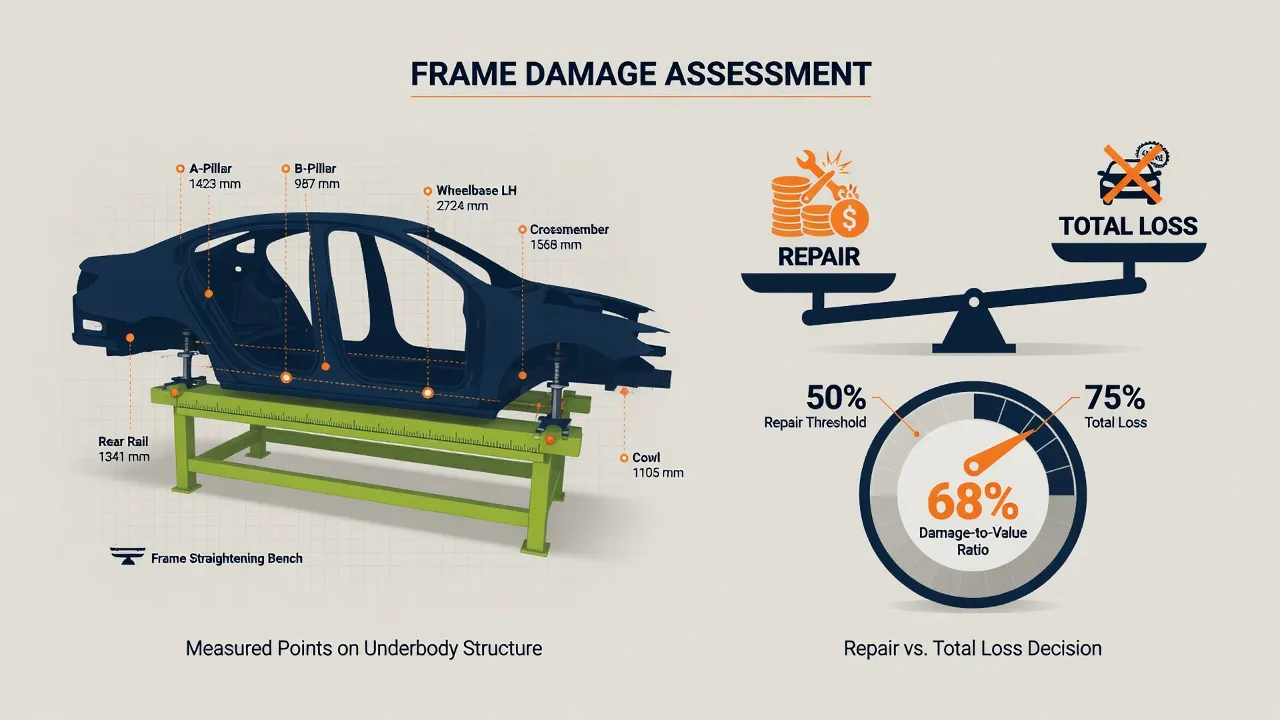
Body shops use frame measuring systems that compare your car's structural dimensions to factory specifications. Deviations of even a few millimeters show exactly where and how much the frame has shifted.
- Minor — Cosmetic structural components bent but main rails intact. Common with fender benders. Usually repairable with no safety concerns.
- Moderate — Main rails or aprons bent but within limits that frame machines can correct. Requires skilled technicians and proper equipment.
- Severe — Main structure twisted, kinked, or cracked. Multiple measurement points out of spec. May be repairable but raises legitimate safety questions.
- Catastrophic — Core passenger structure compromised. Pillars buckled. This is when total loss is the right call.
How Frame Damage Is Repaired
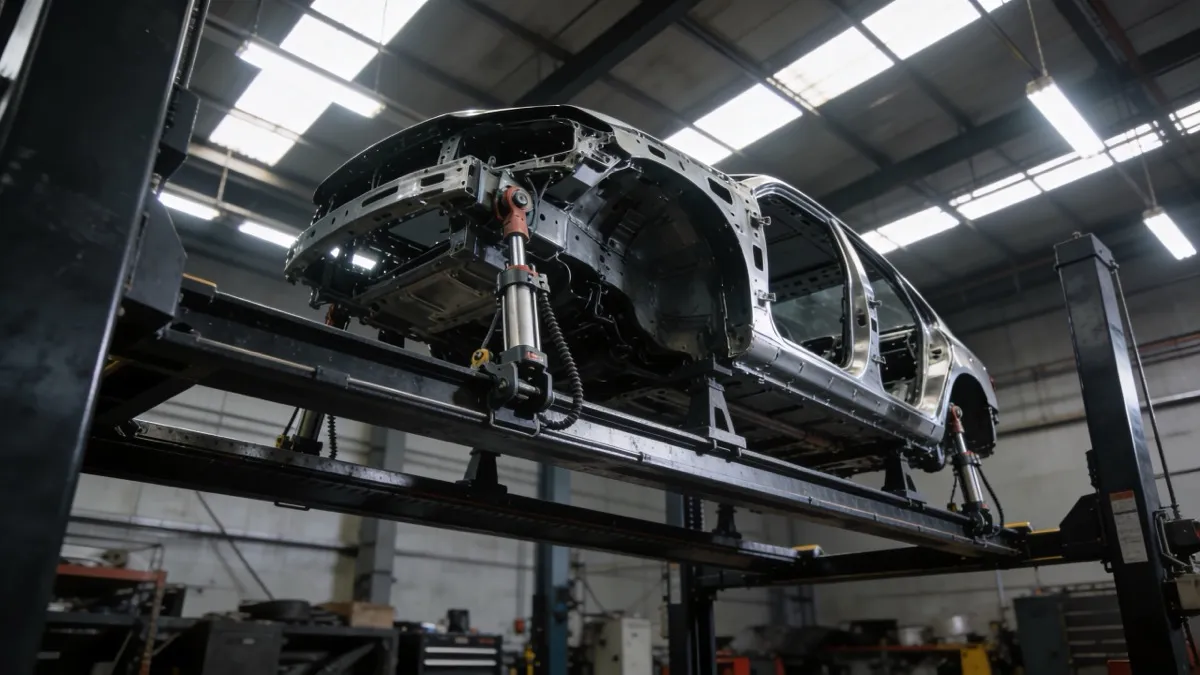
Frame repair uses hydraulic pulling equipment to straighten bent metal back to factory specifications. The car gets mounted on a frame rack, measured against factory specs, and pulled back into alignment.
Some components can be straightened. Others need to be cut out and replaced entirely. Modern cars use ultra-high-strength steel in critical areas that can't be heat-straightened without compromising their properties. These sections must be replaced, not repaired.
If a shop says they can heat-straighten ultra-high-strength steel or boron steel components, find a different shop. These materials lose their strength when heated. The result looks right but won't perform in a crash.
Safety After Frame Repair
A properly repaired frame can be just as safe as the original—when the work is done correctly. The key factors:
- Accurate measurements — Every dimension must match factory specs within tolerance
- Proper materials — Replacement sections must match the original steel grade
- Correct welding techniques — Different steels require different welding methods
- Post-repair alignment — Wheel alignment confirms the suspension geometry is correct
Impact on Resale Value
Frame damage always affects resale value, even after a perfect repair. Carfax and AutoCheck reports show the damage history, and buyers pay attention. Expect a 10-30% reduction in value depending on severity.
That said, a well-repaired car with documented frame damage at a fair price can be a smart purchase. Transparency matters here—a reputable repair with documentation is worth far more than an undisclosed one a buyer discovers later.
"Frame damage isn't a death sentence for your car. What matters is the severity, the quality of the repair, and the honesty of the shop doing the work."
Sources
- National Highway Traffic Safety Administration (NHTSA) — vehicle safety recalls, crash data, and regulations
- Insurance Institute for Highway Safety (IIHS) — vehicle safety ratings and crash test results
- I-CAR (Inter-Industry Conference on Auto Collision Repair) — collision repair industry training standards
- NHTSA Vehicle Safety — federal vehicle safety and crashworthiness standards